
Microsoft unveils Project Solara: building an Android for AI agents
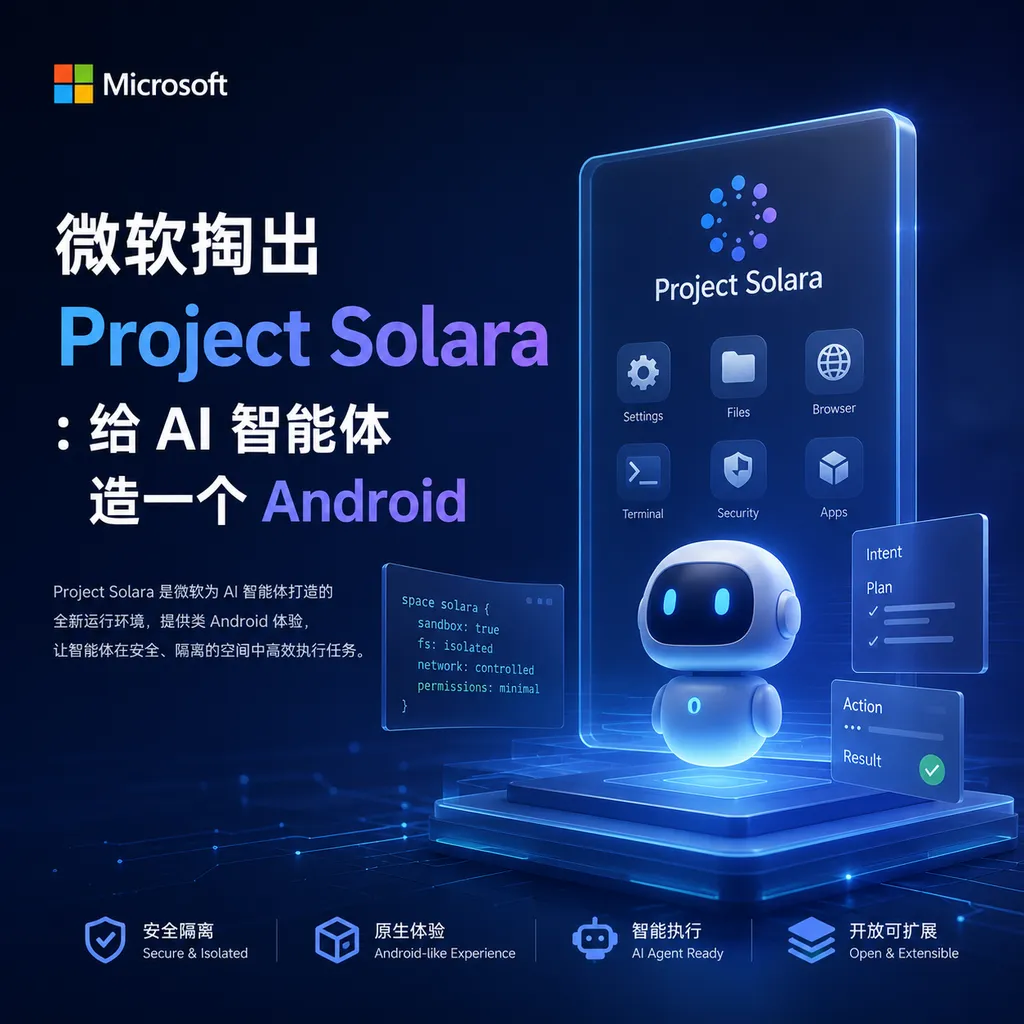
At Build 2026, Microsoft unveiled the Android-based Project Solara operating system, designed specifically for small devices running AI agents, and showcased two reference designs — a desktop terminal and a smart badge. Best Buy, CVS, and others have already launched hardware pilot programs.
Microsoft Built an Operating System for AI Agents—Still Based on Android
On the opening day of Build 2026, Microsoft dropped something that stunned everyone: Project Solara—an operating system built specifically for AI agent devices. The focus isn’t on "yet another OS," but on two key facts: first, it’s not a stripped-down version of Windows, but is built on Android; and second, Microsoft unveiled two concept hardware designs at the same time—a desktop terminal and a smart badge worn on the chest.
Microsoft’s positioning is straightforward: "a new platform built from the ground up to power agent-driven experiences"—a platform built from scratch for agent experiences. In plain terms, the thirty-year Windows desktop legacy just isn’t suitable or efficient for small boxes designed to listen, see, and help you get work done.
Why Android, Not Windows?
This was the most frequently asked question at the event—and perhaps the most thought-provoking aspect of the announcement.
Microsoft’s official answer was that Project Solara uses a customized version called the Microsoft Device Ecosystem Platform. This foundation can run on small, low-power hardware while retaining all the enterprise IT essentials—security, device management, and administrative controls.
Translated into everyday terms, that means three things:
- Windows is too heavy. For a badge-sized device with extremely limited CPU, memory, and battery, even Windows IoT is too large. Android has already proven itself in this size class—watches, car systems, AR glasses, POS terminals all rely on it.
- The ecosystem already exists. Android’s AOSP-level hardware abstraction layer, drivers, and peripheral support have been battle-tested more than anything else except the Linux kernel itself. There’s neither need nor time for Microsoft to reinvent the base layer.
- Microsoft has moved on. From the Surface Duo to now, Microsoft’s stance on mobile OSes has become clear: the kernel doesn’t matter—what matters is that Microsoft’s services, agents, identity, and management systems run on top. Project Solara makes this position fully explicit.
There’s also a more direct comparison behind this: Google’s own Gemini Intelligence has tightly integrated Gemini into Android, and former Android executives Hugo Barra and Rich Miner have both hinted at work on an "AI agent operating system." Microsoft’s move, then, is like turning in an early and complete answer on the same exam—ahead of everyone else.
Two Concept Devices: Desk Concept and Badge Concept
This time, Microsoft didn’t make the hardware itself. The two devices announced are explicitly labeled "reference designs," meant to guide commercialization by partners such as Best Buy, CVS Health, Target, and AccuWeather—all of which are already piloting the platform. The model is reminiscent of Google’s Nexus—or more precisely, Qualcomm’s reference design boards—hardware templates that manufacturers can copy directly.
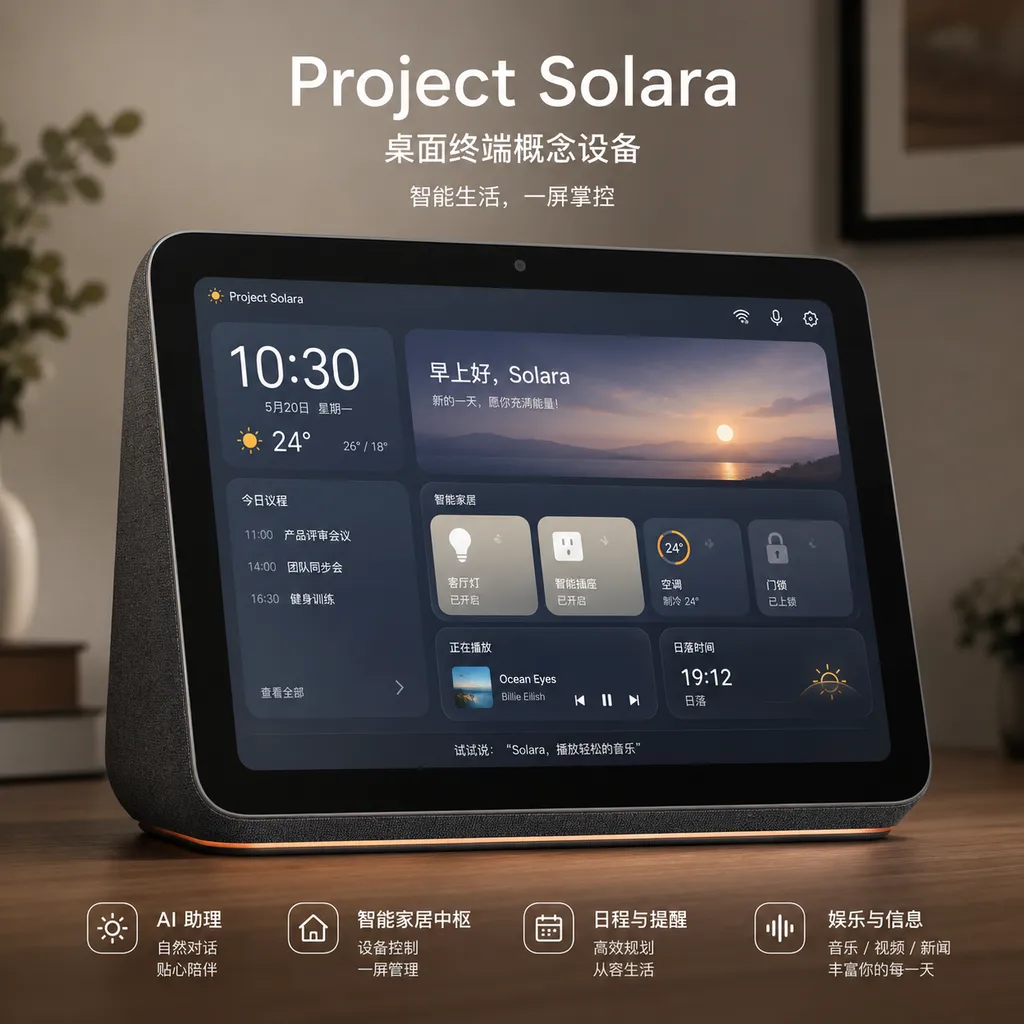
Desk Concept: A Desktop AI Terminal Resembling an Echo Show
The first is called Desk Concept, modeled after Amazon’s Echo Show and Google’s Nest Hub smart displays. Its core interaction design:
- Facial recognition unlock—look at it to begin a personal session
- Direct access to AI agents—the entry point is the agent, not a set of apps
- Always-on and ready on your desk, theoretically replacing assistant-type apps you rarely open on your phone
This design is interesting because the smart display category has been in decline for five years: Amazon laid off much of the Alexa team, and Google’s Nest series has cooled. But with LLMs rising, devices that are "screened, always-on, and voice-enabled" are being reevaluated—what they can do depends less on hardware limits and more on the agents they can access.
Badge Concept: A Smart AI Entry Worn on the Chest
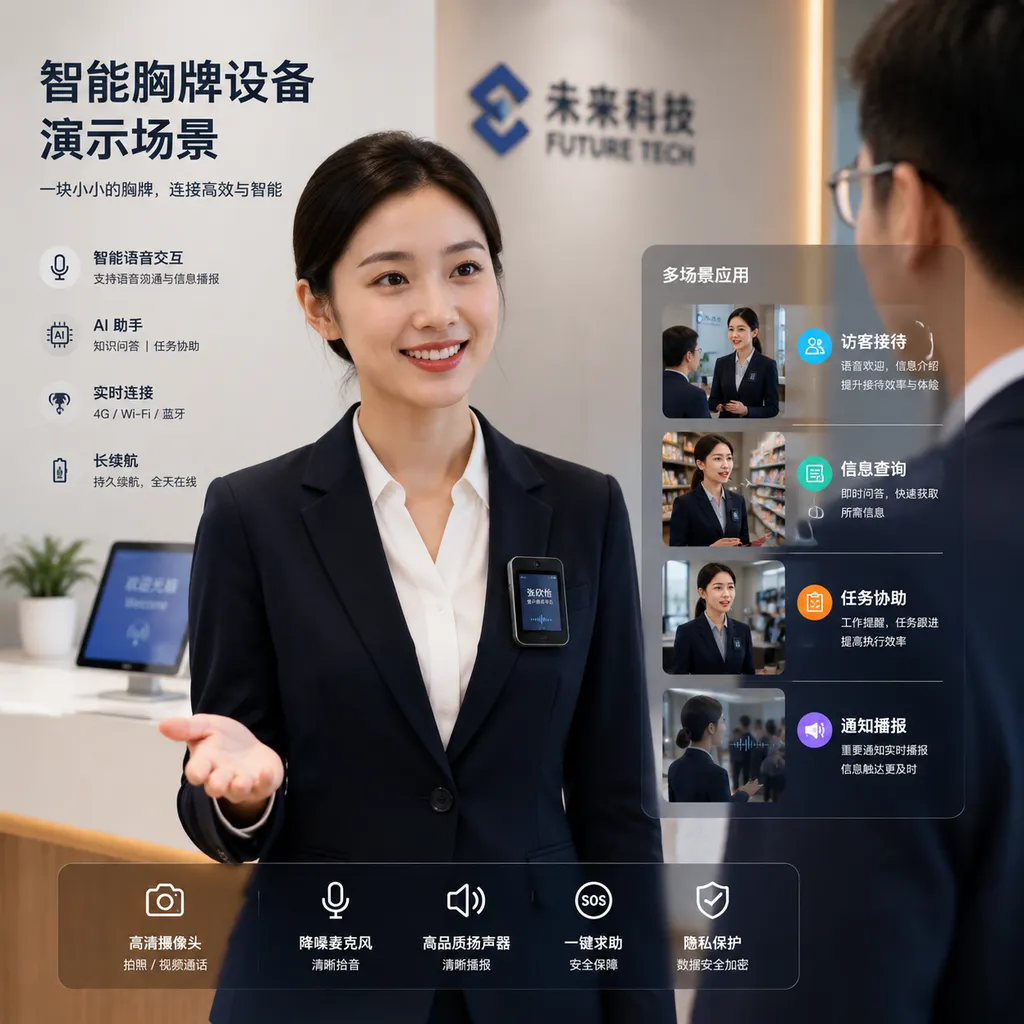
The second is bolder—the Badge Concept, shaped like a company ID badge and worn around the neck or clipped to the chest. Specs include:
- Camera
- Fingerprint reader
- Standalone 5G connectivity (note: connects directly to the Internet without relying on a phone)
- A physical wake button
In Microsoft’s demo, the user presses the button, and the device begins recording conversation, transcribing speech to text in real time. Meanwhile, the camera allows the AI agent to "see" what’s in front of the user and provide contextual assistance.
It’s hard not to be reminded of last year’s failed AI hardware wave—Humane’s AI Pin and Rabbit’s R1. Humane’s badge sold for $700 before HP acquired its remains, largely because a standalone product lacked ecosystem support and delivered clumsy interactions. Microsoft’s approach is different: the Badge is an enterprise device, not a consumer gadget.
That distinction is crucial. For example, a CVS Health employee wearing such a badge might use it to:
- Help a customer locate a medicine by scanning the shelf—the agent answers instantly
- Automatically transcribe and archive customer interactions
- Unlock backend systems via fingerprint, skipping password entry
In enterprise contexts, ID badges are already standard work tools—adding a camera and AI doesn’t feel invasive. That’s a completely different logic from Humane’s consumer-facing chest-mounted laser device.
What the Pilot List Reveals
Microsoft announced the first group of pilot hardware partners:
| Partner | Business Type | Potential Application | |----------|----------------|---------------------| | Best Buy | Consumer electronics retail | In-store assistance, inventory lookups | | CVS Health | Pharmacy/healthcare chain | Drug information, patient service | | Target | Big-box retail | Shelf management, customer service | | AccuWeather | Meteorological services | Data access, contextual broadcasting |
The shared theme is clear: frontline employee–intensive industries. This isn’t a consumer electronics story but an enterprise hardware one. Microsoft is effectively offering a unified hardware reference + OS + agent platform for the long-struggling “AI assistant for frontline workers” sector.
For years, retail and healthcare organizations have purchased scattered devices—tablets, walkie-talkies, scanners—difficult to manage. Project Solara’s answer: unified device base, unified agent access, unified IT control. Microsoft Intune’s existing management infrastructure can plug in directly—this is Microsoft’s biggest moat versus hardware startups.
Project Solara in Microsoft’s AI Strategy
Zooming out, Microsoft’s AI efforts over the past two years can be grouped into three main threads:
- The Copilot product line: M365 Copilot, Windows Copilot, GitHub Copilot—all software running on existing PCs and cloud environments
- Azure AI Foundry + AI Agent SDK: toolchains for developers to build agents, recently including isolated process and session execution layers on Windows and WSL
- Now, Project Solara: pushing agents into "dedicated hardware"
These three layers all address the same question: once AI agents move beyond chat boxes, where should they live? Microsoft’s answer: "everywhere"—on your PC, in your browser, on your ID badge, in the small device on your desk. Project Solara fills in those last two spaces.
Choosing not to make hardware itself is a wise move. The Surface Duo’s failure showed that doing so burdens Microsoft with manufacturing, inventory, channel, and support liabilities—and poor performance backfires on the brand. Providing reference designs, collecting licensing and platform revenue—that’s the sustainable Android-style model. Microsoft is following exactly Google’s early Android playbook, except this time the users are enterprises, not consumers.
Unanswered Questions
For all the information released, several key points remain unclear:
- Whose agents will run on Project Solara? By default, Microsoft’s own Copilot family, of course—but as a "platform," it must allow third-party integration. How open will it be? What’s the API? Can other models run? No details yet.
- Its relationship with Android AOSP. Microsoft says "customized Android," but to what extent? Are Google Play Services included? What does Google think about this? Huawei’s GMS separation ordeal was no small matter.
- OEM business model. Will Microsoft charge OS licensing fees, Azure usage fees per inference call, or both? That will determine whether manufacturers buy in.
- China market plans. All initial partners are U.S.-based. Bringing this platform to China will undoubtedly require a very different path.
Industry Impact
From a broader perspective, Project Solara signals something fascinating: the dimensions of OS competition have changed.
For decades we’ve judged operating systems by file systems, window managers, and app compatibility. But an agent-first OS like Project Solara centers on far different abstractions: user intent, agent orchestration, context management, and permission isolation. Whether the base layer is Android or Linux matters less than what runtime the OS offers to LLM agents.
For developers, this means the application paradigm itself may change. No more building UI-heavy apps; instead, building "capability packages" that agents can call and interoperate with. Microsoft’s AI Agent SDK revealed at Build 2026, together with Project Solara, completes the chain from development to deployment to on-device runtime.
As for whether this path will succeed—the AI hardware graveyard is long, from Humane to Rabbit. But Microsoft’s advantage is not betting on consumers; it’s tackling the underappreciated frontline worker scenario. That space has clear ROI, short decision cycles, and employees already wearing badges—no psychological barrier to adding capabilities.
If 2024–2025 were the years AI agents proved themselves on screens, 2026 will likely be the year they step off-screen into the physical world. Project Solara may not ultimately prevail, but it’s the first example of a tech giant mounting a full-scale, ecosystem-backed entry into this wave.
References
- ITHome: Microsoft Launches Android-based “Project Solara” AI Agent OS, Showcases Desktop Terminal and Smart Badge Concept Devices — Chinese media coverage of the Build 2026 event, including details on the two concept devices and pilot partners.


