
Microsoft unveils MAI-Thinking-1: The umbilical cord with OpenAI is loosening
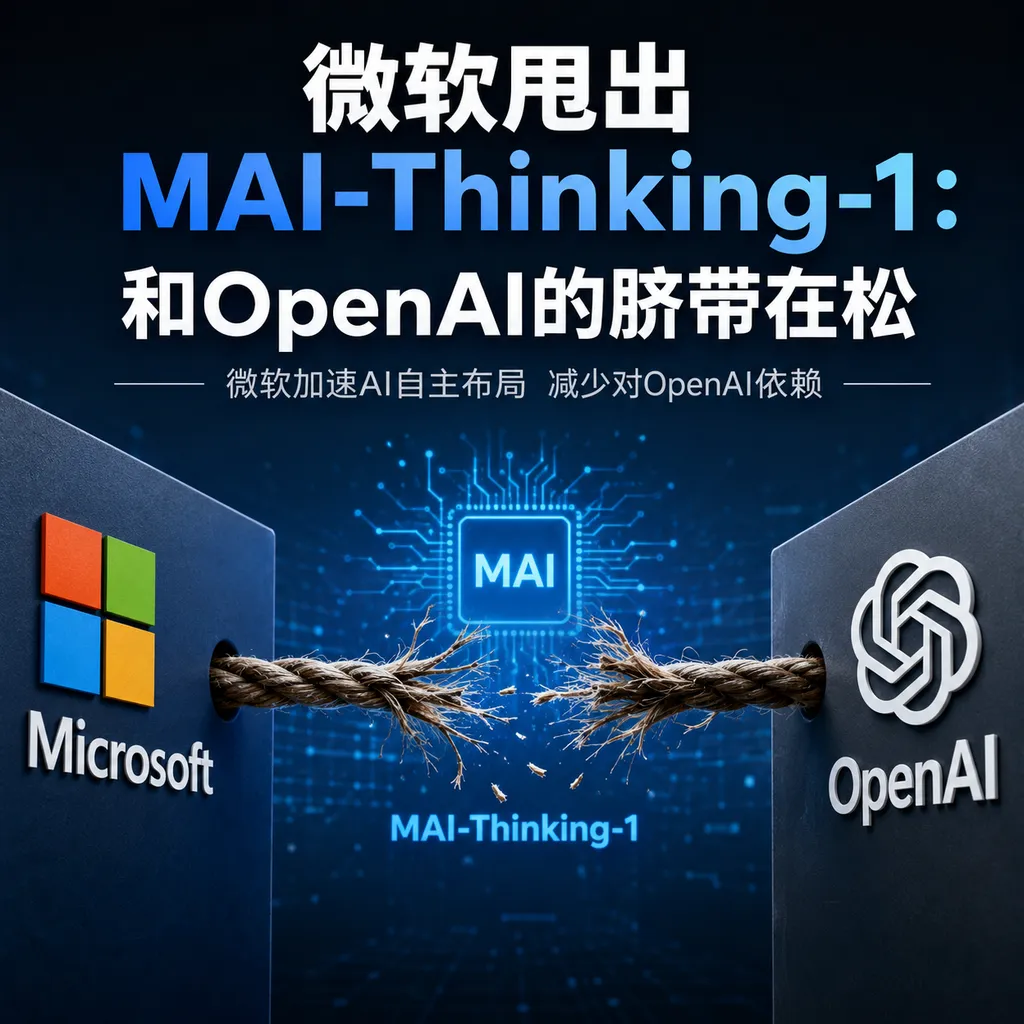
At Build 2026, Microsoft unveiled its first self-developed advanced reasoning model, **MAI-Thinking-1**, described as medium-scale, non-distilled from third-party models, and benchmarked against top performers in software engineering tasks. At the same event, Microsoft also introduced a full suite for image, speech, and coding—marking the initial formation of its self-developed model lineup.
Microsoft Finally Has Its Own Reasoning Model
In the early hours of June 3, Beijing time, half an hour into the Build 2026 keynote, Satya Nadella handed the microphone to Mustafa Suleyman, who revealed a list the public had been waiting for more than half a year: MAI-Thinking-1, MAI-Image 2.5, MAI-Transcribe-1.5, MAI-Voice-2, and MAI-Code-1—five self-developed models in one go. Among them, the real star is the one with the "Thinking" suffix—Microsoft’s first self-developed advanced reasoning model.
The significance of this lies not in the number of parameters or the beauty of its benchmarks, but in a single statement: Microsoft finally has a reasoning model that does not rely on OpenAI or on distillation from any third-party model. Against the backdrop of Microsoft and OpenAI having just renegotiated their partnership at the start of the year—loosening the ties between them—this release carries more political weight than technical meaning.
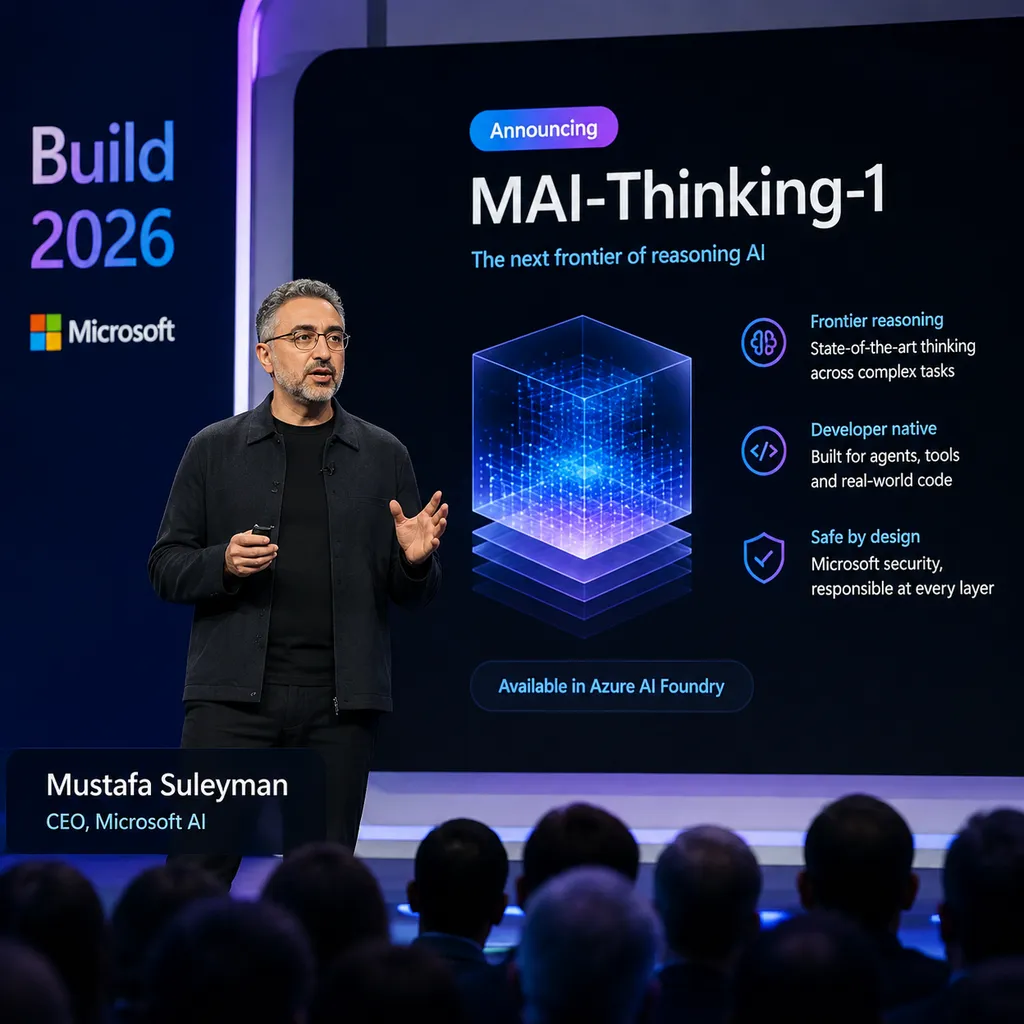
“Medium-Scale” and “Undistilled” — Both Terms Deserve Attention
Microsoft’s official positioning for MAI-Thinking-1 is very restrained: a medium-sized model, that "matches leading models on key software engineering benchmarks." No parameter counts were disclosed, no full benchmark tables released, and unlike Anthropic or Google, no long list of SWE-bench, AIME, or GPQA scores was shown.
Yet these two words convey a lot.
“Medium-sized” — Last year, rumors circulated internally about MAI-1 (around 500 billion parameters), but Thinking-1 clearly avoids the parameter-stacking route. Considering Microsoft’s persistent work on the Phi series around the theme of "small but mighty," MAI-Thinking-1 is most likely in the tens-of-billions parameter class and relies heavily on test-time compute. Suleyman repeatedly emphasized “reasoning efficiency” on stage—something aligned with OpenAI’s o-series or Anthropic’s extended thinking approach—squeezing performance out through chains of thought, not through brute-force scaling.
“Undistilled from third-party models” — This sounds politically correct but hints at an open secret in the industry. Over the past two years, many “self-developed” models have traces of GPT-4 or Claude outputs in their training sets—either directly distilled or “cleansed” via synthetic data. This time, Microsoft deliberately included “trained from the ground up on clean data” in its official release, a statement meant to tell investors and regulators clearly: our model is clean in both copyright and capability sources, and does not depend on OpenAI. For a Microsoft-OpenAI alliance currently renegotiating equity and IP ownership, this is a strong message.
Matching Leading Software Engineering Benchmarks — How to Interpret That
The benchmark category Microsoft chose is software engineering. That’s no surprise—GitHub is under its umbrella, Copilot has the most complete feedback loop in the industry, and in code-related reasoning Microsoft enjoys a natural data advantage.
Still, a phrase like "matches leading models on key benchmarks" should be read cautiously. My take:
- Most likely in the top tier on SWE-bench Verified, but not necessarily surpassing the latest Claude Sonnet 4.5 or GPT-5 models.
- In general reasoning (math, scientific Q&A), Microsoft’s silence likely indicates no standout results.
- The real killer feature is product integration — MAI-Thinking-1 will first replace parts of the OpenAI-based pipelines inside GitHub Copilot’s Agent mode.
In other words, Microsoft isn’t trying to build an “all-rounder,” but rather to make a “good enough, controllable, cost-efficient” in-house model work in its most data-rich scenarios—a very engineering-driven, very Microsoft approach.
The Other Four Models Complete the MAI Family
Thinking-1 may be the headline, but the other four models revealed alongside it are what truly turn MAI from an “experimental project” into a “product lineup”:
| Model | Positioning | Key Selling Point | |--------|--------------|------------------| | MAI-Image 2.5 / Flash | Text-to-Image + Image Editing | Dual versions balance quality and speed | | MAI-Transcribe-1.5 | Speech-to-Text | Claims 5× faster than competitors | | MAI-Voice-2 | Speech Synthesis | Adds 15 new languages, Flash version coming soon | | MAI-Code-1 | Code Generation | Optimized reasoning efficiency, integrated into Copilot and VS Code |
See the pattern? This set perfectly maps to a full AI application stack: Understanding (Transcribe) → Reasoning (Thinking) → Generation (Image / Voice / Code). Microsoft isn’t launching random models; it’s building a backup stack for a complete Copilot experience independent of OpenAI.
The “5× faster” claim around MAI-Transcribe-1.5 is intriguing. If true, it likely targets OpenAI’s Whisper Large v3 or Gemini’s speech API. Given the massive transcription demand across Teams, Office, and Azure Communication Services, every cent saved per second translates into real dollars at Microsoft’s scale.
MAI-Code-1 emphasizes “reasoning efficiency optimization” and is “already integrated into GitHub Copilot and VS Code”—which means users are probably already using it without realizing. Copilot’s backend model routing is long a hybrid mix of OpenAI, in-house, and fine-tuned open-source models. The rollout of MAI-Code-1 further squeezes OpenAI’s share.
Why Microsoft Must Build Its Own Models — An Old Question with New Answers
Ask this question two years ago, and the answer was the classic: “We can’t bet our lifeline on OpenAI.” Ask it today, and the answer has multiple layers:
First, cost.
Copilot’s $30 monthly subscription once made inference costs painful even for Microsoft itself. Suleyman has publicly stated multiple times that one of his team’s core KPIs is to “drive per-token cost down.” Medium-size models plus inference optimization are the fastest route to cost reduction.
Second, regulation and IP.
The EU AI Act, the UK CMA’s antitrust review, and the US FTC’s watchful eye on the Microsoft–OpenAI relationship are all pushing Microsoft to prove its independence. A fully clean-room-trained model is the hardest possible evidence.
Third, product cadence.
When relying on OpenAI’s API, new features depend on OpenAI’s release schedule. With in-house models, Copilot can ship customer-requested features independently—critical for B2B clients who insist on customization and SLAs.
Fourth, Suleyman’s personal bet.
From DeepMind co-founder to Inflection CEO to Microsoft’s head of AI, his career has been tracked by one question: “When will he produce a model of his own?” MAI-Thinking-1 is his report card in his second year at Microsoft.
Keep It in Perspective — Sober Assessments
As someone who’s followed this space closely, I’ll add a few measured points:
- MAI-Thinking-1 won’t replace OpenAI models within Copilot, at least not soon. GPT-5 still underlies the top-tier Copilot experience. The MAI series mainly handles low-to-mid-complexity tasks to cut costs.
- “Undistilled” doesn’t mean “no synthetic data.” Microsoft could still generate data using its own models, rule systems, or retrieval results—which wouldn’t count as third-party distillation, but the quality difference might be modest. Wait for the technical report before judging.
- “Matches” in benchmarks is vague. Until third parties replicate results independently, interpret it as “comparable on certain subsets.” Microsoft itself never claimed SOTA.
- The MAI series’ fate depends on API openness. If limited to internal Copilot use, it remains an internal tool; if opened via Azure AI Foundry with prices below equivalent OpenAI tiers, that could shake the ecosystem. Microsoft hasn’t confirmed the latter—but hinted more info is coming “in the next few weeks.”
What It Means for Developers
If you’re building on Copilot or Azure OpenAI, your APIs won’t change short-term—but the underlying model might already have switched to MAI. Expect subtle differences in latency, cost, and style. Watch for:
- Whether
mai-thinking-1or similar model IDs appear in the Azure OpenAI Service model list - Whether GitHub Copilot’s model selector adds Microsoft’s in-house option (it already supports Claude and Gemini, so this wouldn’t be surprising)
- Pricing: if MAI-Thinking-1 is notably cheaper than models like GPT-5-mini, it could become the practical choice for cost-sensitive apps
For developers in China, the MAI series likely won’t launch as standalone models outside Microsoft channels. The most practical access path remains through Copilot and Azure. If you usually compare multiple APIs via a hub like OpenAI Hub, once MAI models appear there, it’ll be far more convenient than spinning up a separate Azure account—worth watching in the coming weeks.
In Closing
For years, Microsoft’s AI story has been one of “OpenAI’s biggest investor and biggest customer.” From MAI-1 to MAI-Thinking-1, the company spent roughly two years turning “We can build our own” from PR slogan into an actual product lineup. This won’t make OpenAI irrelevant overnight—but it does shift the balance of power at the table.
What’s most worth watching in the second half of 2026 isn’t whether Thinking-1’s benchmark scores climb a few points, but whether Microsoft packages this self-developed stack into a truly independent, commercial model service on Azure. If it does, that’s when OpenAI should start to worry.
References
- Microsoft releases its first advanced reasoning model MAI-Thinking-1: promises no third-party distillation, further expands self-developed AI lineup – IT Home: Build 2026 release details and full MAI suite summary
- Microsoft’s first self-developed reasoning AI model MAI-Thinking-1 and new Copilot super app revealed – IT Home: Pre-event leaks and Copilot super app screenshot analysis


