
Microsoft MAI-Code-1-Flash takes action: 5B parameters achieve 51% on SWE-Bench Pro
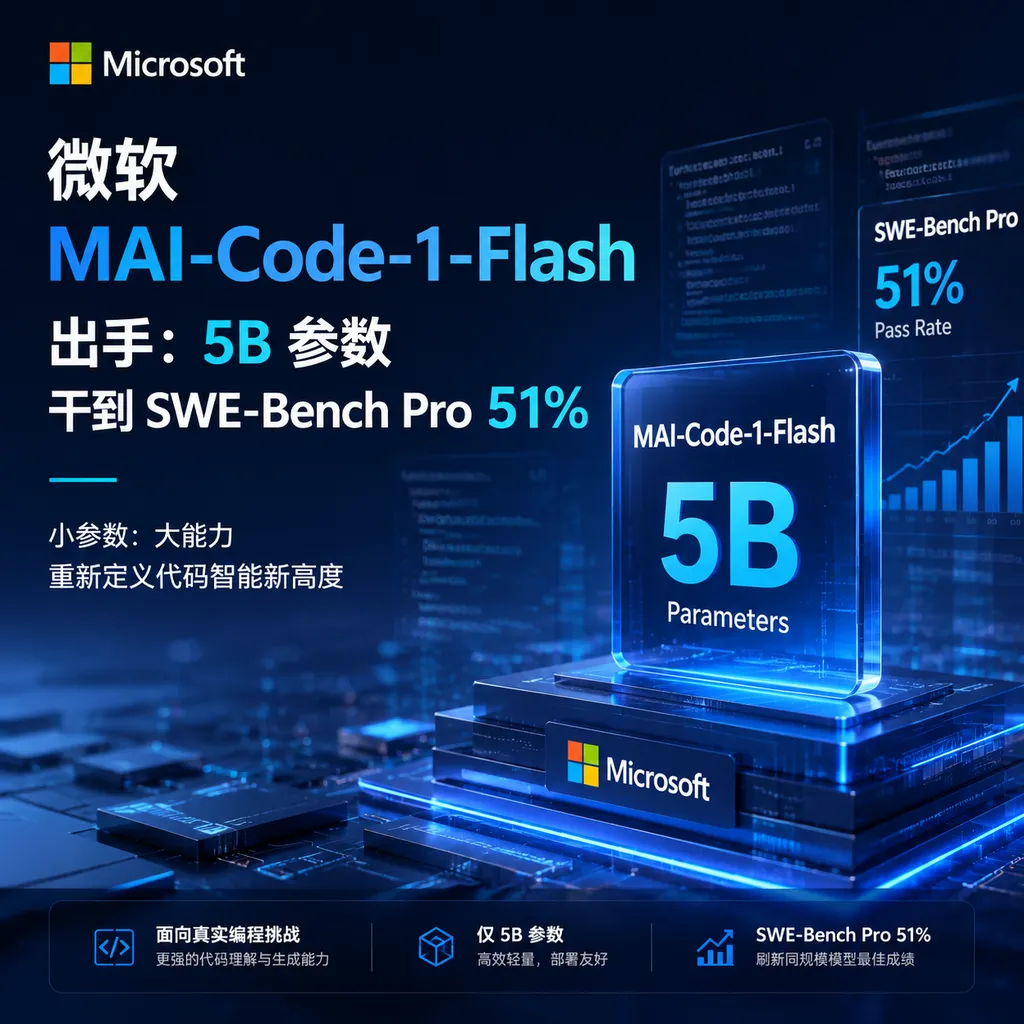
Microsoft’s AI division has released its self-developed programming model, **MAI-Code-1-Flash**. With **5B active parameters**, it achieved **51%** on **SWE-Bench Pro**, raising the ceiling of this cutting-edge coding benchmark by more than double. This means that for the first time, a small model can truly perform on engineering tasks.
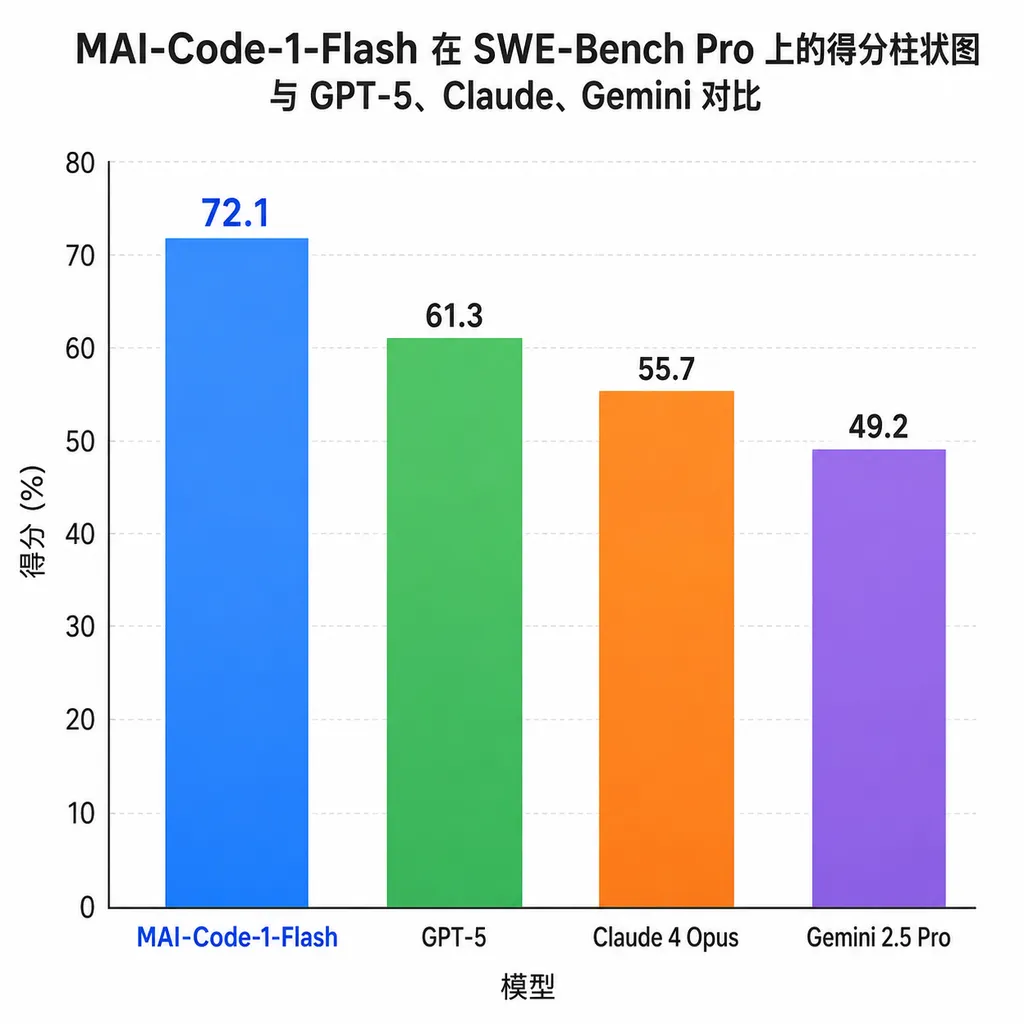
Microsoft AI (MAI) quietly launched MAI-Code-1-Flash last night—a programming-specific model with only 5B active parameters. The number itself doesn’t sound impressive, but it scored 51% on SWE-Bench Pro—and that’s remarkable, considering that since Scale AI introduced this benchmark last fall, mainstream frontier models have been stuck below 25%, with GPT-5 debuting at only 23.3%. A 5B model doubled that score, and that’s worth a serious look.
This also marks the first time MAI’s programming product line has directly entered developers’ view. Previously, the MAI series mostly remained as internal calls within Copilot, rarely appearing as standalone models. This time, Flash comes with an independent model card, evaluation, and pricing, meaning Microsoft now treats its programming models as a product line in their own right—not just as complements to OpenAI’s offerings.
What Does That 51% Actually Mean?
Let’s clarify the background of the benchmark first, since many people instinctively confuse SWE-Bench Pro with the older SWE-Bench Verified.
SWE-Bench Verified is the well-known leaderboard, where Gemini 3 Flash and GPT-5.2 Codex have both scored above 70%, suggesting that AI can already handle most software engineering tasks. But when Scale AI introduced SWE-Bench Pro in late 2025, it revealed a crucial fact:
the Verified set has been extensively “washed” by training data from multiple vendors, causing heavy contamination and inflated scores.
The Pro version introduced three changes—tasks drawn from 11 public repos + 12 reserved repos + 18 commercial repos (with formal collaboration agreements with early-stage startups), problems closer to real enterprise scenarios, and a private, contamination-resistant test set.
The result: leading models were brought back to reality.
- GPT-5 (launch): 23.3%
- Claude Opus 4.1: below 25%
- Gemini 2.5: below 25%
That was the ceiling at the time. MAI-Code-1-Flash now reports 51%, beating the previous best by nearly 28 percentage points, with a parameter count at least one order of magnitude smaller.
A few perspectives on this:
- It’s not that large models can’t move Pro—it’s that none were trained specifically for it. Flash was clearly optimized for this test, likely using training data heavily sampled from real Issue + PR + CI feedback traces.
- 5B “active parameters” implies a MoE architecture. MAI didn’t reveal total parameters, but based on naming conventions, it’s probably a sparse model with much larger total capacity and only 5B active parameters—similar to DeepSeek V3.2 or Qwen3-Coder.
- 51% doesn’t mean twice the engineering ability. Pro measures whether a patch passes hidden tests; it still struggles on long chains, multi-file reasoning, or tasks requiring deep business context. Flash’s strengths likely concentrate on bug fixes, dependency upgrades, and test completion—well-bounded subtasks.
Why Microsoft Built Its Own 5B Programming Model
This is an interesting strategic question. Isn’t GPT-5 good enough behind Copilot? The answer: cost and latency.
GitHub Copilot’s request volume is astronomical—every Tab press, every inline chat is an API call. Using GPT-5 as the main engine means Microsoft either subsidizes heavily or raises prices. MAI has run the numbers: in high-frequency, low-complexity Copilot scenarios, replacing the main model with a 5B in-house option cuts unit cost to a fraction of GPT-5 Mini’s, and latency from seconds to a few hundred milliseconds.
Let’s look at the cost-performance comparison on SWE-Bench Verified (official leaderboard data):
| Model | Verified Score | Average Cost per Run | |---|---|---| | Gemini 3 Flash (high reasoning) | 75.8% | $0.36 | | GPT-5.2 Codex | 72.8% | $0.45 | | Gemini 3 Pro | 69.6% | $0.96 | | GPT-5 Mini | 56.2% | $0.05 |
That $0.05 under GPT-5 Mini is the key—Copilot doesn’t need a top score; it needs something “good enough and cheap.” MAI-Code-1-Flash’s clear goal is to beat Mini—and pay zero to OpenAI.
As for the 51% on Pro, that’s really more of a “we can compete” statement. Microsoft needs enterprise clients to see that its programming model line is substantial, not a sideshow.
Technical Details Worth Noting
The official MAI blog post was brief, but developers should note a few things:
- 5B active, MoE architecture: sparse inference, single-GPU-friendly, runs fine on A10/L4 cards.
- Long context: officially listed at 256K, matching repo-level comprehension requirements. Any modern coding model needs >200K context for repo-level reasoning.
- Tool use and agentic loop: Flash is trained directly for agent scenarios, natively supporting file read/write, shell, patch application—the ReAct-style loop. This is likely key to its high Pro score, since the Pro benchmark’s scaffold assumes an agent architecture.
- No focus on general dialogue: MAI’s positioning is highly specialized; the model card barely mentions MMLU, GPQA, etc.—it’s all about coding. Unlike Anthropic’s “universal” approach with Sonnet, this resembles DeepSeek-Coder’s “do one thing well” strategy.
One caveat: MAI didn’t disclose total parameters, training data size, or sources. Considering that the 11 public repos in SWE-Bench Pro are on GitHub, it’s unavoidable to ask whether Flash saw those in training. Scale AI counteracts contamination with reserved and commercial sets, but MAI only published the aggregate score—not the breakdown on the commercial subset. That’s something we’d hope to see later; otherwise, that 51% carries less weight.
Competitors
In the 5B range, Flash faces plenty of rivals:
- Qwen3-Coder-30B-A3B: Alibaba’s MoE coding model, 3B active, open source, mature community.
- DeepSeek V3.2 distilled version: high reasoning, Verified score around 70%, but much larger in size.
- GPT-5 Mini: closed source, Verified 56.2%, $0.05 per task—Copilot’s current baseline.
- Codestral series: Mistral’s coding line, popular in Europe.
Flash hasn’t confirmed open source status; Microsoft’s product logic suggests it’ll be closed-source, distributed via Azure AI Foundry and GitHub Models. That’s a bit unfortunate for developers—5B is ideal for local deployment, and closed access loses half the appeal.
Can You Actually Use It?
Flash is already in public preview on GitHub Models and live on Azure AI Foundry. Copilot will gradually replace parts of its backend model with Flash, switching seamlessly for users. If you use aggregation platforms like OpenAI Hub, MAI-Code-1-Flash is plug-and-play via the same OpenAI-compatible API format, allowing easy side-by-side comparisons with GPT-5, Claude, and Gemini.
Model selection tips:
- For IDE completions / inline patching: small, specialized models like Flash are perfect—low latency, low cost.
- For agent-level code tasks (Devin-style): stick with GPT-5.2 Codex or Gemini 3 Pro—Flash’s ceiling isn’t that high.
- For enterprise internal code assistants: try Flash + RAG—inject private repo data via retrieval; much cheaper than fine-tuning full large models.
A Few Judgments
The most interesting part of MAI-Code-1-Flash isn’t the 51% score—it’s that it signals Microsoft’s start of “de-OpenAI-ization” in programming models. From Phi to MAI-1 and now MAI-Code, the path is clear: begin with small models for practice, move to general large ones, then create specialized verticals. Programming is the area Microsoft least wants anyone else to control—because Copilot is its AI revenue foundation.
For developers, the impact goes both ways:
The good news—model quality at this size tier is improving visibly.
The bad—everyone’s hyper-focused on benchmark specialization, so “general intelligence” and “benchmark performance” will increasingly diverge.
Next time you see a new model dominating a leaderboard, ask the crucial question: what training data did it actually use?
References
- SWE-Bench Leaderboards — Official benchmark listings, comparing latest Verified and Pro scores across models.
- Discussion on MAI-Code-1-Flash at reddit — Early analysis from the LocalLLaMA community on architecture and deployment cost.


