
Microsoft redefines Windows 11: The operating system is to become the home for AI agents
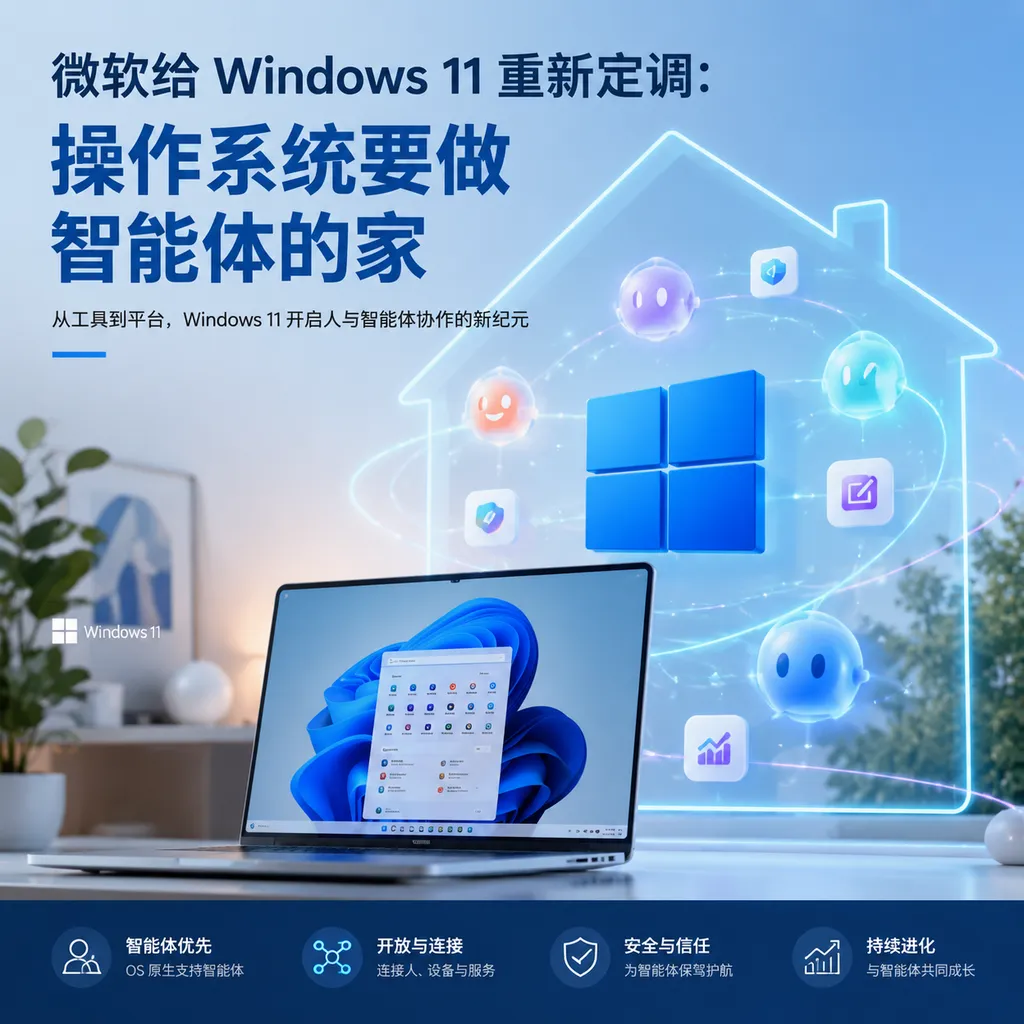
At the 2026 Build conference, Microsoft explicitly upgraded Windows 11 from a “desktop system with AI features” to a complete development platform for AI applications and agents, introducing execution containers, local Aion models, and a unified toolchain integration layer in an effort to address the current fragmentation challenges in AI development.
Microsoft Repositions Windows 11 as a Development Platform
At the 2026 Build Developer Conference, Microsoft gave Windows 11 a new identity—it’s no longer just a “desktop system with AI features,” but is now positioned as a platform for developing AI applications and agents. This statement came directly from Satya Nadella. It might sound like a routine product positioning shift, but upon closer inspection, what Microsoft changed this time is the underlying architecture.
Simply put, over the past couple of years, Windows’ presence in AI has been overshadowed by macOS and various Linux container solutions. Developers run large models with WSL, test Claude on the web, write code using Cursor, and deploy in the cloud—Windows feels more like a “launcher” in that chain, with diminishing value. This time, Microsoft wants to bring every link in that chain back into its own system.
A Core Pain Point: The AI Development Toolchain Is Too Fragmented
Unusually, Microsoft openly called out the current reality at the conference: developers’ AI workflows today are fragmented.
- When writing code, you might juggle GitHub Copilot, Claude Code, and Codex
- Local runs on Ollama or LM Studio, cloud calls to GPT and Claude APIs
- Agent orchestration experimented with LangChain, AutoGen, CrewAI, and other frameworks
- Deployment shifts among Docker, Azure, and local Python venvs
Any developer who has built an Agent project knows this fractured state all too well. Each tool has its own authentication, logging, permission model, and billing. Just switching contexts can be grueling.
GitHub executive Kyle Daigle made a key remark: “Code generation is no longer the biggest challenge; what’s complex is review, deployment, orchestration, monitoring, governance, and enterprise security.” This pinpoints the real bottleneck of AI engineering—everyone can get a model to write code, but few can manage those agents and that generated code elegantly.
Microsoft’s solution: let Windows 11 take on the role of a unified integration layer. Development, deployment, monitoring, and governance all within the same workflow; tools can differ, but the underlying interfaces, identities, logs, and security policies are system-controlled.
Microsoft Execution Containers: “Sandbox + ID” for Agents
The most significant concept unveiled during the event is Microsoft Execution Containers (MEC).
This isn’t Docker, nor WSL—it’s a runtime isolation mechanism purpose-built for AI agents. Its core capabilities boil down to two things:
1. Fine-Grained Resource Constraints
Developers can declare what each agent can access—down to file paths, network endpoints, system APIs, and callable applications. Windows enforces these constraints at runtime: if an agent oversteps, it’s blocked immediately.
This actually addresses one of the hardest questions in agent security: if an agent has permission to “use the computer,” could it secretly upload your entire ~/.ssh folder to some API? Previously, you could only hope your prompt was good enough; now, the system provides a safeguard.
2. Agent Identity Binding
Each agent running in MEC can bind to a local ID or an Entra cloud identity. This means:
- Audit logs can trace “which agent accessed which data, at what time.”
- Enterprise IT can apply Entra policies to agents just like employees.
- Token consumption, API calls, and file operations all have ownership.
This is crucial for enterprise adoption of agents. CIOs’ biggest worry has been, “I have no idea what these agents are doing.” MEC finally provides an auditable, traceable foundation.
Aion 1.0: Microsoft’s Own Local Model Takes the Stage
Microsoft also launched two local models: Aion 1.0 Instruct and Aion 1.0 Plan.
- Aion 1.0 Instruct: A general-purpose instruction model for dialogs and text generation.
- Aion 1.0 Plan: Built specifically for local agent workflows—supports reasoning, sub-agent orchestration, file management, and tool calls.
The interesting part is how the Plan model is positioned. It’s not for “chatting,” but for “scheduling”—you can think of it as a local orchestrator that breaks tasks down, decides which sub-agents to call, when to invoke cloud models, and when local execution suffices.
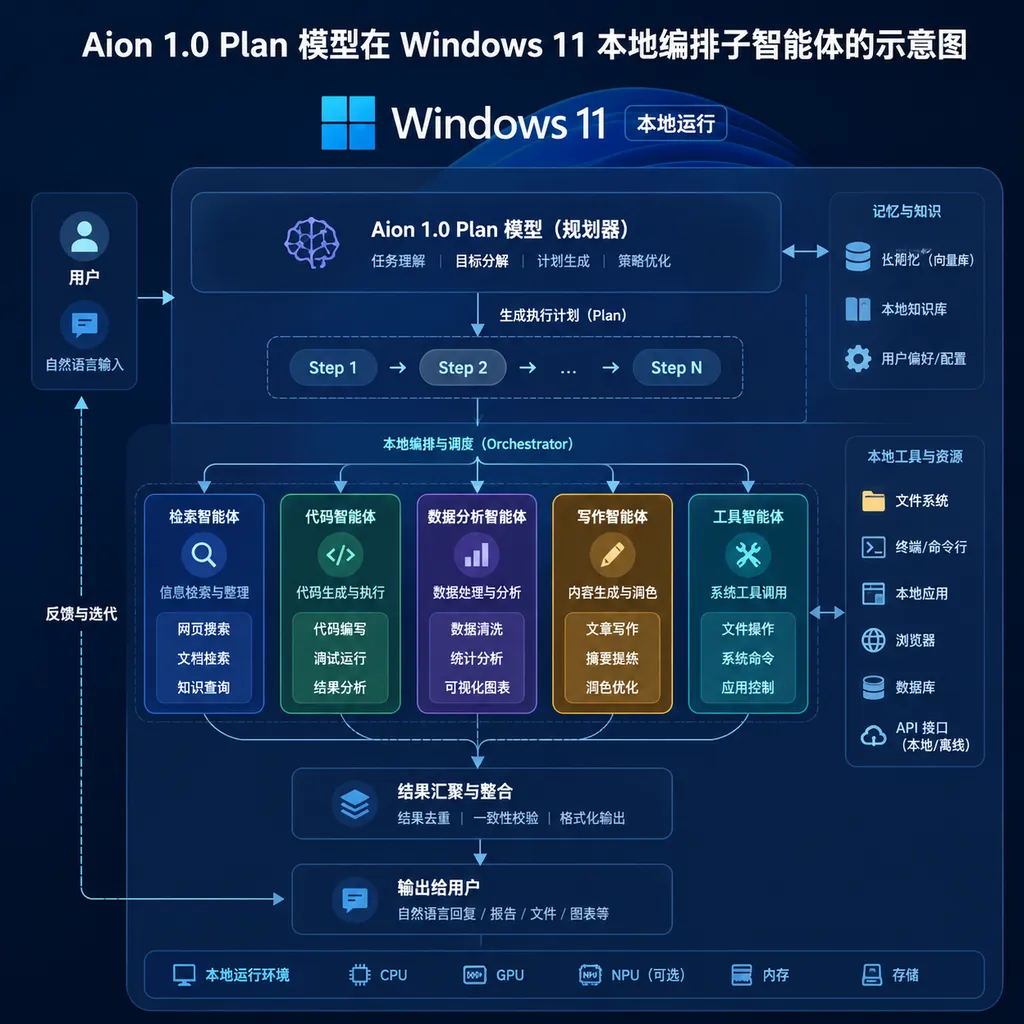
This approach mirrors what leading agent frameworks do—use a cheap, fast local model as the “scheduling brain,” and employ expensive cloud models for “fine work.” The difference: Microsoft has embedded this at the OS level, and Aion is trained specifically for this role—not just a repurposed small model.
Another easily overlooked change: Windows AI interfaces now extend from NPUs to GPUs and CPUs. Meaning, developers without Copilot+ PCs can still access system-level AI inference APIs—no longer blocked by hardware. For existing Windows users (a massive installed base), this is the key to truly making “AI platform” tangible.
Model and Tool Choice: Microsoft Finally Got Smart
Perhaps most surprising this time is Microsoft’s emphasis on “freedom of choice” for models and tools.
They openly acknowledged: enterprises don’t want vendor lock-in; they want
- Control over how agents access business data
- Freedom to decide where models run (local, private cloud, public cloud)
- Visibility into what tokens are spent on
Windows 11’s role, then, is to provide governance, transparency, and trust control at the base layer. In other words—your agents can use GPT, Claude, DeepSeek, or local Aion, but Windows handles accounting, permissions, and logs.
This is a pragmatic pivot. Two years ago, Microsoft pushed Copilot everywhere, wishing everyone would use OpenAI’s models. Now, they’ve softened, recognizing developers already use diverse tools. Instead of resisting, they’re becoming “the foundation.” That’s actually the hidden keyword of Build 2026—from “binding” to “hosting.”
The Reality of Multi-Modal, Multi-Model Mixing
This freedom reflects the reality of AI engineering today. Any serious Agent project typically uses:
- A strong reasoning model (Claude Opus, GPT-5, Gemini Ultra) for decisions
- A cheap, fast model (Haiku, GPT-5 mini, Flash) for lightweight tasks
- A local small model for sensitive data or offline fallback
- A code-oriented model for file generation and editing
If every model requires separate API keys, quotas, and billing, ops costs explode. That’s why API aggregation solutions like OpenAI Hub are gaining traction—one key directly connects to GPT, Claude, Gemini, DeepSeek, etc., with OpenAI-compatible formatting, sparing multi-vendor headaches. What Windows 11 is doing at the OS level mirrors what aggregators do at the API level: consolidating a fragmented AI ecosystem into a governable whole.
Linking Linux Containers, RTX Spark, and Azure
Beyond MEC and Aion, Microsoft also connected several seemingly separate pieces:
- Linux Containers: WSL continues to evolve, now defined explicitly as “Linux runtime for agent development,” not merely a Python helper.
- NVIDIA RTX Spark Integration: Local inference optimized for RTX GPUs—benefiting both Aion and third-party models.
- Azure Integration: Local agents can seamlessly invoke models and services from Azure AI Foundry—hybrid deployment needs no extra glue code.
- Deep GitHub Copilot Integration: Copilot is now more than an IDE plugin—it interfaces with Windows’ Agent runtime, capable of OS-level operations (within MEC constraints).
Put together, the chain looks compelling: developers build agents on Windows, use Copilot for code generation, test with local Aion or third-party models, run safely in MEC containers, push complex tasks to Azure—all within one unified lifecycle.
Can This Approach Work?
Objectively, Microsoft’s vision is bold—but tricky to execute. Several things worth watching:
First, developer experience in MEC. Sandbox technologies succeed or fail not on capability, but on configuration pain. If developers need pages of YAML to launch an agent, they’ll just circumvent it. Microsoft must make MEC as simple as “Docker run.”
Second, real performance of Aion models. Microsoft didn’t release benchmarks—unusual, given the small model race is fierce (Phi, Qwen, Llama, Gemma). If Aion is merely “usable,” why would developers ditch familiar open-source options?
Third, cross-platform reality. Agent development inherently spans platforms—you can’t demand every Mac user buy a Surface. If MEC only works on Windows, enterprises might still choose Docker + custom governance.
Fourth, relationship with open source frameworks. LangGraph, CrewAI, AutoGen all have user bases. Even if Microsoft calls itself “the hosting layer,” integration with MEC and Aion requires active adaptation. Whether and how deeply that happens depends on future investment.
A Simple Judgment
Setting aside grand narratives, the most practical takeaway from Build 2026 is: Microsoft realizes Windows can’t just be a “desktop environment” in the AI era—it must become a “runtime for the AI era.”
That’s the right call. Once agents become everyday tools, they’ll need a foundation that manages permissions, identities, resources, and billing. If not the OS, that foundation will be Kubernetes or a SaaS layer. Microsoft clearly doesn’t want to give that ground up.
Aion models, MEC, expanded Windows AI interfaces, deep Copilot integration—each piece alone isn’t revolutionary, but together, they sketch the outline of a full agent development platform. Whether this vision runs smoothly depends on how developer-friendly Microsoft’s tools become, and whether Aion’s performance can support the story.
At least this time, Microsoft’s stance is right—not “my AI is strongest,” but “your AI can run best here.” That “power company” positioning is far smarter than pushing Copilot everywhere.
References
- Windows 11 repositioned: from OS to AI app and agent development platform – IT Home: Original coverage of Build 2026 platform repositioning
- Microsoft CEO Satya Nadella on the “Agent Network” era – Zhihu: Nadella’s commentary on agent networks and AI coding ratios


