
Meta Muse Spark API has been delayed again.
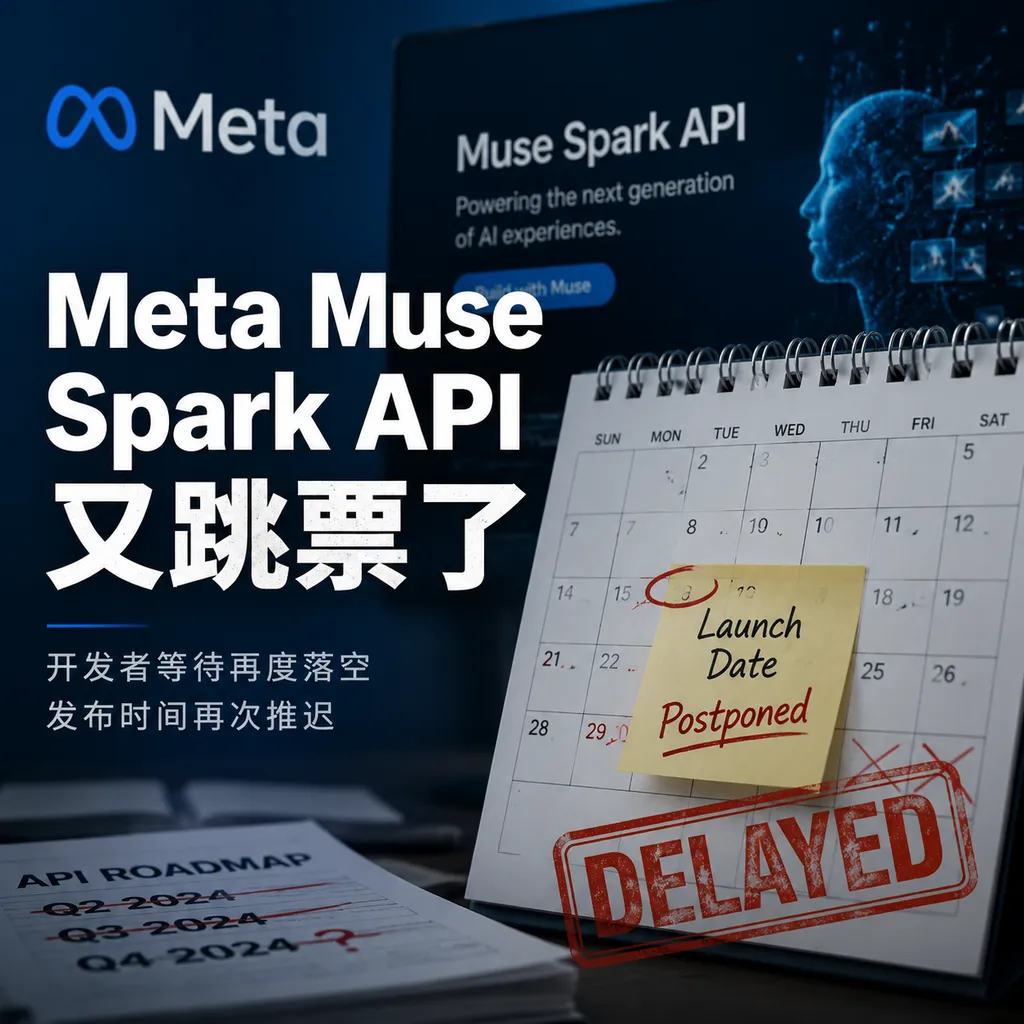
Meta's Muse Spark API has already been delayed from April to May, and now it's been pushed to June. The official explanation is "insufficient infrastructure," but what this really reveals is Meta's disarray in AI infrastructure and product timelines.
Meta Muse Spark API Delayed Again
Meta’s Muse Spark API has been postponed yet again. Originally planned for an April launch, then moved to May, and now it’s June with still no sign of it. A Meta spokesperson said on Wednesday that they are testing with early partners and “expect to release this month” — but that “expect” doesn’t sound reliable.
Sources say the reason is straightforward: bugs in testing and insufficient infrastructure. In plain language: it’s not ready yet, and there aren’t enough machines.
This is worth discussing because it exposes some deep issues in Meta’s AI strategy. Muse Spark is not a small project — it is a symbolic product marking Meta’s complete abandonment of the Llama path and starting over from scratch. And yet, they can’t even get the API out.
What exactly is Muse Spark
On April 8 of this year, Meta Superintelligence Labs (MSL) released Muse Spark. This is the first model in the Muse series and also represents Meta’s outright rejection of its own Llama system.
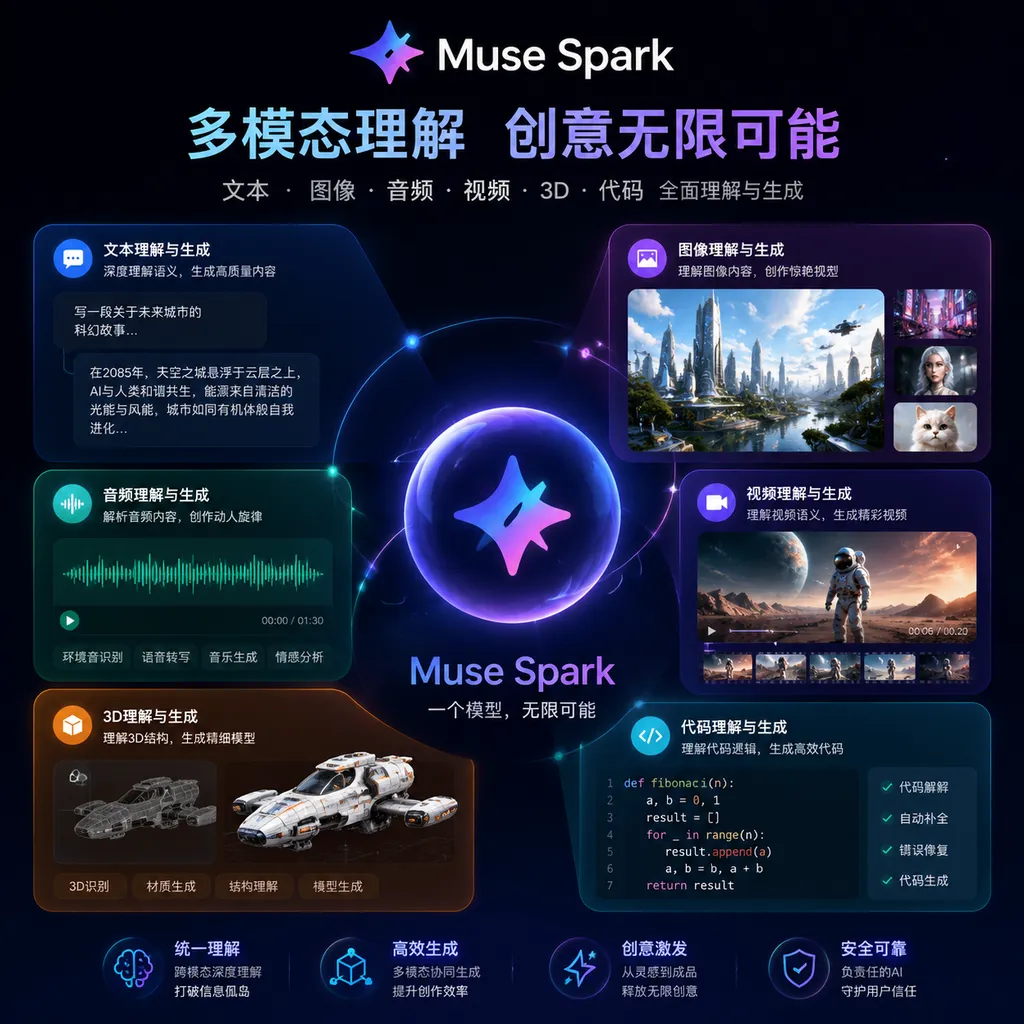
Muse Spark is positioned as “Personal Superintelligence” and focuses on multimodal capabilities. Specifically:
- Strong visual understanding: not just simple image recognition, but true scene comprehension. For example, if you take a photo of a supermarket shelf, it can directly tell you which snack has the highest protein, which best fits your dietary needs, without you reading ingredient lists one by one.
- Practical code generation: able to directly produce interactive web pages and mini-games, not just demo code that doesn’t run.
- Full ecosystem integration: already available in the Meta AI App and web version, with plans to roll out to Facebook, Instagram, Messenger, WhatsApp, and even Ray-Ban smart glasses.
From a technical standpoint, Muse Spark does not chase parameter counts and benchmark rankings; instead, it emphasizes “small-scale, high efficiency.” Meta claims it can handle complex reasoning tasks in science, mathematics, health, etc., but based on actual performance, it looks more like a practical model optimized for consumer-facing scenarios.
Why the API is so important
Muse Spark’s consumer-facing products are already live — so why is the API delay such a big deal?
Because the API is the real battle Meta wants to fight.
OpenAI built its ecosystem around the API, with developers creating products using the GPT API that, in turn, strengthened GPT’s market position. Anthropic’s Claude API works on the same logic. If Meta wants to truly stand firm in the AI field, consumer products alone are not enough; they must build a developer ecosystem.
Llama is open-source, and whether developers use it isn’t under Meta’s control. If Muse Spark goes the closed-source API route, Meta will be able to do what OpenAI does — continuously optimize the model via API usage data, creating a flywheel effect.
But here’s the problem: they can’t get the API out.
At the April launch, they said the API would be released “soon,” yet by June it’s still in testing. This reveals not just technical problems, but also issues in strategic execution.
What “insufficient infrastructure” means
The phrase “insufficient infrastructure” is interesting.
Meta doesn’t lack money, people, or GPUs. They have one of the largest data centers in the world, and Zuckerberg has never been shy about AI investments. So what exactly does “insufficient infrastructure” mean?
The most likely scenario is that Muse Spark’s inference costs are out of control.
The biggest difference between API services and consumer products is scalability. Even with many consumers, traffic is still predictable and controllable. But once an API is open, call volumes can spike rapidly, and developer usage can be wildly varied — from simple text classification to complex RAG applications, and even malicious traffic load testing.
If Muse Spark’s inference costs aren’t optimized, opening the API could turn into a money-burning black hole. OpenAI faced a similar issue when GPT-3 API went live, but they weathered the storm and brought the costs down via scale effects. Meta clearly isn’t ready yet.
Another possibility is model stability issues. API services require extreme reliability — 99.9% uptime is a baseline. If the model crashes in certain edge cases, produces unstable output quality, or has high latency fluctuations, launching prematurely would only damage its reputation.
The awkward comparison with Llama
While Muse Spark is delayed, the Llama ecosystem is flourishing.
The open-source community has been doing amazing things with Llama 3 — quantized versions, fine-tuned versions, adaptations for various verticals keep emerging. Developers don’t need to wait for Meta’s API; they can launch products directly with open-source models.
Meta’s attitude toward Llama has always been conflicted. Open-source brings visibility and community contributions, but monetization is hard and data feedback is limited. The closed-source route of Muse Spark essentially represents Meta’s desire for stronger control and a clearer business model.
But here’s the issue: if Muse Spark’s API never launches, why wouldn’t developers just keep using Llama? Or go straight to GPT or Claude?
Meta’s situation is a bit awkward: the Llama ecosystem is bustling but doesn’t make money; Muse Spark aims to make money, but the product isn’t ready. Neither side works.
The gap with OpenAI and Anthropic
Comparing Meta’s pace with OpenAI and Anthropic makes the gap clear.
When OpenAI released GPT-5 (last August), the API launched almost simultaneously. Developers got their API keys on the same day as the release event. Anthropic’s Claude 3.5 Sonnet followed the same pattern — released and immediately available.
Meta? The product was released two months ago, and the API is still “expected to be released this month.”
This is more than a technical problem — it’s a product mindset issue. OpenAI and Anthropic treat APIs as core products, focusing engineering resources around the goal of “getting developers to use it.” Meta seems more like it built a consumer product first, then remembered, “oh right, we also need an API.”
Different priorities, different outcomes.
The role of the Chinese team
The Muse Spark technical team features many Chinese faces. Meta Superintelligence Labs is highly international, with many core members from top labs in academia and industry.
But even the strongest team can’t save a chaotic strategy.
AI model development is a systems engineering task — algorithms, engineering, infrastructure, and product design are all indispensable. Muse Spark has many technical highlights, but if infrastructure lags and product timelines are disorganized, even the best algorithms will just sit in the lab.
Meta’s AI investments are considerable, but the output doesn’t match the input. The root cause may be that Zuckerberg wants too much — the visibility of open-source and the control of closed-source; consumer user data and B2B API revenue; technical leadership in multimodal capabilities and extreme optimization of inference costs.
Wanting everything often results in doing nothing well.
The chain reaction of API launch delays
The Muse Spark API delay brings more than just lost time — it also means missed market opportunities.
June is when AI companies are ramping up. OpenAI is preparing large-scale commercialization of GPT-5, Anthropic’s Claude 3.5 series continues to iterate, and Google Gemini’s API ecosystem grows ever more complete. Every month’s delay for Muse Spark means a shorter market window.
More critically, once a developer’s tech stack is chosen, switching costs are high. If a team has been developing on the GPT API for six months and is ready to launch, telling them now “we also have an API” gives them no reason to switch.
Only if Muse Spark can offer clear differentiation — cheaper, stronger in some capabilities, or with superior ecosystem tools — will it be attractive. But from what’s publicly known, Muse Spark’s core selling points are multimodal and practicality, which GPT-4o and Claude 3.5 Sonnet also have.
If Meta wants Muse Spark API to gain traction, it must produce a real killer feature. Otherwise, it’s just “yet another available AI API” in an already crowded market — and that’s not enough.
Will it release in June?
Meta says “expected to release this month,” but how reliable is that expectation?
From a technical perspective, releasing in June isn’t impossible. If it’s just a limited beta with a few dozen partners, infrastructure pressure will be low. But that’s totally different from a true public API.
A true public API means:
- Any developer can register and get an API key
- Complete documentation, SDKs, and code examples
- Stable SLA guarantees
- Clear pricing and billing system
- Technical support and community
These aren’t built in one or two months. OpenAI spent years refining its API experience; Anthropic also invested heavily here. If Meta aims to reach the same level, June simply isn’t enough.
More likely is a “early access” version in June, with the real public API coming months later.
What it means for developers
If you’re a developer, how should you view Muse Spark now?
The advice: don’t wait.
The AI field changes too fast. Waiting for an uncertain API is a waste of time. If your project needs multimodal capabilities, GPT-4o, Claude 3.5 Sonnet, and Gemini 1.5 Pro are mature choices — with complete API documentation, active communities, and rich ecosystem tools.
Muse Spark is worth watching, but not worth betting on. Only consider migrating or trying it after it’s publicly released, running stably for months, and having enough developer case studies.
For AI API aggregation platforms, Muse Spark would be worth integrating — if it actually arrives. More model options are always a good thing, especially as Meta’s pricing could be aggressive (they need price leverage to crack the market). But until then, it’s all speculation.
Final thoughts
The Muse Spark API delay is ostensibly about technical and infrastructure problems, but in reality reflects Meta’s wavering and weak execution in AI strategy.
Meta has resources, talent, and data, but in AI’s fast-paced field, resource advantages don’t equate to product advantages. OpenAI became an industry benchmark not because they had the most money or GPUs, but because they perfected “getting developers to use it.”
Muse Spark has plenty of technical highlights, but tech is only the starting point, not the end point. An API that can’t launch — no matter how good — is just a slide in a presentation.
Hopefully Meta really can release it in June, and not say “expect next month” again. Developers’ patience is limited, and so is the market opportunity window.
References
- Meta repeatedly delays release of new AI model for developers - 36Kr — Latest report on Meta delaying the Muse Spark API launch
- Meta delays artificial intelligence API release - Sina Finance — Detailed analysis of reasons and impacts of the delay


