
Tencent Meeting has opened Context to Agents.
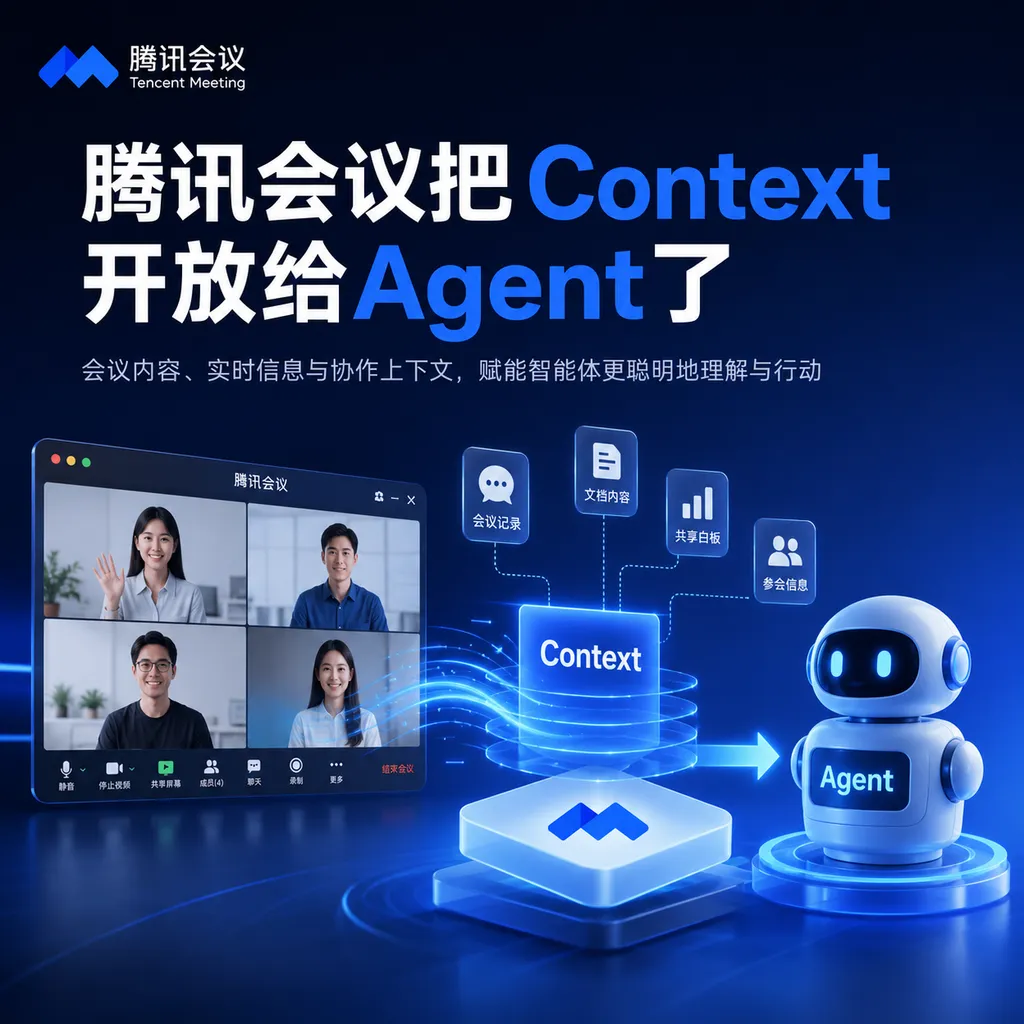
At the 2026 AI Industry Application Conference, Tencent Meeting announced multiple AI feature upgrades, with the core being to transform meeting Context into traceable, callable structured data. Through an open-source CLI, AI Agents can directly access meeting content, recordings, transcriptions, and minutes. This is not just a simple stacking of features, but a redefinition of how meeting tools should collaborate with Agents.
Tencent Meeting Opens Context to Agents
On June 5th, at the 2026 Tencent Cloud AI Industry Application Conference, Tencent Meeting announced something new: it is opening up meeting Context for AI Agents to call. This is not a shallow API integration, but via an open-source CLI, allowing Agents like Openclaw and Hermes to directly read your past meetings, extract transcription content, and generate structured minutes.
The core logic behind this move is clear — meetings are one of the most information-dense scenarios in the workplace, but until now this information was locked in recording files and transcription texts. Agents needed users to manually copy-paste or verbally describe the content before using it. Now Tencent Meeting has removed that barrier, so Agents can proactively retrieve, understand, and act on it.
Looking at the data, from the launch of Yuanbao Minutes in September 2025 to May this year, the monthly usage hours grew nearly fivefold. This growth is driven by genuine user engagement, not a feature going unused after release.
Turning Meetings into Agent-Readable Data Structures
The underlying idea of this upgrade is: turn meeting Context from "content for humans to read" into "data for Agents to operate on".
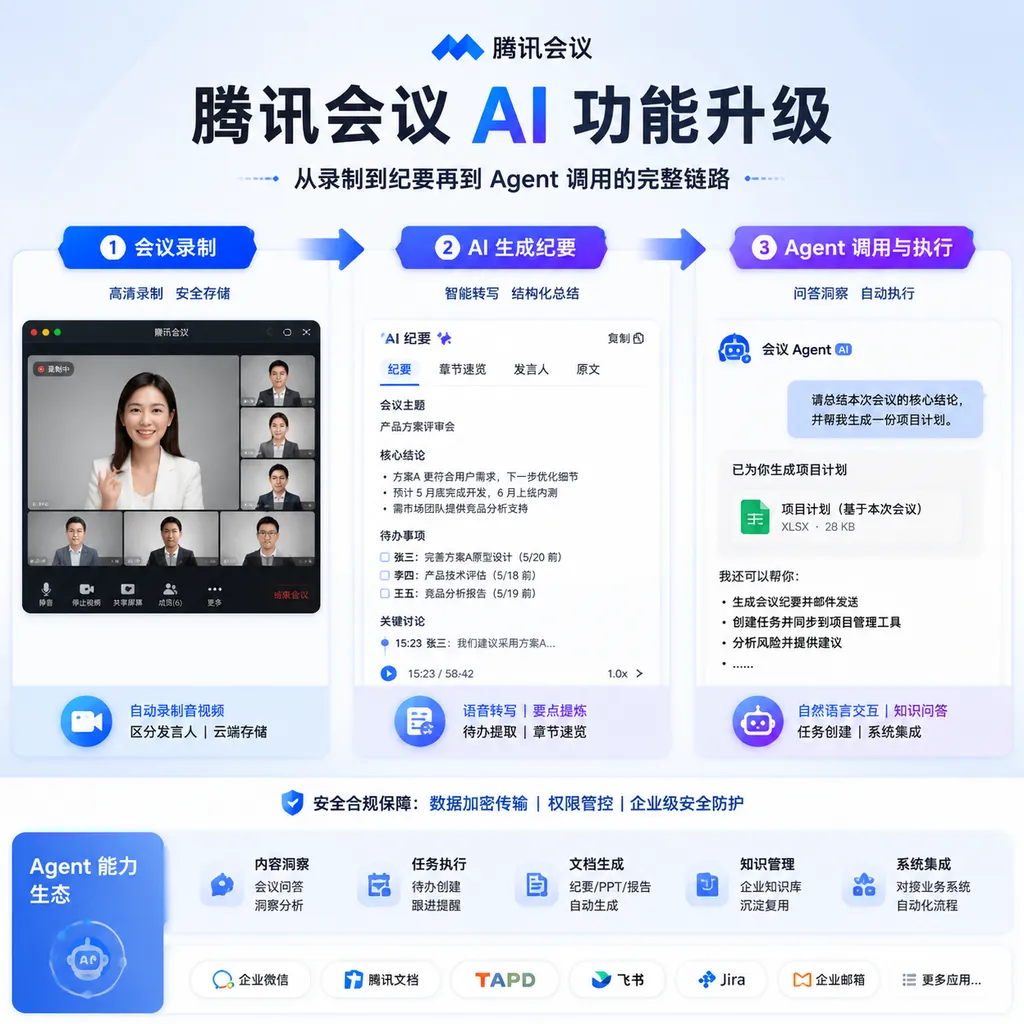
Specifically, through intelligent recording, Yuanbao Minutes, and Ask Yuanbao, Tencent Meeting breaks a meeting down into three actionable data layers:
- Raw Layer: Recording files and real-time transcription — the lowest level information carriers
- Understanding Layer: AI minutes extract structured meeting overviews, conclusions, to-dos, and speaker attitudes — results of the first semantic processing
- Action Layer: This structured data can be called by Agents to generate weekly reports, organize to-dos, and track project progress
This logic solves a core problem for Agent deployment: the cost of acquiring Context. Today, most Agents wanting to know what meetings you had last week and what decisions were discussed either need you to manually feed this information, or they infer it indirectly from calendars or emails. Tencent Meeting is now providing the most accurate primary source, so Agents don’t have to guess — they can just read.
CLI Open Source: Let Agents "Do It Themselves"
The open-source CLI (command-line tool) is the key infrastructure in this upgrade. It doesn’t solve "whether it can be used" but "how to use it smoothly".
Notable technical designs:
- OAuth2 standard authorization: Credentials are AES-256-GCM encrypted and stored locally, discarded after use, without uploading meeting data to the Agent’s server
- Natural language driven: Agents can call the CLI via natural language instructions, without users typing commands manually or clicking in a GUI
- Multi-meeting aggregation search: Supports cross-meeting retrieval, e.g., asking "What to-dos do I have this week?" will automatically query minutes from all meetings this week and extract relevant tasks
Usage scenarios where the CLI enables Agents:
- Post-meeting auto organization: After a meeting, a user says "Please generate minutes for the meeting just now", and the Agent calls the CLI to fetch the recording, extract AI minutes, and format output per the user’s needs — much faster than manually exporting then processing via Agent
- Cross-meeting information aggregation: User asks "What risk points were discussed for this project last week?", and the Agent uses the CLI to search relevant meeting transcriptions, extract risk-related remarks, and organize them chronologically
- Automatic weekly report generation: For meeting-intensive roles, the Agent can write a weekly report based on all meetings from the week, without manual recollection
- To-do tracking: The Agent identifies meeting mentions like "complete before next week" or "need you to follow up" via the CLI, auto-generating a personal to-do list linked to specific meetings
These scenarios share a trait: a greatly increased automation level in information retrieval and processing. Previously, the workflow was "Recall—Describe—Let Agent process", now it’s compressed to "Agent goes and checks" in one step.
AI Minutes Upgrade: From "Summary" to "Atmosphere Reconstruction"
Aside from the CLI, Tencent Meeting also made major changes to AI minutes — extending from objective summaries to subjective atmosphere recreation.
Real-time in-meeting capabilities:
- Pushes updated minutes every 2 minutes without user prompt
- Top bubble box extracts meeting overview, conclusions, and to-dos, refreshing with meeting progress
- Bottom dialogue box shows phase summaries, helping lost attention in long meetings catch up quickly
Layered information presentation:
- Top section shows objective full-meeting summary (structured, noise-free)
- Bottom section shows personal viewpoints and short-term topics (capturing attitude, emotion, atmosphere)
This design is interesting. Traditional minutes tools aim for "objective, accurate, structured", but Tencent Meeting recognizes that remote meetings lack not only record of information, but also the micro-expressions, tone, and atmosphere of face-to-face communication.
Examples:
- Manager says "Progress is okay, but watch the risks". The objective summary is "Progress normal", but the real attitude may be "Concerns exist"
- Cross-department communications missing detection of hesitation or anxiety in tone could cause deviation in execution direction
- Heated discussions where who supports, who opposes, and who’s neutral are often more important than the conclusion itself
AI minutes use intelligent reasoning to analyze speaker emotions, attitudes, and intentions, restoring the meeting from "what was said" to "what the atmosphere was". This is especially useful in decision-making — often the missing piece is judging the attitude behind information.
Integration with Tencent Yuanbao: Closing the Loop from Meeting to Action
AI minutes now also support one-click import into Tencent Yuanbao for further questioning, completing the "Meeting—Decision—Action" chain.
Specific scenarios:
- If trends discussed during the meeting lack complete information, Yuanbao can supplement with online searches based on minutes
- Need to generate mind maps, PPTs, or emails from conclusions — Yuanbao can create them directly from minutes
- Meeting decisions needing data support — Yuanbao can retrieve related reports, cases, and best practices based on discussions
The value here: meeting information is no longer isolated, but extends into follow-up work as living data. Before, minutes sat in a document; you had to find and extract them yourself. Now the minutes themselves are a live Context that can be further dialogued and processed.
Tencent Meeting plans to unlock vertical roles like "Interview Assistant" and "Legal Advisor", meaning different meeting types will have tailored minutes templates and analytic dimensions. For interviews, AI might focus on answer quality, reasoning ability, emotional stability; for legal meetings, it needs to identify key clauses, risk points, and both positions.
From Tool to Platform: The Strategy Behind Tencent Meeting
Looking in a bigger picture, Tencent Meeting is transitioning from a meeting tool to an AI-native collaboration platform.
First layer: data openness. Through CLI and API, Tencent Meeting turns meeting data into a Context source for other AI applications. Not only Tencent’s Yuanbao, but also Openclaw, Hermes, and future internal enterprise Agents can connect. This openness makes Tencent Meeting a potential foundational infrastructure in enterprise AI workflows.
Second layer: capability deposition. Intelligent recording, real-time transcription, AI minutes, emotion analysis — these capabilities can be reused elsewhere. For example, customer service quality checks, sales script analysis, training content extraction — all fundamentally "turning dialogue into structured data". Running this in the meeting scenario first lowers costs for extensions.
Third layer: ecosystem building. CLI open-source signals Tencent Meeting's readiness for developer-driven secondary development. Enterprises can customize Agent call logic according to workflows — e.g., auto-sync meeting to-dos to project management systems, push risk points to risk control teams, extract customer needs into CRM. This flexibility is impossible in closed products.
Compared to competitors:
- Zoom: AI Companion does real-time captions and after-meeting summaries, but hasn’t opened a CLI or API for external Agents
- Microsoft Teams: deeply integrated with Copilot, but Copilot is part of Microsoft’s ecosystem, making third-party Agent integration costly
- Feishu: Has Miaojii for minutes, but it’s mainly tied to Feishu's own docs and task systems, with limited openness
Tencent Meeting’s strategy is "Openness + AI-native" — neither Zoom's conservative approach nor Teams locked-in ecosystem, but aiming to be a standard data source available to any Agent.
How Effective Is It?
From September 2025 to May 2026, Yuanbao Minutes monthly usage hours grew nearly fivefold. This growth suggests:
- Real demand exists — meeting info organization, to-do extraction, weekly report generation are frequent pain points
- AI capabilities are usable — if accuracy falls short or understanding is off, users won’t keep using it
- Product design is reasonable — from real-time in-meeting to post-meeting export, and integration with Yuanbao, the flow is usable
But we must note, the ceiling for these capabilities depends on the underlying model’s comprehension ability. Examples:
- How accurate are transcription and attribution when speakers change quickly
- Attitude recognition — is it based on tone, wording, or contextual reasoning, and what’s the misjudgment rate
- Handling inconsistent descriptions of the same topic across meetings in cross-meeting search
These issues aren’t solvable purely at the product level — they require continuous model improvements. With Tencent’s foundation in the HunYuan large model, there’s an advantage, but real results will show over time.
Meaning for Developers
CLI open-sourcing is good news for developers — enabling more customized Agent applications based on Tencent Meeting.
Possible directions:
- Enterprise internal knowledge base building: regularly extract discussed technical plans and decision rationales from meetings, auto-archiving to a knowledge base
- Project management automation: extract task progress, risk points, and blockers from weekly meetings and auto-update tools like Jira, Trello
- Sales process optimization: extract needs, objections, purchase signals from client meetings, auto-generating follow-up strategies
- Training content deposition: extract knowledge points, cases, and best practices from internal training meetings, generating docs or video clips
Technical considerations:
- Permission management: CLI’s OAuth2 authorization is user-level — enterprise apps must manage batch authorizations compliantly
- Data security: meeting content may include trade secrets — ensure no leakage to third-party services when calling
- Cost control: frequent transcription and minutes generation calls consume tokens — evaluate costs
How Far Can This Go?
The upgrade direction is right, but sustainability depends on:
1. Ecosystem growth. CLI is open, but will developers build on it? This hinges on Tencent Meeting’s user base, documentation completeness, and incentives (official cases, developer community, commercialization support).
2. Sustained AI lead. The meeting scenario demands high AI proficiency: multi-speaker understanding, long-term memory, emotion recognition, cross-meeting reasoning — all model-dependent. If competitors catch up, Tencent Meeting’s edge erodes.
3. Clear commercialization path. AI minutes are temporarily free for personal users; enterprise edition requires contacting a manager — indicating eventual paid model. Pricing strategy, free quota, and bundling with other membership benefits will affect adoption.
4. Privacy and compliance. Enterprises are sensitive about meeting data, especially strategic talks, client info, or unreleased product plans. Tencent Meeting promises no linking of meeting data with user identity and no use in model training, but whether this reassures enterprises needs time.
Summary
The core of this Tencent Meeting upgrade is turning meetings from "content for humans" into "data for Agents", via open-source CLI and upgraded AI minutes, enabling Agents to proactively acquire meeting Context, understand discussion, and generate action lists.
It’s not mere feature piling, but redefining how meeting tools should collaborate with Agents. From data openness to capability deposition to ecosystem building, Tencent Meeting is playing a larger game than just making a meeting tool.
Success will depend on ecosystem uptake, AI capability lead, commercialization clarity, and solving privacy/compliance concerns.
At least the direction is right. In a future where Agents become standard at work, whoever can provide the most accurate, easiest-to-use Context has a chance to become foundational infrastructure. Tencent Meeting is vying for that position.
References
- Tencent Meeting upgrades multiple AI functions, Yuanbao Minutes monthly usage hours increase nearly fivefold — 36Kr — Official source of this upgrade
- How Tencent Meeting is using AI to completely restructure meetings — Zhihu — Detailed introduction to AI minutes function


