
Tencent Cancels Token Ranking Competition, Allocates Quotas Dynamically Based on Output
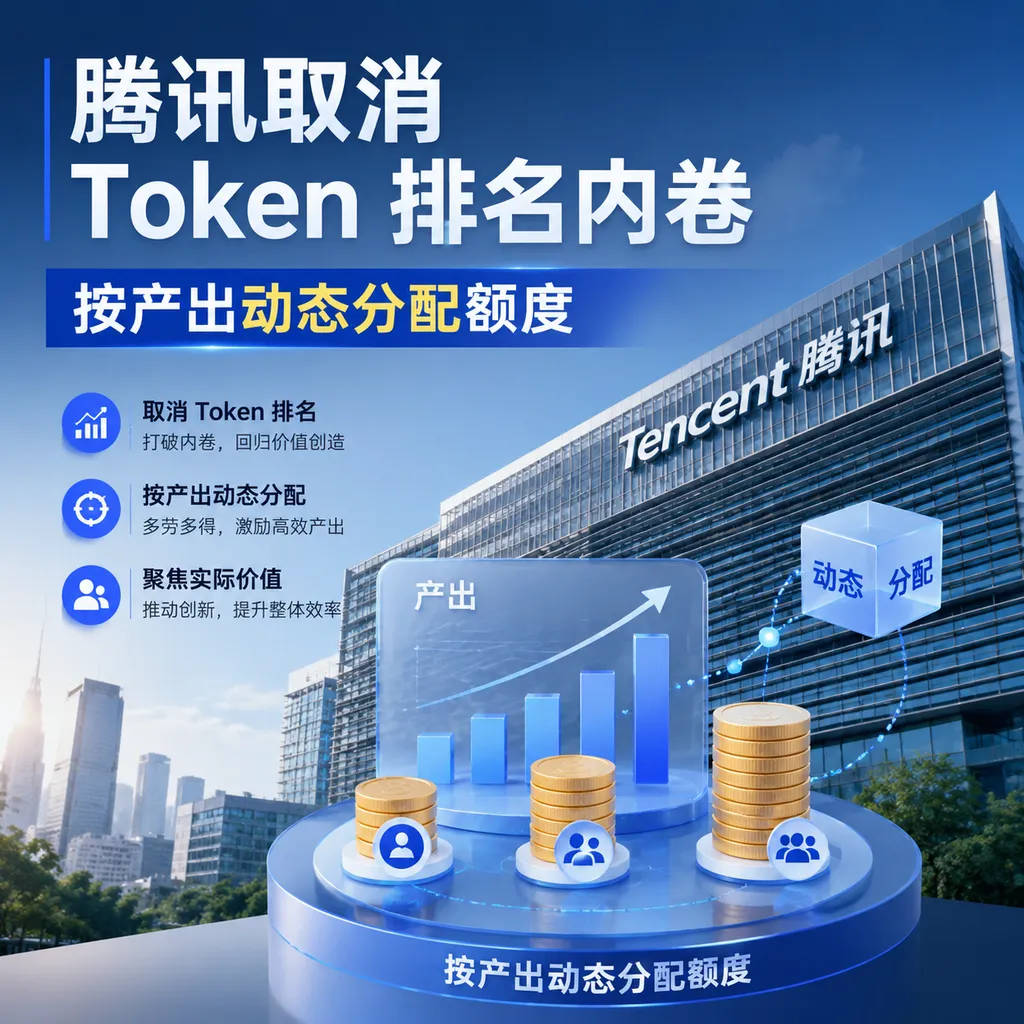
Tencent internally announced an adjustment to the AI token quota mechanism, changing from a unified quota for all employees to dynamic allocation based on work tasks. There will be no consumption rankings, only evaluation of actual output value. This marks the shift in corporate AI resource management from rough distribution to refined, on-demand supply.
Tencent Cancels Token Ranking Competition, Allocates Quotas Dynamically Based on Output
Today, Tencent announced internally that it is adjusting its AI Token quota mechanism.
The core change: a uniform quota for all employees will be replaced by dynamic allocation based on work tasks, no longer ranking by consumption, only looking at actual output.
This adjustment comes at just the right time. In recent months, domestic tech giants have seen a new type of internal competition — employees frantically increasing Token consumption to prove they are “using AI.” Some repeatedly feed code to the model for refactoring, some have AI generate large amounts of useless documentation — all with one purpose: to make their Token consumption metrics look better.
Tencent has now directly changed the rules of the game. The notice clearly states: total investment will only increase, not decrease; employees who can use AI to significantly improve efficiency and produce valuable output will have their Token quotas guaranteed. The key part — no Token consumption rankings, no anxiety selling.
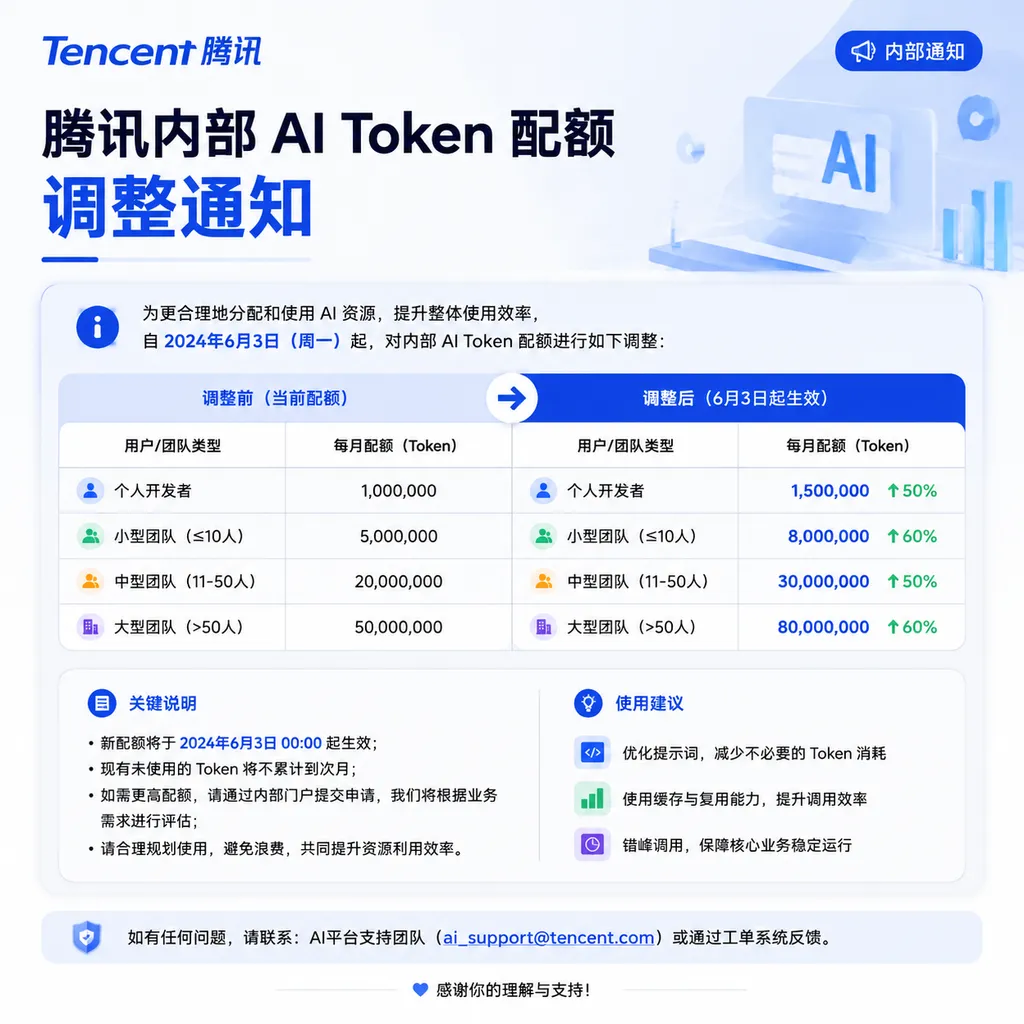
From Per-Capita Allocation to On-Demand Supply
Initially, the Token allocation logic was simple: a fixed monthly quota per person, wait until next month if you run out. This was fine when AI tools were first introduced, but as usage scenarios diverged, problems began to emerge.
A product manager writing documentation might not use up 100,000 Tokens in a month, while a backend engineer generating code could exhaust 500,000 Tokens in two days. The former’s quota was idle and wasted, the latter was forced to lower work efficiency. Worse yet, when HR began tracking departmental Token usage rates, employees started generating useless consumption just to prove they were “using AI.”
Tencent’s adjustment is based on the underlying logic that Tokens are not a perk; they are means of production. Means of production should be allocated according to output, not evenly by headcount.
A case from a Tencent employee illustrates the point well: this engineer used AI-assisted coding to generate three times the code of his peers. Under the old system, his high consumption might be suspected of “wasting Tokens.” Under the new system, his manager proactively increased his quota — because the output was there, providing more resources was worth it.
Technical Optimization Paired with Management Upgrades
Alongside adjusting the quota mechanism, Tencent has also implemented supporting technical optimizations. Official data shows that through mechanisms like context caching, high-frequency request reuse, and external memory optimization, Token consumption can be reduced by over 61% at maximum.
These optimization methods aren’t new, but few have implemented them to this degree. Context caching targets repetitive conversation scenarios — if users stay in multiple rounds discussing the same code file, the system caches the file content, and subsequent requests only transmit incremental portions. High-frequency request reuse identifies common code templates and document frameworks within teams, calling cached results directly without full model inference.
External memory is a deeper-level optimization. Traditional AI conversations pack all context into the prompt, causing Token consumption to grow linearly with conversation rounds. External memory stores less frequently changing background info (project docs, coding standards, historical decisions) in a vector database, retrieving and injecting it only when needed, avoiding repeated transmission.
With this approach, Token consumption for the same task can be cut to one-third or less of the original level. This provides the technical foundation for on-demand allocation — overall investment increases while unit output costs decrease.
Tokens Become the New Work Hours of the Enterprise AI Era
Behind Tencent’s adjustment lies the evolution of Tokens from a technical unit into an economic unit.
When ChatGPT first appeared, Tokens were simply a billing unit developers cared about. Now they have begun to acquire the attributes of “digital work hours” — measuring not just compute usage, but the amount of intelligent labor invested. A requirement from understanding to implementation — how many rounds of model inference, what tools were called, how much code was generated — all ultimately translate into Token consumption.
This shift is evident in Tencent Cloud’s Token Hub released this March. They upgraded the MaaS platform into a Token Hub, changing the core logic from “providing model invocation capability” to “allocating resources based on task execution.” Enterprise customers no longer buy a certain number of API calls, but buy a Token quota, with the system automatically scheduling models, tools, and memory based on task complexity.
Tencent executives have publicly revealed that most of Tencent’s code this year has been generated by AI. Engineers’ focus has shifted to architectural design and code review, leaving concrete implementation to AI. In this work mode, Token consumption directly corresponds to output — more writing and editing naturally means more consumption; but if output quality is high and iterations are few, the overall cost is lower.
Industry-Level Signals
The signal from Tencent’s adjustment is not just internal management optimization, but a marker of the industry’s shift from AI as a tool to AI as production.
In the early days, AI was treated purely as a tool, with attention focused on “can we use it.” Now, in the scaled application stage, the core question becomes “how to use it well.” Using it well doesn’t mean everyone maxes their quota, but that truly value-generating scenarios get ample resources, while avoiding useless consumption.
IDC data shows that Chinese enterprise agent Token consumption has been growing at over 30× annually. This growth comes from both expanded business scale and large amounts of trial-and-error and waste. As Tokens become a measurable cost center, enterprises will inevitably begin refined management.
Tencent’s approach provides a reference paradigm: not restricting usage, but optimizing allocation. Total investment continues to rise, but resources are directed more sharply — toward scenarios that truly generate value, rather than evenly spread across headcount or departments.
This managerial mindset shift essentially answers the question: How should productivity be evaluated in the AI era? In the past, we looked at work hours, lines of code, document counts; now these metrics are no longer precise. When AI can quickly generate vast amounts of content, the evaluation standard must rise to the level of “value of output.” Token consumption is just a process metric — the final deliverable is the goal.
From Internal Competition to Efficiency Gains
Canceling Token rankings might look like removing a metric from assessment, but it is actually redefining the culture of AI tool usage.
If you know the company will track and rank Token consumption, your usage behavior will distort. You’ll lean toward tasks with high consumption but little value, just because the data looks good. You’ll avoid tasks that require deep thinking and multiple iterations but have low per-use consumption, because “it’s not worth it.”
Removing rankings brings employees’ focus back to the work itself. You no longer need to prove through data that you’re using AI — you only need to prove through results that AI has improved your efficiency. Managers grant increased quotas based not on last month’s usage but on what you can produce this month.
This shift demands more from management. In the past, Token rankings quantified “AI usage,” now managers must truly evaluate each person’s output quality. But this is the correct direction — digitalization is not to make management simpler, but to make it more precise.
Tencent internally has a saying: ideally, employees consume about ¥1,000 worth of Tokens per month. The actual number is unimportant — what matters is the expectation behind it: the company wants deep AI tool usage, not superficial dabbling. But the standard for “deep usage” has shifted from consumption amount to output value — a fundamental change.
Technical Debt and Organizational Debt
It’s easy for enterprises to adopt AI; it’s hard to use AI well. Integration and deployment on the technical level is only the first step; the real challenge lies in organization and culture.
Many companies have given employees access to AI tools but without adequate training, clear usage scenarios, or reasonable incentive mechanisms. The result: tools sit idle, or are misused. Some teams, to meet “AI usage rate” metrics, forcibly insert AI into processes that don’t need it, actually lowering efficiency.
Tencent’s adjustment is essentially repaying this “organizational debt.” It acknowledges early-stage average allocation was unreasonable, acknowledges that consumption-based assessment bred internal competition, and replaces it with a more scientific mechanism. This process requires technical support (caching, reuse, dynamic scheduling) as well as managerial mindset shifts (from control to empowerment).
On a broader timeline, this is the necessary stage in moving from “having AI tools” to “establishing an AI production model.” Tools are external; production models are internalized. When AI truly integrates into daily workflows, Token allocation and usage no longer need special management — they will naturally occur like electricity usage: how much you use depends on how much work you do.
Final Thoughts
The value of Tencent’s adjustment lies not in the specific quota numbers or technical optimizations, but in clearly conveying the signal: The correct posture for AI resource management is to seek efficiency from output, not to chase data from consumption.
This logic is simple to state, but its implementation requires systematic coordination of technology, management, and culture. Technically, precise measurement and dynamic scheduling are needed. Managerially, real output must be evaluated rather than surface metrics. Culturally, efficient use must be encouraged rather than blind consumption.
For other enterprises, Tencent’s experience offers a reference: don’t rush to adopt AI, and especially don’t manage AI with traditional KPI thinking. First, be clear on what problems AI is meant to solve, then design appropriate resource allocation and evaluation mechanisms. If it’s just to “look more AI,” it’s better not to deploy it.
Tokens have evolved from a technical concept into a factor of production. How they are allocated, used, and evaluated will determine an enterprise’s true competitiveness in the AI era.
References
-
Tencent Adjusts Internal AI Token Quotas: Dynamic Allocation Based on Work Tasks, Looking at Output not Consumption - IT Home
First-hand source of Tencent's internal Token quota adjustment -
Tencent Cancels Token Ranking Competition, AI Industry Says Goodbye to False Volume - Sohu
Detailed interpretation of Tencent’s Token dynamic allocation system and technical optimization measures


