
NBA Chat Goes Live: Qianwen Large Model Enters the Sports Arena
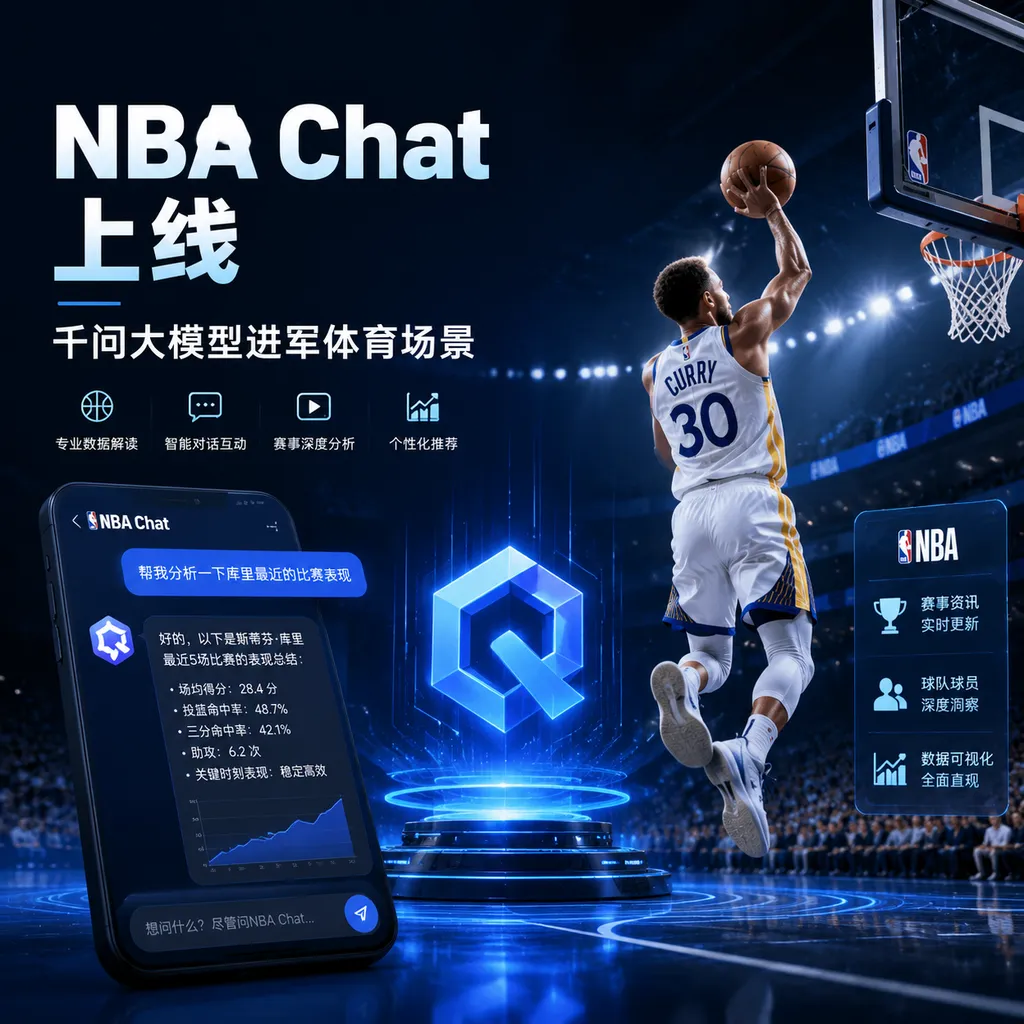
NBA China has launched its first official large language model, NBA Chat, based on Alibaba’s Qwen, now available on the NBA China App. This is a typical example of applying a general-purpose large model to a vertical sports scenario, continuing the long-standing cooperation between Alibaba Cloud and NBA China.
NBA Chat Goes Live: Qwen Large Model Enters the Sports Scene
The NBA Finals have begun, and the official large model "NBA Chat," jointly launched by NBA China and Alibaba, is officially live and integrated into the "NBA China" App. This marks the first time the Qwen large model has been deeply bound to a top sports IP and is another landmark case of domestic large model vendors landing in vertical scenarios.
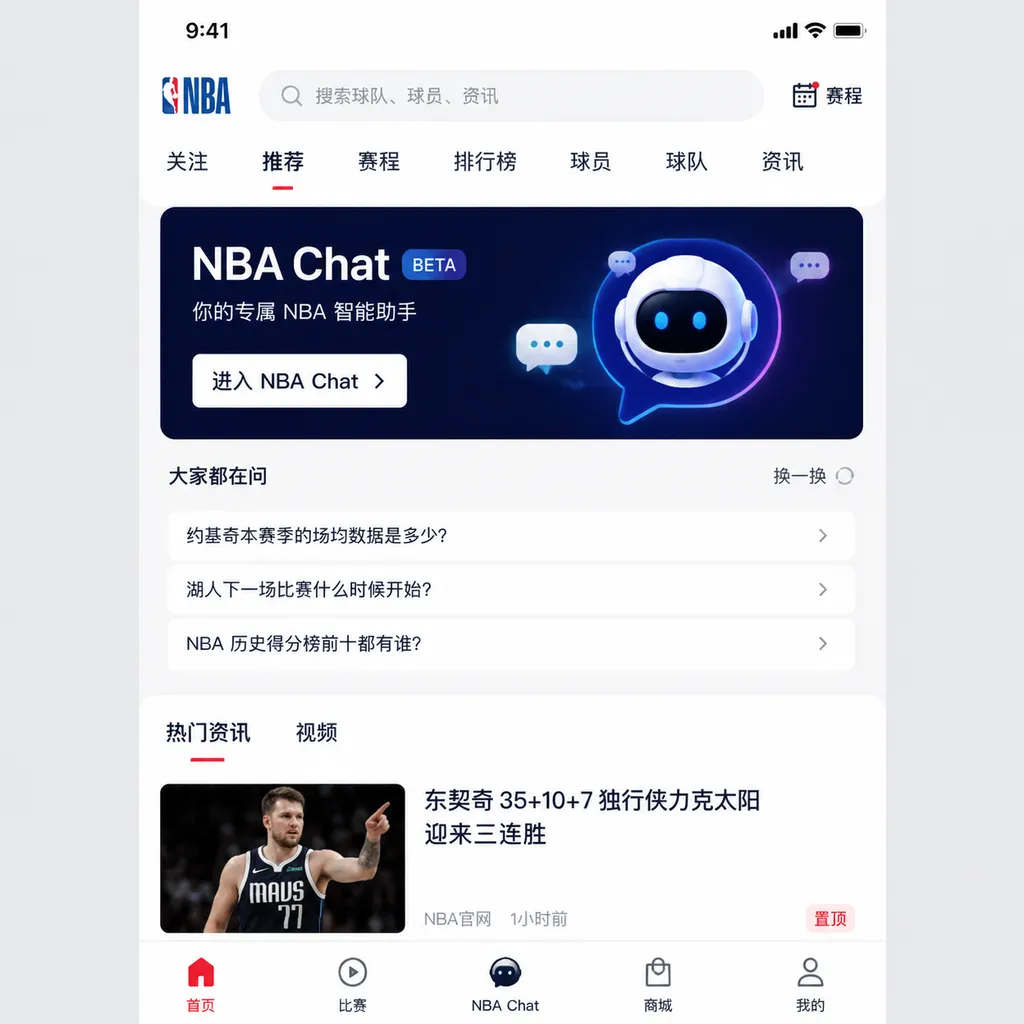
Qwen Foundation, NBA Data Fine-tuning
The foundation of NBA Chat is Alibaba’s Qwen large model, but its core value lies in the fine-tuning layer. Alibaba Cloud acquired NBA China's years of accumulated digital assets — historical game data, player technical statistics, and tactical analysis reports — and used this proprietary data to adapt Qwen to the domain.
This means it is not simply a "sports Q&A bot." If you ask "LeBron James' career average points," it can answer; but more importantly, it can understand complex queries within the basketball context. For example: "What was the Warriors' pick-and-roll efficiency when playing away against the Lakers in the 2024-25 season?" or "Stephen Curry's shooting tendency in clutch playoff moments (last 5 minutes with a score difference within 5 points)" — these types of questions require cross-referencing multidimensional data and combining basketball expertise to answer.
From a technical perspective, this is a typical combination of RAG (Retrieval-Augmented Generation) + fine-tuning. Qwen provides basic language understanding and generation capabilities, while structured NBA data (such as stats.nba.com API data) and unstructured content (such as tactical analysis articles and coach interviews) are vector-indexed and dynamically retrieved for injection during inference. Fine-tuning teaches the model the basketball terminology system, data interpretation logic, and fan questioning habits.
Landing Logic of Vertical Large Models
Sports is a special scenario: high data density, lots of specialized terminology, and clear user needs. The value of NBA Chat lies not in "chatting" but in "interpretation."
For example, you’re watching a game and spot a tactic you don't understand — say, the Bucks suddenly switch to "5-out" offense in the third quarter, and Giannis takes the high post as pivot. Traditionally, you’d search for a tutorial video after the game or ask an expert fan for an analysis. Now you can directly ask NBA Chat: "What was the logic behind that Bucks tactic just now? Why wasn’t Giannis in the low post?" It can combine real-time data (on-court players, score, time) to give targeted explanations, and can also pull up historical success rates for similar tactics as a comparison.
How is this stronger than general-purpose large models? ChatGPT or Claude can also answer basketball questions, but their knowledge cutoff dates are fixed, they don't have real-time game data, and they don’t understand the viewing habits of NBA China’s audience (such as which stars they care more about and Chinese commentary jokes). NBA Chat's fine-tuning makes it "like someone who knows basketball" rather than "an AI that can speak basketball terms."
Alibaba Cloud mentioned in its announcement that "Agent capabilities will continue to be upgraded," which is a key signal. Currently, NBA Chat is in a passive Q&A mode, but it may evolve into proactive service in the future: automatically pushing key data interpretations during games, generating personalized pre-game analysis based on your supported team, or even linking with social functions to produce shareable data visualizations. This requires an Agent framework — enabling the large model to actively call tools (database queries, chart generation, video editing) rather than just answering questions.
Competitor Comparison: AI Arms Race in Sports
Sports + AI is not new, but making large models the core interactive interface is a recent trend.
Abroad, the NBA officially partnered with Microsoft last year to integrate NBA data into Bing Chat, but that was more like a search engine feature expansion without an independent product form. The Premier League, NFL, and other leagues are experimenting too, but most remain at the "data dashboard + simple Q&A" stage.
Domestically, Tencent Sports previously launched an "AI commentary" feature based on its HunYuan large model, but its positioning was to generate text-based live updates for events, not as a user interaction tool. ByteDance tested video content understanding on Douyin Sports Channel (e.g., automatically identifying highlight goals and generating short videos), but did not develop an open conversational product.
NBA Chat's uniqueness lies in "official endorsement + independent product + deep data authorization." It's not a fan tool by a third party based on public data, but an official product led by NBA China as the content owner and supported by Alibaba Cloud as the tech provider. This means it can obtain the most complete data authorization (including some unpublished advanced stats), deeply integrate with other NBA China App functions (live streaming, ticketing, community), and possibly even participate in commercialization in the future (e.g., recommending merchandise, providing paid in-depth analysis).
From a business model perspective, this is the standard Alibaba Cloud to-B strategy: not directly selling large model capabilities to consumers, but helping leading industry clients (NBA China) build vertical applications, using successful cases to attract more sports and entertainment industry customers. Tencent Cloud and Huawei Cloud are also competing for this market, but Alibaba Cloud secured its identity as "official cloud computing and AI partner" of NBA China back in October, and the launch of NBA Chat marks a deepening of that cooperation.
Technical Details Worth Noting
1. Absence of Multimodal Capabilities
Currently, NBA Chat supports only text-based Q&A and does not accept images (e.g., uploading a screenshot of a tactics board asking "How to break this play") or videos (e.g., "Analyze this defensive clip"). Given that basketball is highly visual, this is a clear shortcoming.
Technically, Qwen already has multimodal versions (Qwen-VL), but processing video in real-time on mobile devices — and accurately interpreting NBA’s video data — is no small engineering challenge. Alibaba Cloud’s "360-degree real-time replay technology" demonstrated last year used AI algorithms for motion capture, and may connect with NBA Chat in the future — for example, you ask "Where did Tatum take off in that dunk just now," and the system automatically pulls multi-angle replays and annotates key frames.
2. Real-time Challenges
NBA games are real-time, and data update delays directly affect the experience. NBA’s official stats API usually has a 10–30 second delay. If NBA Chat aims to provide "instant interpretation during the game," it needs a faster data pipeline.
Alibaba Cloud's advantage is its infrastructure: NBA China's live streaming and data services already run on Alibaba Cloud, so the data pipeline can be optimized internally. But this also means NBA Chat will be hard to replicate on other platforms — its core competitiveness is not just the Qwen large model, but the complete "Alibaba Cloud + NBA China" data and service ecosystem.
3. Adaptation to Chinese Context
NBA’s official data and terminology are in English, but Chinese basketball fans’ viewing habits, discussion terms, and cultural references differ greatly from those in North America. Terms like "打铁" (brick), "神仙球" (miracle shot), "毒奶" (jinx) are incomprehensible to general English models; Chinese fans also focus more on certain specific players (e.g., Zhou Qi, Sun Minghui, Chinese players) and certain historical memes (e.g., "LeBron 3–1").
NBA Chat’s fine-tuning data likely includes a large amount of Chinese basketball forum and social media content, which is its localization advantage over ChatGPT. However, this also brings risk: if training data contains too much unofficial, emotional fan chatter, the model might output content with bias (e.g., regional prejudice, fan wars between player supporters). As an official platform, NBA China faces significant content moderation pressure.
Commercial Prospects: More Than Just a Fan Tool
Currently, NBA Chat is positioned as a "fan service," but in the long run, its value may spill over into more scenarios:
- Content Production: Media can use it to quickly generate data-driven match analysis articles and social media images. For example: "Generate an 800-word post-game analysis of Warriors vs Lakers, focusing on Curry’s clutch shots" — this is much more efficient than human writing.
- Betting Assistance (gray area): Although domestic sports lotteries don’t offer NBA betting lines, the overseas betting market is huge. If NBA Chat opens its API, it could theoretically provide data support for betting analysis tools. NBA China would likely strictly control such use, but technically it can’t be fully prevented.
- Youth Training and Tactical Analysis: Professional teams and basketball training institutions could use it for opponent analysis and player evaluation. For example: "Analyze Zhang Zhenlin’s offensive hotspots in the CBA and compare with NBA players in the same position" — this is practical for scouts and coaches.
If Alibaba Cloud wants to export NBA Chat’s capabilities to more clients, the key is to abstract its underlying capabilities into a "sports vertical large model solution": data access framework, domain knowledge fine-tuning toolkit, and Agent development suite. This way, CBA, Chinese Super League, and e-sports events could quickly replicate similar products.
Hidden Contest: Data Sovereignty and AI Security
NBA China handing over core data to Alibaba Cloud for AI training is a matter of trust. NBA’s game data, player privacy data, and commercial data (such as ticket sales and broadcast ratings) are high-value assets — leakage or misuse would have serious consequences.
Alibaba Cloud has presumably deployed a privatized model instance for NBA Chat, keeping data within NBA China’s tenant environment. However, during fine-tuning, the base model parameters of Qwen are shared, and theoretically there is a risk of "model remembering training data" — though extremely low probability, it must be considered in scenarios involving commercial secrets.
Another perspective: NBA China choosing Alibaba Cloud over Tencent Cloud and Huawei Cloud involves strategic considerations beyond technology. Alibaba Cloud has broader overseas footprint (especially in Southeast Asia and the Middle East), which would benefit NBA if they want to replicate similar products in other markets. Tencent has the WeChat ecosystem, but NBA China App is an independent product without relying on WeChat traffic; Huawei Cloud is strong in government and enterprise markets, but has relatively weak consumer internet experience.
Model Deployment’s Benchmark Significance
NBA Chat’s value lies not in "just another chatbot," but in proving this point: for large models to generate actual value in vertical scenarios, they must be deeply bound to industry data and business processes.
In the past year, domestic large model vendors have all spoken about "industry landing," but most cases remain in the demo stage: creating a dialogue interface, accessing public data, and opening APIs for developers to tinker with. Real cases like NBA Chat — led by top industry clients, deeply customized by tech providers, and productized for end users — are still rare.
Sports is a good entry point: high degree of structured data, clear user needs, and clear business models. Whether its experience can be replicated in more complex fields such as healthcare, law, and finance remains to be verified over time. These fields have more sensitive data, higher professional thresholds, and stricter regulation — large models are not a universal key, and each vertical must re-prove itself.
NBA Chat going live inspires developers: don’t focus on general large model benchmark scores; instead, find a vertical you understand, obtain real data, and solve a clear problem. This is more meaningful than chasing the "next GPT-X."
Lastly
It’s hard to say how many games the NBA Finals will go to, but the contest for NBA Chat has only just begun. Whether it can truly become a fan’s "basketball guru" depends on product iteration speed, data update quality, and the long-term commitment of Alibaba Cloud and NBA China.
The domestic large model market has already moved to vertical scenarios, and sports is just one battlefield. We’ll soon see more "XX Chat" products — for music, food, travel — the key is not who announces first, but who can make the product genuinely useful and get users willing to pay for professional capabilities.
The era of general-purpose large models is over. Now is the time for vertical models to prove themselves.
References
- NBA China builds its first official large model based on Alibaba Qwen, capable of interpreting core data such as player positions and scoring — IT Home official report, including product features and cooperation background


