
Qualcomm Bets on In-Vehicle AI Agents, Claw Ecosystem Aims to Make the Cockpit “Truly Understand You”
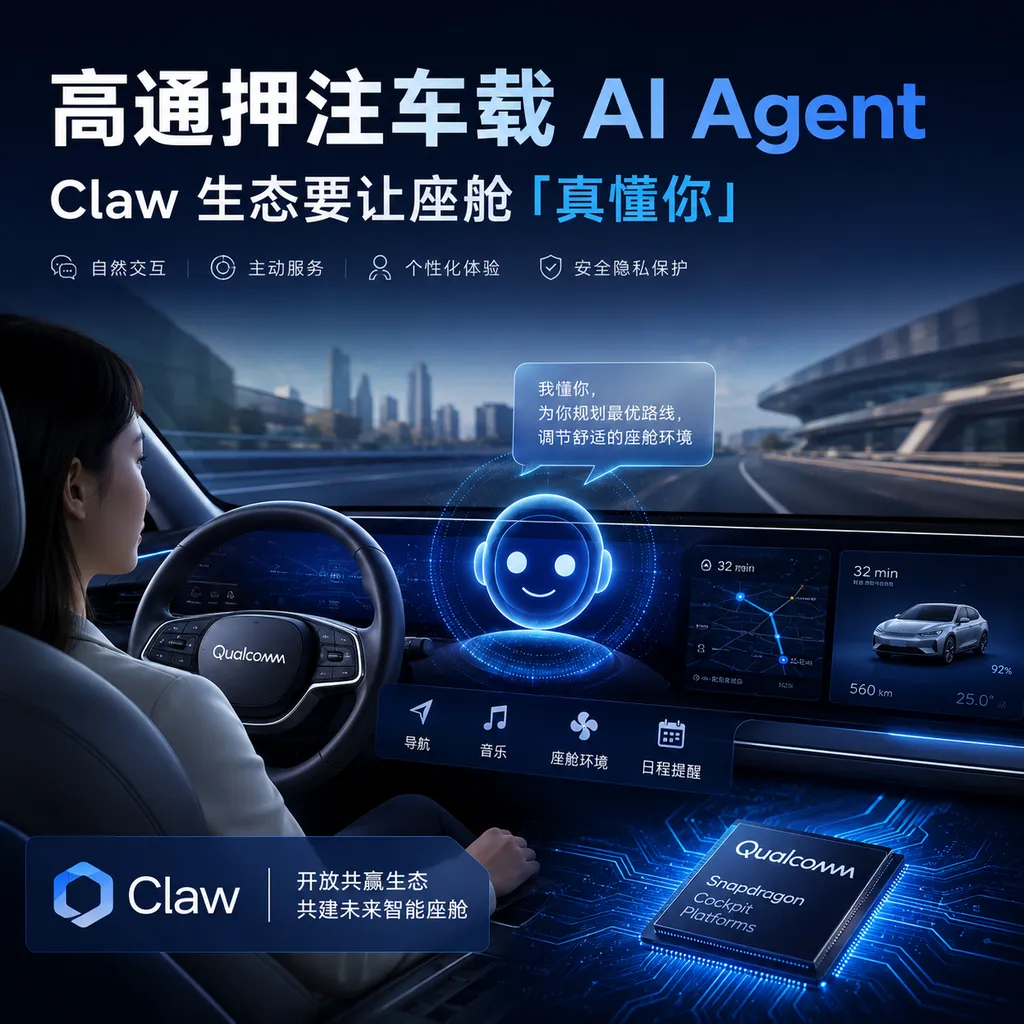
Qualcomm, together with six ecosystem partners including Thundercomm, has launched the Claw Project, integrating a hundred-billion-parameter MoE model and multimodal perception into cockpit chips, with the goal of evolving cars from “following commands” to “understanding context.”
Qualcomm Bets on In-Vehicle AI Agents, Claw Ecosystem Aims to Make the Cockpit “Truly Understand You”
At the Wuxi Automotive Technology Summit today, Qualcomm announced its in-vehicle AI Claw ecosystem plan, partnering with six ecosystem companies—Thundersoft, ArcherMind Technology, Carlink, Banma Zhixing, Desay SV, and Megvii Technology—to directly deploy AI Agents and multimodal large models on the vehicle head unit.
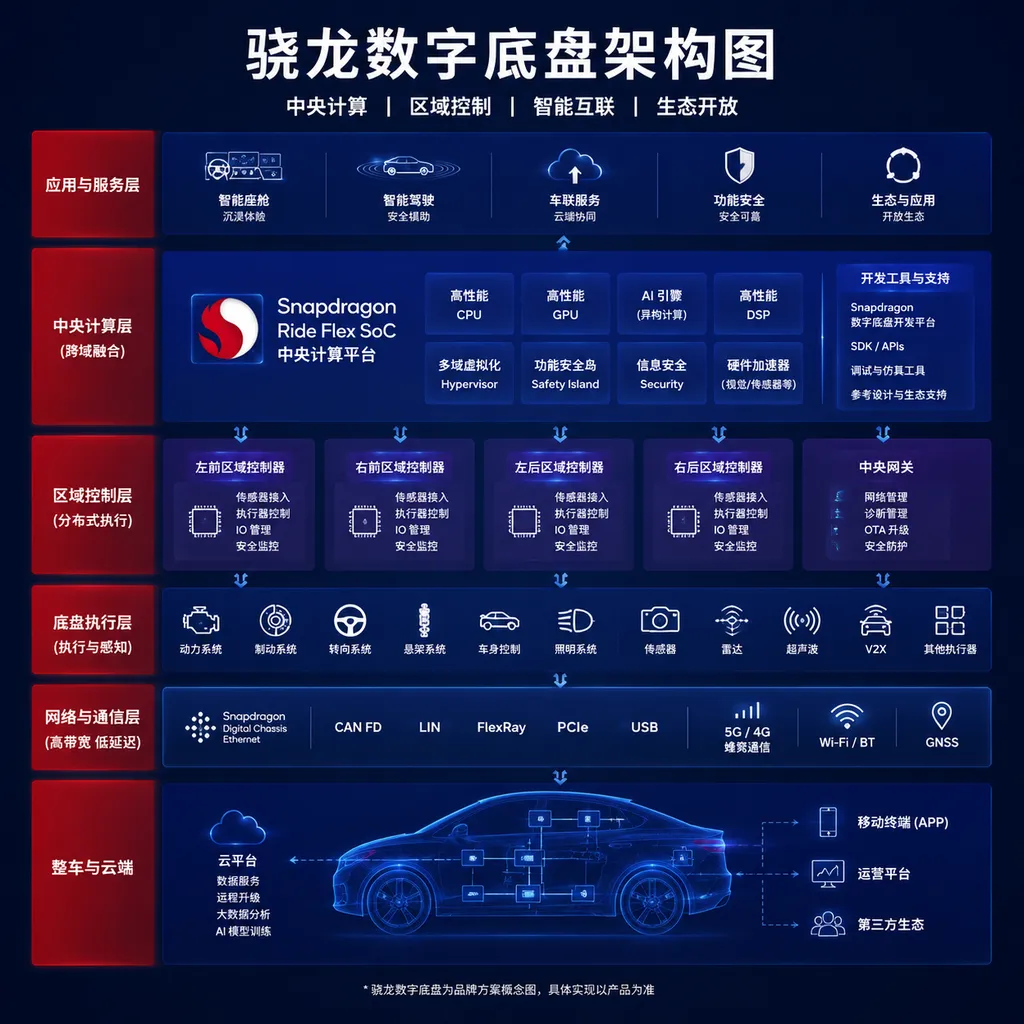
The core goal: Qualcomm plans to use the Snapdragon Digital Chassis solution + AI Agent runtime environment to build a complete technology stack from chip to middleware to applications, enabling automakers to mass-produce “understanding” smart cockpits faster.
Not Just a Voice Assistant—It Needs to “Read the Situation”
Despite years of development, most infotainment systems are still at the “you say one sentence, I reply one sentence” stage. Siri-style voice interaction has proven insufficient—you must precisely issue commands to make it perform; if you phrase it differently or depend on context, it gets confused.
The Claw plan aims to solve the deeper problem: enabling the car to understand situations, not just commands.
Qualcomm’s proposed “all-weather multimodal perception” essentially fuses data from in-vehicle and external cameras, microphone arrays, vehicle CAN bus, GPS location, time, and other multiple sensors in real time, allowing the AI model to continuously build a dynamic semantic map of “vehicle–driver–environment.”
Example: You are driving on the highway, the system detects you have yawned three times (camera vision), your speed exceeds 100 km/h (CAN bus data), it’s now 2 PM (time data), and there’s a service area 50 km ahead (map data). A traditional voice assistant would require you to say “I’m tired, help me find a service area,” while a multimodal perception system could proactively ask, “We detect signs of fatigue, there is a service area 15 minutes ahead—do you want to navigate there?”
This “predictive interaction” requires the AI model to process multimodal data streams in real time and perform inference locally—posing high demands on both computing power and model architecture.
Hundred-Billion-Parameter MoE Models Running on Vehicle Units
The technological highlight: running a hundred-billion-parameter Mixture of Experts (MoE) model on Snapdragon cockpit chips.
The MoE advantage is “sparse activation” to improve compute efficiency—although the total parameter count is large, only a small subset of expert networks is activated per inference. For example, Mixtral 8x7B has 47B parameters, but only uses 13B for each inference. This makes large-model deployment on the edge possible.
In the smart cockpit scenario, such a model enables:
- Complex Semantic Understanding: Beyond simple commands like “Open sunroof,” it can interpret vague expressions like “It’s stuffy, need some air” and decide whether to open the sunroof, turn on AC, or lower windows.
- Multi-Step Task Planning: For example, “Pick up the kid on the way home” includes three sub-tasks (navigate home, locate the kid, plan detour route), which it automatically prioritizes and executes.
- Context Memory: Traditional systems treat each conversation as independent—say “Navigate to the airport,” then “Is there parking there?” and it doesn’t know what “there” refers to. Large models can maintain context, even remembering preferences across days.
Crucially, all this runs offline on the vehicle. Qualcomm emphasizes “whether or not the vehicle is online, it can enable fast, safe interaction experiences at all times”—solving the pain points of weak-network environments like underground garages, tunnels, or remote areas.
Snapdragon 8775 (Qualcomm’s previous flagship cockpit chip) already achieves 120 TOPS AI compute. Running hundred-billion-parameter MoE models requires INT4/INT8 quantization, KV cache optimization, and dynamic batch processing to keep latency under 50 ms (the threshold for perceived real-time interaction).
Six Layers of Security to Block AI Agent “Backdoors”
Deploying an AI Agent in a car is high-risk. Agents can autonomously call tools and perform tasks, but without strict permission control, they might perform dangerous actions—such as adjusting seats at high speeds, altering navigation routes, or sending unauthorized commands via vehicle networking.
Qualcomm’s “automotive-grade security architecture” includes six layers:
- Vehicle Control Grading: Categorizing vehicle functions into read-only (check fuel consumption), low-risk (adjust AC), medium-risk (adjust seats), high-risk (unlock doors), and forbidden (braking system). AI Agents can only call explicitly authorized APIs.
- User Authorization: High-risk actions require driver confirmation. For example, if the Agent suggests “Open the trunk for your delivery,” a confirmation prompt must appear, and only executes after approval.
- Operation Audit: All API calls, actions, and accessed data by the Agent are logged for automaker and regulator review.
- Security Policies: Rule-based context constraints—e.g., “Prohibit seat adjustment when speed exceeds 60 km/h” or “Prohibit non-critical reminders when driver is distracted.”
- Privacy Protection: Raw camera/microphone data stays local; inference occurs in TEE (Trusted Execution Environment). Voice wake words and facial recognition models use federated learning locally.
- Automaker Configuration: An open white-box control panel allows automakers to flexibly configure Agent permission boundaries based on brand tone, regulations, and user agreements.
The challenge is balancing performance and security—too strict reduces usability; too loose invites risks. Qualcomm’s approach is to give automakers configurable frameworks, rather than fixed restrictions.
Breaking Ecosystem Fragmentation—Toward Standardization
A long-standing issue in the smart cockpit industry: fragmented solutions.
Automaker A works with Supplier X for voice interaction; Automaker B starts from scratch with Supplier Y. Even if they use Qualcomm Snapdragon chips at the base, middleware, AI frameworks, and app ecosystems are siloed. Developers must adapt code to each model; automakers must validate each function from scratch—production timelines stretch to 18–24 months.
The Claw plan aims to define industry standards:
- Unified AI Runtime: Similar to Android’s ART VM, providing standardized inference engine, memory management, and thread scheduling. Developers adapt once, and apps run on all Snapdragon Digital Chassis models.
- Open Skill Marketplace (SKILL HUB): Like Apple’s App Store, but for Agent skills—e.g., “Smart Parking Assistant,” “Fatigue Driving Detection,” “Personalized Music Recommendation”—packaged as standardized plugins for automakers to buy and integrate.
- End-Cloud Coordinated AI Planning Platform: Complex reasoning (e.g., planning a weeklong trip) offloads to cloud models; real-time tasks (adjusting AC) stay local. The platform auto-distributes tasks and syncs data.
Division of labor:
- Thundersoft, ArcherMind Technology: Provide Android Automotive-based OS and BSP (Board Support Package), adapting hardware.
- Banma Zhixing, Carlink: Provide Agent middleware and dialogue management engines, packaging large-model capabilities into APIs for automakers.
- Desay SV, Megvii Technology: Handle mass production, vehicle-grade certification, EMC testing, and engineering issues.
Clear roles: Qualcomm provides chips and AI frameworks, OS vendors do adaptation, middleware vendors package capabilities, Tier 1 handles production—avoiding automakers being “both referee and player.”
Benchmarking Tesla FSD—Qualcomm Takes a Different Path
Tesla is already working on in-vehicle AI Agents.
Tesla’s route is vertical integration: self-develop Dojo supercomputer for training, self-develop FSD chip for inference, self-develop in-vehicle OS to control everything. Recently, Musk demonstrated Grok voice assistant understanding “I’m cold” and adjusting AC—a prototype of AI Agent in cockpit.
But Tesla’s model has a flaw: Only Tesla can replicate it. Other automakers lack Dojo-level compute, billions of miles in autonomous driving data, and software teams to write an OS from scratch.
Qualcomm’s route is horizontal enablement: offering standardized toolchains so traditional automakers, EV startups, and Tier 1 suppliers can quickly adopt—similar to Android + Snapdragon enabling thousands of smartphone companies to build smart devices, not just Apple.
From a business model, Qualcomm doesn’t profit from Agent apps; it earns from chips and licensing. The more prosperous Claw ecosystem becomes, the more models carry Snapdragon Digital Chassis, boosting chip shipments.
But there’s risk: standardization vs. differentiation. If all automakers use the same AI framework and applications, what’s the difference between BMW’s cockpit and BYD’s? How to maintain brand premium?
Qualcomm’s answer: “Configurable”—base capabilities are standardized, but interaction logic, UI, and brand tone are customized by automakers—similar to how Samsung and Xiaomi both use Snapdragon chips but have different experiences.
Rollout Timeline: Mass Production Cars by 2027
While Qualcomm didn’t give exact dates, based on automotive cycles:
- H2 2026: Ecosystem partners complete technical validation; automakers begin POC testing.
- H1 2027: Selected models enter SOP (start of production) prep, complete vehicle-grade certification.
- H2 2027–2028: First mass-production cars with Claw ecosystem launch.
This is slower than smartphones—new chips in phones go from release to mass production in six months; cars take 18–24 months due to higher reliability and safety requirements, needing extreme temperature tests, vibration tests, EMC tests, functional safety certification (ISO 26262), etc.
Competitive landscape:
- NVIDIA DRIVE: Leads in autonomous driving chips; late in cockpit chips, ecosystem less mature.
- Horizon Journey: Leading Chinese cockpit chip supplier, secured orders from Li Auto, Great Wall, but still lags in compute and ecosystem completeness.
- Huawei MDC: HarmonyOS cockpit + in-house chips, mainly serving Huawei-affiliated automakers (Seres, Chery), limited openness.
Qualcomm’s advantage is ecosystem completeness: from chip, OS, middleware to apps, each step has mature partners. For automakers not self-developing full stack (over 80% of the market), this is the fastest route.
Remaining Pitfalls
In-vehicle AI Agent sounds great, but real-world deployment faces issues:
1. Long-Tail Scenario Coverage
Large models do well in common scenarios (navigation, music, AC), but driving involves varied contexts: rain/snow weather, dialects, noisy environments, elderly/children users, special driving habits... Recognition accuracy in these long-tail scenarios directly impacts usability.
Tesla iterates via massive real-world data; Qualcomm’s ecosystem must solve the data flywheel issue—if each automaker’s data is isolated, models evolve slowly.
2. Compute vs. Power Consumption
Running hundred-billion-parameter models in cockpit units consumes significant power. Typical cockpit domain controller budgets 30–50 W; high-performance inference may take 20 W—leading to heat, fan noise, battery drain.
Qualcomm must balance compute, power, and cost—likely offering tiered chip solutions for different price segments (similar to Snapdragon 8 Gen flagship/sub-flagship tiers).
3. User Trust
First reaction to in-vehicle AI: “Will it eavesdrop on me?” “Will it sell my location data to advertisers?”
Qualcomm emphasizes “privacy protection” and “local inference,” but needs transparent tech implementation and third-party audits for credibility. Without trust, technology adoption stalls.
4. Legal and Ethical Boundaries
If AI Agent makes a wrong decision causing accidents (e.g., misjudging fatigue, encouraging continued driving, leading to rear-end collision), who’s liable—automaker, chipmaker, algorithm provider, driver?
These issues are familiar in autonomous driving debates, but AI Agent boundaries are fuzzier—it doesn’t directly control driving, but influences driver decisions.
Conclusion
Qualcomm’s Claw ecosystem essentially tries to replicate the “Android + Snapdragon” smartphone success: use standardized platforms to lower development thresholds, open ecosystems to gather developers, leverage scale to reduce costs, and ultimately make AI Agents standard in cockpits.
But the auto industry is far more complex: longer supply chains, longer certification cycles, higher safety demands, lower replacement frequency. Bridging lab-to-mass-production gaps is harder than in phones.
Still, the direction is right. The ultimate smart cockpit should not be “a radio with a screen” but a truly understanding AI partner. Qualcomm and its partners are pushing toward this goal—though the road is long, they are already on it.
Next, questions remain: Which automaker will take the lead and launch a Claw-enabled mass production car? Will real-world performance match demo videos? And will consumers pay extra for a cockpit that “understands” them?
References
- Qualcomm Announces In-Vehicle AI Claw Ecosystem, Bringing AI Agents to Smart Cockpits - IT Home — official release and technical details


