
App Store quarterly new apps surge by 84%, AI programming tools spark a “mass development” trend
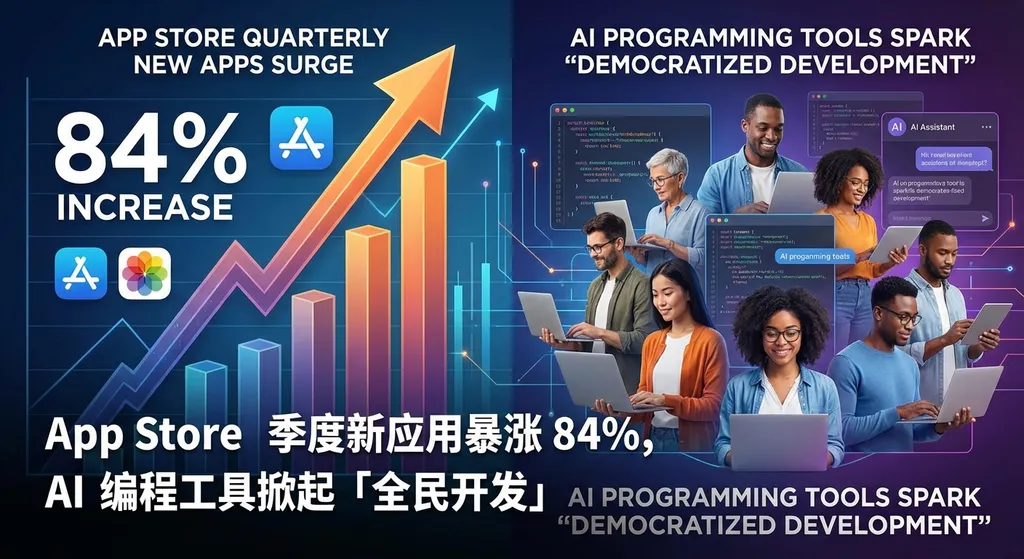
In Q1 2026, the number of new App Store submissions surged 84% year-over-year to 235,800, completely reversing a decade-long decline. AI coding tools such as Claude Code and Codex were the main driving forces, but Apple has begun imposing regulations as issues with app quality have started to emerge.
App Store Quarterly New Apps Surge 84%, AI Coding Tools Spark “Development for All”
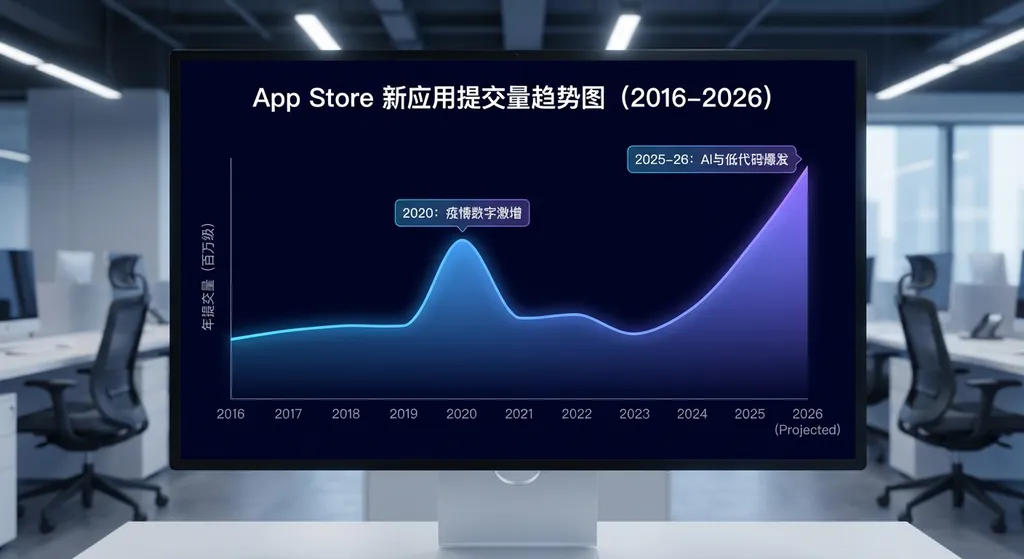
In the first quarter of 2026, the number of new apps launched on Apple’s App Store skyrocketed 84% year-over-year to 235,800. This is the latest data from Sensor Tower and marks the strongest rebound for the App Store in nearly a decade.
From 2016 to 2024, the number of new apps had cumulatively declined by 48%. Developers had either migrated to other platforms or simply stopped making mobile apps. But now, this trend has reversed completely — in 2025, the number of new apps grew 30% year-over-year to nearly 600,000; entering 2026, the growth rate doubled to 84%.
AI Coding Tools Turn On the “Tap”
The main driver of this growth surge is AI coding tools like Anthropic’s Claude Code and OpenAI’s Codex. Their logic is simple: you describe the functionality you want in natural language, and the AI directly generates the code — sometimes even a fully working app.
Claude Code began limited testing in February last year and fully opened in May; Codex tested in May and opened in October. The timeline aligns closely with the App Store submission explosion. Sensor Tower senior analyst Abraham Yousef put it bluntly: “The explosive growth in new apps over the past year strongly coincides with the widespread adoption of intelligent coding tools that remove development barriers.”
The value of these tools lies in two key points:
- Non-programmers can also develop apps: Product managers, designers, even regular users — as long as they can describe their ideas, they can turn them into working code. What used to require tens of thousands of yuan for outsourcing can now be done just by talking to AI.
- Professional developers see doubled efficiency: For those with coding experience, these tools drastically accelerate output. What once took a week may now take a day.
While there’s no precise data on how many new apps are AI-generated, the speed at which these tools are spreading has led most in the industry to believe that the majority of new apps are AI-assisted.
Apple Begins Regulation, but Its Reasoning Is Subtle
Despite the app explosion, Apple’s stance is nuanced. According to The Information, Apple has begun limiting some native AI coding apps: Replit’s app was blocked from updating, and another app called Anything was directly removed.
Apple’s explanation is that this isn’t targeting AI coding tools per se, but enforcing existing review rules — apps are prohibited from rewriting code in ways that meaningfully change functionality without review. In other words, Apple worries about developers generating apps on iPhones that could bypass App Store review and distribution.
That logic seems sound in theory, but it’s awkward in practice. Since the very essence of AI coding tools is “dynamic code generation,” enforcing such rules strictly would block nearly all AI coding apps.
Apple’s concern isn’t unfounded. As development barriers lower, low-quality apps have indeed increased. Both developers and users are complaining that junk apps are flooding the store while quality apps are harder to find. From a security standpoint, AI-generated code may carry vulnerabilities, raising the risk of malicious apps.
Review Pressure Soars; Apple Relies on AI to Cope
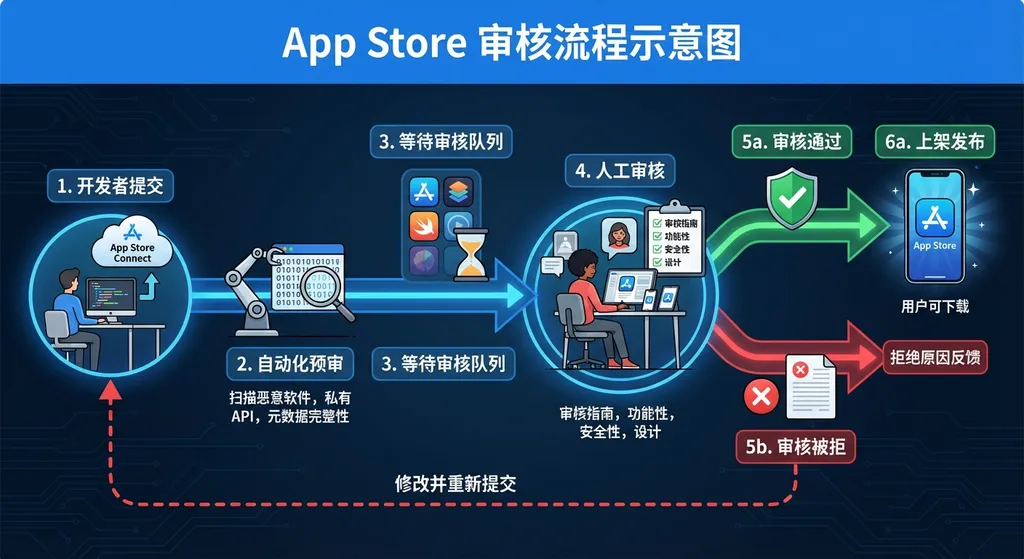
With submissions surging, review pressure naturally follows. Some developers report longer review times, though Apple officially claims “the process remains stable.” A spokesperson said 90% of apps are reviewed within 48 hours, with over 200,000 submissions processed weekly in the past 12 weeks — an average review cycle of about 1.5 days.
Maintaining this efficiency depends on Apple’s own use of AI. Parts of the review process are now AI-assisted, though each app still requires human approval. This creates a paradox: AI tools speed up development, but reviews still rely on humans, forcing Apple to use AI to accelerate reviews — a case of “AI versus AI.”
What Is “Vibe Coding”?
The industry refers to this AI-driven code generation as “Vibe Coding” or “Agent-Based Coding.” It sounds vague, but at its core, it means: “You tell AI what you want, and it writes the code for you.”
Compared with traditional code generation tools (like templates and scaffolding), the key difference in AI coding tools is comprehension. Earlier tools could only process structured input — you had to fill configuration files in specific formats. Modern AI tools can understand natural language: you can just say “I want a bookkeeping app that can scan receipts,” and it will generate the corresponding code.
This leap in ability has caused a steep drop in the development threshold. You no longer need to know programming languages, frameworks, or APIs — you just need to speak.
What It Means for Developers
The impact varies by developer type:
For non-programmers: This is the true era of “development for all.” Product managers can validate concepts, designers can build interactive prototypes, and entrepreneurs can rapidly create MVPs. Projects that once required technical cofounders or outsourcing can now be done solo.
For junior developers: The pressure is intense. Their value once lay in “being able to code,” but now AI can code — and faster. Those who merely follow tutorials will be replaced. However, if you understand business logic, performance optimization, and complex debugging, AI becomes your assistant.
For senior developers: Efficiency leaps forward. Repetitive coding, documentation lookup, API debugging — AI now handles these. You can focus on architecture, performance, and business logic. But you must also learn to manage AI-generated code — ensuring quality and security.
Real-World Usage in API Integration
Many AI-generated apps rely on multiple APIs — large-model APIs, payment APIs, map APIs, etc. Developers used to manually connect each platform’s API; now they can simplify via aggregation services.
For example, if you want to build an intelligent customer service app using GPT-4, Claude, and DeepSeek to compare results, traditionally you’d register separate accounts for OpenAI, Anthropic, and DeepSeek, manage three API keys, and handle three interface formats. Using an aggregator like OpenAI Hub, you only need one key, one unified interface, and minimal code adjustments.
Example code (Python):
import openai

# Configure OpenAI Hub
openai.api_base = "https://api.openai-hub.net/v1"
openai.api_key = "your-openai-hub-key"

# Call GPT-4
response_gpt4 = openai.ChatCompletion.create(
    model="gpt-4",
    messages=[{"role": "user", "content": "Help me write the core logic for a to-do app"}]
)

# Call Claude
response_claude = openai.ChatCompletion.create(
    model="claude-3-opus",
    messages=[{"role": "user", "content": "Help me write the core logic for a to-do app"}]
)

# Call DeepSeek
response_deepseek = openai.ChatCompletion.create(
    model="deepseek-chat",
    messages=[{"role": "user", "content": "Help me write the core logic for a to-do app"}]
)

print("GPT-4:", response_gpt4.choices[0].message.content)
print("Claude:", response_claude.choices[0].message.content)
print("DeepSeek:", response_deepseek.choices[0].message.content)
This unified interface allows quick model switching, performance comparison, and even load balancing or fault tolerance. For AI-generated apps, such flexibility is vital, since model selection often needs adjusting to balance cost and quality.
Quality Issues Are Real
With app quantity soaring, quality problems have followed. As barriers drop, many who know nothing about coding rely completely on AI to generate apps — resulting in buggy, poorly performing, and unpleasant user experiences.
More seriously, AI-generated code can contain vulnerabilities such as SQL injection, XSS attacks, and sensitive data leaks. Developers who don’t understand these issues can’t detect them. While Apple is tightening its reviews to reduce risk, no team can fully audit every line of code.
For users, junk apps are crowding the store, making good ones harder to find. Although Apple is refining its recommendation algorithms, their effectiveness is limited amid the flood of low-quality apps.
This Is a Trend, Not a Bubble
Some argue this growth surge is a bubble that will fade once hype cools. I disagree.
AI coding tools continue to advance rapidly. Last year’s Claude Code and Codex could only generate simple apps; now they handle complex business logic, cross-platform adaptation, and performance optimization. A year from now, even architecture design may be automated.
The drop in development thresholds is irreversible. Just as WordPress once let non-coders build websites, AI coding tools now let non-coders build apps. This isn’t about replacing developers — it’s about expanding the definition of “developer.”
Apple’s regulation won’t stop this trend. At most, AI coding apps will change forms — from native apps to web-based ones, or from generating full code to generating configuration files. Technology will always find a way forward.
Industry Impact
This transformation affects more than the App Store — it’s reshaping the entire software industry.
Development costs and timelines are shrinking dramatically. What once took months and tens of thousands of dollars can now be done in days for a fraction of the price. For startups, this reduces trial-and-error costs and accelerates idea validation.
Developer skill requirements are evolving. The value of “code churners” is declining, while those who understand business, architecture, and performance optimization are growing in importance. Future developers will act more as “AI managers” than “code producers.”
The app ecosystem will become more fragmented. Single-person teams can now build apps, spawning numerous niche products serving long-tail needs. But app lifecycles may shorten, since low costs mean low stakes.
Platform review and regulation pressure will keep rising. Apple, Google, and others must balance “encouraging innovation” with “maintaining quality.” Review processes will likely become more automated — supplemented by more AI tools.
Conclusion
The 84% surge in new App Store apps may look like a numbers game, but it reflects a fundamental shift in development paradigms. AI coding tools have made “development for all” a reality — but also created new challenges in quality, security, and ecosystem management.
For developers, this is both opportunity and challenge. The opportunity lies in efficiency and accessibility; the challenge lies in competition and evolving skill demands. Those who adapt will thrive; those who resist will be phased out.
For platforms, it’s a test of management capability — balancing openness with control, innovation with risk. There’s no clear answer yet; it’s a learning process.
But one thing is certain: AI coding tools won’t disappear — they’ll only get stronger. The trend has begun, and it’s irreversible.
References
- Vibe Coding Effect? New App Numbers in Apple’s App Store Surge 84% in a Quarter – Baidu Baijiahao report analyzing the impact of AI coding tools on app growth.
- Apple App Store Q1 Submissions Jump 84% YoY, Analysts Cite Vibe Coding Push – ITHome report with detailed Sensor Tower data and Apple’s response.
- “Coding for Everyone” Era: Apple App Store Sees 84% Surge in New Apps in One Quarter – Sohu Tech analysis of Apple’s regulatory measures and industry impact.
- Morning Tech Digest: App Store Q1 Submissions Surge 84% – Tencent News coverage providing details on the review process and quality issues.


