
Riverflow 2.5 Launch: A New Approach to Reasoning-Driven Image Generation
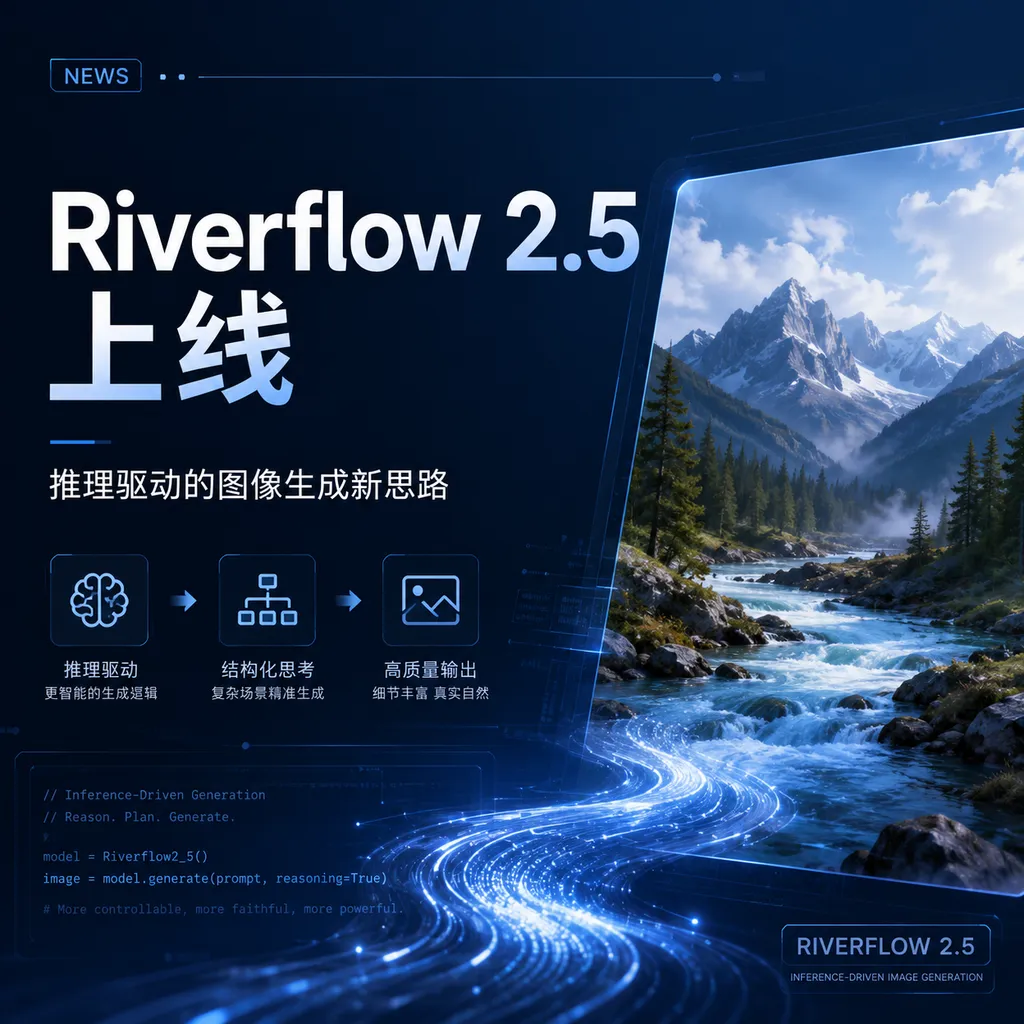
Sourceful releases the Riverflow 2.5 series, bringing reasoning capabilities into the image generation process, supporting multi-round editing planning, 4K output, and joint editing of 10 images. The Pro version is now able to compete in quality with Imagen 2 and Ideogram 2.
Riverflow 2.5 Released: A New Approach to Reasoning-Driven Image Generation
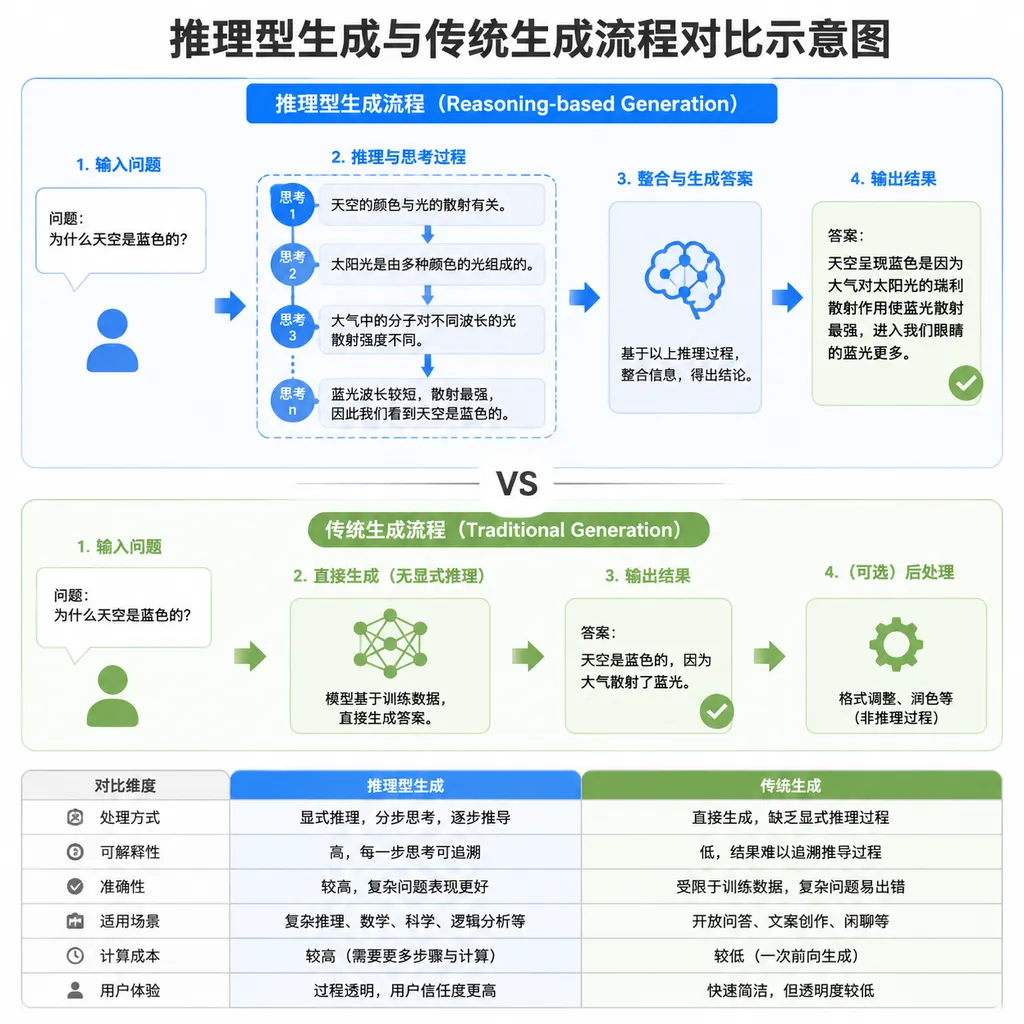
Yesterday, Sourceful released the Riverflow 2.5 series (Flash/Pro versions), a family of models embedding reasoning capabilities into the image generation process. Unlike traditional text-to-image models, Riverflow 2.5 treats generation as a production workflow: first using a reasoning model to plan multi-step editing schemes, generating multiple candidate results, and then selecting the optimal output through a built-in evaluation mechanism.
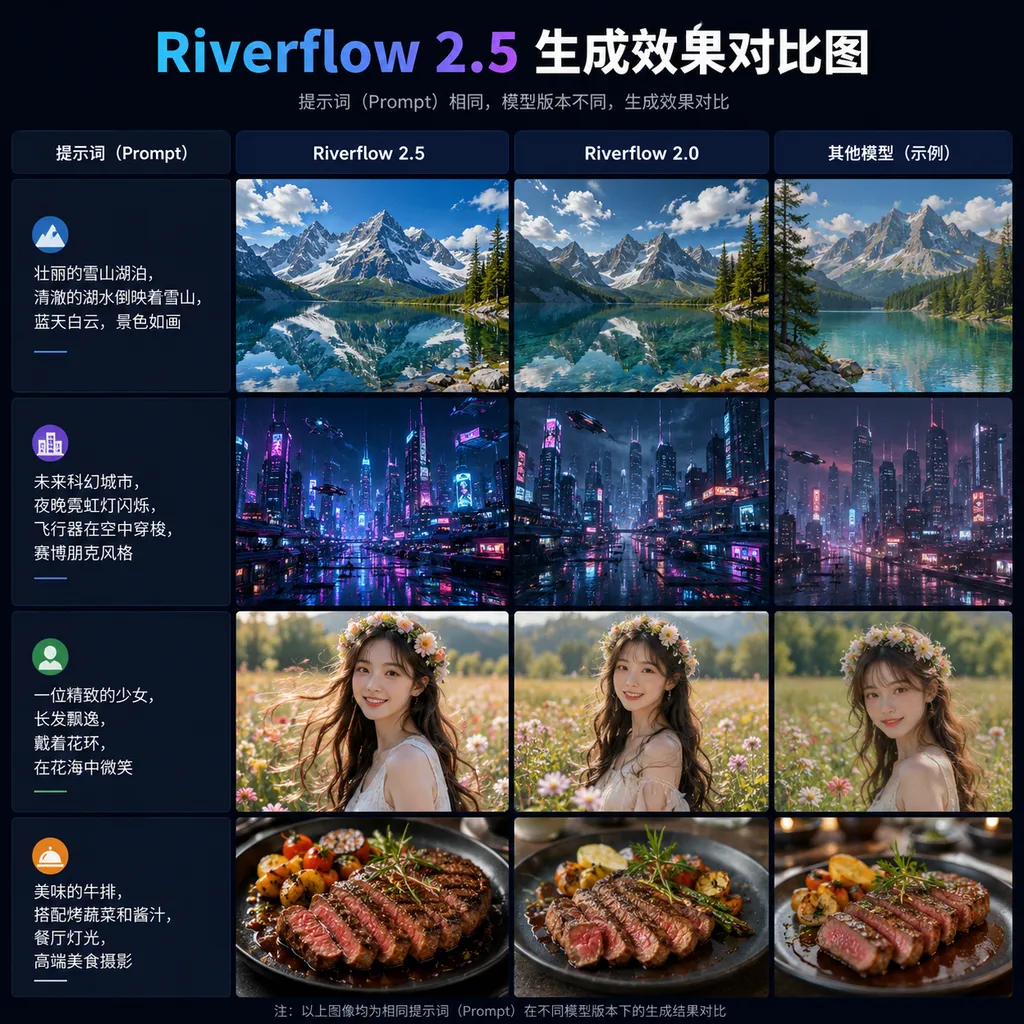
This approach is somewhat similar to what o1 does for text generation—it’s not about producing results in one go, but first figuring out how to do it, then executing. In terms of actual results, the Pro version’s image quality is already on par with Google’s top-tier models such as Imagen 2 and Ideogram 2. Some in the community have even said it’s “on equal footing with the full-powered Big Banana.”
Adjustable Reasoning Parameters for Different Scenarios
The most unique feature of Riverflow 2.5 is the ability to control reasoning depth via reasoning parameters, divided into four levels: low, medium, high, and ultra-high. The higher the reasoning level, the more rounds of internal editing attempts the model will make, with stricter evaluation criteria. The ultra-high tier is suitable for batch image generation scenarios, improving output repeatability—very useful for commercial projects that need consistent style.
This is actually a clever design. Low tier outputs quickly, good for idea testing; high tier is slower but more stable, suitable for final delivery. Users can strike a balance between speed and quality according to their needs, rather than being tied to a single model configuration.
Technically, this reasoning mechanism appears to be an architecture layer independent of the diffusion model. It doesn’t directly modify the diffusion process itself, but adds planning and evaluation externally. The advantage of this is reusing existing diffusion model capabilities while improving final output quality through the reasoning layer, without retraining an entirely new massive model from scratch.
Multi-Image Editing and High-Resolution Output
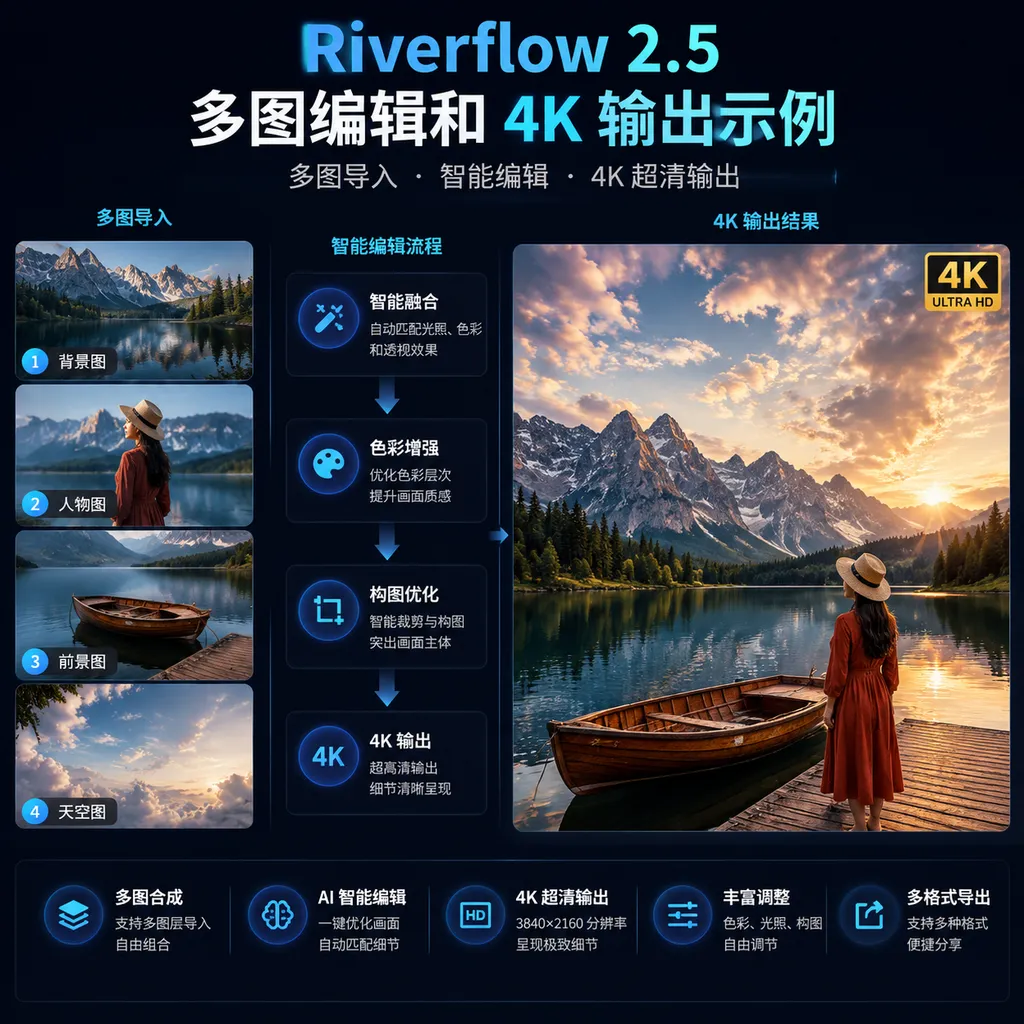
Riverflow 2.5 supports joint editing of up to 10 input images, which is practical in real work. For example, you can uniformly adjust a set of product images’ style or merge multiple materials into one poster, without processing them individually.
In terms of resolution, it supports 1K, 2K, and 4K output. 4K is essential for scenarios requiring high-definition materials such as graphic design and e-commerce visuals. Many previous image models could only generate 1024×1024 or 2048×2048; achieving higher resolution needed post-upscaling, with noticeable detail loss. Riverflow 2.5 supports native 4K, reducing post-processing workload.
Additionally, it adds Font Control. Text rendering has always been a tough problem for image models, often resulting in garbled, distorted, or inconsistent fonts. Although the official description doesn’t detail Font Control’s implementation, based on the functionality it’s likely an optimization focused on text regions, making generated text more controllable and clearer.
Background Output Modes: Catering to Specific Needs
Riverflow 2.5 also offers a background output mode option. It may sound trivial, but it’s valuable for certain scenarios. For instance, e-commerce main images often need solid or transparent backgrounds; design drafts may require editable layered backgrounds. Traditionally, you’d generate the image and then use Photoshop or other tools to cut out/change backgrounds; now you can specify the background mode at generation, reducing post-processing steps.
Such workflow-oriented optimizations reflect Sourceful’s understanding of actual application scenarios. As a company focused on design toolkits, they know the pain points designers and creators face in daily work. Since version 2.0, Riverflow has exhibited capabilities comparable to Ideogram 1.0 (“Small Banana”), and now 2.5 Pro directly benchmarks against Imagen 2 and Ideogram 2—progress has been rapid.
Clear Shortcomings: Prompt Handling and Safety Checks
Nevertheless, Riverflow 2.5’s weaknesses are apparent. The community reports its external LLM (large language model) is relatively weak, showing insufficient performance in handling complex prompts and multi-text scenarios. This may be because Sourceful focused their efforts on image generation and the reasoning mechanism, using a simpler language model for prompt parsing.
Another issue is overly strict safety checks. Some inputs that pass on Imagen 2 get blocked on Riverflow. For creators, overzealous moderation can be even more frustrating than quality issues—you might just want to create a slightly dark-themed illustration, but get blocked due to a misinterpreted keyword.
These two problems aren’t flaws in core generation ability, but productization trade-offs. Prompt handling can be improved by integrating a stronger language model, and safety check strategies can be adjusted. By comparison, breakthroughs in core image generation capability are much harder—and Riverflow 2.5 has already proven its strength in this area.
Reasoning-Based Image Generation: New Paradigm or Over-Engineering?
Is introducing reasoning into image generation truly valuable? Judging by Riverflow 2.5’s performance, it clearly improves controllability and stability. Traditional diffusion models yield some randomness—identical prompts can generate significantly different results each time. Riverflow’s reasoning mechanism, through planning and evaluation, makes outputs more predictable—important for batch production or consistent style scenarios.
But it comes at a cost. Reasoning itself requires additional computational resources, particularly at higher reasoning levels with multiple rounds of editing and evaluation. Sourceful hasn’t disclosed reasoning costs, but logically, the ultra-high tier is far more expensive than low. Whether this trade-off is worth it depends on the application context.
From an industry perspective, reasoning-based generation may be a new direction. OpenAI’s o1 series has shown the value of reasoning in text and code generation, and now this approach is entering image and video multimodal domains. If reasoning costs can be reduced through engineering optimization, this “think first, then do” generation method could become mainstream.
Currently Free to Try
Riverflow 2.5 Pro is currently free to try via the OpenRouter web interface. OpenRouter is a model aggregation platform providing unified access to multiple AI models. How long the free trial lasts is unclear, but at least right now you can experience the full capabilities of the Pro version at zero cost.
Sourceful’s own platform (riverflow.ai) is also open for use, though pricing and quota policies haven’t been publicly disclosed. Considering the cost of 4K output and reasoning computation, it’s likely to adopt a usage-based billing model long-term.
For developers, if a project needs high-quality image generation—especially for batch processing or scenarios demanding consistent style—Riverflow 2.5 is worth a try. It’s not perfect—prompt handling and safety checks could improve—but in core generation quality and controllability, it’s already top-tier.
Competitive Landscape with Mainstream Models
The current top tier in image generation includes Google’s Imagen 2/3, Ideogram 2, Midjourney V6, and Stability AI’s SD3. Riverflow 2.5 Pro joining this tier shows Sourceful’s genuine expertise in model training and architecture design.
Compared with these big players, Riverflow differentiates itself through reasoning mechanisms and multi-image editing. Imagen and Ideogram focus on extreme quality for single generations, Midjourney emphasizes artistic style and community ecosystem, while Riverflow focuses on controllability and stability in production workflows. This positioning could be more appealing to B2B clients (design firms, ad agencies, e-commerce platforms, etc.).
However, as a relatively small team, Sourceful lacks resources and ecosystem advantages. Midjourney has a massive user community and vast portfolio, while Google and Stability AI have deep tech and compute capabilities. To establish itself, Riverflow needs to find clear entry points in vertical scenarios (e.g., e-commerce visuals, UI design) rather than competing head-on with major corporations.
Long-term, the image generation market likely won’t be winner-takes-all. Different models have varying strengths in style, speed, controllability, and cost; users will choose tools according to their needs. Riverflow 2.5’s investment in controllability and production workflow optimization defines a relatively clear market positioning.
Technical Implementation Guesses
Sourceful hasn’t disclosed Riverflow 2.5’s technical details, but based on the feature description, some implementation ideas can be guessed:
-
Reasoning Layer Architecture: Likely an independent planning module atop the diffusion model, similar to an LLM agent. This module analyzes prompts, plans editing steps, and evaluates intermediate results.
-
Multi-Round Editing Mechanism: Instead of generating the final image in one go, it iterates step-by-step. Each step has a clear goal (e.g., adjust composition, optimize details, fix colors), making the final effect easier to control.
-
Evaluation Model: Probably a separately trained scoring model to assess whether outputs meet expectations. It may combine aesthetic ratings, prompt relevance, and technical quality (clarity, color accuracy, etc.).
-
Multi-Image Editing: Technically likely involves encoding multiple input images into the same latent space and editing jointly there, ensuring consistency between images.
-
4K Output: Possibly utilizes cascaded diffusion or super-resolution models—generating at lower resolution, then upscaling to 4K via specialized models. Alternatively, training directly in a high-resolution latent space, though that demands very high compute.
These are speculative based on public info; actual implementation could be more complex. What’s clear is that Riverflow 2.5 isn’t merely a finetuned diffusion model, but incorporates architectural innovation.
Industry Insights
Riverflow 2.5’s release brings several noteworthy signals to the image generation field:
The value of reasoning is validated. Previously, focus was on improving diffusion models themselves (better noise scheduling, more efficient sampling algorithms, etc.). Riverflow shows that adding a reasoning layer outside the model can also significantly enhance results—possibly inspiring a wave of “reasoning-enhanced” image generation tools.
Production workflow-oriented product design. Many image models focus only on single-image quality, overlooking real-world needs like batch processing, style consistency, and post-editing. Riverflow’s multi-image editing, background modes, and reasoning levels are all designed for real production scenarios.
Small teams can produce top-tier models. Sourceful isn’t a big company, yet Riverflow 2.5 Pro’s quality rivals top players like Google and Ideogram. This shows small teams still have opportunities in model training and architectural innovation—key is to pinpoint positioning and excel in a specific direction.
Diverse commercialization paths. Not all image models need to follow Midjourney’s subscription community route—alternatives include API services, vertical industry solutions, and enterprise custom deployments. Riverflow provides services via its own platform and third-party (OpenRouter), a more flexible strategy.
Of course, Riverflow 2.5 isn’t perfect. Prompt understanding, moderation strategy, reasoning costs, and pricing still need improvements. But as an early attempt at introducing reasoning into image generation, it already shows considerable potential.
What’s worth watching is whether others follow this direction. If Google, Anthropic, and Stability AI also start bringing reasoning mechanisms into image generation, it would indicate the approach works. If no one follows, it may mean the cost-benefit trade-off isn’t ideal, or simple diffusion model optimizations can achieve similar effects.
In any case, Riverflow 2.5 brings fresh thinking to image generation. In the backdrop of the large model arms race, such architectural innovation and product differentiation may be more meaningful than simply piling on parameters.
References
- Riverflow 2.5 Series Released, A New King is Crowned - Linux.do – Community users’ real-world experiences and effect comparisons for Riverflow 2.5
- The Mysterious Image Editing Model Riverflow Surpasses Nano Banana - Zhihu – Technical analysis of early versions of Riverflow


