
Nadella is going to give Microsoft's AI agents "employee badges"

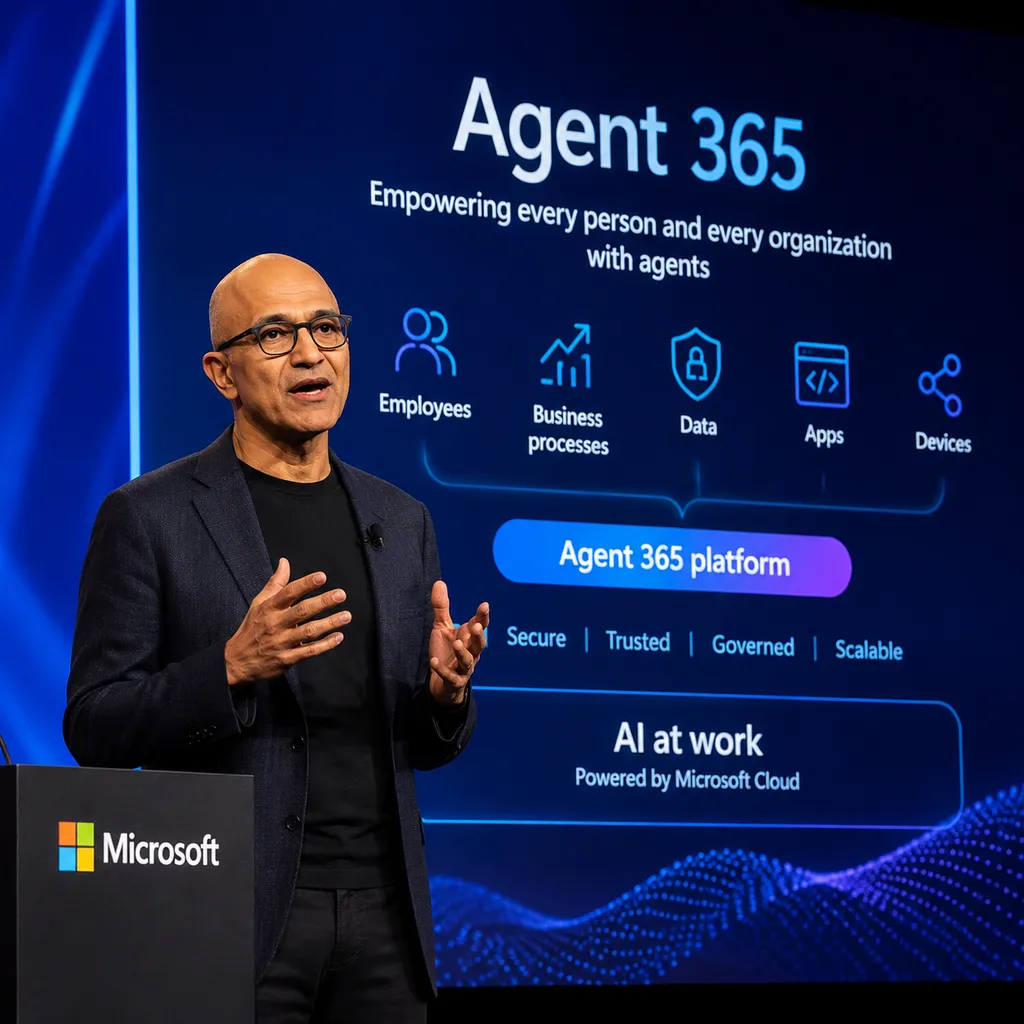
Microsoft CEO Nadella announced that internal AI agents will be managed just like employees—assigning identities, sandboxes, and permission policies—and introduced the Agent 365 toolkit. He himself is running 100 programming agents at the same time, and is already feeling the strain of cognitive overload.
Nadella Is Going to Give Microsoft’s AI Agents “Employee Badges”
Microsoft CEO Satya Nadella sent out a signal today: the pile of AI agents already running inside the company can’t keep operating “in the wild.” They need identity issuance, permissions boundaries, sandbox environments, and audits—in short, basically manage them the same way as employees.
According to Business Insider’s report on June 6, Nadella said Microsoft is sorting out tools and policies with the goal of “governing all internally created AI agents.” How exactly? Three steps: give identity, give sandbox, give governance strategy. The accompanying product is called Agent 365, bundled with Entra (digital identity and network access) and Purview (data labeling and compliance).
It might sound like just another enterprise management tool launch, but underneath lies a shift developers should pay attention to: agents are no longer being treated as “tools to be used,” but as “entities that need to be governed.”
Nadella Himself Attacked by 100 Agents
Here’s a vivid detail: Nadella said he often “runs 100 AI programming agents at the same time,” and if he had to instruct each one individually via a chat interface, “the cognitive load when managing these things is very high.”
Coming from a CEO, that remark carries weight. It implies two things:
First, Microsoft’s top brass are indeed using these tools—it’s not just a PowerPoint concept. Running 100 concurrent agents is far from the “I’m chatting with a chatbot” paradigm; it’s “I’m a project manager with 100 tireless yet unreliable junior engineers under me.”
Second, the current human-computer interaction paradigm simply does not scale to this extent. Chat windows work for one‑on‑one, not one‑to‑many. Tools like Cursor, Claude Code, and GitHub Copilot Workspace have all been moving toward “task panels + background concurrency” this year, basically tackling the same problem—human brains can’t monitor 100 dialogs simultaneously.
In Nadella’s recent long-form interview, he put it more bluntly: future IDEs will become “task control centers” that merge spreadsheets, documents, and message streams; humans will no longer be operators, but “commanders with macro‑delegation ability.” Today’s agent governance framework is essentially the security foundation for that vision.
What Agent 365 Governs
Nadella’s exact words: “Security, isolation, manageability, and observability are how we build confidence in these AI agents.”
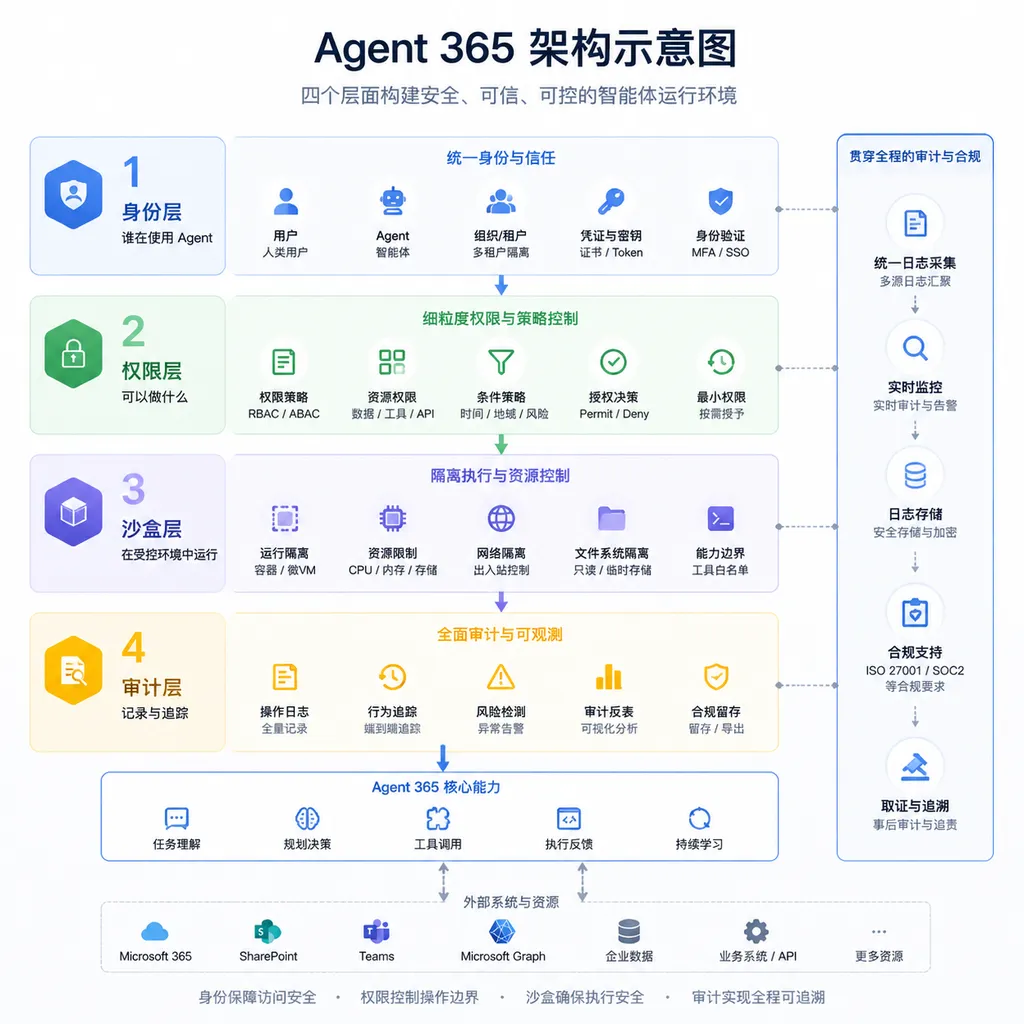
Breaking it down, Agent 365 aims to solve four issues enterprise IT knows inside out—only now the subject changes from “people” to “agents”:
- Identity: Each agent has its own account in Entra—who created it, which department it belongs to, whose APIs it calls—all traceable. Not a new idea—service accounts have always worked this way—but agents are special because they make their own decisions and call their own tools. The traditional “grant permission and let it run for five years” approach doesn’t suffice.
- Permissions Boundaries (Scoping): Clearly define which data it can read and which it can’t. This is especially sensitive for Microsoft because Microsoft 365 Graph contains emails, documents, Teams calls—a cross-department agent with sloppy permission scoping could leak financial data into product discussions in seconds.
- Sandbox: Let agents run in isolation, so mistakes don’t contaminate production data. This is standard in programming agent scenarios, but still lacking in enterprise process agents.
- Audit and Data Labeling (Purview): Agent-generated content gets labeled, making it easier for accountability and compliance reviews. In regulated industries (finance, healthcare, law) this is almost a necessity.
Managing Agents as Employees—Smart or Lazy?
The most interesting part of this approach is “borrowing the way employees are managed.” Worth asking: does this analogy hold?
Valid aspects: Identity, permissions, and audit—the whole IAM (Identity and Access Management) framework—has been battle-tested for decades in enterprise IT. Applying it directly does save effort. An agent entering enterprise systems must have a principal, a scope, and logs—structurally the same as a new employee getting an ID badge, permissions, and a footprint.
Invalid aspects need to be made clear:
- Employees exercise self-restraint; agents do not. An employee knows “I have permission to this folder but shouldn’t look,” whereas an agent facing prompt injection could be tricked into rummaging everywhere.
- Employee behavior is low-frequency and predictable; agents are high-frequency, concurrent, and random. An agent can call APIs thousands of times in a day, meaning audit systems’ log volumes and alert rules need a complete overhaul.
- Employees in trouble can be counseled, trained, or fired; agents can only be taken offline, rolled back, retrained. The accountability chain is entirely different.
So “managing agents like employees” is a handy entry-level analogy, but in product form Entra and Purview will inevitably require extensive agent-specific enhancements. Simply porting human ACLs over is not enough.
Why Now
Enterprise AI has seen massive budget spending over the past year, but the industry is still exploring how agents should collaborate with employees. Gartner previously predicted: by 2027, around 40% of agentic AI projects will be canceled—not because the models fail, but because governance can’t keep up and ROI is unclear.
Microsoft’s choice to productize governance tools at this juncture is spot‑on. A few background points:
- Copilot has already been rolled out widely in Microsoft 365; enterprise IT feedback concentrates on mismatched permission scopes, confidential documents being retrieved, and outputs being untraceable. This time Purview’s inclusion of agent-generated data labeling directly addresses customer pain points.
- Anthropic’s MCP (Model Context Protocol) became the de facto standard this year, making agent calls to external tools increasingly standardized—but governance over who calls, what they can call, and call records ownership remains blank.
- Multi-agent orchestration frameworks (AutoGen, LangGraph, CrewAI) are booming, and developers are accustomed to letting groups of agents collaborate. But once inside enterprise intranets, a rogue sub‑agent could tear open the whole permission model.
Nadella’s move looks like setting an industry reference standard: if you want to run agents in enterprises, follow these four principles—identity, isolation, manageability, observability. The messaging is clearly aimed at CIOs and CISOs—they are the real gatekeepers for enterprise AI procurement.
What This Means for Developers
If you’re building agent-type products, there are several directions to think through early:
- Does each agent have its own identity? Stop the lazy “one API key for all” method. Even with internal tools, at least give each agent a traceable principal.
- Are permissions scoped? Letting agents use the user’s full privilege token downstream is a common security anti-pattern. OAuth 2.1 + fine-grained scope is basic hygiene.
- Is output labeled? Content generated by agents, database records written, emails sent—ideally all carry metadata indicating source. This allows for investigation when incidents occur, and facilitates evaluations otherwise.
- Are audit logs structured? Natural language logs look lively but can’t support anomaly detection. Record tool call, parameters, and results as structured events—this makes later security monitoring possible.
These are old topics—only now they apply to “agents” rather than “services.” The difference is agents’ higher uncertainty, so this infrastructure layer must be thicker.
A Prediction
In the short term, Agent 365 won’t immediately spur follow-ons from other vendors—AWS and Google Cloud each have their own IAM systems, and forcing in agent governance will take time. But in the medium term, agent governance will likely evolve from a “security feature” into an “infrastructure layer,” on par with today’s IAM, KMS, and SIEM.
Microsoft’s strategy is clear: it may not win at the model layer against OpenAI and Anthropic (though it invests in both), but it has guarded the enterprise IT turf for over 20 years. By inserting agent governance into Entra and Purview, it shifts competition from “whose model is smarter” to “who can let CIOs sleep peacefully.”
That’s a battlefield very favorable to Microsoft.
As a side note, for developers wanting to call GPT, Claude, Gemini, DeepSeek and other models simultaneously in their agent systems for comparison and orchestration, OpenAI Hub offers a unified interface in OpenAI‑compatible format, direct access from China, and one key to switch between models—saving plenty of SDK swapping hassle when debugging multi‑agent workflows.
References
- Microsoft CEO Nadella aims to “govern” internal agents with identity and permission boundaries – ITHome — ITHome’s original report on Agent 365 and Nadella’s statement.


