
ChatGPT undergoes the biggest upgrade in history: Chat is dead, super app takes over
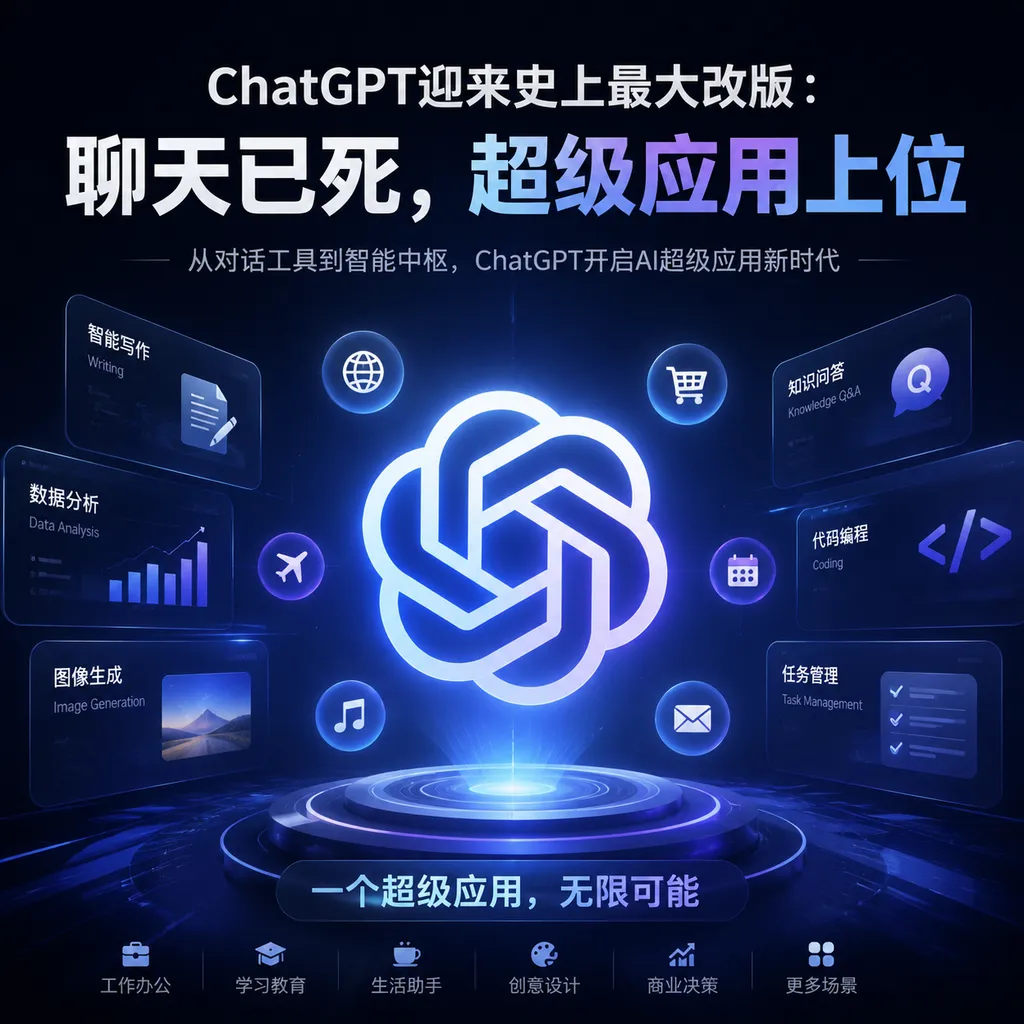
OpenAI is brewing the largest-scale overhaul since ChatGPT’s launch, integrating Codex, the Atlas browser, and agent capabilities into a unified desktop application, with its sights set on the enterprise market guarded by Anthropic. Executives bluntly state that chatting is dead — it’s the agents that can get work done that are truly valuable.
IPO countdown: OpenAI is taking ChatGPT apart and rebuilding it.
According to recent disclosures from the Financial Times and several other media outlets, OpenAI is preparing the largest product overhaul since ChatGPT launched over three years ago—integrating the currently scattered ChatGPT, coding platform Codex, browser Atlas, along with broader Agent capabilities into a single unified desktop “super app.” Sina Finance cited comments from more than ten current and former employees, saying this is part of OpenAI’s overall restructuring; The Wall Street Journal further confirmed that the ultimate goal of this project is to “reshape and simplify the user experience.”
The timeline is tight. Internal memos disclosed by CSLN indicate that the merged version of Codex and ChatGPT will launch “within the next few weeks,” with the integration of the Atlas browser following slightly later; the mobile version of ChatGPT will remain independent for now.
“Chat is dead” — and they mean it
At an all-hands meeting last week, OpenAI’s Applications CEO Fidji Simo gave a stark assessment: “We no longer have the capacity to be distracted by side quests.” The context being that Anthropic has been aggressively swallowing up the programming and enterprise markets over the past six months. Cursor, Windsurf, Devin—these star products’ underlying tech is largely powered by Claude, significantly eroding OpenAI’s presence on the developer side.
Even more telling is another internal statement circulating: “Chat is dead. Agents that can execute tasks are far more valuable commercially than chat.”
This isn’t marketing fluff. From a product standpoint, ChatGPT’s core interaction model over the past three years—you ask, it answers—is essentially a combination of “information retrieval + text generation.” That model has a hard ceiling: every step of the conversation requires human prompting, with AI remaining passive. The Agent model is different: you give it a goal, it plans, calls tools, executes, and reports back, with human involvement only at key checkpoints.
From a subscription economics perspective, these two products’ ceilings differ by an order of magnitude. Chat assistants are priced as “search replacement + a bit of writing help,” and $20/month is already the psychological limit for consumers; Agents that can autonomously complete software development, data analysis, or operational tasks are comparable to SaaS tools or outsourced manpower budgets—hundreds of dollars per seat per month is reasonable. Cursor’s $10B valuation and Devin’s parent Cognition seeing soaring valuations are built on this logic.
OpenAI’s thinking is clear: rather than holding onto ChatGPT as an $850B valuation company’s “traffic gateway,” it’s better to upgrade it into a productivity platform capable of generating a high ARPU directly.
Codex is finally getting “promoted”
The most critical move in this overhaul is Codex.
Anyone who’s worked with AI coding tools for a few years remembers Codex’s somewhat awkward history. Originally launched in 2021 as a fine-tuned GPT-3 variant powering GitHub Copilot, it was later pulled from official offerings. This year OpenAI revived the Codex brand as an independent coding Agent product—capable of cloning repos, running tests, submitting PRs—similar to Devin’s style. But it’s been stuck in an awkward spot: ChatGPT has a code interpreter and Canvas, there’s a separate desktop Codex app, subscriptions are tiered, and developers have had a fragmented experience.
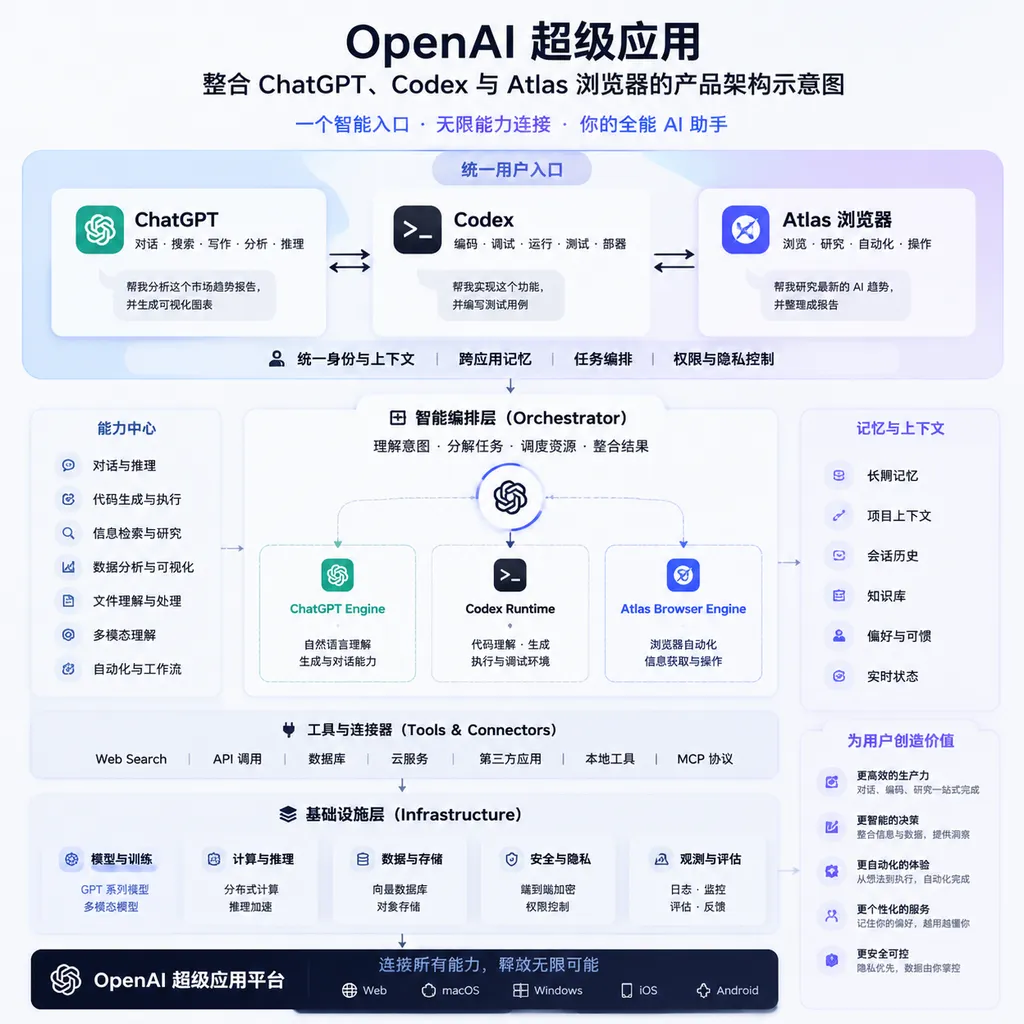
After this integration, the logic will be much smoother:
- ChatGPT main panel remains the entry point, keeping chat and general tasks
- Codex promoted to the “productivity agent” core, expanding beyond coding to data analysis, document processing, and more
- Atlas browser embedded as an execution environment, enabling Agents to directly interact with web pages
- All sharing the same context, file system, and authorization system
The memo has a telling quote: Simo said the team’s “energy is spread across too many applications and tech stacks,” and this fragmentation “slowed down progress and made it harder to meet our quality standards.” In plain terms: previously, each product had its own team and architecture, with separate memory and context—things you mentioned in ChatGPT weren’t known to Codex, and vice versa. This kind of internal friction is unacceptable waste for a company aiming at an IPO.
Team growing to 8,000 — but cutting “side quests”
Interestingly, OpenAI is simultaneously doing subtraction and addition.
Subtraction: product lines. The FT report explicitly mentions “cutting multiple peripheral businesses.” Experimental products with small user bases and unclear commercialization prospects will likely be axed or merged. Standalone Sora apps, various experimental Playground tools could be on the chopping block.
Addition: headcount. Staff is expected to expand from 4,500 early this year to 8,000 by year’s end—almost doubling. The main investment areas are AI infrastructure and enterprise sales. Both are aimed squarely at Anthropic—whose enterprise revenue is rumored to be nearing OpenAI’s level, while OpenAI’s enterprise sales team has long been criticized as having “too much consumer product DNA and poor enterprise selling skills.”
Greg Brockman being brought in to assist Simo in overseeing product reconstruction is also a signal. Brockman previously handled compute operations, has high technical credibility, and strong internal influence. Putting him in charge of product integration suggests Altman truly intends to unify research, product, and infrastructure—three previously siloed divisions.
A developer’s perspective
Here’s my take on this overhaul:
First, it’s necessary but late. The logic of transforming ChatGPT into a super app is sound, but Anthropic already sliced up the developer market with Claude Code, Cursor (editor format), and Devin (Agent format). OpenAI is now playing catch-up, meaning it must accept this fact: the growth curves for API call volumes and ChatGPT DAUs have diverged, with the former increasingly captured by competitors.
Second, desktop is the right choice, but mobile is abandoned. The memo specifically notes that “mobile ChatGPT apps will remain unchanged,” which is a significant product decision. Agent-type AI needs file system access, browser control, and long-run processes—all hard to achieve under iOS/Android sandboxing. Betting productivity on desktop is sensible, but it also means OpenAI won’t roll out a “killer mobile Agent” anytime soon, leaving that market open to others.
Third, unified context is the real killer feature. Once Codex, Atlas, and ChatGPT share the same memory, project directory, and permission model, user experience will undergo a qualitative shift. Example: You browse a technical document in Atlas, have Codex modify code based on it, and ChatGPT’s main panel tracks progress in real-time and accepts your verbal adjustments—this level of smoothness is currently unmatched, as competitors lack full-stack product ownership.
Fourth, potential disruption to the developer ecosystem is significant. If the super app succeeds, OpenAI’s API priorities will tilt further toward “Agent-friendly” features. Expected directions: longer context windows, cheaper “thinking” calls, native tool-call orchestration interfaces, possibly a dedicated state-management API for Agents. Products built on the old ChatCompletion paradigm may need to reassess architecture.
A practical note on API calls
On a practical developer level, this overhaul mainly affects ChatGPT’s desktop application form and won’t immediately change API call structures—GPT-4o, GPT-4.1, o-series reasoning models will be called as before. For developers in China, aggregation platforms like OpenAI Hub (openai-hub.com) remain a stable solution—one key can access GPT, Claude, Gemini, DeepSeek, all in OpenAI-compatible format—avoiding the hassle of maintaining separate SDKs for different models. Especially in this “mainstream models racing for the Agent high ground” phase, demand for multi-model comparison testing will rise sharply.
Final thoughts
This ChatGPT overhaul is essentially OpenAI’s self-reversal on its past three years’ trajectory: the “dialogue box” that attracted users worldwide is being downgraded by its own creator to just one entry point.
This isn’t failure—it’s inevitable product evolution. Chat as a human-computer interaction pattern won’t disappear, but as a core business model, it has peaked. The next competitive stage isn’t about “whose answer is more accurate,” but “whose Agent can actually do work, finish it, and get paid.”
OpenAI’s bet is bold—on the eve of its IPO, doubling staff and rebuilding its flagship product from scratch. Whether it succeeds will be clear the moment the super app goes live in a few months. One thing is already certain: by 2026, AI product competition’s main battlefield won’t be in the chat box, but in desktop workflows.
References
- OpenAI plans biggest ChatGPT overhaul to create “super app” – Chinese summary and discussion by linux.do community on FT original
- OpenAI: “Our super app will combine ChatGPT, Codex, browsing capabilities, and broader Agent abilities” – Developer discussion on Reddit r/OpenAI about the super app integration plan


