
Fei-Fei Li used Qwen3-VL to label 100 million images, and fully open-sourced the 13TB GPIC dataset.
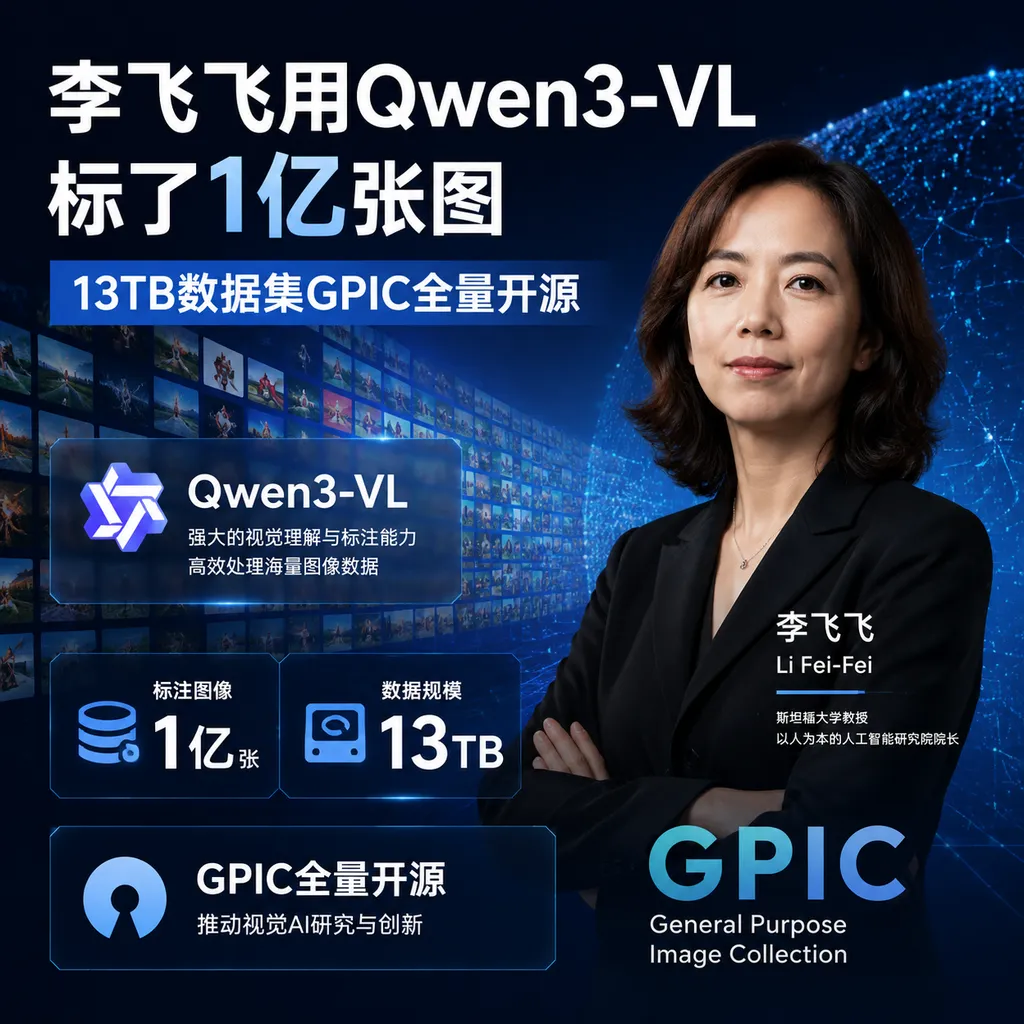
Stanford’s Fei-Fei Li and Jia Jun Wu’s team released the GPIC dataset: 100 million licensed images, 28 trillion pixels, all automatically annotated and filtered using Qwen3-VL-4B. The full 13TB of data is open-sourced and available for commercial use.
Fei-Fei Li Used Qwen3-VL to Label 100 Million Images — Full 13TB GPIC Dataset Open-Sourced
Last week, Stanford’s SVL Lab dropped an image dataset called GPIC on Hugging Face — 100 million images, 28 trillion pixels, 13TB in total, fully open-sourced and clearly licensed for commercial use. The work was spearheaded by Fei-Fei Li and Jia Jun Wu’s team, the same people who previously drew the community’s collective attention back in the ImageNet era.
The focus here isn’t on the sheer size. LAION-5B, derived from Common Crawl, is much larger. But LAION’s approach of “crawl the whole Internet, ignore copyright” is no longer viable — after the wave of copyright lawsuits in 2023, Stability and Midjourney were both sued, and LAION-5B itself had to be taken down and rebuilt due to CSAM content. What GPIC really aims to solve is the long-standing challenge of “where to find clean, compliant image data with high-quality descriptions.”
Labeling 100 Million Images Using Qwen3-VL-4B — Burned 1500 H100 GPU Hours
The detail that caught Chinese developers’ attention was that Stanford chose Qwen3-VL-4B-Instruct for the annotation process.
According to the paper, the team performed cross-model comparisons based on 1,520 human-verified samples, including several closed-source VLMs and open-source models of similar size. In the end, Qwen3-VL-4B won on description accuracy, hallucination rate, and safety filtering. Labeling 100 million images consumed about 1500 H100 GPU hours.
Let’s crunch the numbers: at a public cloud price of $2/hour for H100, the annotation cost for the whole dataset was just over $3,000. Doing the same with GPT-4V or Gemini 2.5 Pro via API calls would cost at least hundreds of thousands of dollars — and would likely be throttled by providers for “bulk automated usage.” This is the real value of small open-source VLMs in 2026: not replacing flagship models for conversation, but making large-scale, dirty data pipeline work cost-feasible.
It’s worth noting that the team also used Qwen3-VL-4B for dual quality and safety filtering — poor quality images or those potentially involving minors or violent/sexual content were removed, with a rejection rate of about 1%. That may sound small, but for a dataset of over 100 million, it means 1 million candidate images were discarded. If LAION had done this, they might not have had to take their dataset down.
Where the Data Comes From: Licensed Image Libraries + Deduplication
GPIC stands for General-Purpose Image Corpus. The source material comes entirely from commercially licensed image library providers, not crawled from public websites. This is the fundamental difference from LAION’s path.
Once they obtained the raw pool, the processing pipeline was roughly:
- Deduplication: A lot of burst shots and similar compositions were removed using perceptual hashing and visual embeddings for two-layer deduplication
- Qwen3-VL-4B Filtering: Low-quality, NSFW, or mislabelled content removed
- Multi-granularity descriptions: Each image has multiple descriptions — short tags with one or two keywords, and long captions of dozens or even hundreds of words
- Metadata retention: Resolution, aspect ratio, and original source IDs preserved in parquet files
This “short tag + long description” multi-granularity structure is almost standard for training text-to-image models — SD3, FLUX, and other models of this generation have already proven that description quality and granularity directly determine a model’s ceiling for understanding prompts. GPIC has done this work and handed it to the community, essentially removing the dirtiest, most tedious part of data preprocessing.
13TB — How to Use It?
A linux.do user asked: other than training models, what front-end applications can this be used for? Frankly, it’s a bit naïve, but it does reflect some developers’ confusion.
13TB of data is not something you “use” directly. Its purpose is very clear — a public benchmark for pretraining vision-generation models. It can be applied along these paths:
- Training text-to-image models: The most direct use. Small teams don’t need to start from scratch for data cleaning — plug GPIC straight into a pretraining pipeline
- Training/fine-tuning VLMs: Image-text pairs are natural training material for VLMs, especially the long descriptions, which help models learn to follow long-text instructions
- Image retrieval / RAG: Precompute image embeddings from GPIC to build a vector database and create commercially viable image search services
- Evaluation benchmarks: Because it contains a human-verified subset, it can be used for alignment evaluation of generation models
If your goal is “image search” or “AI photo album” apps, GPIC probably isn’t for you — you need a model, not raw data. But if you’re building foundational models, GPIC’s scale, cleaning quality, and licensing status are almost unmatched in China.
Why This Matters for Chinese Developers
Beyond the dataset itself, this project highlights several things.
First, open-source VLMs now have the capability gradient to handle serious engineering tasks. Qwen3-VL-4B is a small VLM released early this year by Alibaba, with only 4B parameters. In a methodology-demanding team like Stanford’s, it was chosen to annotate hundreds of millions of images — that’s significant endorsement. Stanford’s papers in recent years have defaulted to GPT-4V or Gemini for VLM work.
Second, “small model + big data” is becoming an infrastructure-level workflow. In the past, data cleaning relied either on crowdsourcing or expensive flagship APIs. Now, 4B-class open-source VLMs can push the cost down to just cloud GPU hours. More teams will likely follow — using Qwen3-VL, InternVL, MiniCPM-V, etc., to relabel and re-clean their own datasets.
Third, compliance issues are being solved through technical means. GPIC’s licensed sources plus automated safety filtering effectively give any team building foundational vision models — but afraid of copyright risks — a “ready-made answer.” This is especially meaningful for Chinese companies wanting to commercialize generative models: when accused of “unclear training data sources,” they now have a clean alternative option.
A Small Regret
The 13TB download size will discourage most individual developers. Even with domestic mirrors, Hugging Face download speeds mean pulling the full dataset will take days — not to mention the local hardware needed for storage and processing.
The good news is the data is in parquet shard format, so it can be streamed on demand. If you just want to check quality or run a small experiment, downloading a few shards is enough. Teams will likely release distilled subsets later, such as a curated 1M-image edition — that’ll be when most people can truly get hands-on.
As for Qwen3-VL-4B, the unsung hero behind this dataset, it’s currently callable directly on OpenAI Hub, sparing you from self-deployment — if you want to reproduce Stanford’s annotation process or clean your own image library, you can use it via the OpenAI-compatible API format.
References
- linux.do Community Discussion: Fei-Fei Li’s team used Qwen3-VL-4B to label 100 million images — Chinese developers’ discussion of GPIC dataset uses
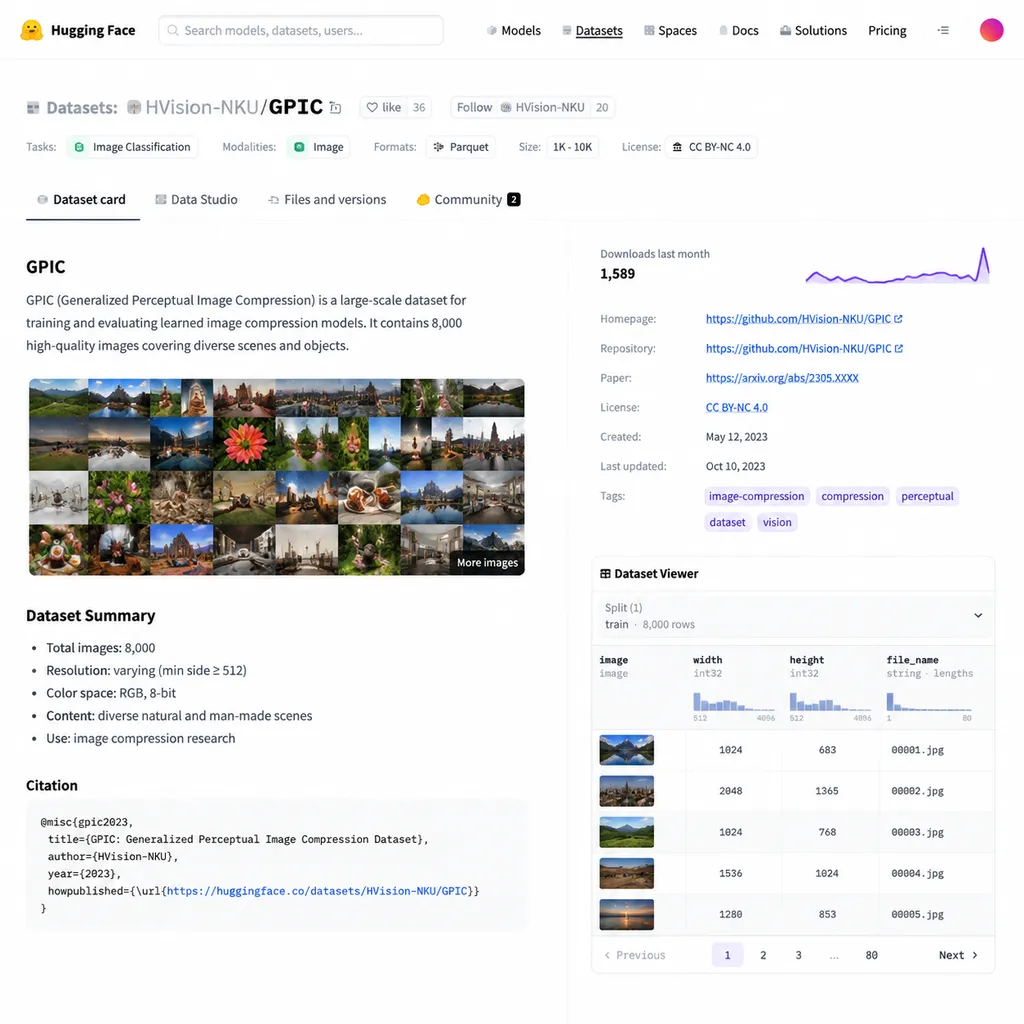
- Hugging Face: stanford-vision-lab/gpic — GPIC official publication page with full 13TB dataset download


