
Fei-Fei Li's team open-sources GPIC: 100 million images, 28 trillion pixels

Stanford Vision Lab has released the GPIC dataset, containing 100 million licensed images with textual descriptions. The annotation model used is Qwen3-VL-4B. This marks a leap in the scale of training data for vision generation.
Fei-Fei Li’s team has done something big again.
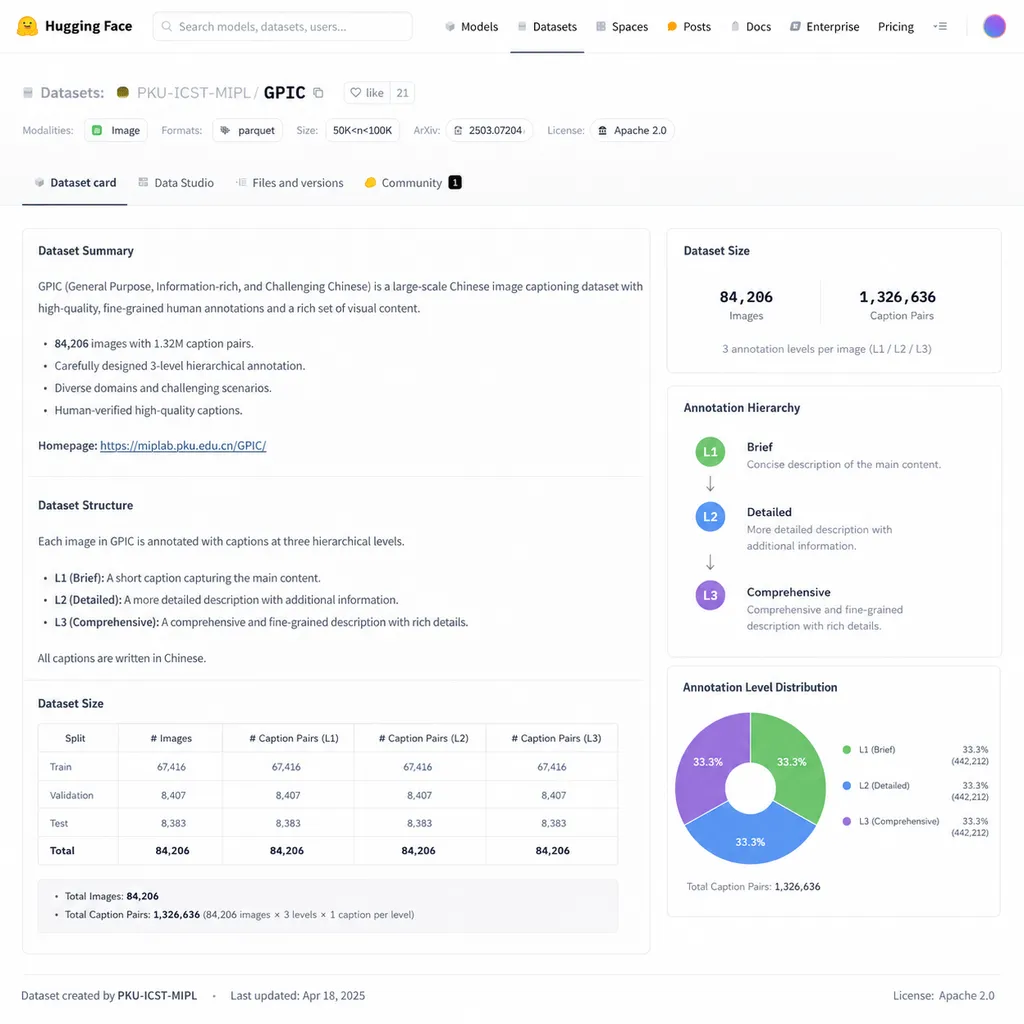
In early June, the Stanford Vision Lab quietly released a dataset called GPIC on Hugging Face — 100 million licensed images with a total pixel count approaching 28 trillion, each paired with detailed textual descriptions. The dataset is about 13TB in size. This is one of the largest publicly available image-text pair datasets with high-quality text annotations to date.
What’s even more interesting is their annotation approach: they didn’t use GPT-4o or Gemini, but instead chose Qwen3-VL-4B, an open-source model released by Alibaba last October with only 4 billion parameters — and ran all 100 million images through it.
This is worth breaking down.
Not just “lots of images” — the dataset design philosophy has changed
In recent years, visual training data has mostly followed the LAION approach: crawling from Common Crawl and using alt-text as annotations. The scale can reach 5 billion images, but quality varies greatly, and copyright issues hover like a sword over your head — LAION-5B was taken down before due to illegal content mixed in, and has yet to fully recover.
GPIC took a completely different path:
- All licensed images, avoiding copyright landmines
- 100 million images — smaller than LAION by an order of magnitude, but each comes with high-quality captions generated by a VLM
- Layered annotations: 1% are Tags (keywords), 45% are Short (brief descriptions), 45% are Medium (medium-length descriptions), 9% are Long (detailed descriptions)
This layered annotation design is clever. When training diffusion models, captions of different lengths correspond to different training objectives — short captions help models learn concepts, long captions help models learn composition details and long-tail semantics. New-generation models like Stable Diffusion 3 and FLUX use similar mixed strategies, but manually assembling such structure from open-source datasets is nearly impossible. GPIC has done it outright.
What does 28 trillion pixels mean? On average, each image is about 280,000 pixels — roughly 500×560 resolution. Not particularly high, but adequate for training fundamental vision models — MidJourney v1 and SD 1.5 once used 512×512.
Why Qwen3-VL-4B? This is the real highlight
Annotating 100 million images is a very practical engineering problem. Let’s crunch numbers:
If you use GPT-4o, at the current API price, each image caption costs about $0.005. For 100 million images, that’s $500,000 — not counting the queue time due to rate limits. Gemini 2.5 Pro is cheaper, but even then costs run into the six figures.
More crucially, there’s latency. Even with money to burn, closed APIs have throughput ceilings. At 100 QPS, it would take 11 uninterrupted days to process 100 million images; factoring in interruptions, retries, throttling — it could take half a year.
So Fei-Fei Li’s team made a pragmatic choice: deploy an open-source VLM themselves, running it on their in-house cluster. Qwen3-VL-4B is a lightweight version released by Alibaba’s Tongyi Qianwen team last October. With 4B parameters, inference fits on a single 24GB 4090 card, and throughput on A100s is excellent.
Their paper says they benchmarked multiple open-source VLMs and found Qwen3-VL-4B “achieves the best balance between quality and throughput.” Translation:
- Larger models (e.g., InternVL2-26B, Qwen3-VL-32B) have slightly better quality but insufficient throughput to handle 100 million scale
- Smaller models (under 2B) lack quality
- The LLaVA series, CogVLM and other established models struggle with Chinese contexts and fine-grained descriptions
This sends a signal to the industry: 4B-scale multimodal models have matured enough to handle industrial-grade annotation tasks. A year ago, if you told me Stanford Lab was annotating 100 million images with a 4B model, I’d ask “Is the quality good enough?” Now it’s just happened.
What this means for the open-source ecosystem
If you examine GPIC’s tech stack, you’ll see something intriguing: a top U.S. lab using a Chinese open-source model as a productivity tool.
Two years ago that was unthinkable. Back then, BLIP-2 and CLIP were the defaults for visual annotation, beyond which you’d go to closed APIs. Now, Chinese open-source VLMs like Qwen-VL, InternVL, MiniCPM-V have become default choices for many research teams, for a simple reason — cheap, locally runnable, and good quality.
By the way, after GPIC was released, the community has discussed potential uses. The most straightforward include:
- Training new text-to-image foundation models — obvious use case; the open-source community can train SD/FLUX-scale models without worrying about copyright
- Training VLMs — conversely, GPIC can be used to train new vision understanding models; Qwen3-VL-4B has essentially paved the way for the next generation
- Creating retrieval-augmented generation (RAG) visual knowledge bases — 100 million described images inherently form a massive multimodal knowledge base
- Building evaluation benchmarks — subsets can be extracted for fine-grained testing
As for “front-end applications,” honestly, directly turning 13TB of data into a consumer product isn’t meaningful — it’s more like raw materials, not a finished product. But models trained on GPIC may very well power some AI tool you’ll use next month.
One cautionary note
One thing to mention: training new vision models on VLM-labeled data is essentially knowledge distillation — the new model learns Qwen3-VL-4B’s understanding of the world, not reality itself.
This may cause two potential issues:
- Error propagation — Qwen3-VL-4B’s mistakes (e.g., mistaking a corgi for a Shiba Inu) will be inherited by the new model
- Style convergence — all models trained on GPIC may share similar descriptive preferences, because their “teacher” is the same
Fei-Fei Li’s team acknowledged this in their paper, employing sampling and post-processing strategies to mitigate it. But this is something the industry should watch long term. As synthetic data increasingly dominates, whether model diversity collapses is an open question.
In closing
Looking back, GPIC marks a very symbolic milestone:
- In terms of data scale, publicly licensed image-text pairs have finally reached the hundred-million level
- In the toolchain, open-source VLMs are officially taking on industrial-grade annotation workloads
- In copyright compliance, fully licensed datasets remove a major obstacle to subsequent commercial models
For domestic developers, the biggest impact is — you no longer need to quietly scrape data for training your vision models; GPIC is ready to use. While 13TB is not small, compared to building a dataset from scratch, the cost is negligible.
Also, if you’re working on the application layer and want to directly call the Qwen3-VL series or benchmark against it, the OpenAI Hub’s Qwen3-VL interface is OpenAI-format compatible, connects domestically without a proxy, and shares a key with GPT-4o, Claude, Gemini — making multi-model evaluations easier.
Fei-Fei Li has advocated “Data-Centric AI” for years, and GPIC is a large-scale implementation of this philosophy. Model architectures have converged; the next wave of competition returns to the data itself — and it seems this judgment is correct.
References
- Fei-Fei Li’s team used Qwen 3 VL 4B to annotate 100 million images - linux.do: Earliest community discussion of the GPIC dataset
- stanford-vision-lab/gpic - Hugging Face: GPIC dataset official page, 13TB download available
- Million-scale datasets are no longer enough! Stanford open-sources GPIC: 28 trillion pixels - Zhihu: Detailed interpretation of GPIC’s annotation process and layering strategy


