
JD.com and Tencent Join Forces to Bet on AI Agents, Achieving First Deep Integration of Supply Chain and Traffic Channels
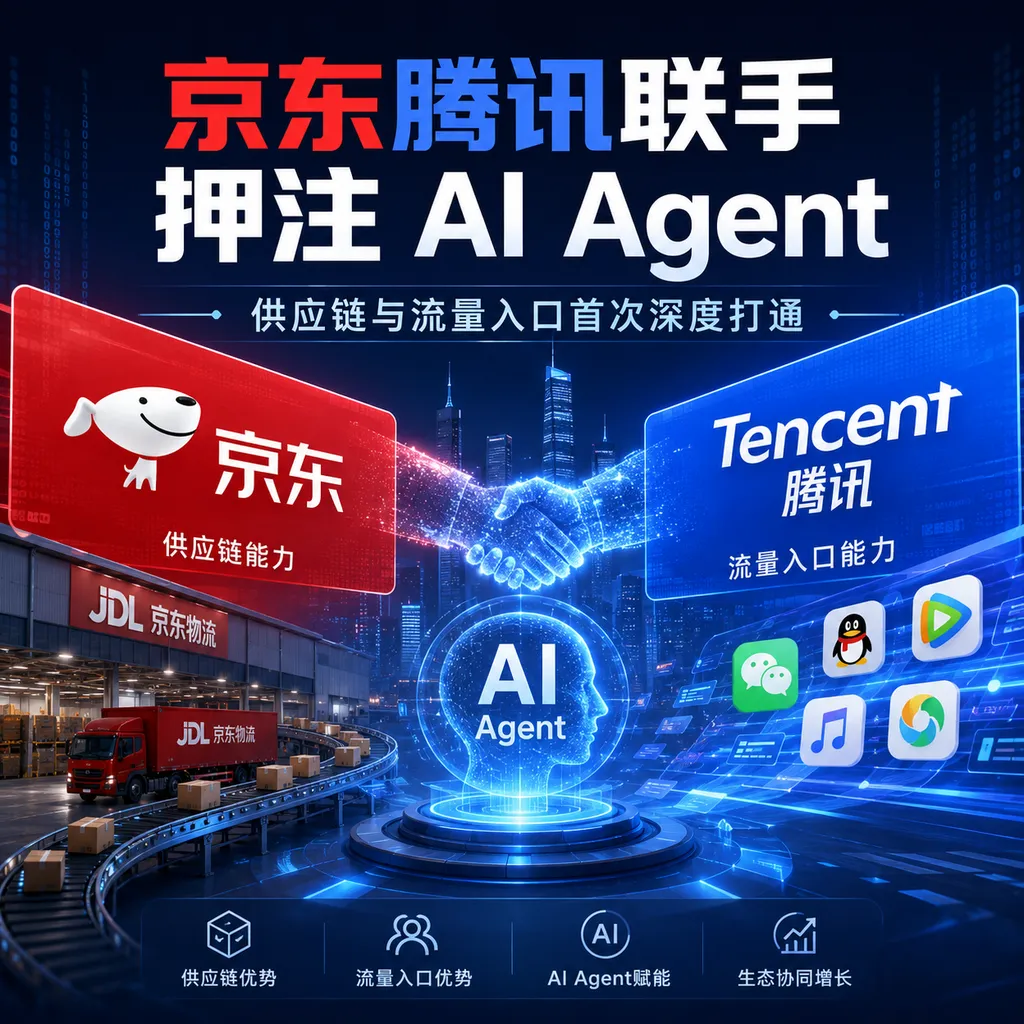
JD.com and Tencent have officially reached an AI Agent cooperation agreement, with JD.com's product supply chain system connecting to Tencent's WeChat and other entry resources. This is the first time domestic internet giants have achieved structural integration of supply chain and traffic at the Agent level, marking the transition of AI Agent from technical demonstration to a commercial closed loop.
JD.com and Tencent Join Forces to Bet on AI Agents — First Deep Integration of Supply Chain and Traffic Entry Points
JD.com and Tencent’s collaboration in the AI Agent field has finally come to fruition. On June 7, news broke that the two companies recently reached a partnership, connecting JD.com’s product supply chain and fulfillment service system with Tencent’s entry-point resources. This marks the first time domestic internet giants have structurally integrated supply chains and traffic flows at the Agent level, and represents another deep binding between the two after past collaborations in e-commerce, payment, and cloud services in a new technology cycle.
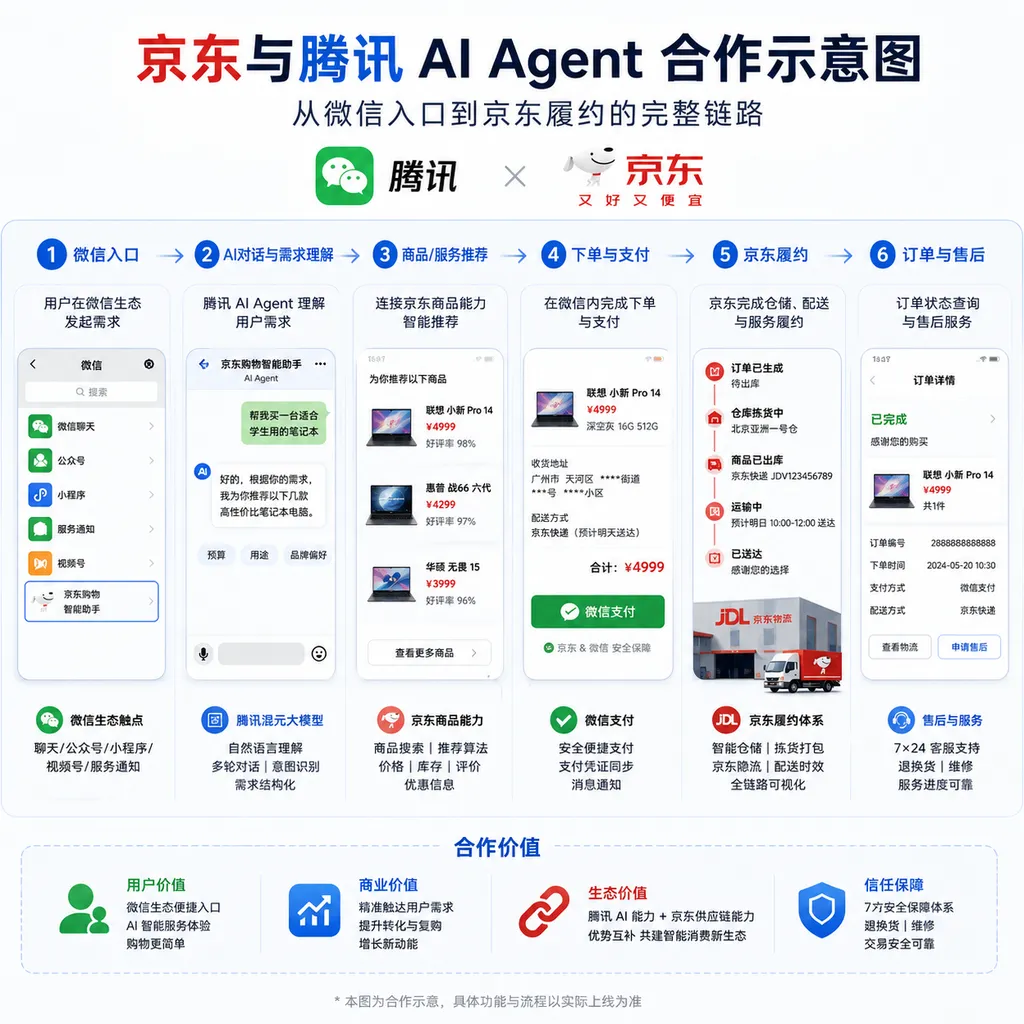
Not Just Interface Integration, But Reconstruction of the Shopping Journey
On the surface, this looks like a routine business collaboration, but the actual moves are more foundational than expected. JD.com has already completed AI Agent integration with major device manufacturers such as Huawei, OPPO, and Honor, adopting an A2A (Agent to Agent) architecture — when users express shopping needs in their phone’s native intelligent agent, the system directly calls JD.com’s AI Agent to complete the entire process of product search, information comparison, order placement, and fulfillment, without launching an app, or even needing to “open JD.com.”
This is fundamentally different from traditional mini-programs or H5 redirects. Mini-programs are essentially lightweight apps, and users still perceive “I’m using JD.com”; in the A2A model, JD.com’s role is more like a backend service provider, with front-end interactions completely handled by the device’s intelligent agent. When a user says “Help me buy a bottle of shampoo,” the system understands the intent, matches the product, completes payment, and arranges delivery — JD.com’s brand perception is greatly diluted, but its fulfillment capabilities are deeply embedded into the intelligent agent’s service network.
Tencent’s moves are equally aggressive. WeChat is advancing A2A assistant capabilities with Huawei, Honor, Xiaomi, OPPO, and vivo. According to the Financial Times, WeChat plans to launch an independent AI intelligent agent, possibly starting regulatory approval as soon as June. Tencent insiders confirmed the news but emphasized that the launch date depends on regulatory approval — with WeChat’s 1.4 billion-user scale, the compliance process could be stricter than for other products.
Structural Integration of Supply Chain and Traffic
The logic behind JD.com and Tencent’s cooperation is clear: JD.com has the supply chain, Tencent has the traffic entry points, and AI Agents are the new conduit linking the two.
JD.com’s core asset is its self-built logistics and product fulfillment system. In the traditional e-commerce era, this system reached users via apps; in the mini-program era, via WeChat’s ecosystem — but always limited by the prerequisite of “users must proactively open a shopping interface.” The advent of AI Agents changes this logic — shopping needs can be expressed in natural language in any scenario, and intelligent agents handle intent comprehension and backend service calls. JD.com no longer needs to compete for “open counts,” but instead for “service call rights” within intelligent agents.
Tencent, via WeChat, QQ, Tencent Video, etc., covers nearly all domestic internet users, but in the AI Agent era faces risk of traffic being intercepted at the OS and device manufacturer level. Huawei, Xiaomi, and OPPO are all promoting their own native intelligent agents; users may get used to speaking directly to their phone rather than opening a specific app. Tencent must establish presence at the intelligent agent layer, or risk becoming a backend provider of content and services without directly touching users.
Ultimately, JD.com and Tencent’s collaboration is about redistributing the weighting of supply chain, traffic entry, and service fulfillment in the AI Agent era. JD.com gains new touchpoints potentially holding hundreds of millions of users via Tencent’s intelligent agents like WeChat and QQ; Tencent gains the ability for its intelligent agents to actually complete transactions and fulfill orders, rather than only aggregating information and redirecting traffic.
A2A is the New Battleground, But Rules Not Yet Set
A2A (Agent to Agent) is the technical keyword in this cooperation, but the industry’s understanding and implementation of A2A is far from standardized.
From a technical architecture perspective, A2A involves at least three layers:
- Protocol Layer: How do different Agents communicate? Via traditional protocols like HTTP/gRPC, or dedicated Agent communication protocols? How are message formats, identity authentication, and permissions defined?
- Intent Understanding Layer: When the user tells Agent A “I want to buy shampoo,” how does Agent A decide to call JD.com’s Agent instead of Taobao or Pinduoduo’s Agent? Is it based on user history, price comparison, or commercial agreements?
- Fulfillment Assurance Layer: After Agent B (JD.com) receives Agent A’s (WeChat/device manufacturer) forwarded shopping request, how is service quality ensured? If products are out of stock, delivery is delayed, or there are after-sales disputes, how are responsibilities delineated?
Currently, most A2A implementations are in early stages, closer to “targeted integration” rather than “open protocols”. JD.com’s integrations with Huawei, OPPO, Honor are one-on-one negotiations to open interfaces; Tencent’s push for WeChat intelligent agents with phone manufacturers is likewise case-by-case. This approach scales quickly short term but accumulates high long-term maintenance costs, and makes access harder for small service providers.
The industry needs infrastructure akin to “HTTP protocol for intelligent agents” to allow any agent to call another agent’s services in a standardized way. At present, however, giants clearly prefer building closed partnerships to establish moats before considering standardization.
Opportunities for Developers and Small Merchants
The JD.com–Tencent cooperation impacts more than just two giants’ business — it sets an example for the AI Agent ecosystem.
For developers, A2A architecture means a new development paradigm. Previously, e-commerce app development centered on UI/UX and conversion optimization; now, Agent services focus on clearly defining “capabilities” for other agents to easily call. JD.com has essentially wrapped its supply chain and fulfillment capability into an Agent API; other intelligent agents need only know “this Agent handles shopping needs,” without caring about backend stock or logistics.
For small developers, this capability-wrapping approach is an opportunity — instead of building an entire e-commerce platform, you can make a service in a vertical niche (e.g., flower delivery, pet supplies, local lifestyle services) into an Agent capability and connect to major intelligent agent platforms to reach massive users. The prerequisite is deep vertical expertise and delivering a better experience than general platforms in your niche.
For small merchants, traffic allocation rules may change in the AI Agent era. In traditional e-commerce, merchants vie for SEO, buy ad slots, join promotions; in the AI Agent era, purchase intent is handled directly by intelligent agents, and merchants must think about “how to make the agent more likely to recommend my products.” Factors may include product quality, pricing competitiveness, fulfillment speed, or depth of cooperation with the platform.
If JD.com’s AI Agent gives priority to self-operated goods or heavily partnered merchants, small merchants’ influence may be further reduced. But if JD.com chooses a relatively open recommendation strategy based on user needs and product matching, small merchants may break through via product strength without fighting on ad budgets as before.
Regulatory Variables Cannot Be Ignored
Tencent insiders mentioned that WeChat AI intelligent agent launch dates largely depend on regulatory approval progress. This is not lip service — it’s a real factor.
Regulatory issues for AI Agents are more complex than for traditional applications:
- Data Flow: When users request shopping in WeChat’s intelligent agent, what data must WeChat pass to JD.com? Chat logs, payment info, delivery address — what can and cannot be transmitted? How is safety and privacy ensured when data flows between agents?
- Responsibility Boundaries: If goods bought via WeChat’s agent on JD.com are defective or delivery disputes arise, who does the user turn to? Does WeChat, as entry-point provider, bear joint responsibility? How does JD.com ensure service quality?
- Competition Fairness: If WeChat’s agent integrates JD.com’s supply chain preferentially, does it constitute unfair competition toward other platforms? If device manufacturers’ native agents only integrate certain service providers, must they open to all?
These issues have been contested in traditional internet eras, but lines are blurrier in the AI Agent era. Regulators must balance innovation encouragement with competition protection — a process that may slow some product launches, but is necessary for long-term healthy industry growth.
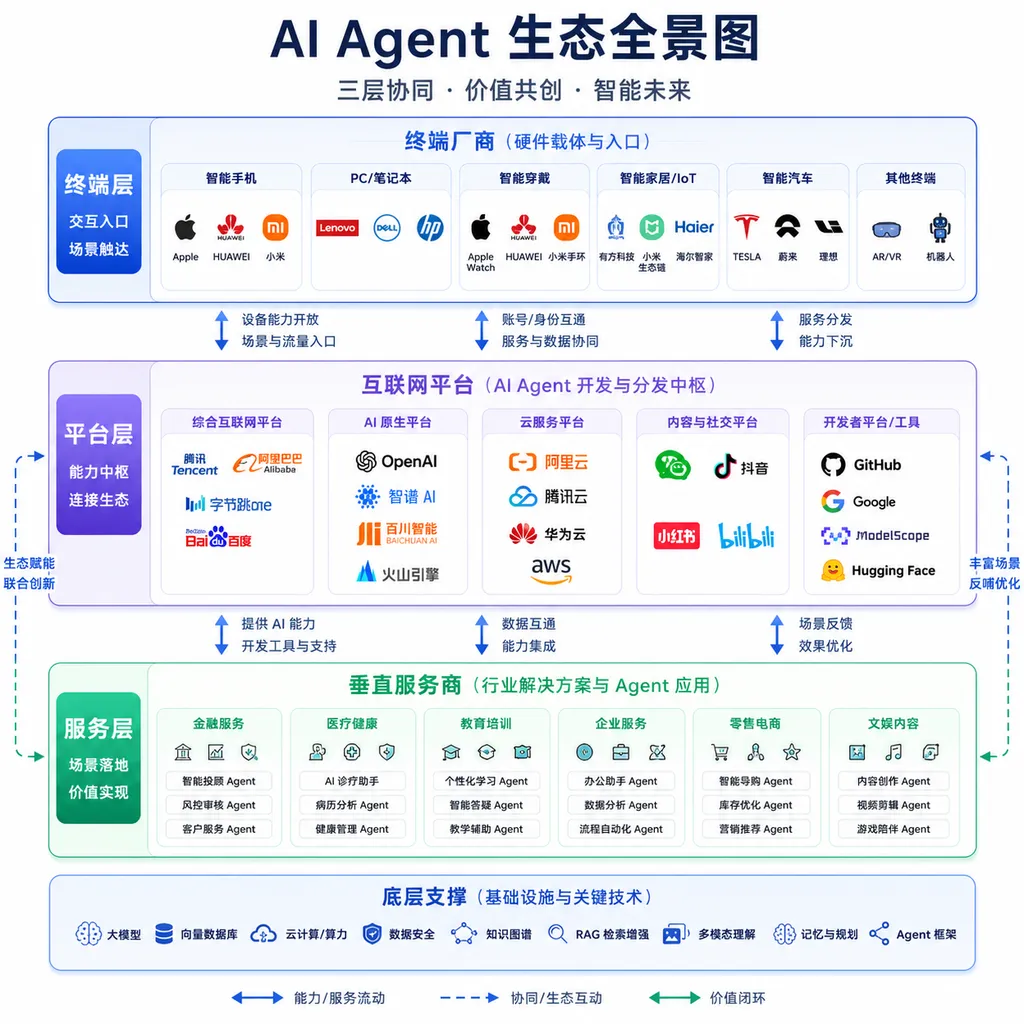
Segmentation of the Domestic AI Agent Ecosystem
JD.com and Tencent’s cooperation also reflects segmentation trends in the domestic AI Agent ecosystem.
Device Manufacturer Route: Huawei, Xiaomi, OPPO, vivo are pushing native intelligent agents at the OS level to control the primary user interaction entry point. Advantage: high hardware integration, access to system-level capabilities (camera, sensors, contacts); disadvantage: content/service ecosystems require integration one by one, high cold-start costs.
Internet Platform Route: Tencent, Alibaba, ByteDance have massive users and rich content/service ecosystems — launching independent AI agents is natural. Advantage: large base, diverse content; disadvantage: OS-layer control limitations may cause traffic interception.
Vertical Service Provider Route: JD.com, Meituan, and Ctrip wrap their supply chain/fulfillment into Agent capabilities integrated into various intelligent platforms. Advantage: service depth and fulfillment assurance; disadvantage: weaker brand perception — becoming “invisible backend providers.”
These routes are not mutually exclusive; they foster a complex mix of cooperation and competition. JD.com and Tencent’s tie-up is a combination of “internet platform route” and “vertical service provider route”; JD.com’s integration with Huawei, OPPO is combining “vertical service provider” and “device manufacturer” routes.
The likely future: device manufacturers control OS-layer agent entry, internet platforms like WeChat and Douyin offer second-tier agent entry, vertical service providers’ Agent APIs are invoked at all levels. Each layer has its own value-capture, but faces risk of being squeezed by upstream and downstream players.
Overseas Benchmarks: Google and Apple’s Agent Strategy
The domestic AI Agent ecosystem’s evolution somewhat benchmarks against Google and Apple.
Google’s Gemini Agent (shown at I/O 2025) integrates Google Search, Gmail, Google Maps, Google Shopping, etc., into one agent, enabling complex cross-service tasks via natural language. For example: “Plan my weekend trip to LA, book flights and hotels, then email my colleagues” — Gemini automatically calls maps, flight search, hotel booking, email to complete this.
Apple’s Apple Intelligence (announced at WWDC 2025) upgrades Siri into a more powerful agent, deeply integrating iOS/macOS system-level capabilities, and opens App Intents API for third-party apps to be called by Siri. Apple’s strategy is “terminal is king” — tightly controlling hardware and OS so all services must go through Apple Intelligence.
Domestic conditions are more fragmented — no single company owns OS, super-app, and vertical services altogether. Huawei has OS but lacks a content ecosystem; Tencent has WeChat but is OS-layer constrained; JD.com has supply chain but lacks traffic entry. This creates a patchwork ecosystem relying heavily on business cooperation to assemble capabilities, unlike Google/Apple’s vertical integration.
The downside: lower efficiency, fragmented experiences, users switching agents; upside: more competition, no monopoly, opportunities for smaller players to enter via differentiated capabilities.
Technology Evolution: From Chatbot to Agent
AI Agents differ fundamentally from early chatbots — explaining why JD.com and Tencent chose to cooperate now.
Chatbots’ core is dialogue understanding and generation — essentially “a talking search engine.” Chatbots can answer “What’s today’s weather in Beijing” or “Recommend a laptop” but cannot execute actions — they can’t place orders, book tickets, or send emails.
Agents’ core is task execution and tool calling — they understand intent and invoke backend services to execute. If a user says “Buy a bottle of shampoo,” an Agent not only recommends products, but understands needs, matches items, calls payment APIs to place the order, and arranges logistics.
This leap from “information retrieval” to “task execution” relies on:
- Reasoning and Planning in Large Models: Agents must handle multi-step tasks like “buy shampoo” — involving preference determination → product search → price comparison → inventory check → payment → logistics tracking — requiring strong reasoning to plan steps.
- Tool Invocation and API Integration: Agents must call various backend services (e-commerce, payment, logistics APIs) — requiring knowledge of tool parameters, calling timing, exception handling.
- Context Management and Memory: Agents must maintain context over multiple turns, remembering user preferences/history — e.g., last shampoo brand, size, delivery address — to personalize service.
These elements matured after the emergence of GPT-4, Claude 3, etc., making AI Agents an industry hotspot in 2024–2025. JD.com and Tencent’s timing is because technological infrastructure is now ready for real commercial application.
Business Model: Who Pays for the Agent?
The AI Agent business model isn’t settled, making it the biggest uncertainty in JD.com–Tencent’s cooperation.
In traditional e-commerce, merchants pay for traffic (ads, commissions), users use platforms free, and platforms take a cut. In the Agent model, logic may change:
- User Subscription Fees: If Agents provide “finding optimal products, saving time/money,” users may pay for it — similar to ChatGPT Plus.
- Merchant Paid Promotion: Merchants may pay to have Agents prioritize their products, but Agent recommendations must balance satisfaction and retention — “pay to rank” could damage trust.
- Platform Commissions: Platforms may take a cut of Agent-facilitated transactions, but complex transaction chains and multiple parties make commission distribution tricky.
- Data Monetization: Agents collect user behavior/preferences, useful for model training or, under compliance, precise marketing.
Short-term, JD.com and Tencent will likely use traditional e-commerce models — merchant pays, user free, platform takes a cut. Long-term, once Agent value is proven, new models will emerge.
Final Note
JD.com and Tencent’s cooperation marks a critical step from technical demos to commercial AI Agent loops. This is not simple API integration but a reassembly of supply chain, traffic entry, and fulfillment in a new technology era.
The industry is still early-stage — many unanswered questions: What’s the A2A standard protocol? How to ensure privacy/data security? How to sustain business models? Where is the regulatory boundary? The answers will emerge over the next few years of practice.
For developers/entrepreneurs, it’s not too late. Giants are building infrastructure and relationships, but vertical Agent capabilities, small merchant service quality, and UX optimization still have room to fill. Rules for the AI Agent era aren’t set — whoever finds the right entry point has a chance to become the next important player.
References
- Report: JD.com and Tencent Partner to Collaborate Around AI Agents – IT Home — First disclosure of JD.com–Tencent AI Agent cooperation, including A2A architecture and phone manufacturer integration details


