
Zhipu GLM-5.2 Countdown: 7 Days Until Release Window Reappears
The Zhipu AI beta model GLM-5.2 has appeared in the system, and based on the historical pattern of GLM-4.7, 5.0, and 5.1, the official release will not take more than 7 days. This is the first major update since the release of GLM-5 four months ago.
Zhipu GLM-5.2 Countdown: 7 Days Until Release Window Reappears
Zhipu AI is about to make a big move again. Community users have discovered that a beta model codenamed GLM-5.2 has appeared in the system. Following Zhipu’s past release cadence, this means the official version will go online within a week.
The 7-Day Rule Proven Again
Developers familiar with Zhipu’s release rhythm know an unwritten rule: whenever a beta model appears, the official release will happen within 7 days. This was true for GLM-4.7, GLM-5.0, and GLM-5.1 — now it’s GLM-5.2’s turn.
This rule stems from Zhipu’s relatively aggressive iteration strategy. Unlike OpenAI’s months-long refinement cycles, Zhipu prefers a “small steps, fast run” approach — the beta phase mainly verifies core capabilities and stability, and once approved, it rapidly pushes to market. Such a pace is rare among domestic large model vendors, but it has kept Zhipu’s version update frequency high over the past year.
First Major Update to GLM-5 After Four Months
From the timeline perspective, GLM-5.2’s appearance isn’t surprising. On February 11 this year, Zhipu released the next-generation flagship model GLM-5 — a giant model with 744 billion parameters, achieving open-source SOTA performance in Coding and Agent capabilities. At the time, Zhipu claimed its “real programming scenario experience was close to Claude Opus 4.5.”
Four months have passed since February, making this the first major version update since GLM-5’s launch. According to large model iteration cycles, four months is enough for a round of targeted optimization — whether to fix known issues, enhance specific capabilities, or adapt to new hardware platforms.
When GLM-5 launched, Zhipu emphasized two points: deep adaptation to seven domestic chip platforms — Huawei Ascend, Moore Threads, Cambricon, Kunlunxin, Muxi, Suiyuan, and Hygon — and significant API and subscription price hikes (Coding plan subscription prices increased by 30%-60%, API call prices rose by 67%-100%). Whether GLM-5.2 will continue to push forward in these two directions is a focal point of industry attention.
Possible Capability Directions
Although Zhipu hasn’t announced specifics about GLM-5.2’s improvements, several directions are worth watching based on industry trends and GLM-5’s shortcomings:
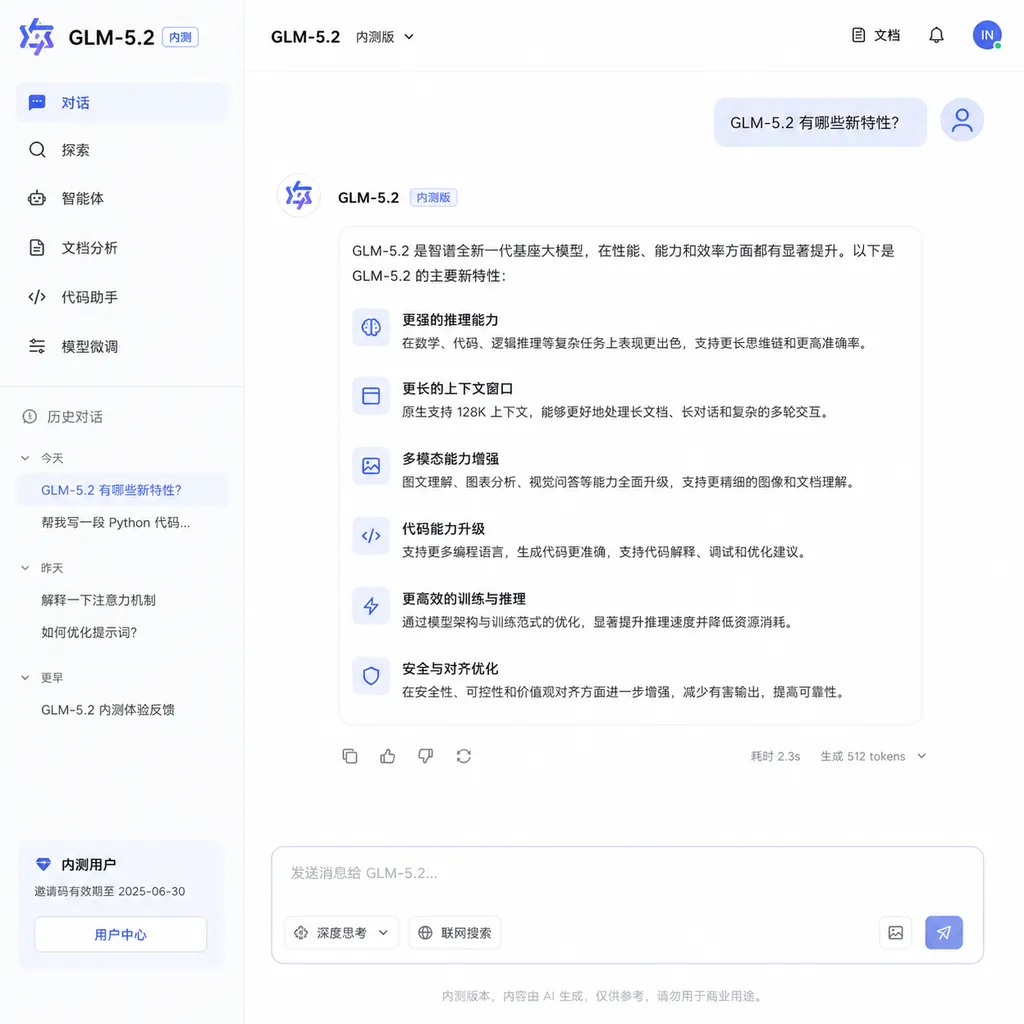
Enhancing multimodal capabilities. This year, multimodal has become a battlefield for all players. GPT-5.2 and GLM-4.6V already achieved “native full modality,” with millisecond-level response in video understanding and real-time speech interaction. GLM-5 was relatively conservative here, focusing mainly on text and code. GLM-5.2 may work on visual understanding and voice interaction.
Long text processing capability. DeepSeek recently began limited testing of 1 million-token context length, making GLM-5’s current context window look insufficient. While most use cases don’t need million-level contexts, it’s a direct proof of tech strength and an important lever to win enterprise clients.
Inference efficiency optimization. GLM-5 emphasized domestic chip adaptation on release, but adaptation doesn’t mean optimization is complete. Based on user feedback, there’s still room to improve inference speed and cost control on domestic compute platforms. GLM-5.2 may invest effort into operator-level optimization, mixed-precision inference, and dynamic batching.
Evolution of Agent capabilities. Zhipu has always treated Agent as a differentiating advantage. GLM-5 already performs well in real programming scenarios, but there’s room to improve complex task planning and tool call accuracy. If GLM-5.2 breaks through here, it will be more attractive to developers.
The Collective Surge of Domestic Large Models
Zooming out, GLM-5.2’s release window coincides with an acceleration point for domestic large models.
ByteDance’s Doubao Model 2.0 was released in February, positioned directly against GPT-5.2 and Gemini 3 Pro, while its video generation model Seedance 2.0 was so popular that Elon Musk reposted it. Over at Alibaba, Qwen released its next-generation image generation model Qwen-Image-2.0, ranking third globally in AI Arena text-to-image evaluations; Ant Group open-sourced its full-modality model Ming-flash-omni 2.0, surpassing some Gemini 2.5 Pro indicators.
DeepSeek quietly tested million-token contexts while updating its knowledge base to May 2025 — meaning it can accurately output April news without connecting to the internet. iFlytek released Spark X2, trained entirely with domestic compute power, claiming to match top international standards.
Behind this surge lies the gradual maturity of domestic compute power and the ongoing reduction of training costs. GLM-5’s deep adaptation to seven domestic chip platforms isn’t just marketing — it genuinely reduces training and inference costs. When training a hundred-billion-parameter model drops from tens of millions of RMB to millions, iteration speed naturally increases.
The Delicate Balance of Pricing Strategy
GLM-5’s significant price hikes stirred discussion in the industry. Coding plan subscription prices rose 30%-60%, API call prices climbed 67%-100% — a rare major price hike among domestic models recently.
The logic behind price increases is clear: first, model capabilities have genuinely improved; second, to cover high training and inference costs; third, to signal to the market “we are on par with top international models.” But price hikes also risk losing users, especially price-sensitive small and mid-size developers.
Will GLM-5.2 continue to hike prices? It depends on Zhipu’s market strategy judgment. If GLM-5.2 mainly fixes bugs and optimizes performance, prices will likely stay the same; if it significantly boosts capabilities (e.g., multimodal, long text), some markup would be justifiable.
Judging from Zhipu’s stock performance, the market’s confidence remains. After GLM-5’s launch, Zhipu’s stock hit a new high since listing, with market value nearing HK$150 billion. This gives Zhipu the confidence to keep investing and more flexibility in pricing.
Developers’ Key Concerns
For developers already using GLM-5, GLM-5.2’s release raises several practical questions:
API compatibility. Zhipu usually maintains backward API compatibility in major updates, but minor updates sometimes adjust parameter structures or return formats. If your app heavily depends on GLM-5’s output format, it’s best to prepare for adaptation in advance.
Quota consumption. At GLM-5’s release, Zhipu stated “calling GLM-5 will consume more plan quota than historical models.” If GLM-5.2 improves capabilities, quota use may further increase. For applications with large call volume, this directly impacts cost calculations.
Migration cost. If GLM-5.2 significantly improves some capabilities, is it worth migrating from GLM-5? It depends on your use case. For IDE plugins requiring high-quality code generation, upgrading may yield clear benefits; for simple text summaries, the old version may suffice.
Final Thoughts
GLM-5.2’s countdown reflects the overall state of domestic large models: rapid iteration, capability catch-up, cost reduction, and ecosystem improvement. Zhipu isn’t the only company sprinting, but its release pace does represent a certain industry consensus — in this window, speed matters more than perfection.
In seven days, we’ll see GLM-5.2’s true form. Which areas it surpasses GLM-5 in, and which areas still fall short, will naturally be revealed then. As for whether it truly “approaches top international levels” as Zhipu claims, that will depend on developers’ real experience and objective benchmark data.
For domestic developers, one thing is certain: more choices are available. Beyond GPT, Claude, and Gemini, GLM, Doubao, Qwen, and DeepSeek are evolving fast. Ultimately, competition benefits users — better models, lower prices, and more flexible deployment options.
OpenAI Hub will integrate GLM-5.2 immediately after its official release, allowing developers to call it with the same OpenAI-compatible code. After all, in an era of rapid model iteration, maintaining API layer stability matters most.
References
- GLM-5.2 Coming Soon, Expected Within Days - Linux.do - Community users spotted GLM-5.2 beta model, discussing release timing rules
- Frontier Analysis: Zhipu GLM-5 — The First Domestic Large Model on Par with Top International Levels - CSDN - GLM-5 technical report interpretation
- GLM-5 Released! - Reddit r/ZaiGLM - Overseas developer discussion on GLM-5
- From Text Assistants to Productivity Agents — 2025 Annual Large Model Evaluation: Multimodal - Zhihu - Multimodal large model capability comparison analysis


