
VibeOS Release: The First AI-Native Operating System
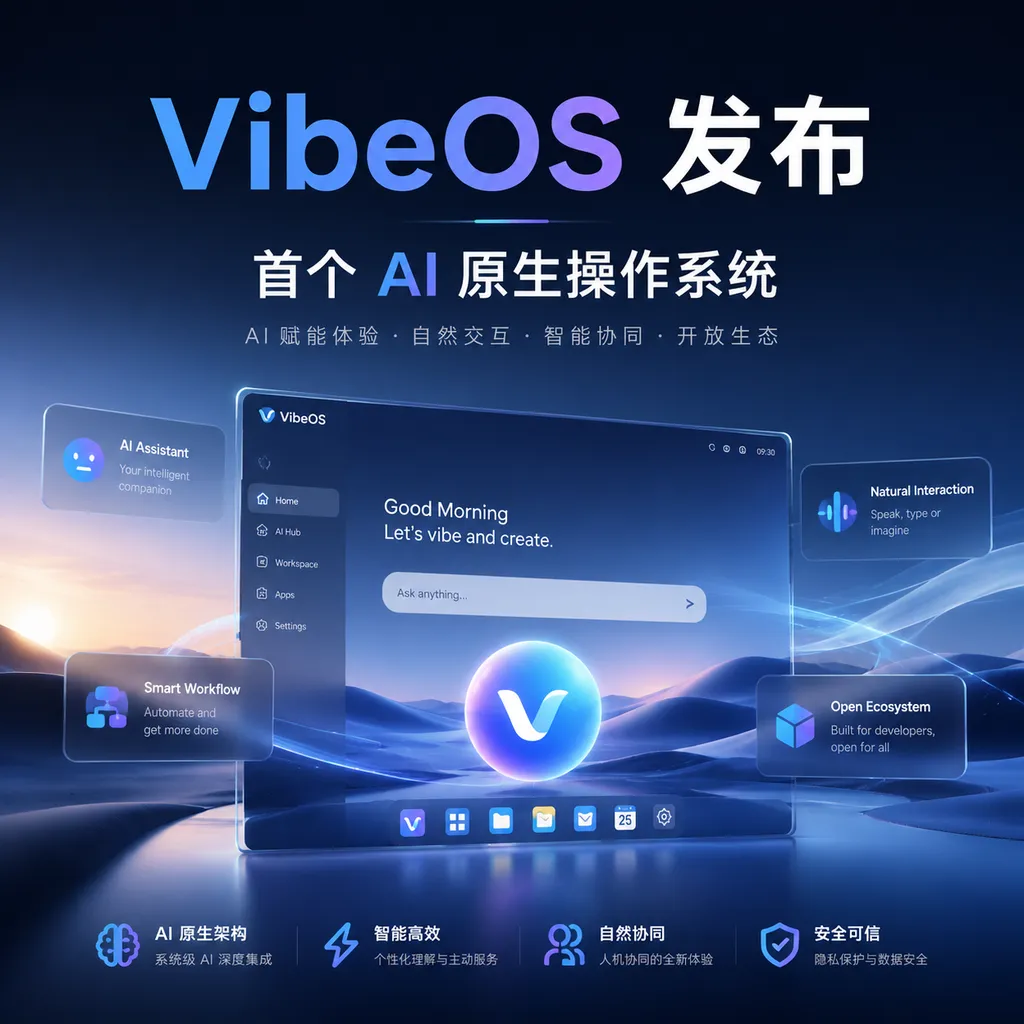
VibeOS officially released, claiming to be the first operating system designed for AI from the ground up. Unlike traditional OSs that add AI features on top, it has been restructured entirely around large models—from the kernel and scheduling to interaction—but its technical details and practical implementation remain to be verified.
VibeOS Release: The First AI-Native Operating System
Today, a project called VibeOS was released, claiming to be "the first AI-native operating system." This positioning sounds very radical—not adding AI functions on top of an existing system, but designing an operating system from scratch specifically for AI.
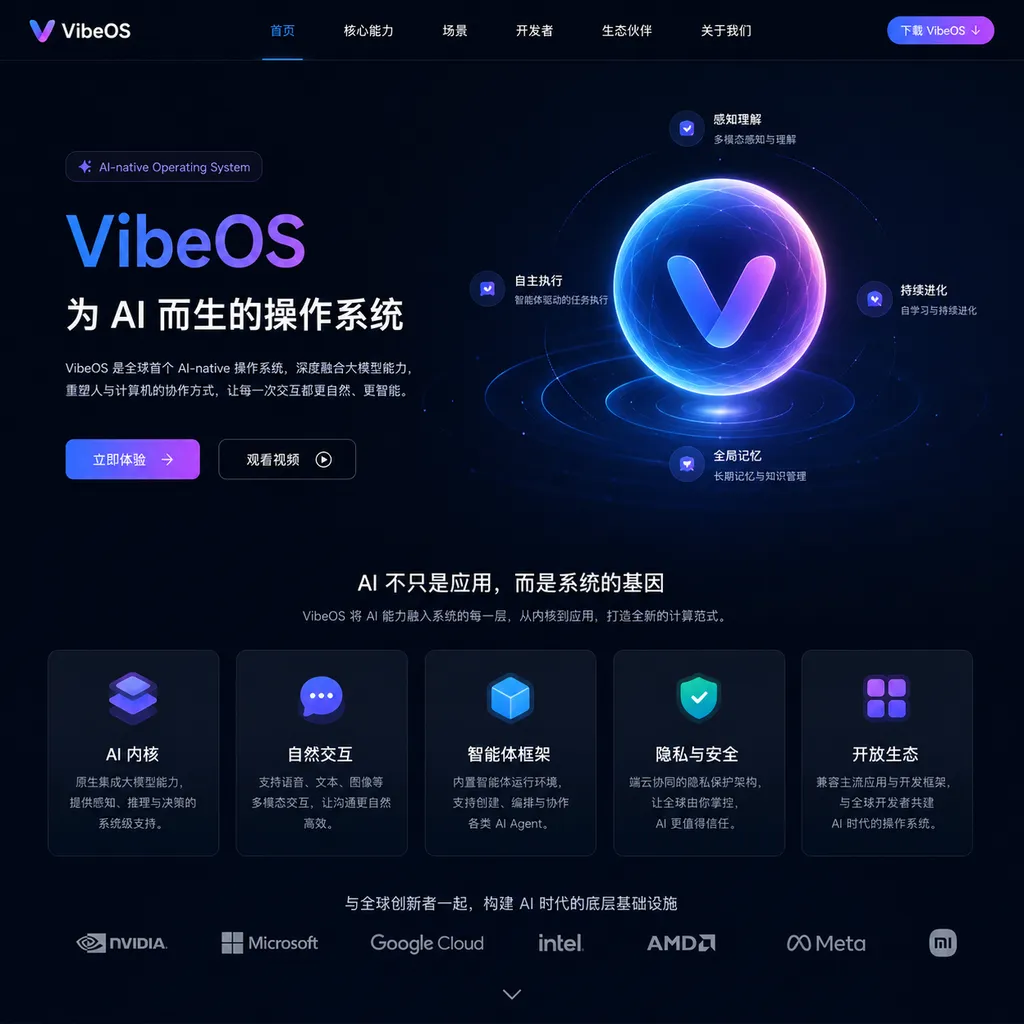
What is an AI-Native Operating System
Over the past two years, operating systems have all been moving toward AI. Apple's Apple Intelligence, Microsoft's Copilot, Google's Gemini Nano, as well as domestic examples like vivo's Blue Heart Intelligent and Xiaomi's upgraded Xiao Ai assistant are essentially additive work on traditional OS architectures: running on-device large models, adding AI assistant entry points, optimizing scheduling to make model inference faster.
VibeOS takes a different approach. It claims to redesign from the kernel level for AI—not treating the large model as an app running in the system, but making the entire operating system revolve around the large model. Specifically, this is reflected on three levels:
Kernel scheduling restructuring. Traditional OS schedulers optimize for general computing tasks; VibeOS’s scheduler is specially designed for the inference characteristics of Transformer models. It claims to dynamically sense the attention computation load of the model, pre-schedule GPU resources, and reduce inference latency. This idea is somewhat similar to vivo Blue River OS 2’s "heterogeneous computing space" concept, but VibeOS says it is more radical, pulling model inference priority directly to the kernel level.
Targeted memory management optimization. Large model inference is extremely memory-intensive, especially for KV Cache. VibeOS has designed a “model-aware memory manager” that can identify which memory pages store model weights, which store KV Cache, and which store temporary activations, then apply differentiated paging strategies. For example, model weights can be lazily loaded, KV Cache is prioritized to stay resident, and activations are released immediately after use. This is similar in spirit to vivo OriginOS 5’s Ledger memory bookkeeping mechanism, but VibeOS works at a finer granularity, down to the Tensor level.
Redefining the interaction paradigm. VibeOS is no longer app-centric but intent-centric. The user doesn’t need to open a particular app but simply states a requirement; the system’s large model understands the intent and automatically schedules underlying capability modules to complete the task. This concept is similar to vivo’s PhoneGPT (mobile agent), but VibeOS has implemented it as a system-level capability, not a separate assistant application.
How is it Technically Implemented
From the information publicly available on its website, VibeOS is based on a modified Linux kernel, but has made extensive changes to the scheduler, memory management, and file system. In the kernel, key modules have been rewritten in Rust—this is consistent with vivo Blue River OS 2’s tech stack. Rust’s memory safety is advantageous in AI scenarios, helping avoid memory out-of-bounds issues during model inference.
On the user-space side, VibeOS provides a new API framework where developers no longer write traditional apps but define “Capability Units.” Each capability unit is a functional module that can be called by the large model, such as “send email,” “check weather,” “edit document.” The large model dynamically orchestrates these capability units based on user intent to complete complex tasks.
The architecture sounds ideal but faces several issues:
Ecosystem starting from scratch. VibeOS is incompatible with existing Linux apps, Android, or iOS ecosystems. Developers must rewrite all functionality using its new framework. Vivo, when developing Blue River OS 2, at least maintained compatibility with the Quick App standard to quickly integrate lightweight services. VibeOS has not shown a similar ecosystem migration plan, meaning its initial available functions will be very limited.
On-device inference capability questionable. VibeOS emphasizes on-device priority but hasn’t clarified what parameter size models it supports. Vivo’s Blue Heart 3B on-device large model runs at 80 characters/sec on flagship phones with a 450mA power draw. If VibeOS wants system-level intent understanding and task orchestration, model parameters can’t be too small, otherwise accuracy suffers. But larger parameters mean on-device compute and power can’t handle it. The website has provided no specific data on resolving this contradiction.
Privacy and security safeguards. If all operations require large model understanding, the model sees all user activity data. VibeOS mentions “localized knowledge graph” and “on-device priority,” but hasn’t explained its privacy protection mechanisms in detail. Vivo has more specifics—Blue Heart Intelligent promises “data that can be processed on-device will never go to the cloud” and has certification from TAIER Lab. As a new project, VibeOS’s credibility here needs observation.
Advantages Over Existing Solutions
Comparing VibeOS to existing AI OS solutions highlights its positioning.
Compared to Apple/Google/Microsoft: These giants’ AI features are incremental, adding AI on top of mature OS. Advantage: complete ecosystem, high stability. Disadvantage: AI ability is constrained by existing architecture, many optimizations can’t go deep into the kernel. VibeOS’s radical reconstruction could fully exploit AI performance, but the trade-off is abandoning existing ecosystems and starting from scratch.
Compared to vivo Blue River OS: Blue River is also self-developed and emphasizes AI-native, but vivo’s strategy is more pragmatic. Blue River first launches on watches, smart home devices, gradually building ecosystem while maintaining mainstream standard compatibility. VibeOS seems to want to go all-in instantly, creating a complete AI-native desktop/mobile OS. Bigger ambition, higher risk.
Compared to HarmonyOS NEXT: HarmonyOS NEXT also dropped Android compatibility and started a new ecosystem, but its core remains traditional app mode, with AI as an added capability. VibeOS puts AI in a more central position, redesigning the entire interaction logic around large models. If done well, the user experience could leap forward; if done poorly, it’s just an empty shell without app ecosystem.
How Developers Use It
VibeOS provides an SDK for developers to define Capability Units and register them with the system. The website shows a simple example:
name: send_email
description: "Send an email to a specified recipient"
parameters:
  - name: recipient
    type: string
    required: true
  - name: subject
    type: string
    required: true
  - name: body
    type: string
    required: false
execution:
  type: native
  binary: /usr/local/bin/email_sender
Once defined, when the user says “Send an email to Zhang San, subject Project Progress,” the system’s large model will parse the intent, extract parameters (recipient: Zhang San, subject: Project Progress), and then call this capability unit for execution.
This mechanism requires developers to define every capability’s semantics and parameters very precisely. If the definition is unclear, the large model will misunderstand and fail the call. Vivo’s agent platform faces similar problems, and their solution is to provide many standard capability templates for developers to fine-tune. VibeOS hasn’t shown such supporting tools, so initial developer experience may be rough.
Where It Fits
Frankly, VibeOS currently looks more like a technology proof-of-concept than a daily-use OS. Its concept is cutting-edge, but engineering implementation is still early-stage.
Possible application scenarios:
-
AI-native devices: Hardware designed specifically for AI interaction, such as AI Pins, Rabbit R1. These devices lack traditional app ecosystems, so VibeOS’s intent-driven interaction model is an advantage.
-
Developer toolchain: VibeOS’s kernel optimization technologies could be extracted and integrated into existing AI dev tools. For example, its model-aware scheduler could be made into a standalone runtime, enabling better performance when running large model inference on Linux servers.
-
Industry-specific custom systems: Certain verticals, such as healthcare or industrial control, require highly customized AI capabilities without needing a general app ecosystem. VibeOS could serve as a base, deeply optimized for specific scenarios.
In the short term, VibeOS is unlikely to replace mainstream operating systems. It’s more like a bold exploration into what an “AI-era operating system” should look like. Success depends on proving its value in a niche scenario and then expanding its scope.
Vivo took three years to move Blue River OS from concept to commercial use on smartwatches and tablets. VibeOS’s technical difficulty is higher, its ambition greater, and it may take even longer.
Points Worth Watching
Open-source plan. VibeOS’s code is not fully open-sourced yet; the website has only posted partial kernel patches and SDK docs. If it follows vivo’s example of open-sourcing its 7B-parameter Blue Heart large model, releasing core code could attract more developer participation and accelerate ecosystem building. If it remains closed-source, it will just be a lab project with limited influence.
Performance benchmarking. The site has not given any performance comparison data—e.g., on identical hardware running the same large model, how much faster or more power-efficient VibeOS is compared to Linux + Docker. These numbers are key to proving whether its technical advantages are real.
Commercialization path. OS development is a heavy investment. Vivo’s Blue River and OriginOS are backed by phone sales. Who is behind VibeOS? What is its funding situation? Without sustained investment, such foundational projects are hard to maintain long-term.
Conclusion
VibeOS raises an interesting question: when AI becomes the core of computing, do we need to reinvent the operating system? Past OS design focused on CPU-intensive and I/O-intensive tasks; AI inference has completely different characteristics—large amounts of matrix operations, massive memory usage, and real-time interaction demands.
Vivo, Apple, and Google’s approach is patching existing architectures—safer but with clear ceilings. VibeOS chooses to start over, a risky path, but if successful, could truly define the shape of next-generation OS.
It’s too early to draw conclusions. First, see if it can prove itself in a niche scenario; then, see if it can attract a strong developer ecosystem. The track of AI-native operating systems has just begun.
References
- VibeOS Official Site - Official site introducing the core concepts and technical architecture of the AI-native operating system.


