
NAVER Bets on Gigawatt-Level Computing Power: Teams Up with NVIDIA to Seize the High Ground in Asian AI Infrastructure
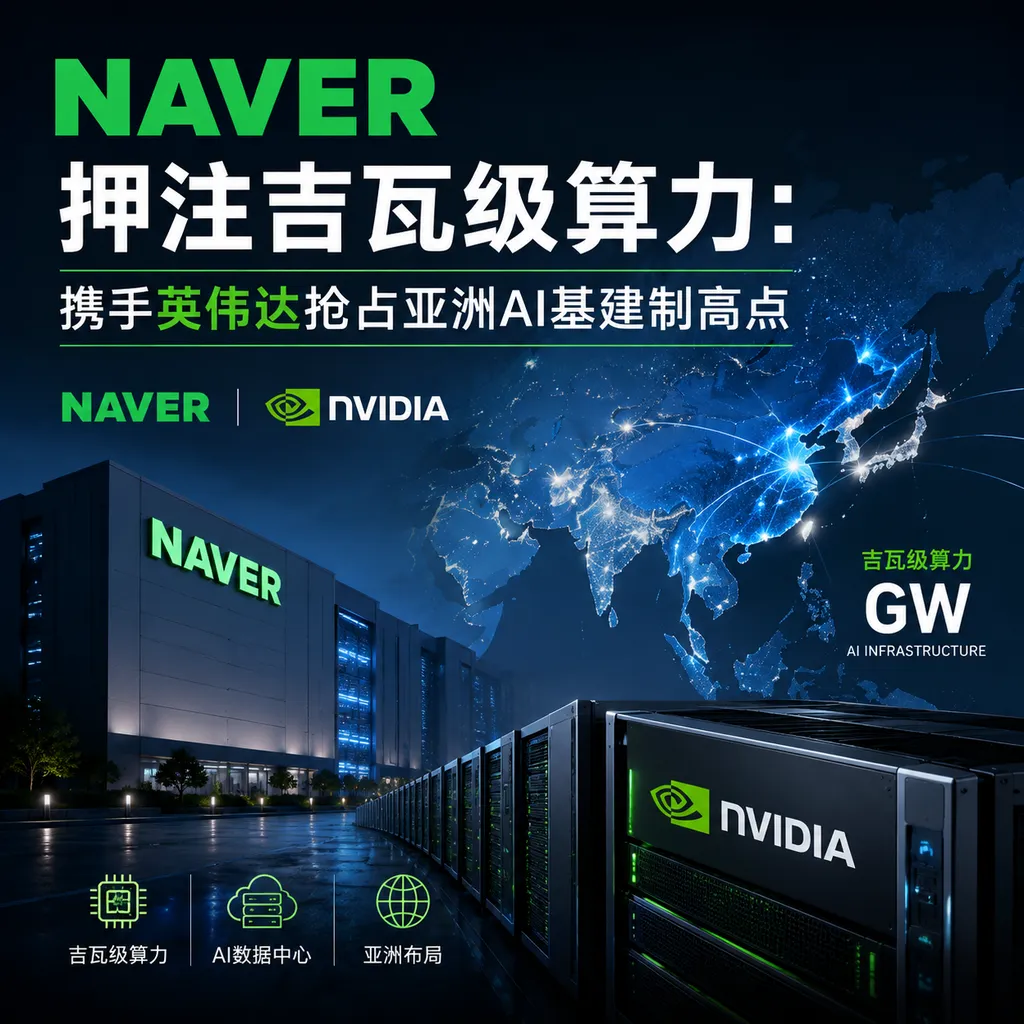
South Korean internet giant NAVER has entered into a deep partnership with NVIDIA, planning to expand its AI infrastructure to gigawatt-scale, while developing a localized HyperCLOVA X based on NVIDIA’s open-source models. This is an important bet by an Asian tech company in the era of sovereign AI.
NAVER Bets on Gigawatt-Level Computing Power: Partnering with NVIDIA to Seize the AI Infrastructure High Ground in Asia
Korean internet giant NAVER announced today (June 8) that it has reached a strategic cooperation agreement with NVIDIA, expanding its self-owned AI infrastructure from 55 megawatts to gigawatt scale. This is not just a simple scale-up of computing power—NAVER also became the first Korean company to join NVIDIA’s Nemotron Alliance and plans to fine-tune a localized version for the Korean language market based on the open-source Nemotron 3 Ultra model.
The core logic behind this move is clear: in the global AI market dominated by US companies like OpenAI and Anthropic, Asian tech giants need their own "Sovereign AI" capabilities. NAVER’s chosen path is a dual approach of infrastructure independence and localized models, while NVIDIA uses this opportunity to replicate its AI cloud ecosystem strategy in Asia that has proven successful in North America.
What Gigawatt-Level Computing Power Means
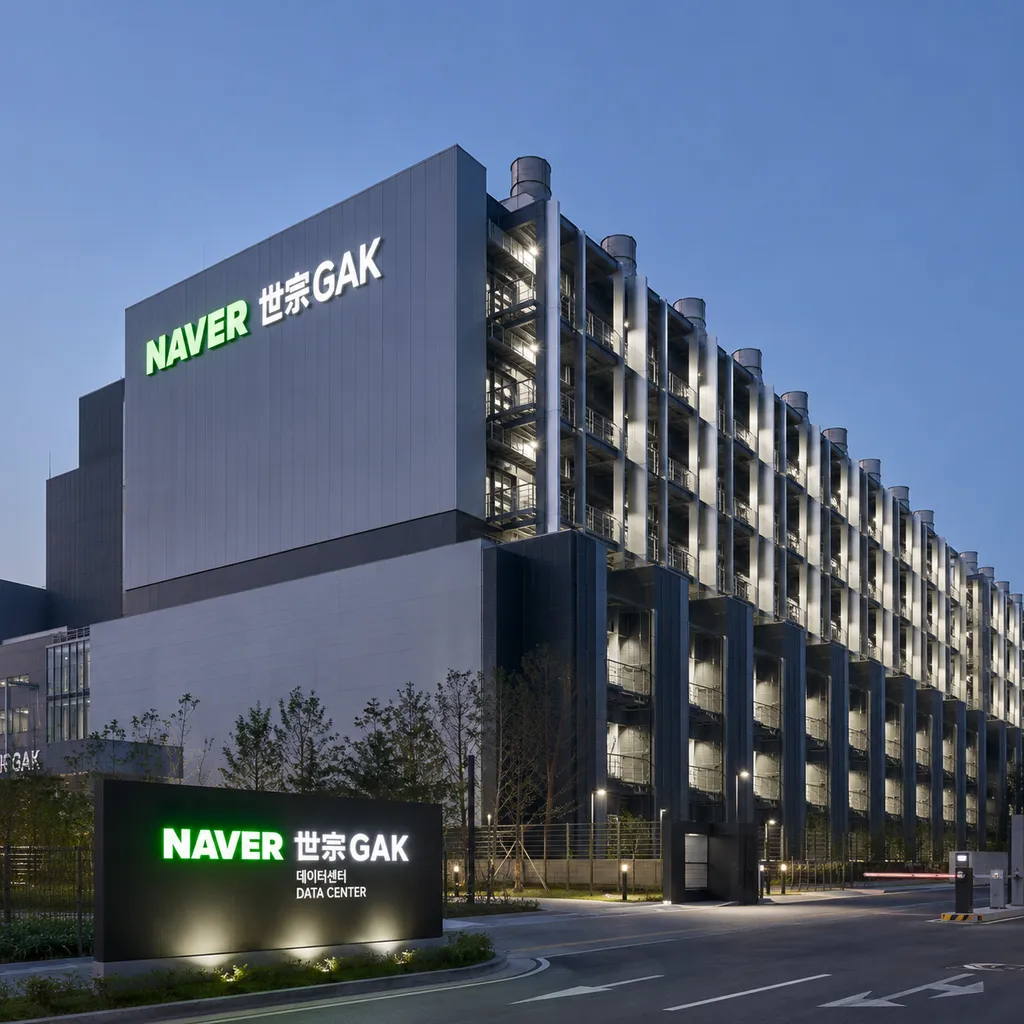
Let’s talk about this "gigawatt" concept. NAVER’s first-phase deployment in the Sejong GAK data center is 55 megawatts (MW). One gigawatt (GW) equals 1000 MW, meaning NAVER’s ultimate goal is to expand computing power nearly 20-fold.
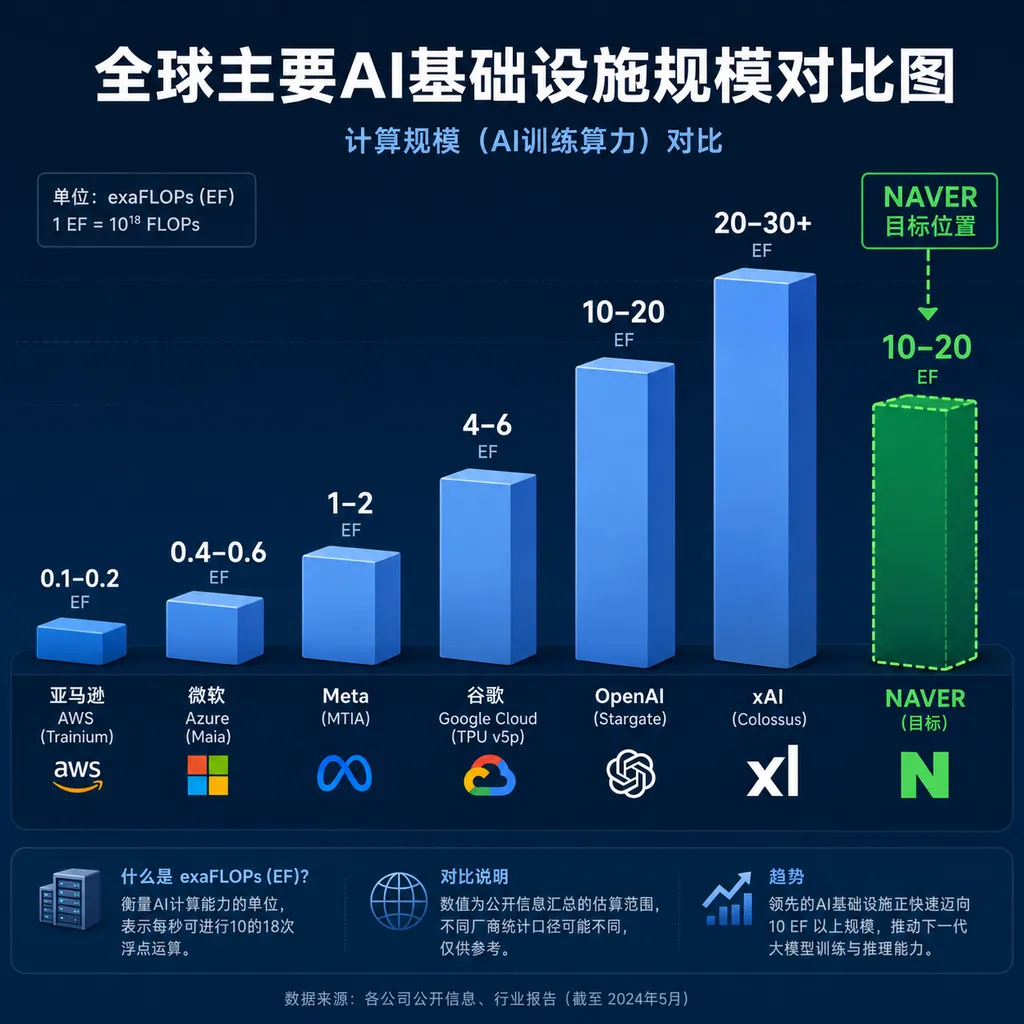
In the global context, how big is this scale? As a comparison:
- Meta’s AI infrastructure is currently around 600 MW
- xAI’s Memphis Colossus supercomputing cluster is about 150 MW for a single unit
- Microsoft and Google’s ultra-large-scale data centers are typically between 100–300 MW
If NAVER truly reaches gigawatt scale, it will enter the world’s top tier in AI computing power. But there’s a key issue: electricity supply. Can Korea’s power system support such massive AI data center expansion? NAVER’s choice of Sejong as the starting point is no coincidence—it’s Korea’s government-planned administrative hub with relatively abundant power infrastructure. However, expanding to gigawatt scale will inevitably involve national-level energy policy coordination.
HyperCLOVA X’s Localization Logic
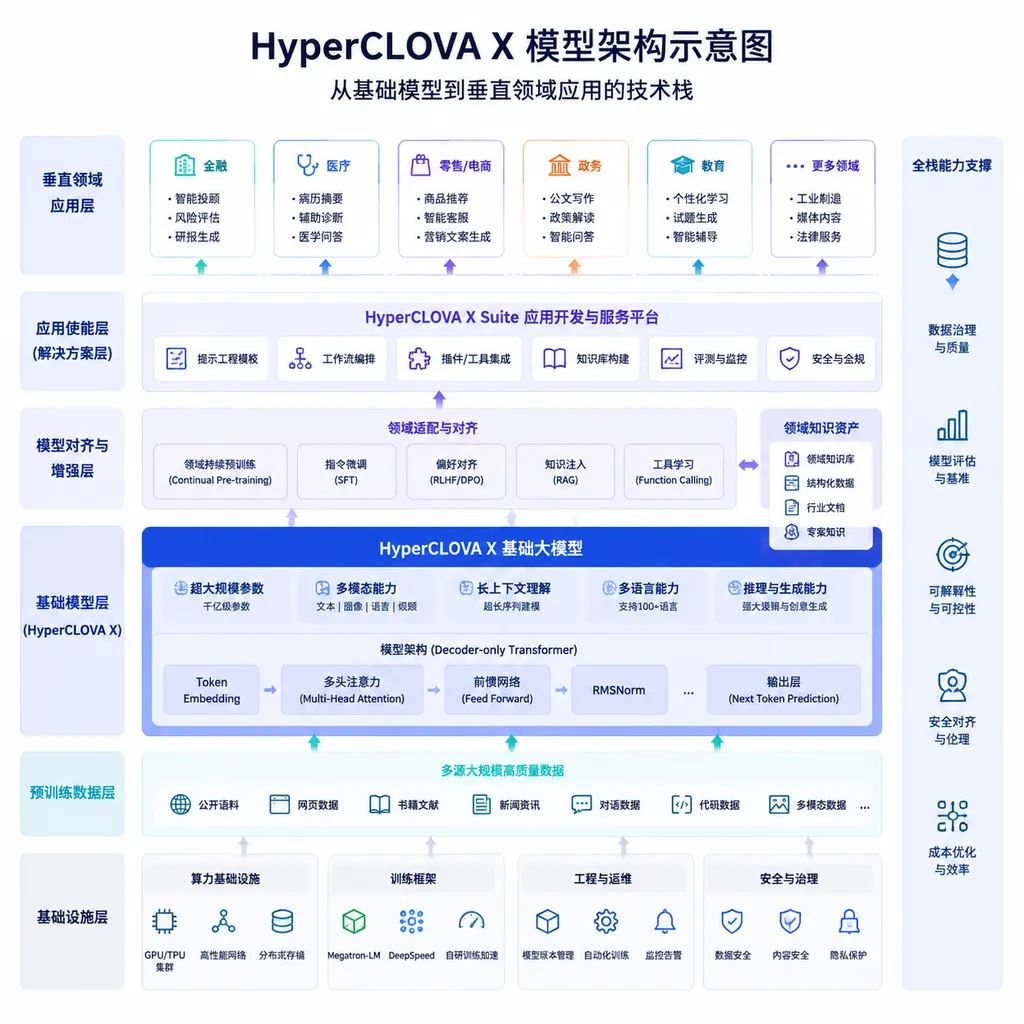
The core of NAVER’s AI strategy is HyperCLOVA X—a self-developed Korean-language large model that has already matured through iterations. According to official information, the next generation of HyperCLOVA X is planned for release in May this year (note: timeline referenced in source material), strengthening its reasoning capabilities.
In this cooperation, NAVER will fine-tune the open-source Nemotron 3 Ultra model from NVIDIA. This choice is interesting:
Why not continue pure in-house development?
-
Cost Considerations: Training a trillion-parameter model from scratch costs hundreds of millions of dollars. Fine-tuning an open-source model can cut costs to one-tenth or even less.
-
Technical Accumulation: Nemotron 3 Ultra is optimized by NVIDIA for enterprise scenarios, with advantages in inference efficiency and multilingual capabilities. NAVER can focus its efforts on Korean-language corpora, cultural understanding, and vertical domain adaptations.
-
Ecosystem Binding: Joining the Nemotron Alliance means obtaining NVIDIA’s technical support, priority access to the latest hardware (such as soon-to-be-released Blackwell architecture GPUs), and opportunities for data sharing with other alliance members.
This also means NAVER will form an underlying-architecture dependency on NVIDIA. But compared to fully using GPT-4 or Claude APIs, this "semi-independent" solution at least ensures data sovereignty and customization capabilities.
The Asian Model of Sovereign AI
"Sovereign AI" is a concept that NVIDIA CEO Jensen Huang has advocated strongly over the past two years: nations or regions should own AI models trained on local data, culture, and language, instead of relying entirely on US company APIs.
This narrative is especially appealing in the Asian market:
- Japan: SoftBank partnered with NVIDIA to build Japan’s largest AI supercomputing center
- Singapore: Government-led SEA-LION project to train Southeast Asian language models
- UAE: Technology Innovation Institute released the Falcon series of open-source models
- China: Baidu’s Wenxin, Alibaba’s Tongyi, and Zhipu GLM model ecosystems
NAVER’s move is essentially the Korean rollout of Sovereign AI. Their advantages include:
-
Market Dominance: NAVER’s market share in search, payments, e-commerce, and content is similar to a combined Tencent + Alibaba + ByteDance domestically, giving them natural advantages in data and application scenarios.
-
Government Support: The Korean government considers AI infrastructure a national strategic priority, and NAVER’s expansion plan will inevitably receive policy and funding backing.
-
Manufacturing Clients: Korean manufacturing giants like Samsung, LG, and Hyundai need localized AI services, especially for sensitive scenarios involving industrial data and supply chain management.
NAVER’s planned "AI Agent Platform" for the second half of the year is likely to be benchmarked against Microsoft’s Copilot Studio or Google’s Vertex AI Agent Builder, enabling enterprise clients to quickly build business agents based on HyperCLOVA X. This is the key step in turning foundational model capabilities into commercial revenue.
NVIDIA’s Plans
From NVIDIA’s perspective, this cooperation is an Asian template for its "AI Factory" strategy:
Hardware Layer: DGX platform + Blackwell GPUs + InfiniBand network, full-stack binding
Software Layer: NeMo framework, Triton inference server, CUDA ecosystem
Model Layer: Nemotron series open-source models, fostering developer habits
Service Layer: AI Enterprise subscription, providing ongoing technical support and updates
This "hardware + software + model + service" four-in-one approach makes it very hard for clients to switch to AMD, Intel, or domestic GPU solutions. Once NAVER deploys tens of thousands of H100/H200/B100 GPUs in the Sejong Data Center, migration costs will become prohibitively high.
NVIDIA has another deeper consideration: building an "open-source but controllable" model ecosystem via the Nemotron Alliance. Although Nemotron models are open-source, their most optimized operating environment is NVIDIA hardware, with training toolchains tied to NeMo. This is similar to Google’s Android strategy—open-source to attract developers, but retaining control over core services and ecosystem.
Developer Perspective: Real Value of Localized Models
For developers, NAVER’s bet on localized models has several noteworthy points:
1. Real Gaps in Korean Language Understanding
Korean is an agglutinative language with grammatical structures, honorific systems, and cultural metaphors vastly different from English. GPT-4 supports Korean but still has notable shortcomings in detail handling:
- Honorific Levels: Korean has 7–8 honorific levels, requiring tone changes depending on conversation context. General models struggle to get this right.
- Cultural Context: For example, "한강뷰" ("Han River view") has a specific meaning in Korean real estate contexts, which general models may only interpret literally.
- Rapid Coinage: Korean internet slang evolves rapidly; models trained on real-time Korean data can keep up faster.
HyperCLOVA X indeed outperforms GPT-4 in Korean NLU tasks—this is NAVER’s core competitive strength.
2. Compliance Advantages of Data Localization
EU’s GDPR, China’s Data Security Law, and Korea’s Personal Information Protection Act impose strict limitations on cross-border data transfers. Enterprise clients using OpenAI APIs for Korean user data face compliance risks.
NAVER’s approach is to keep data within Korea, deploying models in local data centers with fully controllable inference processes. This is essential for sensitive industries like finance, healthcare, and government.
3. Long-Term Cost Structure Advantage
While initial buildout investment is massive, once scaled, self-owned computing power has a much lower marginal cost than calling third-party APIs. NAVER can offer more aggressive pricing to enterprise clients, forming market barriers in Korea.
Looking at domestic precedents: Alibaba Cloud and Tencent Cloud’s Tongyi Qianwen and Hunyuan APIs are already priced an order of magnitude lower than OpenAI, with custom deployment plans for large clients. NAVER is following the same path.
Hidden Risk Points
This cooperation appears promising, but there are several potential risks:
Technology Dependency Risk
If in the future the US imposes AI technology export controls on Korea (similar to chip restrictions), NAVER’s computing power expansion plan could be hindered. Although unlikely, the Korean government must consider such extreme scenarios.
Rising Electricity Costs
A gigawatt-scale data center’s annual electricity bill could reach hundreds of millions of dollars. While Korea’s industrial electricity rates are discounted, will such massive, sustained consumption provoke public criticism? Especially during summer peaks or energy crises.
Commercialization Below Expectations
AI infrastructure is a heavy-asset investment with a long payback cycle. If enterprise client adoption falls short, NAVER’s financial statements will be under pressure. Given Korea’s limited market size, whether overseas expansion (exporting AI services to Southeast Asia, the Middle East, etc.) can bring sufficient revenue is uncertain.
Open-Source Model Iteration Speed
Nemotron 3 Ultra looks good now, but in six months Meta could release Llama 4, and Mistral might launch stronger open-source models. If NAVER chooses the wrong base model, fine-tuning investment could be wasted.
Lessons for China’s AI Industry
From a domestic perspective, NAVER’s move offers several takeaways:
-
Computing Power Independence Is a Long-Term Trend: While calling APIs is more flexible short-term, tech companies with strategic ambition must build their own computing power and localized models.
-
Fine-Tuning Open-Source Models Is a Pragmatic Choice: Not every company needs to train models from scratch. Fine-tuning open-source bases like Llama, Qwen, DeepSeek enables quick entry into vertical domains.
-
Government-Enterprise Market Is Key to Commercialization: Consumers may prefer free ChatGPT, but government, finance, and manufacturing sectors have real, paid demand for data security and customization.
-
Ecosystem Alliances Are More Efficient than Going Solo: By joining the Nemotron Alliance, NAVER can share technology, data, and customer resources. Domestic AI companies should also consider open collaboration rather than isolated development.
Final Thoughts
NAVER’s bet on gigawatt-level computing is essentially a gamble on the advent of the Sovereign AI era. If AI truly becomes infrastructure in the next decade, like the internet and mobile internet, then companies with independent computing power and localized models will hold absolute advantages.
But it’s also a high-stakes gamble: tens of billions in investment, years of construction, uncertain commercial returns. Success means becoming Korea’s "AI national team," failure could weigh down the group’s finances.
For developers and enterprises, this means there will be more choices for localized AI services in the future. Whether using OpenAI’s globalized solution or NAVER/Alibaba Cloud’s localized ones, the key is to understand the technical features and cost structures of each option and make reasonable choices based on business needs.
From a broader perspective, AI infrastructure competition has already moved beyond simply comparing model performance—into an all-round contest of computing power, data, compliance, and cost. This battle is just beginning.
References
- naver-hyperclovax (HyperCLOVA X) - Hugging Face - NAVER official open-source model repository, with technical details and usage documentation for the HyperCLOVA X series.
At the time of writing, OpenAI Hub already supports API calls for mainstream models including GPT, Claude, Gemini, and DeepSeek. Developers can use a unified interface to access different model capabilities.


