
Gemini 3.1 Flash Live: 400 ms Response Breaks the Ceiling of Voice Interaction
Google launches Gemini 3.1 Flash Live, reducing voice response latency to under 400 milliseconds, surpassing GPT-4o and Claude in multiple benchmark tests. This “voice bug,” which took three years to fix, may finally bring AI voice assistants into a truly usable stage.
Gemini 3.1 Flash Live: 400 Milliseconds Response Breaks the Ceiling of Voice Interaction
Google officially launched Gemini 3.1 Flash Live last week—a new audio model designed for real-time voice conversations. The core improvement boils down to one thing: reducing response latency to under 400 milliseconds.
What does that mean? When you ask, “Will it rain tomorrow?”, it begins responding the instant you finish that last word. That’s the natural rhythm of human dialogue—and the “product-level bug” Google took three years to fix.
The Three-Year Itch: From 2.3 Seconds to 400 Milliseconds
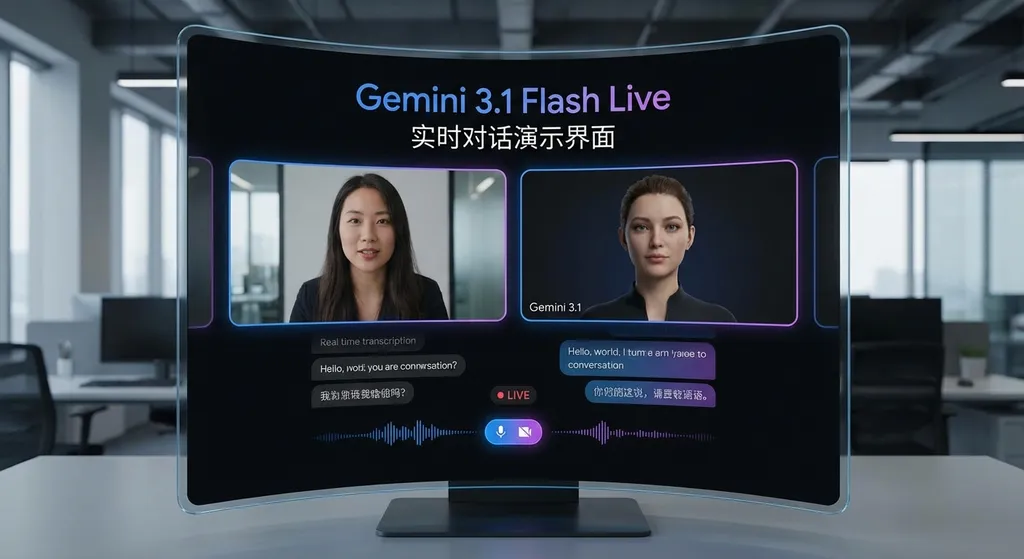
At Google I/O 2022, then-CEO Sundar Pichai demonstrated LaMDA, the predecessor of Gemini, in a smooth sci-fi-like conversation. But once the product rolled out, users found a fatal flaw: the cloud processing chain was too long, averaging 2.3 seconds from wake-up to response.
2.3 seconds in voice interaction is social death—long enough for awkward silence. Worse yet in smart home scenarios: shouting “Turn on the light!” with greasy hands in the kitchen, only for the speaker to freeze while you’ve already walked over to press the switch.
Over three years, Reddit’s r/googlehome board accumulated over 42,000 complaint posts. The most brutal one from 2024: “I bought six Google Nests. Their biggest use now is as alarm clocks—because clocks don’t need to talk.”
Google didn’t sit idle. In 2023, it released “Quick Response Mode,” cutting latency to 1.2 seconds, but at the cost of accuracy. Users often got off-topic answers. A former Google Assistant engineer revealed on Blind that the team hit a “latency–accuracy” deadlock: speed required fewer model layers, accuracy called for more compute, and edge devices simply couldn’t handle both.
It wasn’t until Gemini 3.1 Flash Live that this knot was untied.
Architectural Overhaul: Splitting the Brain in Half
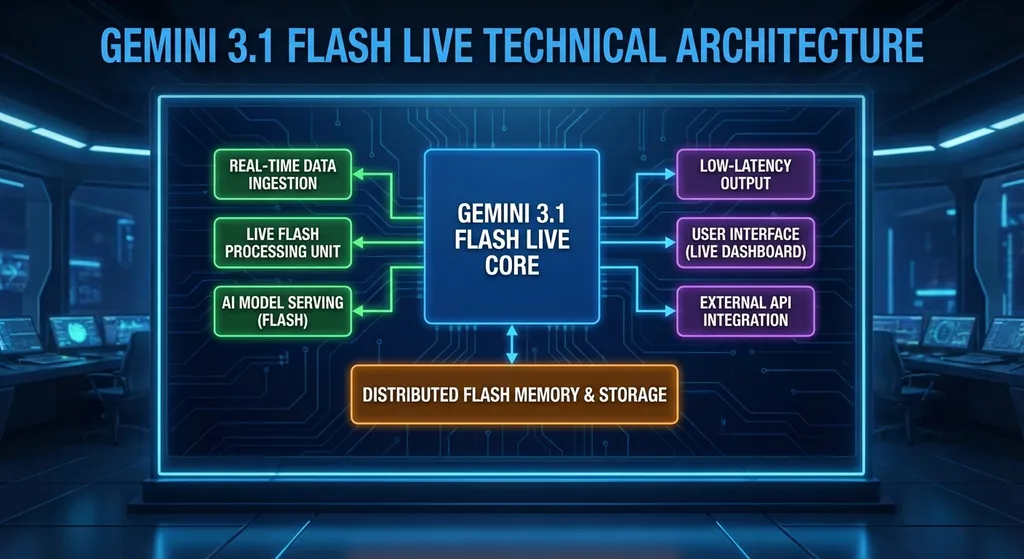
Flash Live’s breakthrough lies in its rearchitected dual-pipeline design:
- Intuition pipeline: a lightweight model running locally, handling wake-up and simple commands (turn on the light, adjust temperature)
- Reasoning pipeline: the full model in the cloud, processing complex queries (“Find a sci-fi movie from the 2010s rated above 8.”)
They work together via a predictive coordination mechanism—the local model anticipates user intent and prewarms cloud resources. As Audrey Tang, VP of Product at Google DeepMind, simply put it:
“Previous systems were like single-threaded CPUs—you had to wait for one task to finish before starting the next. Flash Live is multicore: wake-up, comprehension, and generation now overlap.”
Test results are clear:
- Simple commands: latency dropped from 2.1s to 380ms
- Complex queries: from 4.7s to 1.2s
- Interruptions: users can interject while Gemini is speaking; context switching happens within 200ms (older versions required full re-wake-up)
Another hidden upgrade: the context window doubled. It now retains longer conversational history without “forgetting” across multiple dialogue turns.
Benchmarks: Outperforming GPT-4o and Claude Across the Board
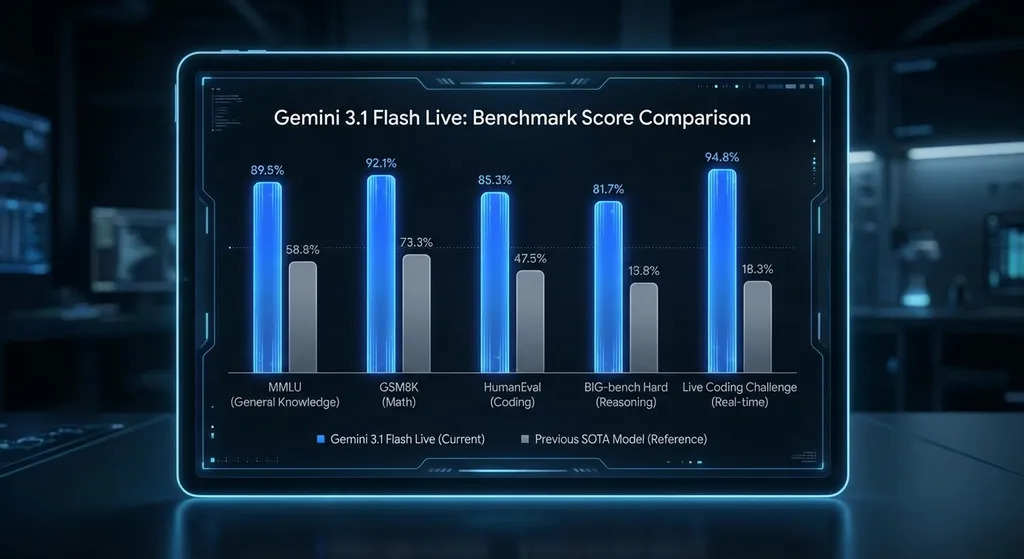
Google published detailed benchmark data showing top scores across several key dimensions:
ComplexFuncBench Audio (function call accuracy)
- Gemini 3.1 Flash Live: 90.8%
- Gemini 2.5 Flash (Dec 2024): 71.5%
- Gemini 2.5 Flash (Sep 2025): 66.0%
This measures tool invocation ability in multi-step tasks. A 90.8% score means reliable comprehension of chained commands like “Book a meeting room for tomorrow at 3 p.m., then email the participants.”
Scale Audio MultiChallenge (audio output quality)
- Gemini 3.1 Flash Live: 36.1%
- GPT-Realtime-1.5: 34.7%
- Qwen3 Omni 30B A3B Instruct: 24.3%
- GPT-4o Audio preview: 23.2%
This benchmark evaluates handling of hesitations, interruptions, and mispronunciations in audio input. Though 36.1% sounds modest, note that offline non-real-time models only score around 50%. Real-time voice interaction is far more technically demanding.
Big Bench Audio (reasoning ability)
Flash Live also ranked near the top in this reasoning test with 1,000 audio-based problems. Google didn’t publish specific scores, but based on other benchmarks, performance should be strong.
Real-World Experience: The Devil Is in the Details
Beyond numbers, Flash Live’s real-world improvements are more telling:
More natural intonation, speed, and pauses. Previous Gemini Live sounded like a news broadcast—each word clearly enunciated but robotic. Flash Live adapts rhythm to context: fast when needed, pauses organically.
Better noise resistance. In cafés or subway stations, previous versions misheard or triggered incorrectly under background noise. Flash Live filters ambient noise much more effectively, improving instruction reliability.
Tighter compliance with complex instruction constraints. For example, when asked “Summarize this paper in a casual tone, under 100 words,” it adheres to tone, length, and content simultaneously—old versions struggled with this balance.
Users with the update are exploring new tricks. Some now use voice commands to have the model generate short vocal segments—a capability that can be triggered in dialogue. Though Google hasn’t officially promoted this feature, the technical structure does support audio generation.
API Pricing: Audio Input and Output Are Not Cheap
Flash Live’s API is now live, with the following pricing:
- Text input: $0.5 / million tokens
- Text output: $4.5 / million tokens
- Audio input: $3 / million tokens
- Audio output: $12 / million tokens
Audio I/O costs are 6× and 2.7× higher than text, respectively. Clearly, Google wants developers to use text by default and switch to audio only when necessary.
For heavy voice-interaction applications (like call center bots or voice assistants), costs add up. Suppose a bot handles 1,000 calls per day, 5 minutes each, with half input and half output audio—monthly API costs range around $4,500–$6,000.
If you’re using OpenAI Hub to call Gemini APIs, here’s how to integrate Flash Live:
import openai

# Configure OpenAI Hub
client = openai.OpenAI(
    api_key="your-openai-hub-key",
    base_url="https://api.openai-hub.net/v1"
)

# Call Gemini 3.1 Flash Live
response = client.chat.completions.create(
    model="gemini-3.1-flash-live",
    messages=[
        {"role": "system", "content": "You are a voice assistant."},
        {"role": "user", "content": "What’s the weather in Beijing tomorrow?"}
    ],
    # For audio input/output, specify modalities
    modalities=["text", "audio"],
    audio={"voice": "alloy", "format": "wav"}
)

print(response.choices[0].message.content)
OpenAI Hub supports the entire Gemini lineup and uses OpenAI-compatible formats—accessible directly within China without VPNs.
SynthID Watermark: Preventing AI Voice Impersonation
Flash Live outputs are embedded with SynthID watermarks, a DeepMind-developed technique for audio marking—imperceptible to humans but detectable by tools.
Why add watermarks? Because Flash Live’s voice realism can enable impersonations. Google notes that partners like Home Depot and Verizon are testing it for customer service. If Flash Live audio is misused for fraud or identity spoofing, SynthID helps verify authenticity.
It’s a delicate balance: Google wants speech realism that could pass a Turing test, but also safeguards against abuse. SynthID is a compromise—but its reliability remains to be seen. If scammers re-record or regenerate the audio, the watermark might vanish.
Siri’s “Savior”?
After Flash Live’s release, online users dubbed it Siri’s savior—and not without reason.
The day before launch, media leaked that Apple’s WWDC 2026 will spotlight AI, unveiling a new Siri version. Crucially, Apple reportedly gained direct access to Google’s full Gemini model, planning to distill and deploy a lightweight edge AI onto iPhones.
If true, Apple could use Gemini as Siri’s brain—processing complex queries in the cloud while handling simple commands locally. That’s precisely Flash Live’s architectural philosophy.
Apple–Google AI collaboration isn’t new: in June 2024, Apple announced Gemini integration into parts of iOS 18. But adopting Gemini as Siri’s core engine is huge—it implies Apple acknowledging its lag in large-model tech and leveraging Google to catch up.
For Google, this is a triumph. Siri’s user base exceeds 1 billion; if Flash Live powers Siri’s backend, Google’s footprint in voice interaction could skyrocket.
The “iPhone Moment” of Voice Interaction?
Community feedback on Flash Live is largely positive. Some users call it a “powerful update,” with faster responses being a “key UX breakthrough.”
Others remain cautious. A Hacker News developer noted:
“400ms latency is a milestone, but the real challenge is long-term stability. If performance and continuity stay consistent over time, adoption will surge. But if it's only impressive in demos, it’s meaningless.”
A fair point—Google’s demos often wow, but product reality disappoints. Early Gemini Live versions were prime examples: overhyped launches, underwhelming usability.
Will Flash Live repeat history? Too soon to say. But judging from architecture and benchmarks, this time Google seems serious.
If Flash Live truly sustains its demo-level performance, voice interaction may indeed reach its own ‘iPhone moment’—the way the iPhone redefined touch interaction in 2007, Flash Live could redefine voice.
But that “if” still needs time to prove.
Final Thoughts
The launch of Flash Live marks a crucial leap from “usable” to “delightful” voice interaction. A 400ms response, 90.8% function-call accuracy, and stable complex instruction comprehension showcase three years of Google’s technical grind.
But breakthroughs are just the beginning. For voice AI to truly go mainstream, cost, privacy, and misuse must be addressed. Flash Live’s API isn’t cheap; SynthID’s protection remains untested; long-term stability demands more field data.
Still—at least now we can say:
AI voice assistants are finally no longer clueless.
References
- Gemini 3.1 Flash Live: AI Voice Conversation Reaches Near-Human Level – Sina Tech Flash News on launch
- Google Ushers in a New Era of Voice Agents: Productivity by Speech, Siri’s Strongest Add-on? – Detailed intro and benchmark coverage
- Google Finally Fixes Three-Year Voice Latency Bug – Deep-dive into Google’s voice interaction evolution
- Google Cuts the Search Bar—350 Million People Shout Instead – Discussion on Flash Live’s impact on search UI
- Gemini 3.1 Flash Live: AI Voice Dialogue Reaches Near-Human Level – Google’s official blog technical interpretation


