
Swedish team trains neural networks in physics before design, making nanophotonic material screening 10 times faster

Chalmers University of Technology has directly embedded physical laws into neural networks, reducing the training time for screening nanophotonic materials from 30 days to 3 days. This is not about brute-force computing power, but about enabling AI to understand fundamental physics before training.
Swedish Team Makes Neural Networks Learn Physics Before Designing, Accelerates Nanophotonic Material Screening by 10x
A research team from Chalmers University of Technology just published a paper in Laser & Photonics Reviews, with one core idea: embed physical laws directly into neural networks so that AI understands fundamental physics before training. The result: the training time for nanophotonic material screening was reduced from 30 days to 3 days, with improved prediction accuracy.
The interesting part is not just “another AI acceleration” — it’s about a shift in thinking. In recent years, the AI community has been focused on scaling up computing power and datasets, but this team went the opposite direction: since physical laws are deterministic, why make models derive them from scratch?
How Slow Traditional AI Material Screening Is
Nanophotonics studies light propagation and interaction on scales smaller than the wavelength of light. At this scale, light behaves completely differently than in the macroscopic world. Natural materials have limited performance, so artificial optical materials must be designed for precise light control.
The challenge is in how to design them. The traditional process is: propose a structure → run electromagnetic simulations → evaluate optical properties → if unsatisfactory, adjust parameters → run simulations again. Generating one data point takes 10 minutes to 1 hour, and training a neural network model may require 40,000 data points. That means just generating the training data could take weeks to months.
Machine learning can indeed accelerate this process, but the bottleneck is data generation. No matter how smart the model is, it still needs enough samples to learn from. The Chalmers team previously ran into this problem: they wanted to use AI to optimize nanostructure designs but discovered most of the time was spent waiting for data.
Giving AI a Physics Lesson First
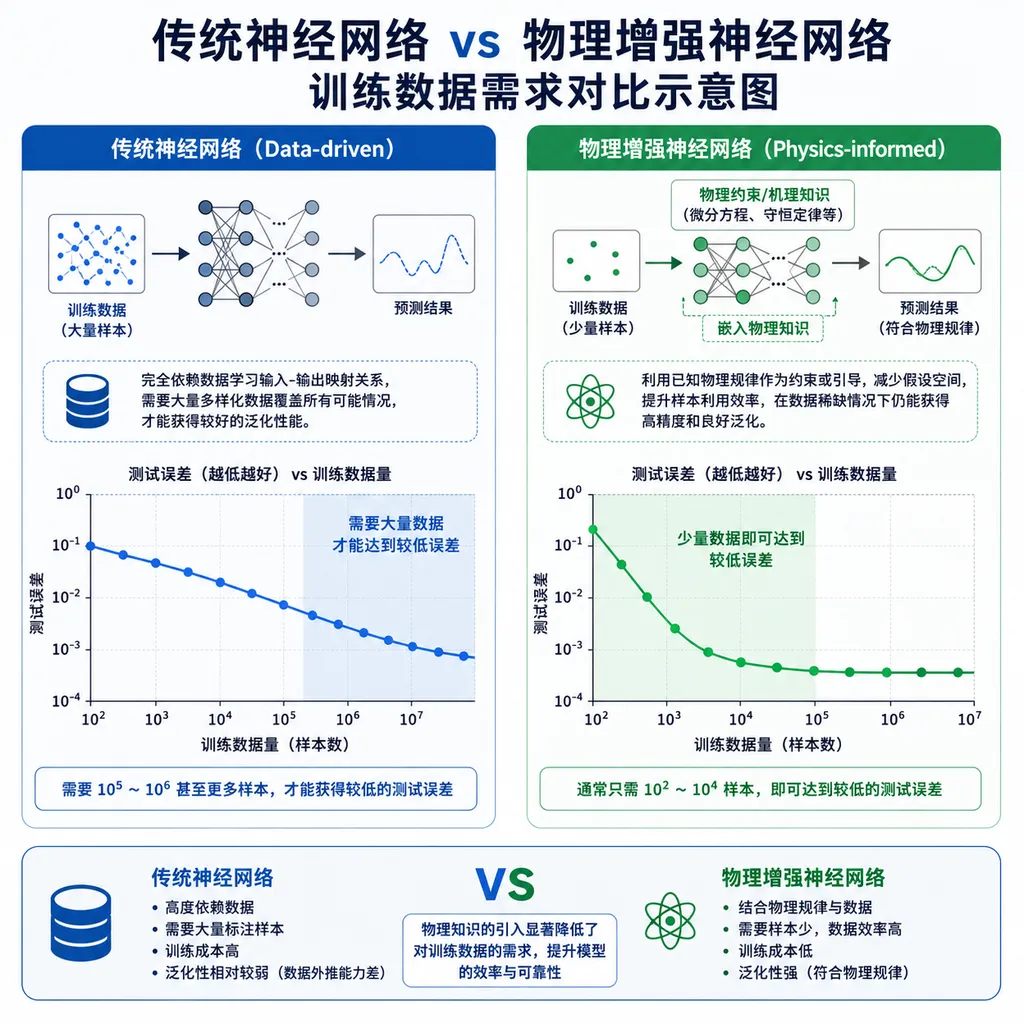
The team’s breakthrough came from changing the relationship between neural networks and physical laws. Traditionally, neural networks “discover” physical laws by themselves from large amounts of simulation data — much like asking someone who has never attended a physics class to deduce Newton’s laws through repeated experiments.
The Chalmers approach: encode the basic laws of physics and electromagnetism directly into the neural network architecture. Specifically, they embedded constraints from Maxwell’s equations into the network, so the model already “knows” light propagation rules in media, boundary conditions, energy conservation, and other basic physics before training.
This way, the model doesn’t need to infer these laws from data — it only needs to learn higher-level questions like “how does light behave in this particular nanostructure.” The data requirements instantly drop by an order of magnitude.
From 30 Days to 3 Days, With Improved Accuracy
The test results are straightforward: what used to take 30 days for data generation and model training now takes 3 days. There’s no faster hardware — they simply generated 90% fewer training data.
More importantly, accuracy improved. Normally, fewer data should mean worse model performance. But since physical constraints act as a strong prior knowledge, the model avoids obvious physically inconsistent mistakes. For example, when predicting the transmittance of a structure, a traditional model might return results violating energy conservation, but a physics-enhanced model won’t make such elementary errors.
Once trained, this “physics-aware” neural network can predict the optical properties of any nanostructure in milliseconds. By comparison, traditional electromagnetic simulation software (like COMSOL or Lumerical) takes minutes to hours for a single run.
This speed difference means quick iteration through thousands of candidate designs during the design phase to pick the optimum. Previously, you might only test dozens of design schemes; now you can exhaustively explore the entire parameter space.
Not Just for Optical Materials
This approach has a much wider application scope than nanophotonics. Any field requiring large-scale physical simulations with expensive data generation can benefit:
Quantum Computing: Qubit design demands precise control of electromagnetic fields and material properties, with traditional simulations being extremely time-consuming. Physics-enhanced neural networks can accelerate optimization of superconducting and topological qubits.
Advanced Optical Devices: Designing metalenses, optical metasurfaces, and integrated photonic chips involves complex light-field manipulation, and now these design cycles can be greatly shortened.
Materials Science: Predicting electrical, magnetic, and thermal properties of new materials traditionally relies on density functional theory (DFT) calculations, which are costly. Embedding quantum mechanics constraints into neural networks can speed up material screening without sacrificing physical correctness.
Fluid Dynamics and Aerodynamic Design: Optimization of airplane wings and turbine blades requires numerous CFD (computational fluid dynamics) simulations. Physics-enhanced neural networks can significantly cut down simulation counts.
Similar ideas are emerging in other fields. In September 2025, Nature published a review on “Physical Neural Networks,” discussing using physical systems like light, electricity, or vibrations directly for computation to bypass traditional GPUs. While Chalmers’ work still runs on digital hardware, the core idea is the same: leverage physical laws themselves to reduce computational complexity.
Limitations of This Direction
Physics-enhanced neural networks are not a silver bullet. They require a clear understanding of the problem’s underlying physics and the ability to write down the governing equations. For complex systems whose physics is unclear (like biological systems or social networks), this method won’t apply.
Another drawback is generalization. Traditional neural networks, though data-hungry, can generalize well to similar problems once trained. Physics-enhanced models, because they embed specific physical constraints, may require redesigning the architecture for a different problem.
Engineering difficulty is also a factor. Encoding Maxwell’s equations or the Schrödinger equation into a neural network is not as simple as adding a few fully connected layers — it requires deep knowledge of numerical methods for differential equations and automatic differentiation frameworks, making development harder than standard deep learning.
However, these limitations don’t change one fact: in fields with well-defined physical laws and high simulation costs, physics-enhanced neural networks have already proven their value. The Chalmers team’s tenfold reduction in training time is not the finish line — it’s the starting point.
A New Relationship Between AI and Physics
In recent years, AI’s main development paradigm has been “data and compute solve everything.” Large models, Transformers, GPT — the core strategy is brute force: pile on data, parameters, and compute to let the model extract patterns from massive samples.
This approach works in NLP and computer vision because the “rules” in these domains are fuzzy and statistical. But in scientific computing and engineering design, physical laws are deterministic and precise. Asking a model to rediscover Newton’s laws or Maxwell’s equations from data is inefficient and unreliable.
The Chalmers work represents another direction: encode humanity’s existing scientific knowledge into AI systems so models stand on the shoulders of giants instead of starting from scratch. This is not a negation of deep learning but a supplement and upgrade.
Similar approaches are being explored in drug design, protein folding prediction (AlphaFold embeds physical and chemical constraints), climate modeling, and more. In the coming years, this type of “knowledge-enhanced AI” may become increasingly important in science and engineering applications.
For developers, this means that pure machine learning skills are not enough. You need to understand the physical essence of the problem you aim to solve to design truly efficient models. Cross-disciplinary skills — deep learning + physics + mathematics + domain expertise — will become increasingly critical.
References
- Science and Technology Daily - Digital “Super Brain” Dramatically Improves Optical Material Screening Speed — official report providing research team background and technical details
- BAAI Hub - Breaking GPU Dependence! Nature Publishes “Physical Neural Network” Review — interpretation of the Nature review, discussing broader background and future directions of physical neural networks


