
NVIDIA Secures Doosan Full Suite: From Robotic Arms to Nuclear Power Plants
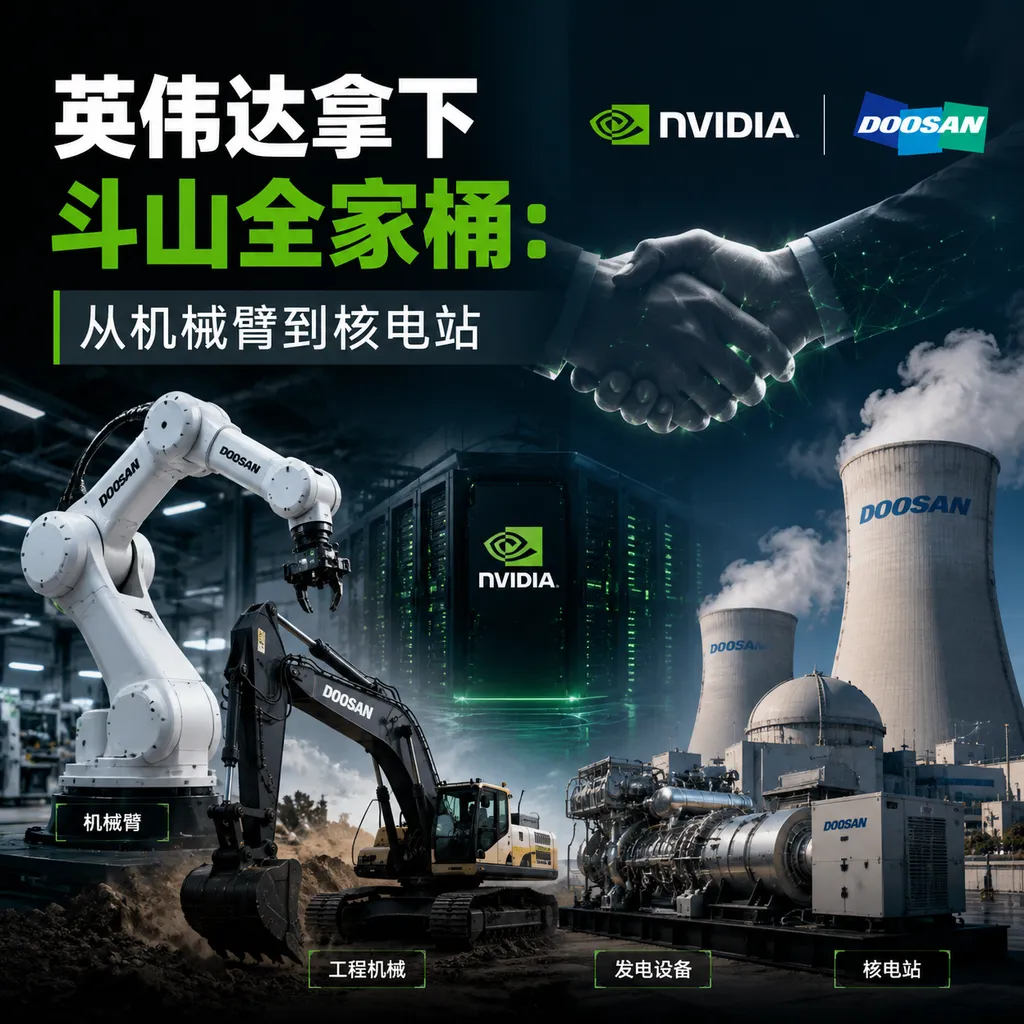
NVIDIA officially announced today that it has reached a comprehensive partnership with South Korea’s Doosan Group, launching four simultaneous lines from robotics and construction machinery to energy infrastructure. Doosan Robotics will rebuild its operating system based on Isaac Sim and Cosmos, aiming to shift from selling robotic arms to becoming a full-stack AI solutions provider.
Nvidia Secures Doosan’s Full Portfolio: From Robotic Arms to Nuclear Power Plants, Physical AI Gets Serious
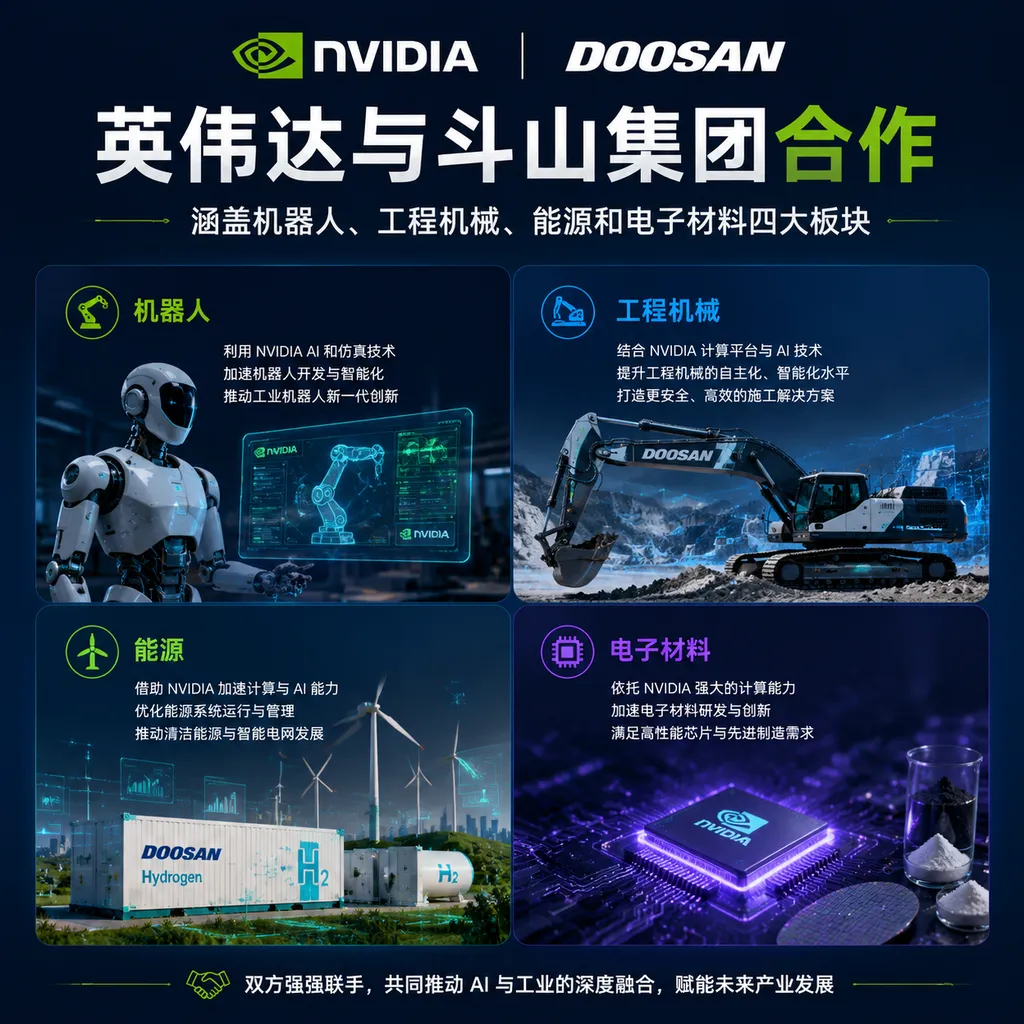
Today (June 8), Nvidia officially announced an expanded collaboration with South Korea’s Doosan Group. This time it’s not a single breakthrough, but an all-in-one package covering Doosan’s four major business segments — robotics, construction machinery, heavy industries & energy, and electronic materials — with full coverage from the software stack to the hardware supply chain.
The signal value of this cooperation is more important than the specific terms. Nvidia has been touting “Physical AI” at GTC for over a year and now needs real-world cases to prove it’s more than just a PowerPoint presentation. Doosan, meanwhile, needs a technology anchor to transform itself from traditional manufacturing into a player in the AI era. Both sides get what they want, but whether it can actually work will depend on how it’s executed.
Doosan Robotics’ Transformation Gamble: From Selling Mechanical Arms to Selling “Brains”
Doosan Robotics is making the boldest move. It plans to integrate Nvidia’s Isaac Sim, Cosmos world model, and Jetson Thor chips into its “Agentic Robot OS,” with the goal of transforming from a simple mechanical arm supplier into a full-stack AI robotics solutions provider.
The logic behind this transformation is clear: The traditional industrial robotics market is a red ocean, dominated by the “big four” — FANUC, ABB, YASKAWA, and KUKA — with fierce price wars. If Doosan continues to focus only on mechanical arm hardware, its growth ceiling is obvious. But if it can embed AI capabilities to shift robots from “programmed execution” to “task understanding and autonomous decision-making,” it can open up new value space.
How will this be done? It hinges on three key technical components:
Isaac Sim is Nvidia’s robot simulation platform built on Omniverse, supporting physically accurate digital twins. Doosan can train robots in virtual environments, run extreme scenarios, then transfer strategies to real hardware — much faster and cheaper than repeated trial-and-error on a production line.
Cosmos World Model is Nvidia’s flagship Physical AI foundational model, capable of understanding 3D space, object interactions, and physical laws. Doosan can use Cosmos to generate synthetic training data, enabling robots to handle unfamiliar scenarios. Traditionally, robots require dedicated control code for each task; Cosmos aims to give robots generalization — encountering a new task and reasoning out solutions.
Jetson Thor is Nvidia’s edge AI computing platform designed for humanoid robots, integrating a Transformer engine and multimodal processing. Doosan plans to embed it in robot controllers for real-time AI inference, allowing local decision-making without sending data to the cloud — lowering latency and removing network dependency.
Doosan also mentioned exploring dual-arm and humanoid robots. Dual-arm robots are much more flexible than single-arm robots for assembly and packaging tasks requiring two-handed coordination, but also much harder to control. Humanoid robots are more of a long-term goal — Doosan mostly makes collaborative robotic arms now — but it signals their direction.
Whether this transformation succeeds depends mainly on:
- How well Cosmos’ world model generalizes in industrial scenarios — current demos show relatively simple cases.
- Whether Doosan can turn AI capabilities into products customers will pay for, instead of just technology showcases.
Doosan Bobcat: Putting Physical AI in Excavators
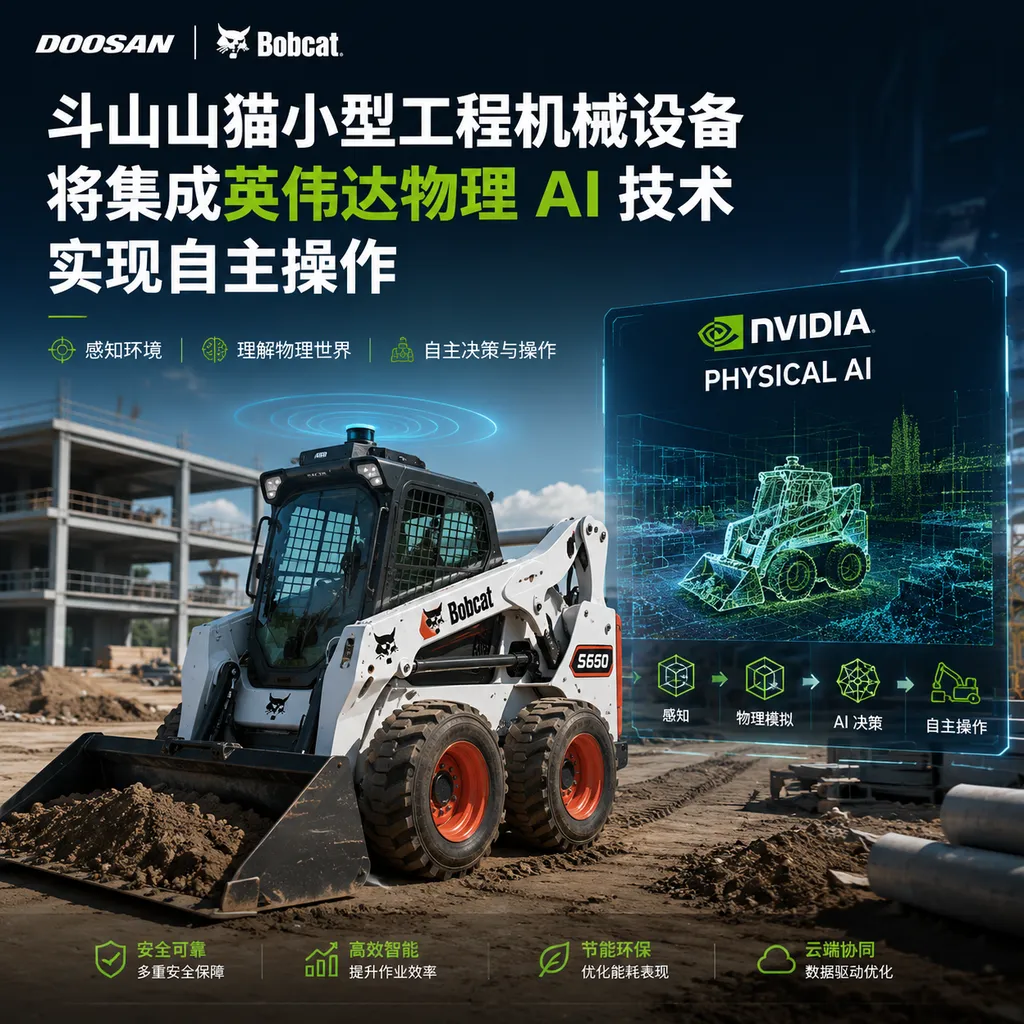
Doosan Bobcat focuses on small construction machinery — skid steer loaders, mini excavators, and telescopic handlers. In this partnership, Bobcat will introduce Nvidia’s Physical AI into construction, agriculture, and material handling equipment, aiming to promote an “industry-standard ecosystem for compact autonomous machines.”
Automation of construction machinery has been discussed for years, but progress has been slow due to complex environments. Construction sites, farms, warehouses — each has unique terrain, obstacles, lighting conditions — making it hard for traditional rule-based systems to cope.
The Physical AI approach equips equipment with perception and reasoning: Using cameras and LiDAR to understand surroundings, world models to predict object motion and terrain changes, and then autonomously planning paths and operating strategies. For example, excavators can judge soil hardness/depth, forklifts can recognize cargo positions and plan grabbing poses.
One challenge: Construction machinery lifespan is usually a decade or more — customers won’t replace old equipment just for AI functions. Automation must be retrofittable or cost-effective in new equipment. Nvidia’s Jetson edge computing platforms are relatively power-efficient and affordable, suitable for embedding in such equipment.
Doosan Bobcat’s talk of promoting “industry standard ecosystem” is intriguing. The industry is highly fragmented — various equipment brands have different control interfaces and communication protocols. If Doosan and Nvidia define a unified software/hardware standard for autonomous machines, they could gain an ecosystem advantage. Of course, whether giants like Caterpillar or Komatsu play along is another matter.
Doosan Heavy Industries: Powering AI Factories
This line may seem unrelated to AI, but it strikes at a core Nvidia pain point: energy.
Training large models and running AI inference in data centers consumes massive power. An AI factory with thousands of H100s can demand tens of megawatts — like a small city. Traditional grids aren’t always stable, and many places lack sufficient capacity.
Doosan Heavy Industries is one of Korea’s largest power equipment makers, producing gas turbines, steam turbines, small modular reactors (SMRs), and hydrogen fuel cell systems. This partnership will explore power infrastructure for Nvidia’s AI factories.
Gas and steam turbines are mature technology and deploy quickly, but CO₂ emissions are a drawback. SMRs are next-gen nuclear tech — tens to hundreds of megawatts per reactor, smaller and faster to build than conventional plants, with zero carbon emissions. Nvidia CEO Jensen Huang has repeatedly highlighted nuclear power’s importance to AI infrastructure — Doosan’s SMR tech fits the bill.
Hydrogen fuel cells can serve as backup power and distributed energy. Data centers require extreme supply reliability — fuel cells can provide emergency backup or work with renewables to smooth peaks and valleys.
This cooperation is strategic — unlikely to have short-term breakthroughs, but in the long term, energy is indeed a bottleneck for AI infrastructure. If Nvidia can align its energy supply chain alongside chips, software, and computing power, its AI factory delivery capability will be far stronger.
Doosan Electronic Materials: Making PCBs for MGX
This is the most pragmatic and easiest to implement.
Doosan’s Electronic Materials division produces copper-clad laminates (CCLs), the core raw material for printed circuit boards (PCBs). In this partnership, Doosan will supply CCL materials for Nvidia’s MGX ecosystem AI servers and networking devices.
MGX is Nvidia’s modular AI server reference design platform, allowing OEMs to quickly build AI server products based on Nvidia GPUs. MGX defines specifications for motherboard, cooling, power, and interconnect — partners simply integrate hardware per these specs.
AI servers demand higher PCB performance than regular servers: higher signal frequencies, greater power density, stricter thermal requirements. CCLs must use low-loss, high-heat-resistant materials to ensure signal integrity and stability. Becoming MGX’s CCL supplier means Doosan gains a steady growth order source.
Technically, this line is less complex than the others, but supply chain stability matters greatly to Nvidia. AI server shipments are exploding — if upstream supply of materials can’t keep up, production capacity will be bottlenecked. Nvidia needs to bind more suppliers to spread risk.
Physical AI’s Implementation Challenges: From Simulation to Reality
Over the past year, Nvidia has repeated its “Physical AI” narrative at GTC and various industry events. The core idea: AI must move beyond language and images in the digital world into the physical world to truly transform productivity.
It sounds compelling, but implementing it is difficult. The biggest challenge is the sim-to-real gap.
Isaac Sim can model physical laws, lighting, and materials, but reality is more complex. Ground friction changes with dust or oil; rigidity and deformation of objects are hard to model precisely; sensors encounter noise under bright light, shadows, or reflections. Strategies that work beautifully in simulation can fail in reality.
The Cosmos world model aims to shrink this gap via large-scale learning, but the physical world’s long-tail scenarios are myriad. Language models can train on massive internet data, image models can expand datasets with generative methods, but physical interaction data is hard to collect en masse. You can’t let robots trial-and-error millions of times in reality — cost and safety forbid it.
Nvidia’s solution: use Cosmos to generate large synthetic datasets, validate in Isaac Sim, then fine-tune with small real-world datasets. Theoretically sound, but questions remain: How small is “small”? What kind of real data is most valuable? How to collect efficiently? Still under exploration.
Another issue: generalization. Traditional robots are task-specific — a mechanical arm assembling phone camera modules executes a fixed script; swap the part and you must reprogram. Physical AI aims for general capability — seeing a new task and reasoning out a solution. But where is the boundary of “general”? Within one product type? Across product lines? Across industries?
Companies like Skild AI and FieldAI are betting on the latter — training massive world models to understand physical laws, object properties, tool use, and then transferring this “brain” to any robot form with minimal hardware adaptation.
If this works, it’s revolutionary. But there’s no clear technical roadmap yet. The physical world’s state space is orders of magnitude larger than language or images — how big a model, how much data, how much compute to reach “general” remains unknown.
Doosan’s partnership essentially bets on Nvidia’s tech stack succeeding. If Physical AI lands, Doosan will reap technical dividends and ecosystem advantage; if not, the investment becomes sunk cost.
Competitive Landscape: Who’s Fighting for Physical AI Standards
Nvidia faces many rivals in Physical AI.
Tesla has its own full-stack: FSD vision and perception system, Dojo training cluster, Optimus humanoid robot. Tesla’s advantage is closed-loop — vehicles and robots generate massive real-world data for training, improved models are pushed back to devices. As a platform vendor, Nvidia relies on partners for data, making its loop less efficient.
Figure, 1X, Agility — these humanoid robot companies use Nvidia’s stack but also develop their own AI. Figure works with OpenAI for multimodal understanding via GPT; 1X has its own world model; Agility is building end-to-end warehouse solutions. Currently partners, but if their AI gets strong enough, they may reduce dependence on Nvidia’s software stack, using only chips.
ABB, FANUC, YASKAWA, KUKA — the big four industrial robot giants all partner with Nvidia yet have their own software platforms and ecosystems. Nvidia must deeply integrate Isaac and Cosmos into their systems — more than bolting on an AI module — requiring strong ecosystem integration.
Chinese robotics companies are catching up fast. Zhiyuan, Fourier, and UBTECH are making humanoid robots — some use Nvidia’s stack, some their own. Domestic advantage lies in rich scenarios and rapid iteration, but in foundational models and simulation platforms, they lag Nvidia.
The battle over Physical AI standards is essentially an ecosystem battle. Nvidia’s strategy: lock developers with CUDA and Omniverse, lower barriers with Isaac and Cosmos, cover compute from edge to data center with Jetson and Thor, and let partners build products atop this system. If the ecosystem forms, Nvidia could become Physical AI’s infrastructure provider — like it was in deep learning.
But Physical AI differs from deep learning: deep learning centers on compute and algorithms — Nvidia excels here. Physical AI also requires real-world data, hardware integration, and scenario understanding — not Nvidia’s strengths. It must find strong partners to land this stack in practical applications.
Doosan is such a partner: hardware capability, application scenarios, customer base — but needs AI upgrades. Whether the partnership works will be a major indicator of Physical AI’s viability.
Lessons for Developers
If you’re developing robotics, this partnership offers several points of interest:
Lower barriers for Isaac Sim and Isaac Lab — Nvidia recently released Isaac Lab 3.0 with the new Newton physics engine, supporting multi-physics simulation and faster training. If you found Isaac Sim too heavy before, now’s a good time to try again.
Cosmos world model now commercially licensed — Nvidia announced GR00T N1.7 supports commercial licensing, meaning you can build products atop Cosmos without licensing issues. Details and pricing depend on Nvidia.
Rapid expansion of Jetson Thor ecosystem — For edge AI devices, Jetson Thor is worth a look. It integrates a Transformer engine, offering stronger multimodal processing than Jetson Orin, with good power control.
Sim-to-real transfer remains tricky — No matter Nvidia’s claims, the sim-to-real gap is unavoidable. If building real products, allocate enough real-world testing time — don’t expect simulation tuning to deploy flawlessly.
Physical AI application boundaries are expanding — From industrial robots to construction machinery, warehouse logistics to agriculture — boundaries are widening fast. If your business involves automating the physical world, now is a good time to watch and invest. The tech isn’t mature yet, but the window could be just a year or two.
Final Words
On the surface, Nvidia and Doosan’s cooperation is a strategic alliance between a chip supplier and a manufacturing group. At its core, it’s an attempt to expand AI from the digital into the physical world.
The Physical AI story has been told for a while, but real-world cases are scarce. Most remain lab demos and proof-of-concepts — far from large-scale commercialization.
If this partnership works, it’ll be a significant milestone: proving Physical AI can become valuable products. If it fails, it’ll still yield valuable lessons for the industry — identifying dead-end tech paths and fake-use scenarios.
Either way, Physical AI is one of the most important tech directions in the coming years. Still in its early stage, with high uncertainty — but also huge opportunity.


