
Chinese large models have ranked first globally in usage for six consecutive weeks
OpenRouter's latest data shows that China's weekly AI large model usage has reached 14.19 trillion tokens, surpassing the United States for six consecutive weeks. The global top four are all domestic models. DeepSeek, MiniMax, Tencent, and Xiaomi occupy the leading positions, while the Claude series has fallen out of the top five for the first time.
China's Large Model Call Volume Tops Global Rankings for Six Consecutive Weeks
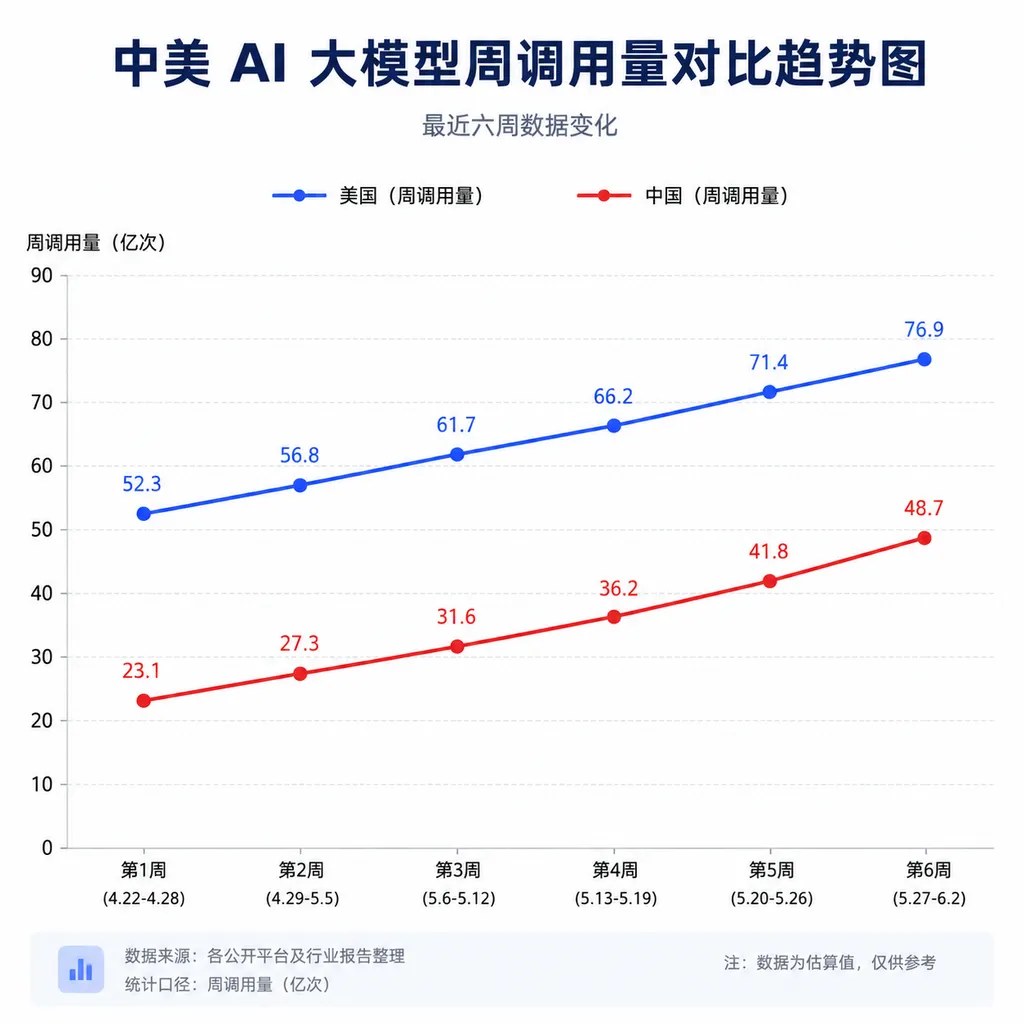
Last week (June 1–7), the global AI large model call volume reached 36.1 trillion tokens, with China recording a weekly call volume of 14.19 trillion tokens—surpassing the U.S. for six consecutive weeks—representing a 27.49% week-on-week increase. In the same period, the U.S. volume was only 3.2 trillion tokens, down 24.53% week-on-week. More critically, the top four models globally by call volume were all domestic Chinese models—signaling that China's large models have truly established themselves in the global developer ecosystem.
This is not merely a numbers game. Call volume reflects developers voting with their wallets, demonstrating that domestic models have formed a comprehensive advantage in performance, cost, and usability. From last year’s latter half, when the U.S. still had an absolute lead, to China overtaking for six straight weeks this year, the speed of this reversal has exceeded most people's expectations.
DeepSeek Tops for Three Consecutive Weeks, MiniMax Emerges as a Dark Horse
DeepSeek-V4-Flash, with a weekly call volume of 3.69 trillion tokens, has held the top spot for three weeks straight, growing 19% week-on-week. After its release late last year, it quickly became the developers’ first choice, for a simple reason: performance close to GPT-4 level, but priced at a tenth of the cost, and supporting a 128K context window. In scenarios requiring high-volume calls, this cost advantage is overwhelming.
Tencent Hy3 preview has held firm in second place for three consecutive weeks, with 2.94 trillion tokens in weekly calls. Although it saw a slight 3% week-on-week decline, considering it’s a preview version, maintaining such volume speaks to strong product capability. Tencent’s optimization in multimodal understanding and long-text processing gives it an edge in content moderation and customer service dialogues.
The real dark horse is MiniMax M3, which debuted straight into third place with 2.5 trillion tokens in weekly calls. It’s China’s first large model to simultaneously offer advanced programming capabilities, a one-million-token ultra-long context window, and native multimodal support. What does a 1M context mean? It can process about 750,000 Chinese characters in one go—equivalent to a medium-length novel. This capability is essential for scenarios like long-document handling, codebase analysis, and legal contract review.
Xiaomi MiMo-V2.5 ranks fourth with a weekly call volume of 2.19 trillion tokens, surging 50% week-on-week. Xiaomi’s integration with IoT devices and on-device inference has carved out a differentiated path in smart home and automotive systems. Notably, the heavily discounted MiMo-V2.5-Pro briefly surged to eighth place before quickly falling off the list, showing that call volume driven solely by price wars is unstable—developers value the balance between performance and stability.
Claude Series Falls Out of the Top Five for the First Time, U.S. Models Decline Across the Board
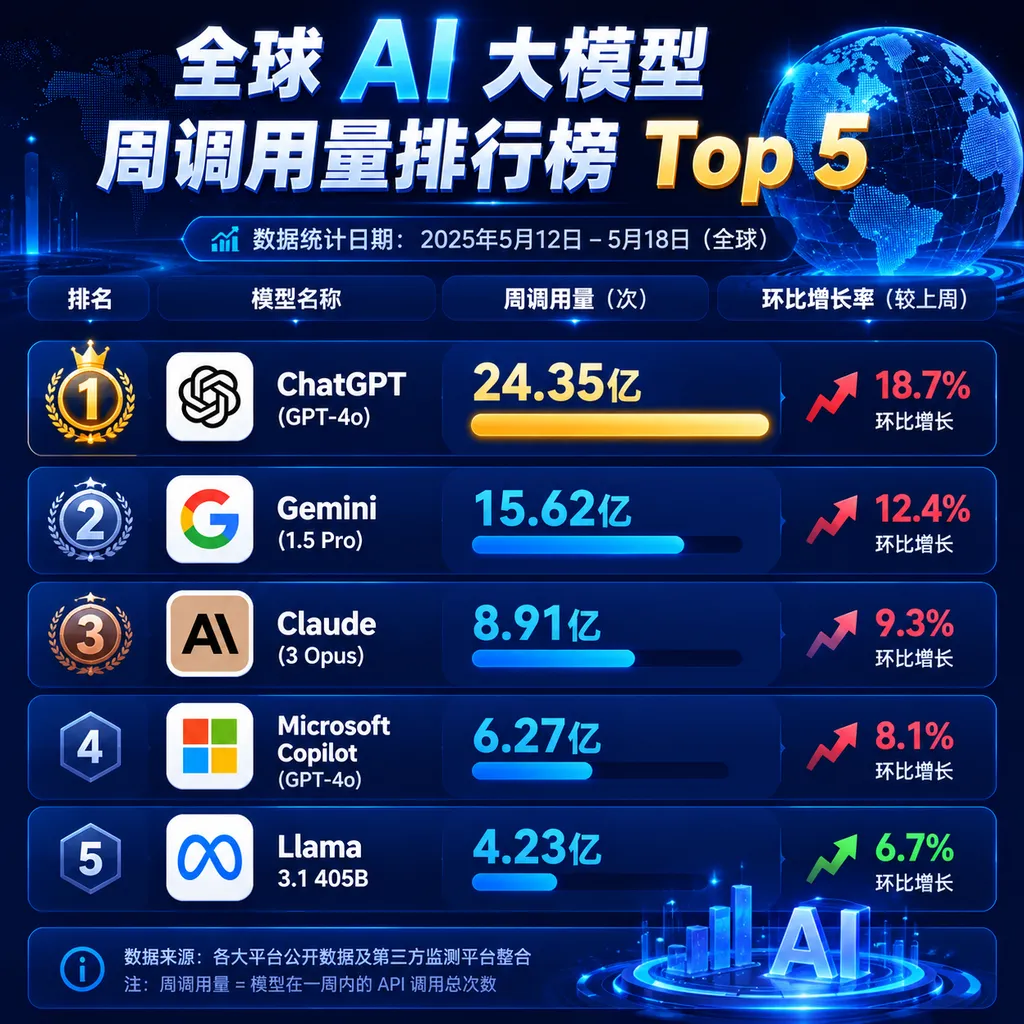
Claude Sonnet 4.6 and Claude Opus 4.7 both fell out of the top five, with weekly call volumes down 9% and 38% week-on-week, respectively. This is Claude Sonnet 4.6’s first time in nearly two months dropping out of the top five—bad news for Anthropic.
The Claude series has long been praised for code generation and complex reasoning tasks, but faces issues: First, prices remain relatively high—Opus 4.7’s input cost is 20 times that of DeepSeek-V4-Flash. Second, access in China is unstable, forcing developers to bypass network restrictions, adding integration costs. Third, domestic models’ advantages in Chinese comprehension and localized scenarios are becoming increasingly evident.
This is not to say Claude’s technology is lacking, but in global competition, pure technological leadership is no longer enough. Developers need comprehensive solutions—performance, price, usability, and localization support are all indispensable. Domestic models are rapidly catching up and even surpassing in these areas, weakening Claude’s moat.
In terms of overall vendor performance, DeepSeek’s total call volume reached 6.75 trillion tokens, topping the vendor rankings for four consecutive weeks, ahead of Anthropic and Google. MiniMax’s total call volume of 3.05 trillion tokens surpasses Xiaomi and Tencent, making it the new leader of the second tier. Both companies share traits: solid technology, fast product iteration, and flexible pricing strategies.
Surge in Call Volume Driven by Scene Implementation and Cost Optimization
China’s large models surpassing the U.S. for six weeks straight is driven by two core factors.
The first is fast scene implementation. Domestic vendors quickly expanded into high-frequency scenarios like e-commerce customer service, content moderation, code generation, and intelligent customer support—these scenarios generate astronomical call volumes. For example, a medium-sized e-commerce platform may generate tens of millions of dialogues per day; multiplied across tens of thousands of such platforms nationwide, volumes naturally rise. Domestic models’ strengths in Chinese comprehension, colloquial expression, and emotion detection make them more effective in these scenarios than English-centric models.
The second is extreme cost optimization. DeepSeek-V4-Flash’s input costs are $0.14 per million tokens, output $0.28, whereas Claude Opus 4.7’s input costs are $15, output $75. For applications with tens of millions of daily calls, the cost difference can be tens to hundreds of times—this isn’t pocket change, but a critical factor in whether a business model succeeds.
Price wars aren’t sustainable, but given narrowing performance gaps, cost advantages accelerate market reshaping. Developers aren’t philanthropists—if performance differences are small, they naturally choose the cheaper option. Domestic models, leveraging MoE (Mixture of Experts) architecture, inference optimization, and self-developed chips, have reduced costs to levels difficult for U.S. vendors to match.
Another often overlooked factor: direct domestic connectivity. For Chinese developers, accessing OpenAI or Anthropic APIs requires solving network issues, adding latency and compliance risks. Domestic models don’t face this problem, being deployed on local cloud services with low latency and high stability. For applications with strong real-time requirements—such as online customer service, game NPCs, and live streaming assistants—this is a hard metric.
The Double-Edged Sword of Pricing Strategy: Xiaomi's Lesson
After significant price cuts, Xiaomi MiMo-V2.5-Pro’s weekly call volume jumped 321% week-on-week, briefly reaching eighth place. But just one week later, it fell off the list, with volume dropping sharply. This case is highly representative.
Price cuts can quickly boost call volume, but without strong product competitiveness, users won’t stay. Developers aren’t attracted solely by low prices—they want value for money. If a model’s performance lacks stability, output quality is low, or API response speed is insufficient, even free offerings won’t gain traction.
Conversely, DeepSeek and MiniMax are also inexpensive, yet their call volumes keep growing, showing strong product capability. Developers are willing to pay for good products—but the product must genuinely solve problems. Price is only the entry point; long-term competitiveness depends on technology and service.
The Shift in the Global Developer Ecosystem’s Center of Gravity
OpenRouter, the world’s largest AI model API aggregation platform, offers objective call volume data reflecting real developer choices. Chinese models topping the charts for six consecutive weeks signals a shift in the global developer ecosystem’s center of gravity.
This shift isn’t limited to China. OpenRouter data shows developers in Southeast Asia, Latin America, and the Middle East are also using domestic models extensively. The reason is simple: developers in these regions are more cost-sensitive and less dependent on English-centric models, making domestic models’ value-for-money advantage more pronounced.
U.S. models still dominate in Europe and North America, but in Global South countries, domestic models are rapidly spreading. This is a noteworthy trend. The future of AI competition is not just about technology, but also ecosystem and market. Whoever best meets global developers' needs will gain the largest market share.
From this perspective, the rise of Chinese large models is no accident—it’s inevitable. A massive domestic market provides ample training data and application scenarios; fierce competition pushes vendors to iterate rapidly; cost optimization enhances competitiveness. These factors combine into a positive cycle.
How Large Is the Remaining Technology Gap?
Objectively, in certain frontier capabilities, domestic models still lag behind GPT-4o and Claude Opus 4.7. For instance, in complex reasoning, creative writing, and multilingual mixed comprehension, top U.S. models still have the edge. But the gap is shrinking quickly.
DeepSeek-V4 already matches or surpasses GPT-4 in math reasoning and code generation; MiniMax M3’s 1M context window is more practical than GPT-4o in some scenarios; Tencent Hy3 outperforms Claude in Chinese multimodal understanding. Domestic models’ strategy: not chasing overall leadership, but excelling in specific scenarios.
That strategy is smart. AI large models are not a single product, but a toolbox. Developers don’t need one universal model, but a matrix of models covering different scenarios. DeepSeek focuses on value, MiniMax on ultra-long context, Tencent on multimodal, Xiaomi on on-device integration—each with its own moat.
From call volume data, developers are voting with their feet. They don’t care which country a model is from; they care whether it solves problems, controls costs, and offers stable service. Domestic models already perform well enough in these dimensions—this is the fundamental reason for topping the charts for six consecutive weeks.
Upcoming Variables: Multimodal and On-Device Inference
The next phase of competition will focus on two directions: multimodal and on-device inference.
Multimodal is a must-have. Real-world information isn’t just text—it includes images, video, audio, and 3D data. Models capable of understanding and generating multiple modalities will hold advantages in more scenarios. MiniMax M3 supports multimodal natively, Tencent Hy3 has unique strengths in video comprehension—these capabilities will shine in short-video moderation, intelligent surveillance, and medical imaging.
On-device inference is even more crucial. Deploying large models on phones, IoT devices, and edge servers reduces latency, enhances privacy, and lowers cloud costs. Xiaomi is most aggressive in this area, with the MiMo series heavily optimized for on-device scenarios. As on-device compute power improves and model compression technology matures, more applications will move from the cloud to the device.
U.S. vendors are also working on these directions, but domestic vendors have the advantages of being closer to scenarios, iterating faster, and better localized. Whoever first completes a commercial loop in these areas will gain the upper hand in the next stage of competition.
Lessons for Developers
The changes in call volume rankings offer several lessons for developers:
First, don’t blindly chase the newest and most expensive model. Value for money is key. DeepSeek-V4-Flash’s performance already meets 90% of application scenarios, but costs only a tenth of top models. Unless your application demands extreme reasoning capability, there’s no need to pay 10 times more for a mere 10% performance gain.
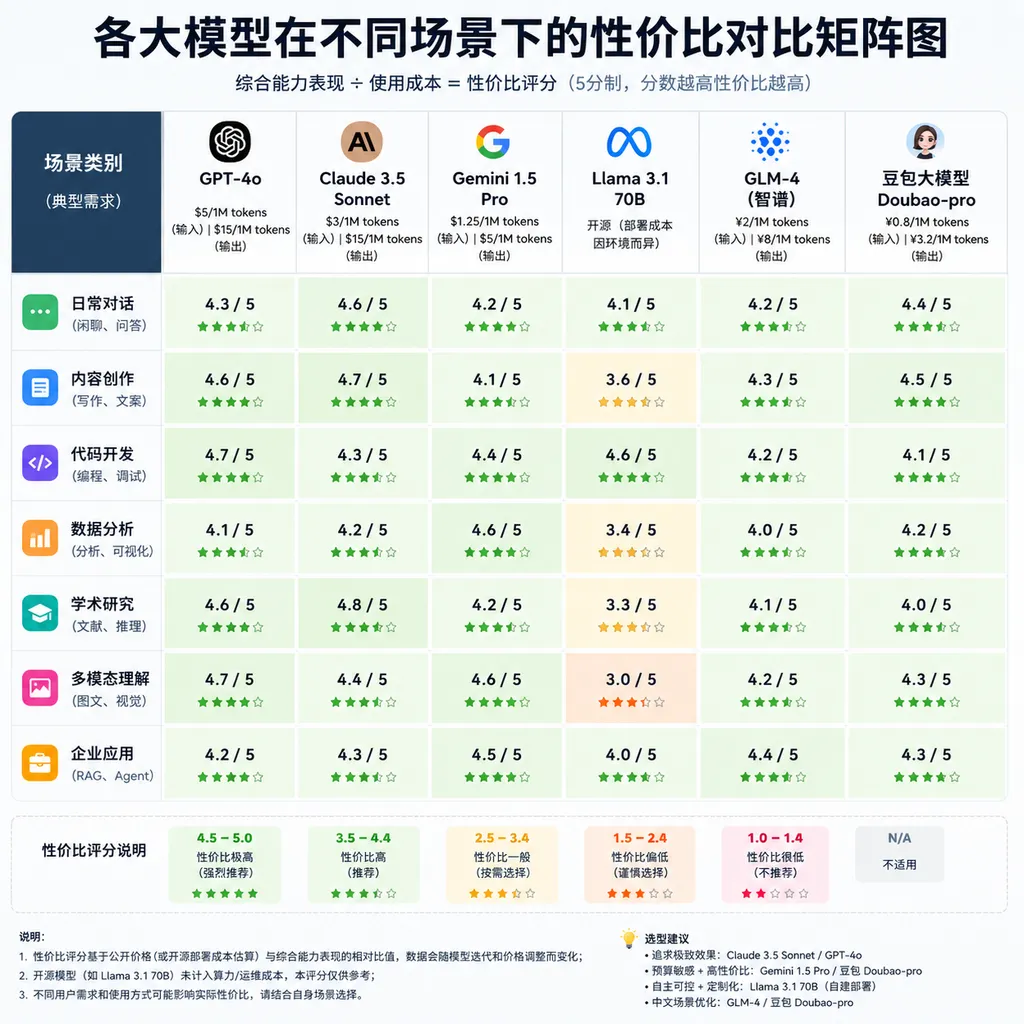
Second, multi-model strategies are the trend. No single model can cover all scenarios—matching different models to different tasks achieves the best balance between performance and cost. For example, use DeepSeek-V4-Flash for simple customer dialogues, MiniMax M3 for complex code generation, Tencent Hy3 for long-text analysis, Xiaomi MiMo for on-device inference. Platforms like OpenAI Hub are valuable here: one key to access all models, lowering integration costs.
Third, pay attention to call volume trends, but don’t be misled by short-term fluctuations. Xiaomi MiMo-V2.5-Pro’s boom and bust is a classic example. Truly competitive models will sustain growth, not blossom and wither. When selecting models, look at long-term trends, not promotional spikes.
Fourth, consider compliance and accessibility. For domestic applications, domestic models avoid network and compliance issues—a hidden cost factor. If your application needs high availability and low latency, domestic models are the safer choice.
Final Note
China’s large models topping global call volumes for six weeks straight is not due to policy support or low-price dumping—it’s genuine product competitiveness. Vendors like DeepSeek, MiniMax, Tencent, and Xiaomi got the technology, cost, and scenario deployment right, earning developer recognition.
The Claude series falling out of the top five isn’t because it got worse, but because competitors got stronger. This is an open global market, and developers vote with money. U.S. vendors still lead in certain frontier capabilities, but domestic vendors have matched them in overall competitiveness.
Competition will get fiercer. Multimodal, on-device inference, vertical scenario optimization—all offer opportunities. For developers, this is good news: more choices, lower costs, better service. For vendors, it’s a challenge: you must keep innovating to avoid being eliminated in this marathon.
The global AI large model landscape is being reshaped, and Chinese vendors are now at the table. Who will have the last laugh depends on who can continually create value for developers. Call volume is just the result; product strength is the cause.
References
- China AI Large Model Weekly Call Volume Surpasses U.S. for Six Consecutive Weeks, Top Four All Domestic - IT Home - Latest OpenRouter monitoring data detailing call volumes and ranking changes for each model
- China AI Large Models Surpass U.S. Weekly Call Volume, Dominate Global Top Three - Zhihu - Early data analysis showing the trend of China’s large model rise


