
WeChat AI Open Access: Automatic Code Reading vs. Self-Developed Skills
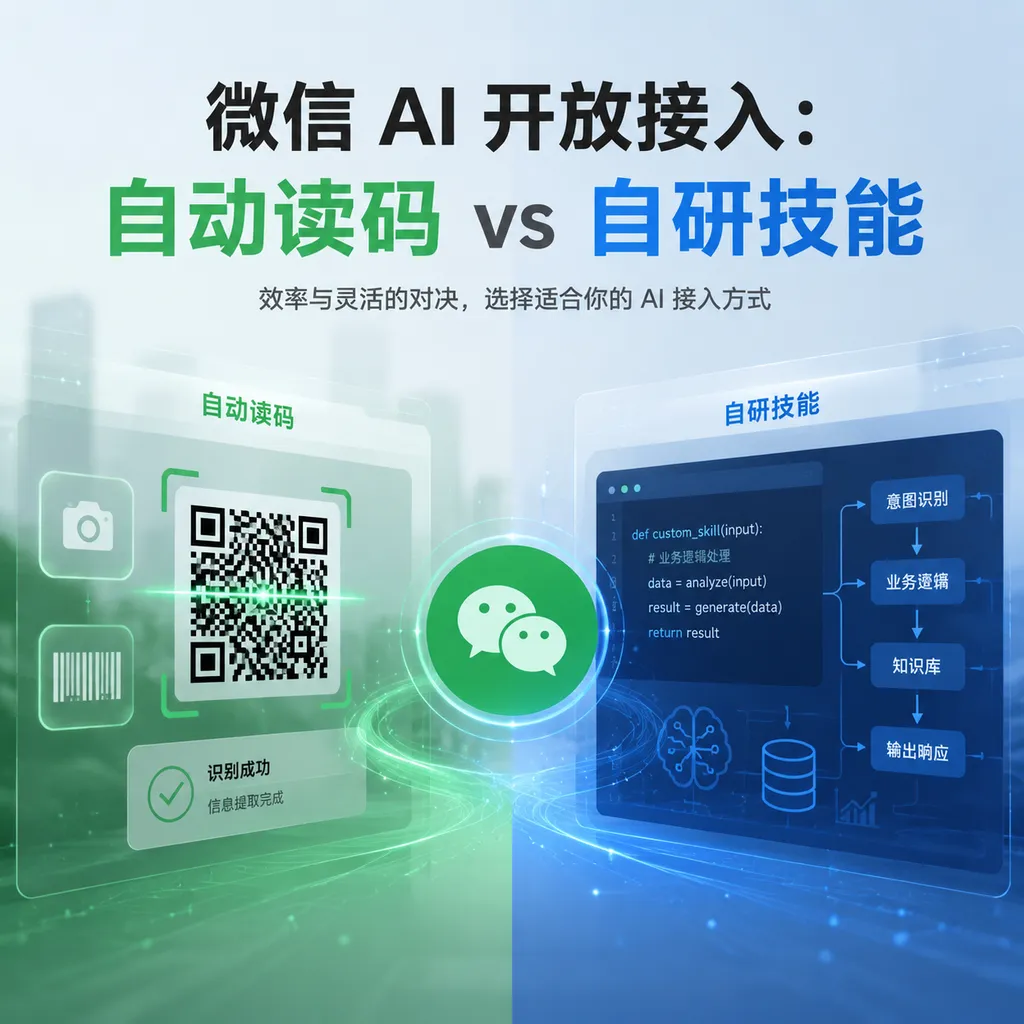
WeChat Open Platform today launched internal testing of its AI ecosystem, offering two integration options: automatic mode and development mode. As one of the first partners to join, JD.com will deploy Agent capabilities focusing on scenarios such as e-commerce, food delivery, and logistics.
WeChat AI Open Access: Automatic Code Reading vs Custom Skills
Today (June 8), the WeChat Open Platform has granted developers access to AI ecosystem integration capabilities, currently in the beta stage. This is not simply “adding a chat box” — it allows AI to directly operate mini program pages. A user says something, and the AI can help click buttons, fill out forms, and complete shopping processes.
JD.com has already joined as one of the first beta teams, deploying WeChat AI Agents for e-commerce, food delivery, logistics, and other services. This choice is unsurprising: JD.com has sufficiently complex business scenarios to validate AI capabilities' practicality, and enough technical accumulation to tolerate early version instability.
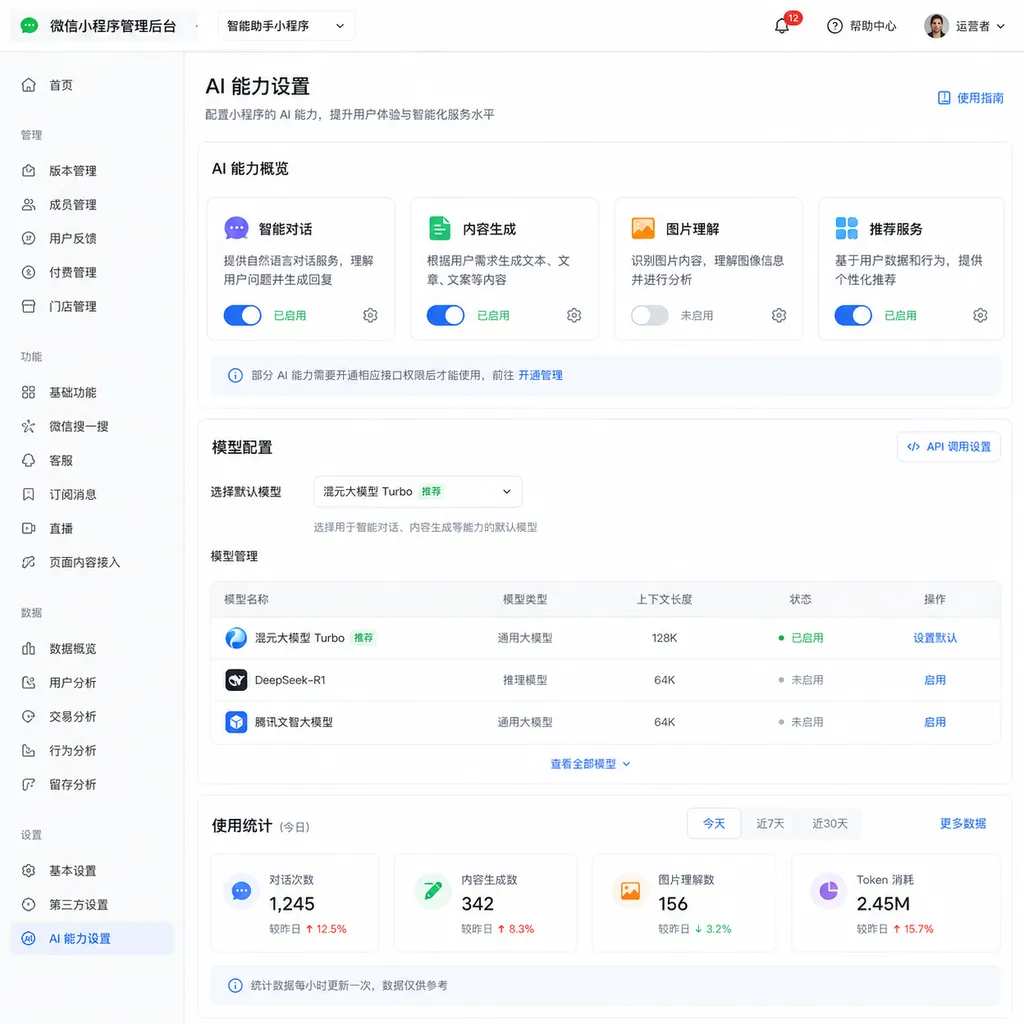
Two Modes: Automatic vs Manual
WeChat offers two integration options, differing in how much you want the platform to handle:
Automatic Mode: Authorize the platform to read the mini program source code during submission for review, automatically analyze the page structure, and let AI know which buttons can be clicked and which forms need to be filled. Developers don’t need to write any additional code — the platform will automatically generate operation instructions.
The benefit of this mode is zero development cost, suitable for small teams or simple mini programs. The downside is losing fine control over AI behavior — the platform’s analysis logic may not grasp your business’s special nuances. For example, in an e-commerce mini program, the platform may treat “Add to Cart” and “Buy Now” as equally important, whereas your business might prefer AI to guide users straight to checkout.
Development Mode: Developers define the AI-callable skills based on the business characteristics of the mini program. These skills must pass evaluation and platform review before going live, allowing precise control over AI’s behavioral boundaries and interaction logic.
This mode is suitable for complex businesses with special interaction flows. JD.com is likely using development mode — its shopping processes involve coupon calculations, address selection, payment methods, and other complex decisions that automatic mode can’t fully handle.
The two modes are not mutually exclusive and can be enabled simultaneously. In practice, developers might use automatic mode first to quickly cover general functions, then customize and optimize core business with development mode.
Technical Implementation: From Page Analysis to Skill Invocation
The core of automatic mode is the page analysis engine. The platform must extract page structure, interaction logic, and data flow from the mini program source code, then generate an AI-interpretable set of operation instructions. This is not simple DOM parsing — it must understand the mini program’s component system, event binding, data binding, and other framework-level logic.
Example: A product list page might have the following structure:
<view wx:for="{{productList}}" bindtap="onProductClick" data-id="{{item.id}}">
  <image src="{{item.image}}" />
  <text>{{item.name}}</text>
  <text>¥{{item.price}}</text>
</view>
The platform needs to identify:
- This is a clickable product card
- Clicking triggers
onProductClick - Product ID is passed via
data-id - Page data comes from the
productListvariable
Then generate a skill description like:
{
  "skill_name": "view_product_detail",
  "description": "View product details",
  "parameters": {
    "product_id": "string"
  },
  "action": "tap",
  "selector": "view[data-id='{{product_id}}']"
}
When AI receives the user command “Look at the first product,” it can call this skill and use the respective product_id to perform the click.
Development mode bypasses page analysis, letting developers directly define skill interfaces. Developers need to implement logic like:
// Register AI skill
wx.ai.registerSkill({
  name: 'search_products',
  description: 'Search products',
  parameters: {
    keyword: { type: 'string', required: true },
    category: { type: 'string', required: false },
    price_range: { type: 'object', required: false }
  },
  handler: async (params) => {
    const { keyword, category, price_range } = params;
    // Call business API
    const results = await searchAPI(keyword, category, price_range);
    // Return results to AI
    return {
      success: true,
      data: results,
      message: `Found ${results.length} products`
    };
  }
});
This approach allows precise control over skill inputs/outputs, error handling, and permission checks, but requires additional development work.
Why JD.com Is a First Adopter
JD.com’s participation is not just “trying it out” — there is clear business value:
-
Lower shopping decision-making costs. Users don’t have to browse complex product lists — they can just tell AI, “Buy a case of Nongfu Spring,” and AI can filter, compare prices, and place the order. This is particularly effective in high-frequency consumer goods scenarios.
-
Activating long-tail services. JD.com has many low-frequency services like home delivery, flash sale, auctions, crowdfunding, which users rarely discover. Through AI conversation, these services can surface naturally in the right scenarios — e.g., when a user asks “What should I eat tonight,” AI might recommend JD’s food delivery.
-
Seizing WeChat ecosystem entry points. If WeChat AI becomes the default user interaction mode, services that AI can smoothly call will have huge traffic advantages. By connecting early, JD.com secures a prominent spot in the “AI skill store.”
However, JD.com faces challenges:
-
Data privacy concerns. Automatic mode requires the platform to read mini program source code, meaning WeChat can see JD’s frontend implementation details. Although WeChat promises to “fully respect developer rights,” in fiercely competitive e-commerce, the risk of source code leakage shouldn’t be ignored.
-
Controllability of AI recommendations. If a user says “Buy a phone,” AI might recommend products that aren’t JD’s priority promotions. Developers must embed business rules into skill implementation to balance “intelligent recommendations” with “operational strategy.”
-
Error attribution. If AI malfunctions while operating a mini program (e.g., order failure, payment errors), who’s to blame? Is it WeChat AI’s fault or JD.com’s mini program? There must be a clear responsibility framework.
WeChat AI’s Ecosystem Ambitions
This open access move is not about making a “chat assistant” — WeChat aims to turn AI into the new operating system of its ecosystem.
Traditional mini program interaction is “User clicks → Page jumps → Action completed.” WeChat AI’s approach is “User speaks → AI understands intent → Action auto-completed.” This shift seems simple but has disruptive implications:
-
Traffic distribution logic changes. Previously, mini programs relied on search, recommendations, and sharing to get traffic; in the future, traffic may primarily come from AI recommendations. Mini programs AI can call smoothly will get more exposure.
-
Development paradigm changes. Developers will design “skills” — defining what AI can and cannot do, and how to do it — rather than just designing pages and flows. This demands new tooling and best practices.
-
Business model changes. If AI is the main entry point, traditional monetization like ad spots and recommendation slots may lose effectiveness. WeChat could introduce new monetization models, such as “AI recommendation ranking” or “skill invocation revenue sharing.”
But WeChat AI faces fundamental challenges:
Accuracy — Can AI interpret user intent correctly? If a user asks for “a cheaper phone,” can AI accurately grasp the definition of “cheap”? If it’s wrong, will the user correct it or just give up?
Trust — Will users allow AI to complete payment operations? Especially for big transactions, they may prefer confirming each step themselves. WeChat must design “AI operation + manual confirmation” hybrid flows.
Ecosystem fairness — Large enterprises can invest in development mode for fine-grained skill development; small developers may only use automatic mode, potentially disadvantaged in AI recommendations. WeChat must balance ecosystem health and avoid “winner-takes-all.”
Suggestions for Developers
If you’re a mini program developer, what should you do now?
1. Don’t rush to integrate — Beta-stage features are often unstable, and APIs may change frequently. Unless your business heavily depends on AI capabilities (e.g., customer service, shopping guides), it’s safer to wait for the official release.
2. Assess automatic mode feasibility — If your mini program's page structure is clear and interaction logic simple, automatic mode may suffice. Test it first, see how much AI can interpret, then decide if development mode is necessary.
3. Design AI-friendly interactions — If you integrate, adjust interaction design to make AI understanding easier, such as:
- Give key buttons clear semantic labels
- Simplify form structures, reduce required fields
- Provide clear operation feedback so AI knows if it succeeded
4. Prepare skill documentation — Even with automatic mode, prepare a skill description document describing what your mini program can and cannot do. This aids platform analysis and can serve as the foundation if you switch to development mode.
5. Monitor competitors — If competitors integrate WeChat AI early, they may gain first-mover advantage. Stay informed and respond promptly.
The Bigger Picture: The OS Battle in the Agent Era
WeChat AI’s open access is essentially Tencent’s OS positioning battle in the Agent era.
OpenAI has GPTs and Plugin ecosystems, Google has Gemini Extensions, Apple has App Intents with Apple Intelligence. They all aim to make AI the intermediary between users and applications, reshaping human-computer interaction.
WeChat’s advantage is its closed ecosystem + social graph. Mini programs are already a semi-closed app ecosystem with user data, payment capabilities, and social connections all under WeChat’s control. AI can directly use these without complex third-party authorizations like OpenAI Plugins require.
WeChat’s disadvantage is its AI capability itself. What is WeChat AI’s underlying model? How strong are its reasoning, multi-turn dialogue, and multimodal capabilities? Without competent AI, even the best ecosystem will fall short.
Based on current information, WeChat AI’s positioning may not be as a “general-purpose intelligent assistant” but as a “task executor within the WeChat ecosystem.” Its core strength is not chatting with users but understanding intent, invoking mini program skills, and completing tasks. This is more pragmatic and easier to implement.
However, this also means WeChat AI’s ceiling may not be high — it’s unlikely to become a “second brain” like ChatGPT, functioning more as a “productivity tool” for the WeChat ecosystem. For developers, integrating WeChat AI is more about “optimizing service reach” than “creating entirely new product forms.”
Final Thoughts
The launch of WeChat AI’s beta marks the beginning of the largest mobile app ecosystem in China embracing the Agent era. But this is not the end — it’s the starting point.
On the technical side, WeChat must resolve AI accuracy, controllability, and security issues.
On the ecosystem side, it must balance large enterprises' and small developers’ interests to prevent imbalance.
On the business side, it must find new AI-driven monetization models to incentivize developer integration.
For developers, now is the time to observe and prepare. No need to “All in” right away — but don’t ignore it either. Stay informed, understand the technical logic, evaluate business value, and follow up quickly when the time is right — this may be the safest strategy.
After all, in an operating system-level revolution, no one can truly stand aside.
References
- WeChat AI Beta Announcement: One sentence and the user can directly operate mini program pages - IT Home — Official WeChat developer integration guide details
- Tencent announces latest progress in WeChat AI ecosystem layout, JD.com joins as first beta team - 36Kr — JD.com’s business scenarios for WeChat AI integration


