
National Data Bureau Releases First High-Quality Dataset Development Plan, AI Training Data Enters the “Industrialized” Era

The National Data Administration today released the Implementation Plan for Building High-Quality Industry Data Sets, marking the first systematic deployment of data-driven AI development at the national level. The plan focuses on cutting-edge areas such as intelligent agents and embodied intelligence, launching six major special initiatives, with the goal of establishing a data set system covering key fields by 2028 and achieving an average annual growth rate of over 20% in the data industry.
National Data Administration Releases First High-Quality Dataset Development Plan, AI Training Data Enters the “Industrialization” Era
The National Data Administration today issued the Implementation Plan for Promoting the Development of High-Quality Industry Datasets, marking the first systemic deployment at the national level to empower AI development through data.
This plan is not just empty slogans. It revolves around key links such as dataset supply, circulation, and application, introducing six major special actions: foundational expansion, annotation breakthroughs, quality and efficiency improvement, application enablement, management services, and value release.
The core logic is clear: targeted to AI application needs, continuously promoting multi‑modal high‑quality dataset development in text, images, audio, and video; focusing on key directions such as intelligent agents, embodied intelligence, and world models, and accelerating dataset construction; guiding capable regions to establish data annotation innovation pilot zones adapted to local conditions.
In the Era of AI Large Models, Data Evolves from “Fuel” to “Strategic Asset”
In the past few years, training large models focused on “optimizing model architecture.” The paradigm has now shifted to “co‑optimizing models and data.”
Data is no longer a static file collected and processed once, then stored away — it has become a dynamic asset requiring continuous investment, management, monitoring, and optimization.
Several key changes underpin this shift:
Automated data pipelines replace manual operations.
Programmable, scalable data processing workflows systematically handle massive volumes of data, improving quality. This is not a simple tool upgrade, but a fundamental transformation of data production methods.
Domain experts integrated directly into the data pipeline.
Experts with deep industry knowledge are leveraged to define data standards, annotate complex cases, and identify subtle biases in datasets — injecting industry expertise directly into the data.
For example, in medical AI, a lung nodule detection model trained on just over 10,000 cases with sub‑millimeter lesion boundary annotations significantly reduced false positive rates in early‑stage lung cancer screening. In industrial quality inspection, a company used synthetic data to generate 100,000 extreme defect samples, compensating for the scarcity of rare defect data in real production and dramatically improving defect detection coverage.
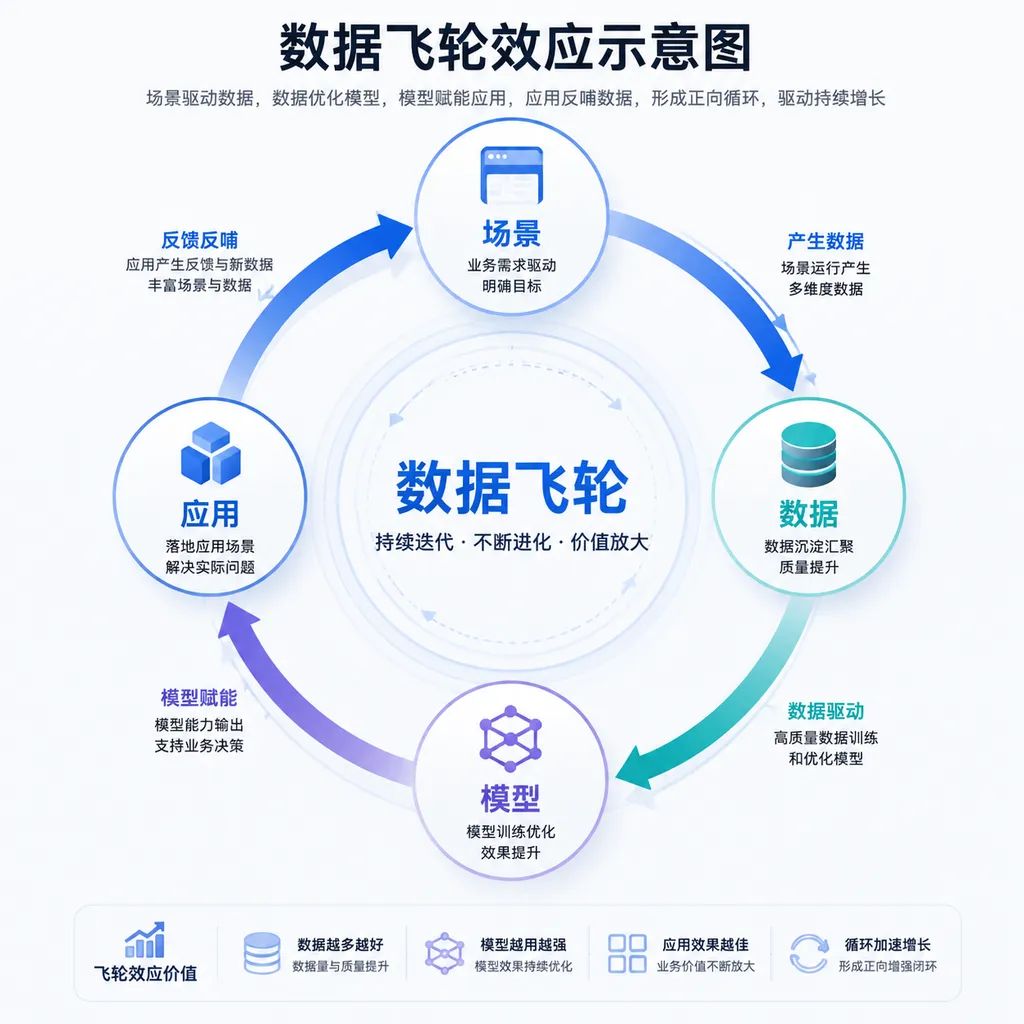
Model feedback loops create a “data flywheel.”
Errors made by models in real‑world applications serve as diagnostic signals to uncover issues in the data (label errors, unbalanced distributions, missing edge cases), and then datasets are improved accordingly. Better data produces better models, and better models, in turn, help collect better data.
OpenAI and DeepSeek both illustrate this logic.
OpenAI, using reinforcement fine‑tuning and other techniques, achieved model specialization in vertical domains through small‑scale but highly precise, well‑structured datasets.
DeepSeek’s R1 breakthrough in complex logical reasoning came from its math reasoning dataset — which demanded not only correct answers but also strict adherence to solution step clarity and logical chain completeness.
Data Annotation Evolves from “Crowdsourcing” to “Expert + AI Collaboration”
Data annotation — injecting knowledge and experience into training data — is an indispensable step in dataset construction. The plan pushes annotation from being human‑only to multi‑tier human–AI collaboration, with deep expert involvement.
How will this be done?
Develop intelligent annotation services.
Adopt models such as “model pre‑annotation + human calibration,” “human annotation + model verification,” and “model pre‑annotation + model verification” to improve efficiency and quality. This is not mere automation — it is deep integration of human expertise with AI capabilities.
Establish expert annotation systems.
Create industry expert certification and registration mechanisms to drive expert involvement in specialized knowledge annotation during instruction‑fine‑tuning, reinforcement learning, and other phases, producing high‑quality datasets for reasoning and domain knowledge.
Medical imaging annotation requires radiologists; legal text annotation requires licensed lawyers; industrial defect detection needs quality inspection specialists.
Layered deployment of annotation innovation pilot zones.
Continue strengthening the first seven cities tasked with piloting annotation reforms. For regions with strong innovation, solid foundations, and distinct industry advantages, pilot zones will be deployed in stages. The plan explicitly warns against blind rushes, homogeneity, or low‑level redundant construction.
Talent development will also advance in parallel — supporting schools to add annotation‑related courses, fostering talent through industry–education integration, and implementing annotation skills certification to create growth pathways. A professional annotation workforce combining full‑time and part‑time staff will be built.
Six Special Actions: Building a Complete Chain from Supply to Value Release
The plan’s six actions span the entire data lifecycle:
Foundational Expansion Action — Focused on 18 key fields (scientific research, industrial manufacturing, healthcare, financial services, etc.) and emerging areas such as the low‑altitude economy, embodied intelligence, and smart driving, promoting systematic dataset development. Data resources and application scenarios will be cataloged, and both upstream and downstream collaboration along industrial chains will be strengthened.
Annotation Breakthrough Action — As described earlier, building intelligent annotation and expert systems.
Quality & Efficiency Improvement Action — Establish datasets meeting structural integrity, content diversity, annotation accuracy, and model adaptability standards. Strengthen data cleaning, augmentation, alignment, and quality inspection. Build high‑knowledge‑density datasets for industry‑specific scenarios to reduce training and inference costs, and use synthetic data to address challenges in rare or high‑cost data collection.
Application Enablement Action — Create a positive “scenario–data–model” feedback loop. Build integrated facilities for dataset production, processing, circulation, and model training. Launch “data × intelligent agent” demonstration projects to show high‑quality datasets solving real‑world problems.
Management Service Action — Strengthen lifecycle management covering acquisition, processing, annotation, QC, evaluation, iteration, and audit. Build a “physically decentralized, logically centralized” national dataset management platform to link directories and supply–demand information, allow local/industry sub‑zones, and connect existing platforms to the national hub.
Value Release Action — Promote dataset commercialization and assetization, fostering consensus on paid data usage. Develop subscription, marketplace, and custom service models. Explore token‑based trading, dataset‑backed financing, equity stakes, and securitization.
Clear Goal: Data Industry to Grow Over 20% Annually by 2028
The plan’s targets are concrete:
By end‑2028, build a batch of application‑verified high‑quality industry datasets, create over 300 high‑impact demonstration application scenarios, foster innovative, high‑growth data providers and third‑party service agencies, boost the data industry’s average annual growth rate to over 20%, and double data transaction volumes.
For comparison, China’s digital economy growth in 2024 is about 10% — meaning the data industry must grow at twice that rate, requiring leaps forward across the supply–circulation–application chain.
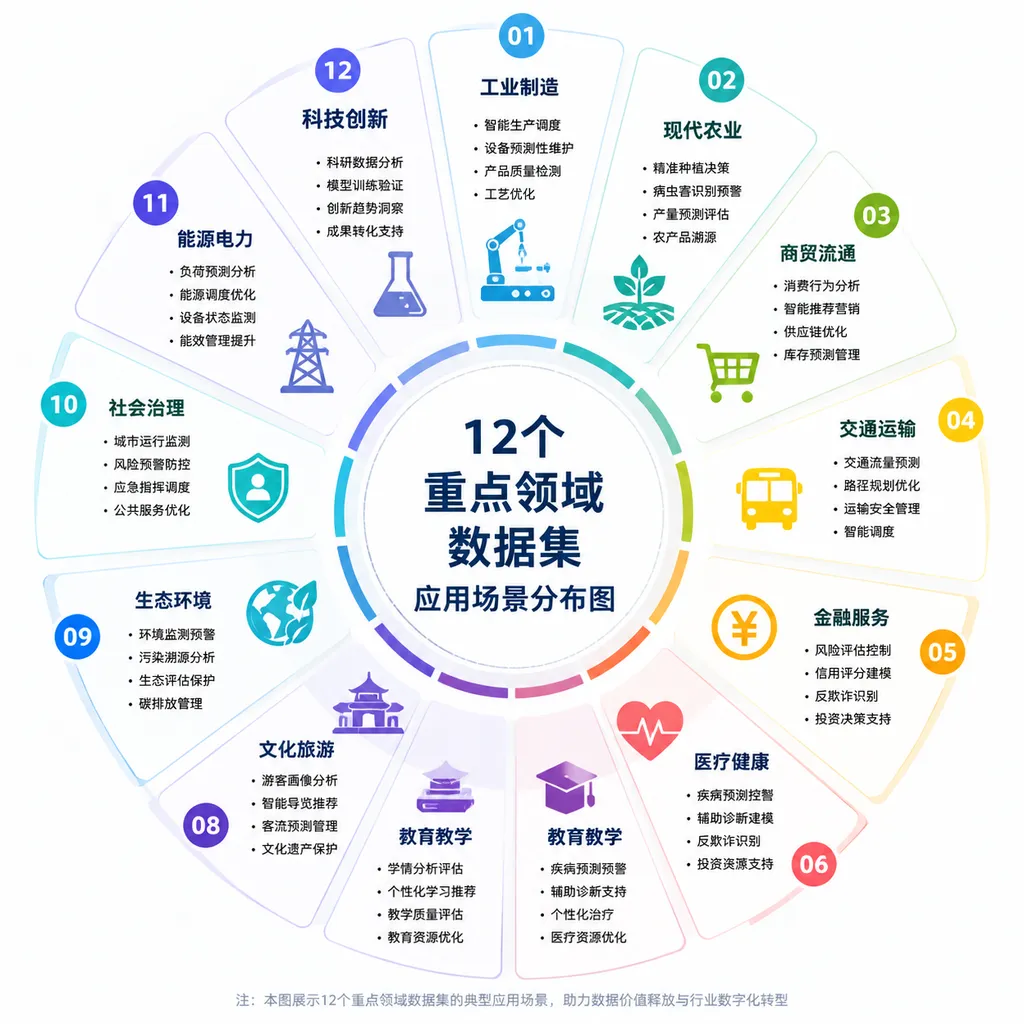
The plan outlines dataset application needs for 12 key sectors — from industrial manufacturing and smart agriculture to trade distribution and scientific research. Each has clear data integration directions.
Examples:
- In manufacturing, integrate design, simulation, and experimental data to foster data‑driven R&D models, and promote circulation of production, procurement, inventory, and logistics data to improve supply chain monitoring.
- In healthcare, promote sharing of EMR data and unified test results standards across institutions, integrate multi‑source data for traditional Chinese medicine prevention, treatment, and rehabilitation.
- In transportation, share and mutually recognize freight tracking, waybill, and settlement data for unified multimodal logistics; support commercial pilot operations of autonomous vehicles under specific conditions and break data silos between carmakers, platforms, and logistics operators.
Three Key Issues: Data Rights, Security & Compliance, Value Distribution
The plan also addresses several core issues:
Data rights allocation.
Follow the “three rights separation” principle — ownership, usage rights, and operational rights — to define dataset property rights. While protecting lawful interests, appropriately expand fair use boundaries for copyright. Harmonize IP protection with innovation needs, and explore flexible regulation in AI training.
This is a nuanced position — signalling China’s approach to the globally contested issue of using copyright data for AI training.
Security & compliance baseline.
Adhere to ethical principles and fairness, explore codes of ethics for high‑quality datasets, and strictly prohibit illegal collection or use of sensitive data. Prevent bias and discrimination during dataset development, strengthen security against data poisoning, tampering, and leaks.
Value distribution mechanisms.
Ensure all players — from supply, processing, circulation to application — receive market‑driven returns. Government bodies, SOEs, and AI model companies should lead by example, budgeting for and executing data purchases to build consensus on paid data usage.
This last point is critical:
Currently, willingness to pay for training data is low in AI, with heavy reliance on publicly available internet data. To build a healthy, sustainable ecosystem, suppliers must be fairly compensated. The plan explicitly calls for fostering a paid‑data culture, starting with public and state‑owned actors.
What Does This Mean for Developers?
For AI developers and firms, this plan has direct implications:
-
High‑quality industry datasets will increase significantly.
Training a vertical model used to be bottlenecked by data collection and annotation. Now, state‑level efforts in 18 key fields mean more standard, high‑quality datasets in manufacturing, healthcare, finance, transport, etc. -
Annotation services will be more professional and AI‑driven.
You’ll find not just piece‑rate annotators, but domain‑savvy, AI‑assisted professional teams — better quality and efficiency, potentially at lower cost. -
Data compliance and circulation will be more standardized.
Lifecycle management with privacy‑preserving computation and trusted data spaces will enable controlled, traceable data sharing — beneficial for multi‑party projects. -
Paying for data will become the norm.
Suppliers will see market returns; demand‑side should budget for procurement — free data will be rarer. -
Intelligent agent and embodied intelligence projects will enjoy a data dividend.
The plan’s focus on these frontiers means more targeted datasets for complex task planning, long‑term reasoning, HCI, decision‑making, physical interaction, perception, and motion control.
A Key Step from “Data‑Rich” to “Data‑Strong”
China does not lack data — with the world’s largest internet user base, abundant scenarios, and a complete industrial system.
The problem is being “big but not strong”: variable quality, inconsistent annotation standards, obstructed circulation, and under‑realized value.
This plan aims to fix these systematically — not merely urging dataset creation, but building from top‑level design a full chain from supply, annotation, quality evaluation, and trading, to application and value realization.
Crucially, it binds dataset development tightly with AI application, creating a data flywheel of “scenario draws data, data drives model, model enables application, application creates value.”
This avoids the trap of “build database first, find use later” — instead letting application needs drive data supply, and model feedback refine data quality.
In global terms, the US started earlier: OpenAI, Anthropic, and others have deep data engineering experience; the EU has rigorous governance via GDPR.
This national‑level, systemic deployment leverages China’s institutional and market scale advantages, offering a potential unique path for data–AI co‑development.
Challenges remain — rights allocation, cross‑jurisdiction sharing, security–utility balancing, market‑based value mechanisms — each is tough.
But the direction is right, the path is clear, and resources and policies are aligning.
The next two‑and‑a‑half years will reveal how regions and agencies turn this into tangible datasets, applications, and ecosystems. Whether the 300 demonstration scenarios, 20% annual growth, and doubled transactions are achieved will directly affect the quality of China’s AI development and its global competitiveness.
References
- National Data Administration — Implementation Plan for Promoting High‑Quality Industry Dataset Development — Full plan and supporting documents
- 36Kr — National‑Level First Systemic Deployment of Data Empowerment for AI Development — News release
- NDA — High‑Quality Dataset Development Guidelines (PDF) — Technical guidelines and industry cases


