
Ctrip takes the lead in the WeChat AI ecosystem, among the first to integrate Agents to establish a tourism gateway
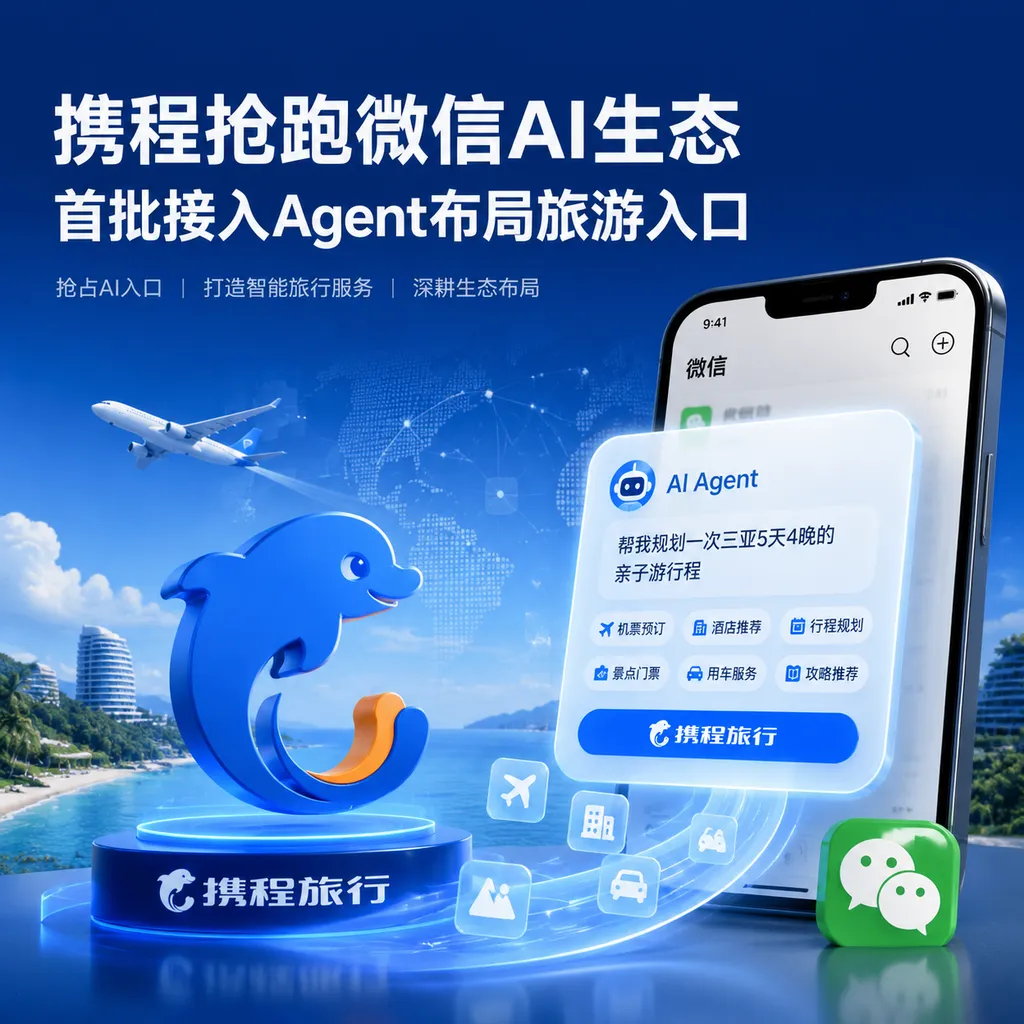
On June 8, Trip.com announced that it has joined the WeChat AI ecosystem as one of the first pilot developers. In the future, it will connect the WeChat AI Agent to core scenarios such as hotels, flights, and vacations. The OTA giant is seizing the intelligent entry point of the super app.
Ctrip Takes the Lead in WeChat AI Ecosystem, Among First Batch to Integrate Agents for Travel Entry Points
The developer ecosystem for WeChat AI Agents welcomed its first movers today, and Ctrip is one of them.
On June 8, WeChat Open Class released the Guidelines for Developers to Access the WeChat AI Ecosystem, officially opening up access channels to external developers. Almost simultaneously, Ctrip confirmed via its official “Ctrip Bulletin” that its mini program has completed initial integration and adaptation as one of the first batch of internal test developers. Next, they will fully connect with WeChat AI Agents around core travel scenarios including hotel booking, flight search, vacation planning, and transportation services.
The timing is no coincidence. Just a week earlier, on June 2, news surfaced that WeChat AI Agent’s public launch was entering compliance approval this month. Tencent’s stock price responded immediately, rising 7%–11% that day. Today’s simultaneous announcements from WeChat Open Class and Ctrip indicate that after almost a year of preparation, WeChat AI Agent has finally moved from “internal rumor” to the practical stage of “developer ecosystem recruitment.”

1. The Real Significance: Securing a "Ticket" in WeChat AI for the Travel Sector
To understand why Ctrip jumped at this internal test opportunity, we first need to clarify the logic behind WeChat AI Agent.
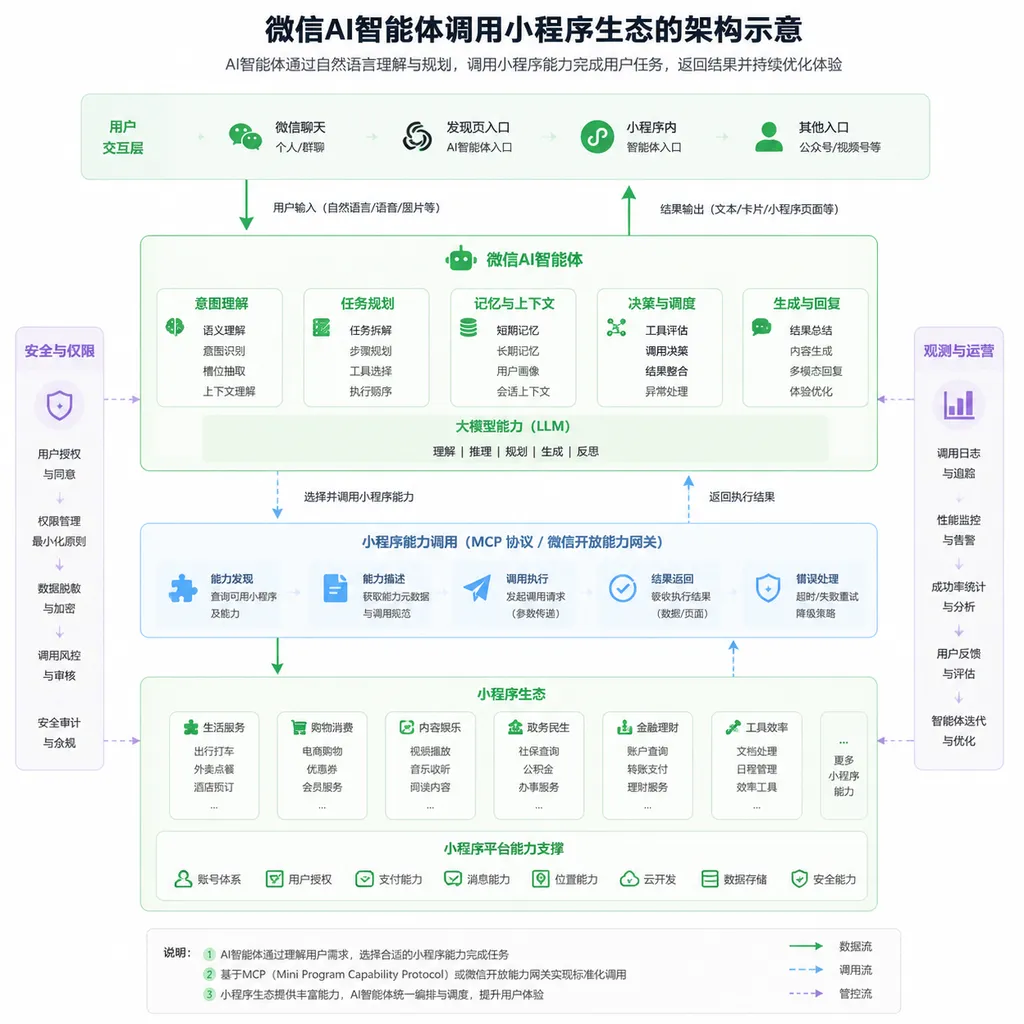
From previously disclosed information, the format of the WeChat AI Agent is a conversational interface appearing in the user’s chat list—you can think of it as a permanent “super assistant” inside WeChat. Users give instructions in natural language, and it completes the task by invoking millions of mini programs. Calling a ride, ordering food, buying a plane ticket, booking a hotel—all can be done in one sentence, without repeatedly switching between mini programs.
The killer aspect of this design is: It consolidates isolated mini programs into a unified execution layer coordinated by AI. For service providers who have been operating mini programs in WeChat for years, this reshapes the rules of traffic distribution.
Who gets called by the Agent first, who completes intent recognition and parameter alignment first, whose services get set as default—these determine the rankings in OTA, transportation, and local life sectors in the next cycle.
For Ctrip, hesitation was hardly an option:
- WeChat ecosystem has 1.432 billion MAU (as of March 31, 2026), the largest traffic pool in China
- Alibaba has already integrated Tongyi Qianwen with Fliggy, Taobao, Amap, and Alipay, enabling bookings for flights and hotels
- ByteDance has upgraded Doubao into an AI agent capable of handling e-commerce and multiple service scenarios
- Ctrip’s own “Wendao” AI travel assistant inside its app was always limited by its own DAU
Missing WeChat AI Agent’s debut would mean handing over a hundred-billion-level intelligent entry point to competitors like Tongcheng, Fliggy, or even Meituan Travel.
2. Why Travel is a "Golden Scenario" for AI Agents
Among all consumer scenarios that can be “agentized,” travel is widely regarded by model providers and platforms as the optimal testing ground.
The reason is simple. A complete travel decision involves at least eight steps: destination selection, itinerary planning, flight price comparison, hotel booking, visa processing, transportation arrangement, mid-trip changes, and post-trip reimbursement. Traditional OTAs solve this by creating eight separate entry points for the user. But what users really want is a simple request: “Help me go to Dali next weekend, budget under 5000.”
This is exactly where Agents shine—multi-step, cross-service, strong parameter dependencies, long decision chains.
In January this year, Entgroup released its Panoramic Report on AI and Tourism Industry Integration, stating: in 2025, AI travel tools’ presence on social media rose 243% year-on-year, and over 70% of respondents had developed a habit of using AI travel tools, with 27% using them frequently. The pre-trip stage (itinerary planning, price monitoring, information search) had the highest AI penetration rate, accounting for 57% of total AI usage in travel.
In other words, users have moved from novelty to habit for “AI helping plan trips” — what’s missing is simply a convenient entry point. WeChat AI Agent + Ctrip precisely fills the “high-frequency entry” and “deep transaction capability” gap.
3. Technical Implementation: From Adaptation to Invocation
Although neither side has disclosed technical details, referencing the usual integration standards of WeChat Open Platform and the prior implementation paths of QClaw and ClawBot, we can outline the logic for Ctrip mini program integration:
- Capability Declaration: Ctrip must declare to WeChat AI Agent the list of capabilities its mini program opens externally, such as “search flights,” “book hotels,” “modify orders,” etc., each matched with a structured parameter schema.
- Intent Alignment: When a user types “Book me a flight from Shanghai to Tokyo this Friday” into the WeChat AI Agent chat, the intent recognition module must parse natural language into parameters Ctrip understands (origin, destination, date, seat class, etc.).
- Mini Program Invocation & Callback: Agent calls the corresponding capability interface in Ctrip’s mini program, completes the booking or returns structured results, then translates them back into conversational form for the chat window.
- State Retention & Multi-turn Interaction: For example, if the user asks “How much for business class instead?”, previous flight info must be retained in context.
This mechanism essentially transforms the traditional “mini program jumping” into “mini program API-ization.” The challenge for developers is that mini programs designed for user-facing UI must be reorganized into a capability interface for Agents, ensuring stability in multi-round conversational transaction flows.
According to Tencent President Martin Lau during the Q1 earnings call in May: “Aside from foundational models, AI agents with autonomous execution capabilities are showing breakthrough application value. The WeChat platform naturally has multiple advantages for bearing AI agents.” — internally, this integration mechanism is already prioritized as a top strategic initiative.
4. Points Worth Watching
First, who defines the Agent’s ‘default choice’?
When a user says “Help me book a hotel,” will the Agent first call Ctrip, Meituan, or Fliggy? This ranking logic could be even more decisive than the search ranking of mini programs back in the day. WeChat hasn’t disclosed relevant rules, but the first internal test list itself is an implicit form of traffic allocation.
Second, will Ctrip’s own AI products be replaced?
Ctrip’s “Wendao” AI travel assistant launched in 2024 already has a user base. Will WeChat AI Agent integration create a “WeChat front-end, Ctrip back-end” structure, turning Ctrip from a user-facing brand into a called service backend? This is a strategic trade-off for Ctrip.
Third, the progress of compliance approval
Tencent previously stated that due to WeChat’s massive user base, the compliance process will be stricter than for other products, and the launch timing “will largely depend on regulators.” Today’s disclosure is the developer access guidelines; actual public availability to end users could be months away.
Fourth, uncertainty at the model level
The WeChat team is reportedly training its own model to support the Agent. This means whether for Ctrip or other developers, the ultimate experience ceiling will be determined by this model’s capabilities.
5. Industry Landscape is Being Reshaped
Taking a broader view, this is the latest episode in China’s “Super App + AI Agent” three-way contest.
Alibaba follows a “Tongyi Qianwen + its own e-commerce/local/travel ecosystem” full-stack integration path; ByteDance uses Doubao to connect Douyin e-commerce and local life; Tencent has chosen a different route — instead of building a standalone Agent app, it embeds Agent capabilities into WeChat, inviting external ecosystems to integrate.
This is the classic Tencent “build ecosystem, not product” strategy, which President Martin Lau calls the core of “WeChat’s natural advantages.” For developers, this approach is friendlier: you’re not forced to go all-in on one Super App, and can integrate with WeChat, Alibaba, and ByteDance all at once, leaving the choice to users.
For developers, parallel invocation across multiple models and platforms is becoming the norm. More teams are choosing aggregation layers to manage different vendors’ models and Agent interfaces — for example, platforms like OpenAI Hub, which let you call GPT, Claude, Gemini, DeepSeek, etc., with a single key, compatible with the OpenAI format and directly accessible in China, saving the cost of maintaining separate SDKs and authentication for each vendor. As each Super App’s Agent ecosystem opens to developers, this “model aggregation + ecosystem adaptation” dual-layer architecture will increasingly become standard.
The next point to watch is the Tencent Cloud AI Industry Application Conference on June 12 — WorkBuddy Enterprise Edition will be launched there, and Tencent’s Chief AI Scientist Yao Shunyu will speak. We are likely to hear more details about WeChat AI Agent, including specific developer access specifications and revenue sharing mechanisms.
Ctrip has secured the first ticket. The next question is who will be on the second batch list, and when WeChat AI Agent is finally available to its 1.4 billion users, how the entire OTA industry ranking will be reshuffled.
References
- Targeting Alibaba and ByteDance! Report: Tencent secretly builds WeChat AI Agent, may open to all users this year - Zhihu: Detailed analysis of WeChat AI Agent’s strategic positioning, grey-box testing schedule, and Q3 rollout plans


