
Kimi Deploys 300 Agents to Bet on the World Cup: A Public Test of Multi-Agent Reasoning
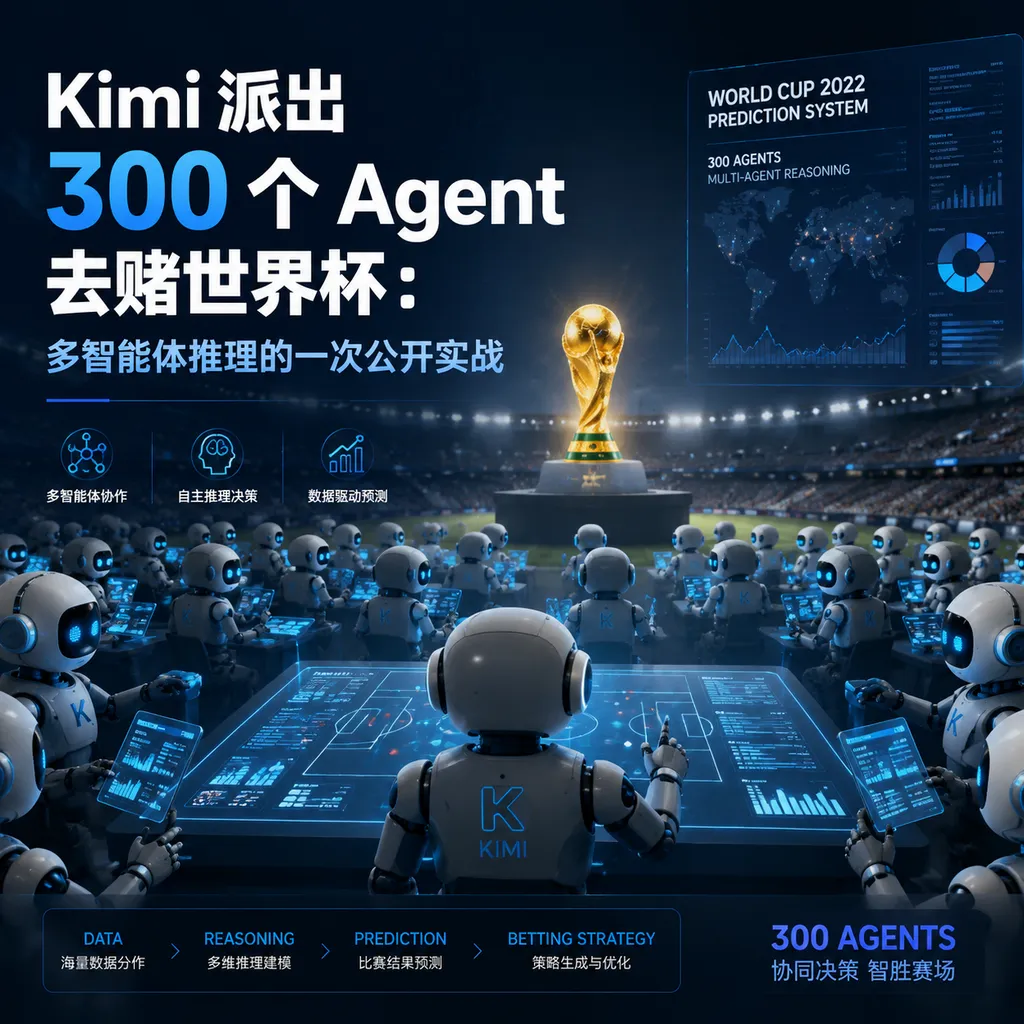
Moonshade announced the simultaneous scheduling of 300 sub-agents using an agent cluster to predict all 104 matches of the 2026 Canada–USA–Mexico World Cup in parallel, and to publicly review the results. One finding is that Germany’s probability of winning the championship may be underestimated by the market.
June 8 — the 2026 Canada–USA–Mexico World Cup is about to kick off. Today, Moonshot AI launched a project with a touch of “performance art”: using Kimi’s Agent Swarm to publicly predict the results of this expanded World Cup — now 48 teams, 104 matches in total. Predictions will be made before each round, with reviews afterward, and errors acknowledged.
This isn’t just making a fancy PPT. Kimi has brought its Agent Swarm architecture — released in January and significantly upgraded on K2.6 in April — into a scenario where anyone can verify the outcome. Football match results can’t be “PR-adjusted.”
300 Sub-Agents Working Simultaneously
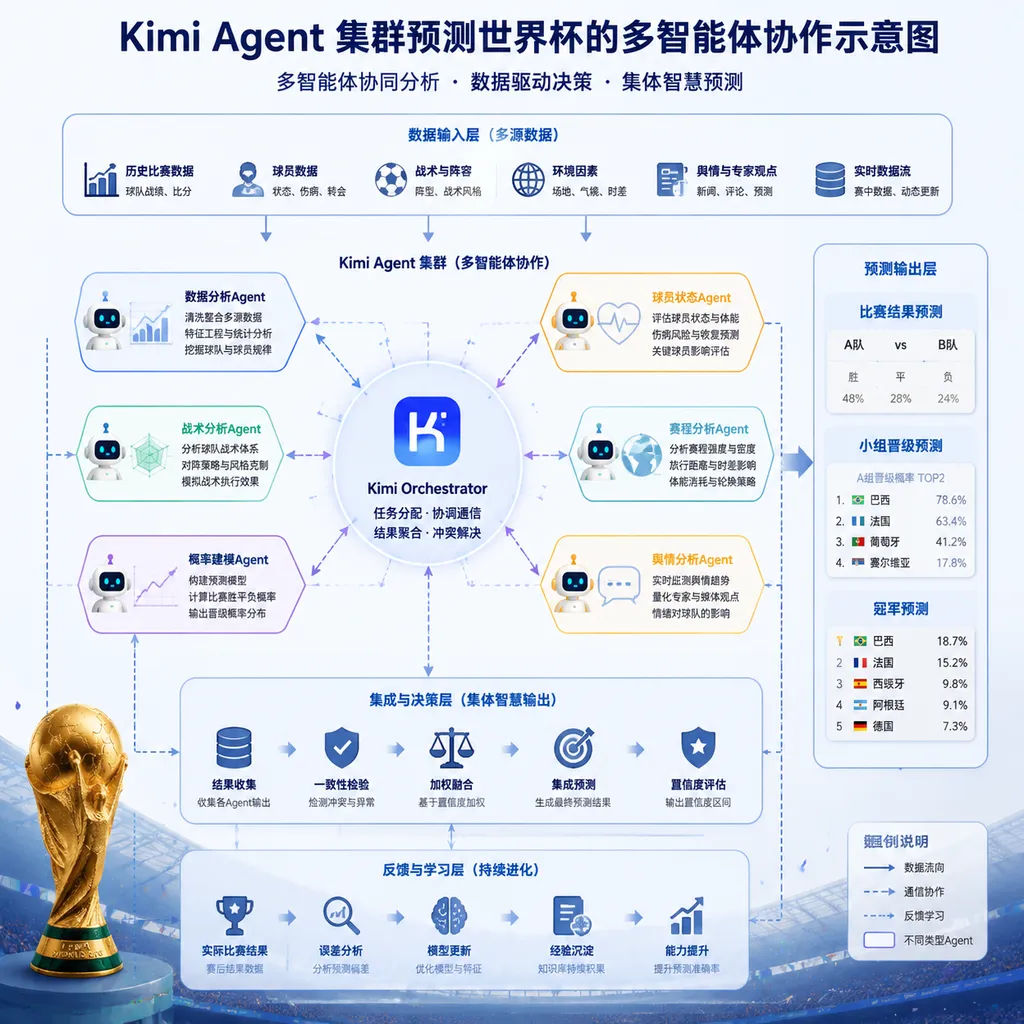
According to Kimi’s official explanation, the prediction workflow works as follows: a main Agent supervises around 15 key steps, with up to 300 sub-Agents running reasoning in parallel. The entire workflow can scale to about 4,000 steps. Each sub-Agent tackles the same match from a unique perspective, and their conclusions are then integrated.
The perspectives are divided to an extremely fine degree:
- Strength-focused: Track Elo ratings and FIFA rankings to anchor fundamental team strength
- Data-focused: Use xG (Expected Goals) and xT (Expected Threat) to measure the quality of offense and defense, not just scores
- Tactics-focused: Analyze the interplay of high pressing vs. low blocks, counterattacks, and set pieces
- Environment-focused: Travel distance, climate (massive latitude spread across North America), rest days
- Roster-focused: Track injuries, suspensions, and starting player minutes
- Market-focused: Monitor odds and implied probability deviations; detect model-vs-market gaps
- Black Swan-focused: Evaluate random-like factors such as red cards, penalties, VAR, and goalkeeper performance
Each sub-Agent submits not just “I think Team A will win” but a structured quadruple: Conclusion + Evidence + Confidence + Counter-argument. In summarizing, Kimi explicitly states it does not use majority voting — this is critical, and we’ll come back to why.
What’s Different in This Architecture
To understand why Kimi is doing a public demo, you have to return to Agent Swarm’s design philosophy.
Traditional multi-agent systems usually have humans manually build workflows: define roles like “researcher,” “analyst,” “writer,” determine who calls whom and when; essentially using LLMs as tools to tighten a flowchart.
Agent Swarm takes a different path — let the model decide whether to parallelize, whom to hire, and how to divide tasks. The Moonshot team recounted its origin: one member wanted Kimi to scan stocks daily, and upon writing 100 lines of if-else, realized — “I’m manually building a multi-agent system; why not let the model build it itself?”
Engineering-wise, this was implemented using PARL (Parallel-Agent Reinforcement Learning) to train an orchestrator, teaching it when to spread tasks, how wide to fan out, and when to pull back. Sub-Agents are frozen models; the orchestrator is trainable — a brain that commands paired with many working hands.
Efficiency gains from official data: compared to single-Agent sequential execution, key steps reduce by 3–4.5×, end-to-end time on large search tasks is shortened up to 4.5×. Improvements are especially noticeable on deep information retrieval benchmarks like BrowseComp.
World Cup predictions fit this architecture’s “comfort zone”:
- Highly parallelizable tasks: 104 matches have almost no dependencies, each can be split into multiple independent dimensions
- Extremely dispersed sources: team sites, injury news, betting odds, weather forecasts, social media sentiment — a single Agent scraping sequentially would still be working after the final
- Results verifiable: Ground truth appears 90 minutes later, unlike reports that require subjective scoring
Not One Model — A Consensus of Many
Seeing “AI predicts football” might make you think it’s just an LLM spitting out results. Kimi’s disclosed method stack is far more hardcore:
- Elo / FIFA strength models: foundational scoring for teams
- Poisson / Dixon-Coles goal distribution models: decades-old classic football prediction methods modeling goal probability
- xG / xT metrics: the factual standard in modern football analytics
- Machine Learning enhancement models: residual correction atop traditional statistical models
- Monte Carlo simulation: produces numerous result distributions; especially for knockout-stage recursion
- Market–model deviation analysis: uses betting markets’ implied probabilities as an external signal; identifies systemic bias
- Bayesian dynamic updating: updates priors after each round
Here, the LLM isn’t the “judge” — it’s more like a coordinator: task distribution, method invocation, evidence collection, and uncertainty verbalization. Kimi says the value lies “not in eliminating uncertainty, but in systematically identifying it.”
This stance is rare. Most AI demos compete on “accuracy”; Kimi repeatedly emphasizes “we will be wrong”:
- High confidence predictions: historical backtest accuracy 85–90%
- Medium confidence: 55–65%
- Low confidence: close to random
Implication — when difficulty increases, AI doesn’t suddenly become godlike. This message is more useful for developers than casual onlookers.
Why the Germany Observation Is Worth Highlighting
Mainstream models currently give Spain and France the highest championship probabilities; Kimi agrees these are the top tier. But its cluster surfaced an observation post-run: Germany’s championship probability may be underestimated by the market.
This might sound clickbait at first, but look closely at Kimi’s wording — “The model identified a potentially existing probability deviation worth public record and later verification” — this is a very Bayesian expression.
It’s not saying “Germany will win,” but “the implied probability from market odds and our model’s computed probability differ by a noteworthy gap.” This is precisely why Agent Swarm avoids majority voting: if voting were used, a clear “minority + strong evidence” conclusion would be drowned; requiring each sub-Agent to produce counter-arguments and then weighted integration allows minority views to surface.
Architecturally, this is a point Kimi highlights repeatedly in its docs — Agent Swarm can “structurally avoid groupthink.” In domains like finance, medical diagnosis, and product decisions, minority visibility may outweigh “speed” in importance.
Observations for Developers
Beyond the fun of the World Cup, this demo offers several takeaways for Agent app developers:
1. Know the limits of parallelism. 300 sub-Agents sounds impressive, but not all tasks can be split like this. Kimi’s documentation stresses “key steps” — measuring whether parallelism actually saves time depends on the number of steps in the critical path, not the total call count. Blindly splitting tasks just adds coordination overhead.
2. Sub-Agents don’t need to be strong individually. In the Swarm, sub-Agents are frozen; the orchestrator drives performance. This is pragmatic engineering: in large-scale parallelism, sub-tasks are usually simple; having a well-trained “commander” do division of labour is more cost-effective than maxing out each executor.
3. Structured output is foundational engineering. Forcing each sub-Agent to provide a quadruple of Conclusion / Evidence / Confidence / Counter seems like product design but actually enables fusion algorithms upstream — without this, the main Agent can only weight “by feel.”
4. Verbalizing uncertainty is product power. Stating “60% probability” is more important than saying “likely.” Publicly predicting the World Cup over weeks will test whether a large-model-driven system can maintain disciplined probabilistic language.
By the way — Kimi’s K2.6 model itself is open-source. Agent Swarm is currently a Beta capability on Moonshot’s own platform, open to Allegretto/Allegro members. If you want to run Kimi alongside GPT, Claude, Gemini, DeepSeek, etc., for comparative experiments, OpenAI Hub–style aggregation platforms allow direct domestic connection via a single key in OpenAI-compatible format, saving the trouble of multiple SDKs.
What to Watch Next
The World Cup starts in June and ends mid-July. Kimi will publicly release prediction probabilities for each round and reviews after matches. The interest isn’t in how many matches it guesses right — its own backtest data guarantees plenty of misses — but in:
- Whether actual hit rates for high-confidence predictions hold in the 85% range
- Whether cluster-found “undervalued Germany” style contra-market conclusions turn out to be valid signals or noise
- Whether Bayesian updating remains stable when uncertainty spikes and sample sizes shrink in knockout stages
The answers will reveal more than any benchmark: just how valuable multi-agent reasoning actually is in the real world. We’ll know in a month.
References
- IT Home: Using AI to predict winners — Kimi officially announces prediction of 104 World Cup matches — Official announcement coverage of this Agent Swarm World Cup prediction project
- Zhihu: How Kimi Agent Swarm runs 100 AI agents at once — Chinese explanation of Agent Swarm architecture and PARL training method


