
Visual Studio Copilot Hacked: Custom Model Integration Achieved Overnight with mitmproxy
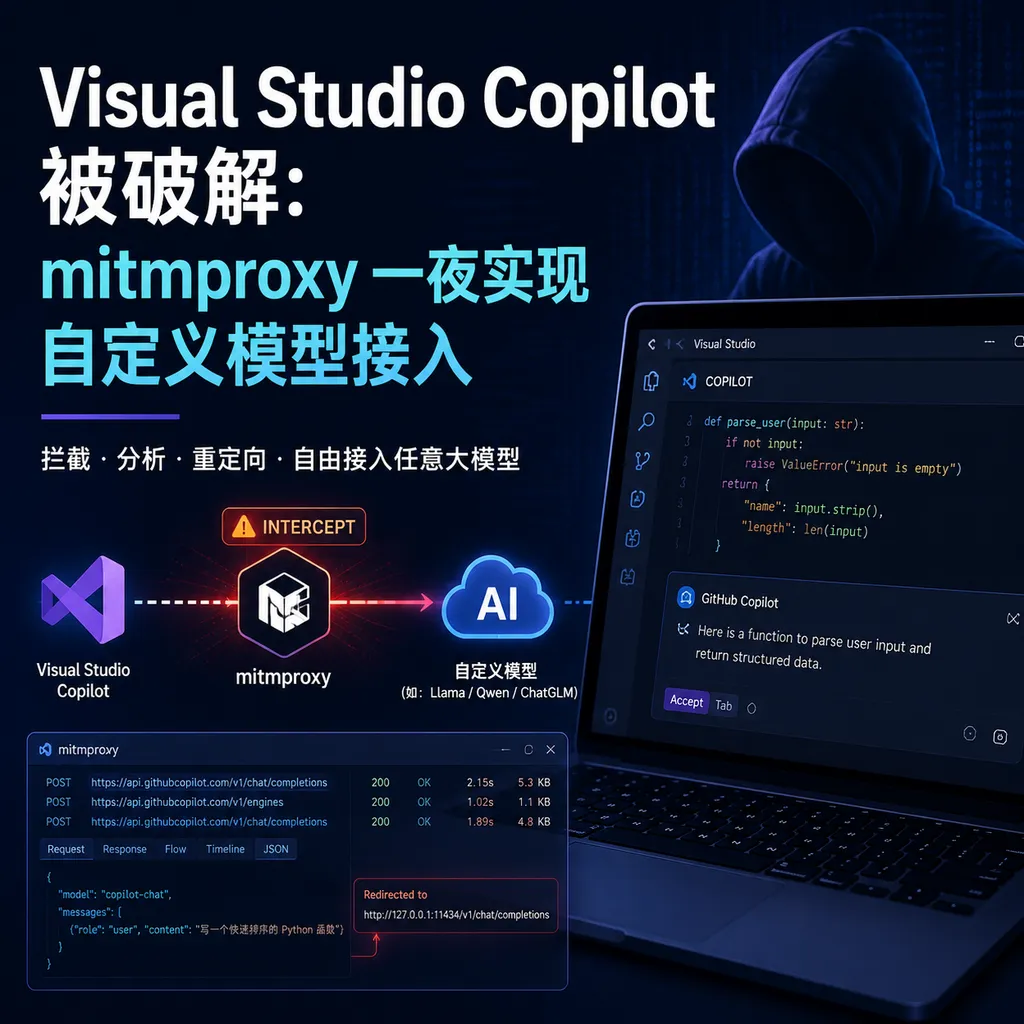
Microsoft has been slow to enable BYOK for the Visual Studio version of Copilot, so community developers used mitmproxy to intercept traffic to api.anthropic.com, bypass the model validity check, and got custom URL and model integration working in one night. Rough, but it runs.
Visual Studio Copilot Can Finally Use Custom Models — But Unlocked via mitmproxy
On the VS Code side, GitHub Copilot officially opened up BYOK (Bring Your Own Key) months ago — the Base URL, API Key, and Model ID trio can be fully configured with just a few clicks in the GUI. But on the other side, the real Visual Studio — the heavyweight IDE on Windows, often dozens of GB, indispensable for .NET and C++ development — has shown no movement on this.
Over the past couple of days, developers on linux.do couldn’t hold back and took matters into their own hands, breaking through the wall. The approach was blunt and simple: since modifying the Copilot plugin itself kept throwing errors, they skipped touching the plugin and worked directly at the network layer — intercepting api.anthropic.com requests with mitmproxy, forwarding them to any local-compatible endpoint, and forging responses to trick Copilot’s model name validity check. One night of tinkering, and it runs.
This isn’t some earth‑shattering technical breakthrough, but it does put the pent‑up demand of Visual Studio Copilot users, held back for half a year, right on the table: Why can VS Code do it, but Visual Studio can’t?
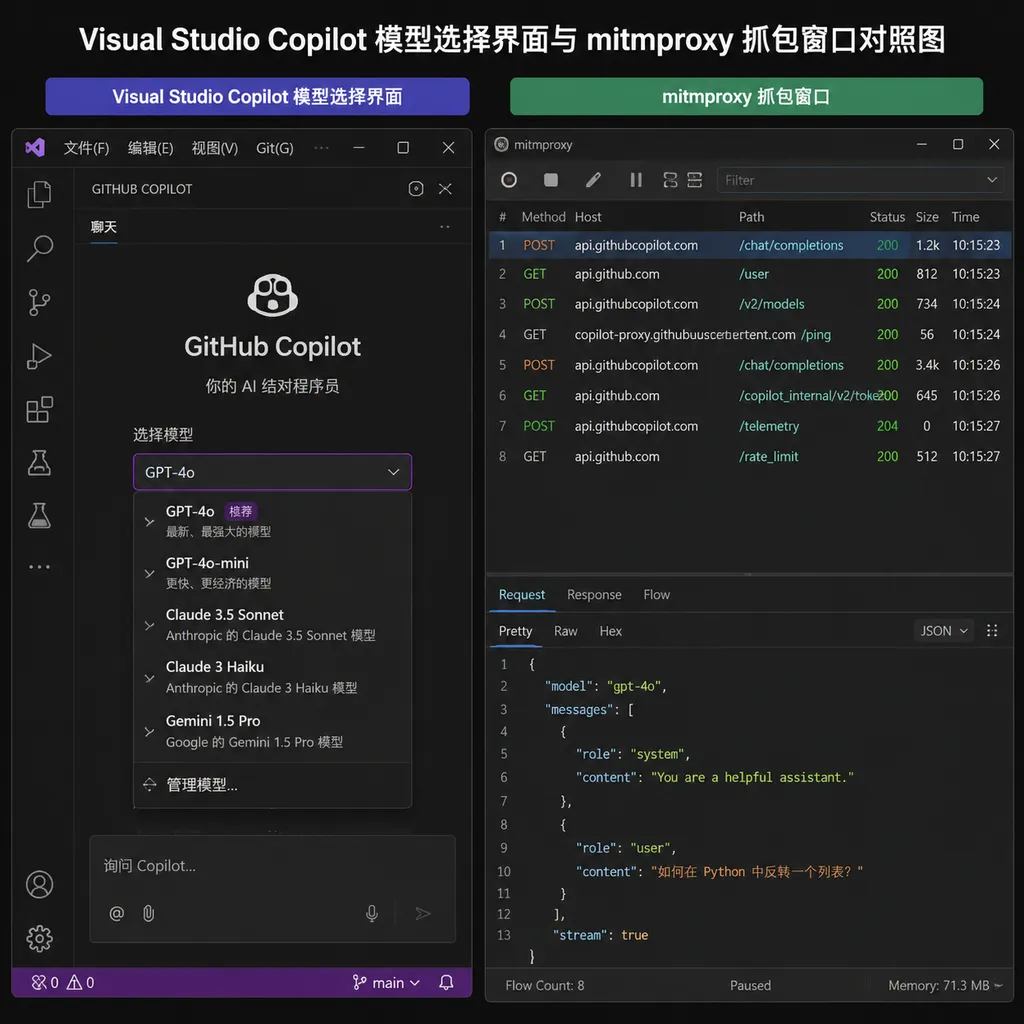
VS Code vs. Visual Studio — Microsoft Treats Them Differently
Let’s lay out the timeline to avoid confusion between the two Copilots.
In spring 2025, VS Code’s Copilot Chat v1.99 began supporting BYOK, allowing integration with major providers like Azure, Anthropic, Gemini, OpenAI, Ollama, and OpenRouter. Later, a GitHub issue (vscode-copilot-release#7518) pushed Microsoft to further open an “OAI Compatible” option — any endpoint compatible with the OpenAI format could be used, whether DeepSeek, Kimi, Tongyi, local Ollama, or aggregation platforms.
At this point, VS Code’s Copilot was essentially a semi‑open ecosystem at the model level. It used the official Language Model API, giving custom models the same context injection and tool invocation treatment as built‑in GPT‑4o and Claude Sonnet — not second‑class patchwork citizens.
But Visual Studio’s pace has been completely different. Microsoft’s official documentation on “Using AI models in Copilot Chat” has long listed only a few preset options, with BYOK barely visible, and no endpoint customization at all. The documentation even has an interesting disclaimer: “When using custom models, output is returned directly from the provider and may bypass Responsible AI filters in Copilot. Support for custom models is not available for Copilot Business or Enterprise users.” — translated: Enterprise users can forget it, personal users use it at your own risk.
The problem is, Visual Studio’s user base is entirely different from VS Code’s. Most VS Code users are lightweight developers — front‑end, Python, Go — while Visual Studio runs C#, C++, game dev, and enterprise‑scale .NET projects. These folks are often more tightly bound by company compliance, and demand for internal deployments and private models is more rigid. Yet openness is reversed — logically, it makes no sense.
Community Solution: mitmproxy as Middleman, Fooling Validation
Back to this cracking method. The original poster first tried the conventional route — directly decompiling or hooking the Copilot plugin to change the endpoint. This works on VS Code, but Visual Studio’s Copilot plugin structure is different; as the author put it, “kept throwing errors, so abandoned.”
So they changed tactics, working from the network layer:
- Run mitmproxy locally as a system‑level HTTPS proxy
- Intercept all requests to
api.anthropic.com, rewrite host to local (or any Anthropic‑compatible relay endpoint) - Forge the model list response, inserting the model name Copilot wants to validate (e.g., a specific claude‑3.5-sonnet version) into mock data to pass validation
- Actual requests get routed to the backend you want to use — could be local Ollama, an aggregation service, or your company’s internal private model
The benefit is you never touch the Copilot plugin itself — upgrading Visual Studio or Copilot won’t break it, as long as Anthropic’s protocol doesn’t change much. The downside is a higher configuration bar — you must install mitmproxy, trust its root certificate, write proper traffic rules, and keep the proxy running. Tuning this pipeline takes patience for ordinary users.
The author admits this is “a relatively simple and crude implementation.” But in this gray area, “it runs” is hard currency.
Why Intercept Anthropic and Not OpenAI?
Attentive readers might ask: Isn’t Copilot from Microsoft? Isn’t OpenAI always the closer partner? Why intercept Anthropic’s API?
The answer is Copilot Chat now heavily depends on the Claude Sonnet series. Since Claude 3.5 Sonnet swept code evaluation last year, more developers have made Claude their daily coding driver, and Copilot conveniently added the Claude series to its default model pool. In Visual Studio, Copilot’s calls to Claude use Anthropic’s official endpoint.
This gives a natural interception point — as long as you mimic Anthropic API’s response format, what the backend actually connects to doesn’t matter. Anthropic’s messages API protocol is relatively clean; compared to OpenAI’s messy coexistence of chat completions, responses, and assistants, mocking is actually easier.
Ripple Effects
Broadly, this “users break the wall themselves” phenomenon shows that the AI programming tools landscape hasn’t stabilized.
A year ago, Copilot could rely on GPT‑4’s exclusive advantages to lock users in its walled garden. But this year: Claude 4 beats GPT on SWE‑bench, DeepSeek’s code model gets close to the top tier at extremely low cost, Qwen and GLM gain strong word‑of‑mouth among domestic developers. Any IDE vendor still binding users to two or three “blessed” models is fighting the market.
VS Code figured it out early and opened BYOK. Cursor, Windsurf, Cline, Roo Code — the radicals — have supported custom endpoints from day one, even surpassing Copilot Chat in Agentic Coding capabilities: automatically reading/writing files, running tests, executing terminal commands.
Visual Studio clearly hasn’t figured it out yet — or has, but is slow to decide internally. So the community used this “mobster tactic” with mitmproxy to fill the gap.
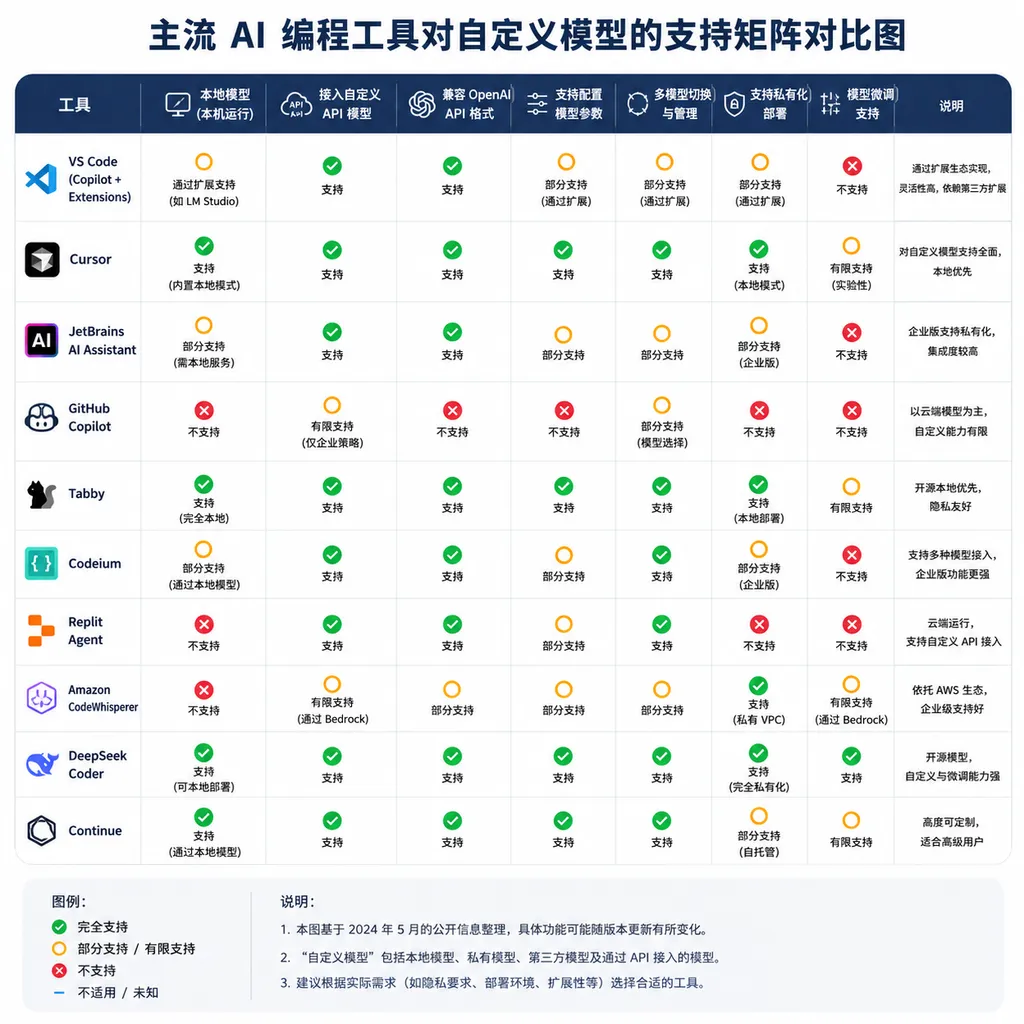
What This Means for Developers
If you are a heavy Visual Studio user, whether this cracking method is worth it depends on your needs:
- Want models directly accessible in China: Worth it. Copilot’s default endpoints have always been unstable to access domestically; using your own proxy also solves the network issue
- Want Claude’s latest version or specific fine‑tuned models: Worth it. Copilot’s preset model updates often lag
- Deploy private models on enterprise intranet: Worth it, but note compliance risks. Docs clearly state enterprise editions don’t support custom models — this path may trigger warnings
- Just want to save on Copilot subscription fees: Calculate carefully. Maintaining the mitmproxy pipeline isn’t cheap — the savings might not buy you a coffee
Another notable angle is the role of API aggregation platforms. In this cracking method, “what backend you connect to” is entirely up to you — you can point to aggregation services like OpenAI Hub, calling GPT, Claude, Gemini, DeepSeek with one key, setting Base URL once, avoiding repeated certificate and quota swaps between providers. For those already on the mitmproxy path, switching to an aggregation endpoint is trivial.
Will Microsoft Patch This Hole?
Most likely they won’t proactively patch it.
First, mitmproxy methods are invisible to Copilot — on the client side, all traffic appears as normal HTTPS requests, with no hooks or plugin modifications. Microsoft would need to add certificate pinning to block it, but that would break enterprise users’ proxy auditing and firewall strategies — a net loss.
Second, the community pressure is there. The GitHub feature request for custom endpoints in Visual Studio Copilot has hundreds of likes, and developer forum threads keep cropping up. If Microsoft wants to keep these users, better to open than to block. VS Code’s path is already there — porting it to Visual Studio isn’t a technical issue, it’s a priority issue.
My personal assessment: Visual Studio’s official BYOK will likely arrive within this year — simply because if they delay, users will take mitmproxy and move to Cursor.
Final Thoughts
This is a small matter, but it reflects a bigger issue. At this stage in the AI programming tools race, the model itself is no longer the barrier — developers want the freedom to use whatever model they choose. Any tool vendor betting on “our pre‑selected one is the best” will inevitably be met with community ingenuity breaking through.
One night’s work with mitmproxy might be more effective than a Microsoft internal feature request meeting.
References
- linux.do community: Visual Studio’s Copilot finally supports custom URL and model — original post sharing mitmproxy cracking approach and implementation details
- GitHub Issue #7518: Add custom OpenAI endpoint configuration — key issue pushing BYOK into VS Code, for comparison with Visual Studio progress
- Reddit discussion: Configure custom local model in GitHub Copilot — community discussion of multiple approaches to Copilot custom models


