
Xiaomi MiMo‑V2.5‑Pro zooms to 1000 tokens/s: The trillion‑parameter speed limit has been breached

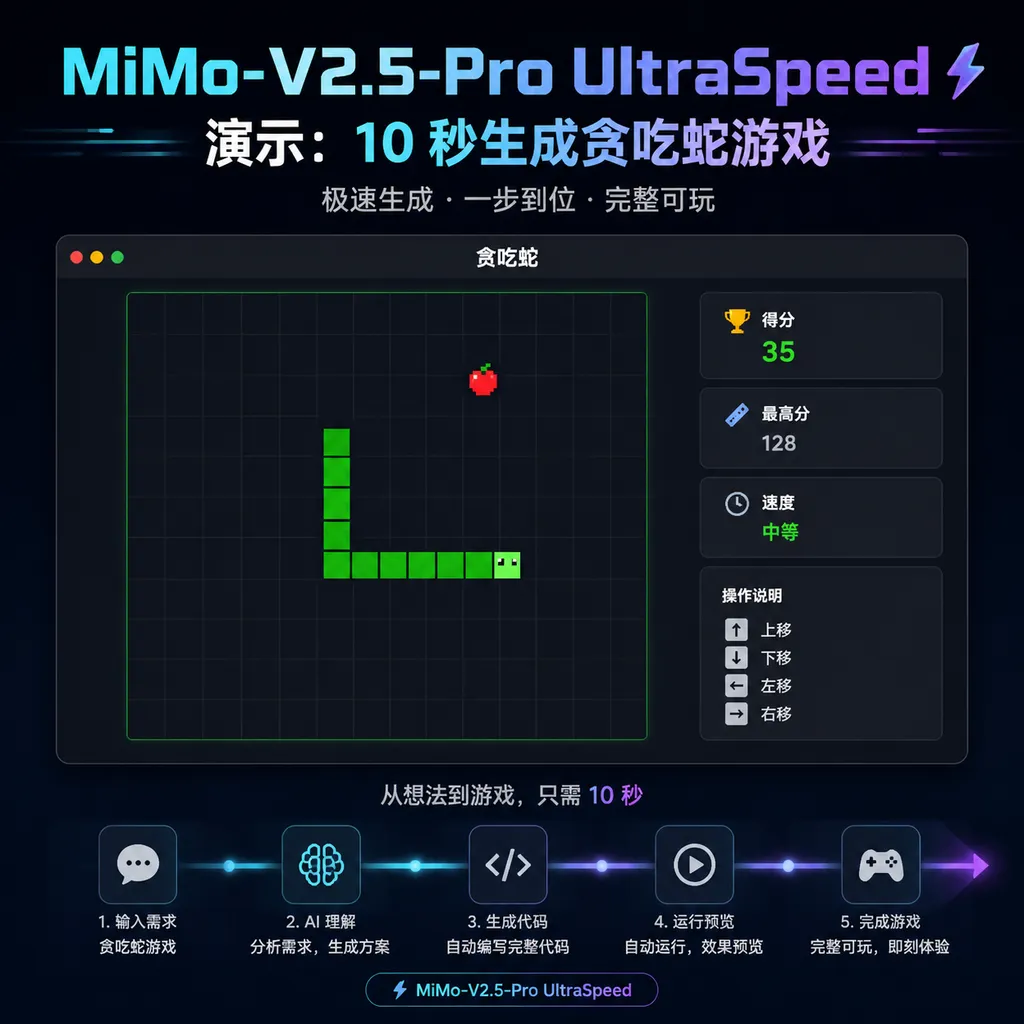
Xiaomi, in collaboration with TileRT, has launched the MiMo-V2.5-Pro UltraSpeed mode, pushing the generation speed of a 1.02T-parameter MoE model on general-purpose GPUs past 1,000 tokens/s for the first time. It can write a Snake game in 10 seconds and replicate the macOS interface in 1 minute. The trade-off is 3× the API price, and access will be granted by application only, limited to two weeks.
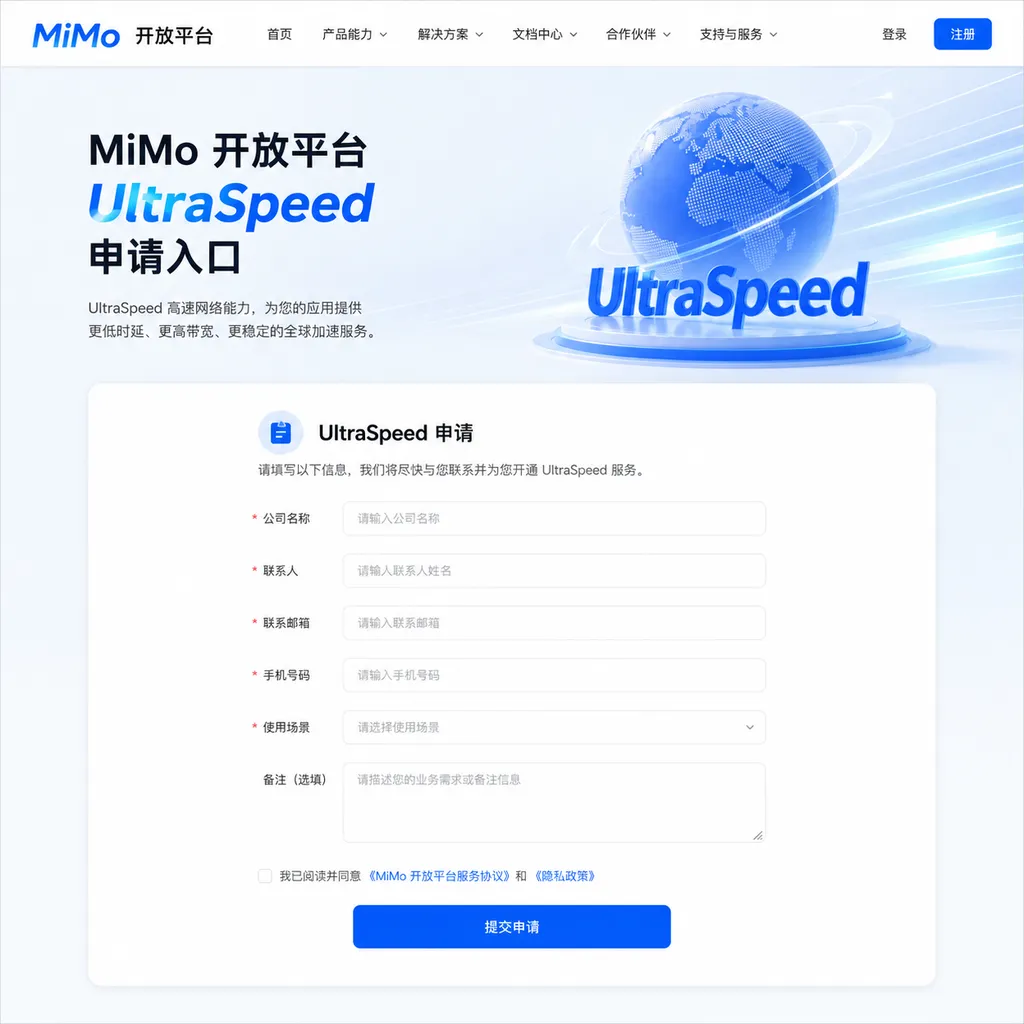
On the evening of June 8, the Xiaomi MiMo team, together with inference engine company TileRT, dropped a figure: 1000 tokens/s. This is the first time a trillion‑parameter‑level model has crossed this line on a general‑purpose GPU. The corresponding product is UltraSpeed mode for MiMo‑V2.5‑Pro, with the API going online today. From June 9, it will be released in limited quantities on an application basis. The window closes at 23:59 on June 23—only two weeks in total.
The official slogan for this update is straightforward — 3× the price, 10× the output experience. The original output price for MiMo‑V2.5‑Pro was ¥6 per million tokens; UltraSpeed raises this to ¥18 per million tokens, but generation throughput is boosted by an order of magnitude. Calculating the "speed‑cost ratio" per token, you actually come out ahead—provided you really need that speed.
What does 1000 tokens/s mean?
Let’s make a horizontal comparison. Currently, mainstream closed‑source flagship models usually output in the range of 50–100 tokens/s. Claude Opus 4.6 can drop to 40 tokens/s when slow, GPT‑5.4’s high‑speed tier runs about 120–180 tokens/s. High‑speed inference specialists like Cerebras and SambaNova can reach 2000+ tokens/s on models with tens of billions of parameters, but that’s on custom hardware, and the model sizes differ by two orders of magnitude.
MiMo‑V2.5‑Pro is a 1.02T total parameter, 42B active parameter MoE model, with native support for 1‑million‑token contexts, hybrid attention interleaved at a SWA:GA ratio of 6:1, plus 3 layers of MTP (Multi‑Token Prediction). Achieving 1000 tokens/s for this scale on a general GPU is an engineering challenge on another level compared to speeding up Llama‑7B — expert routing in MoE, KV cache scheduling, communication overhead for long sequences — each is a hell‑level problem.
Xiaomi describes it as “extreme model‑system co‑design.” In other words, not just inference optimization, but structuring the model itself to accommodate high‑speed inference: MTP allows each inference step to output multiple tokens at once; hybrid attention reduces long‑context KV cache to 1/7 of original; sparse activation in expert routing means only 42B parameters are called out of 1T. These design choices were baked in during training, setting the stage for deployment alongside TileRT’s engine to balance the equation.
“10‑second Snake, 1‑minute macOS” — gimmick or real?
The official demo videos include one generating a runnable Snake HTML in 10 seconds, and another replicating the macOS desktop (HTML/CSS static version) in 1 minute. The demos are crafty picks — tasks with large output token counts but controllable logic complexity, perfectly showcasing the speed advantage.
But the scenarios themselves are real. Front‑end code generation, long‑document rewriting, large‑scale data structuring, multi‑turn Agent calls — these are “token‑intensive” workflows. A typical Cursor/Cline programming session can output tens of thousands of tokens; if the model is twice as fast, the user’s wait time drops from “go grab a drink” to “blink and it’s done.” For AI coding tool makers and Agent framework developers, 1000 tokens/s isn’t just a flashy figure in a spec sheet — it’s the inflection point for product experience.
Worth noting: MiMo‑V2.5‑Pro is already a token‑efficiency beast. In Artificial Analysis benchmark data for the same Intelligence Index tasks, DeepSeek V4 Flash, GPT‑5.4 mini, and Claude Sonnet 4.6 all output around 200M tokens, while MiMo‑V2.5‑Pro uses only 92M — a 50%+ reduction. In ClawEval, it achieves 64% Pass^3 with ~70K tokens per trajectory, 40–60% fewer tokens than Claude Opus 4.6, Gemini 3.1 Pro, or GPT‑5.4. When “shorter thinking” is paired with “faster token output,” end‑to‑end task completion time leaves peers far behind.
How to do the price math
Here’s the table:
| Model | Input (uncached) | Input (cached) | Output | |---|---|---|---| | MiMo‑V2.5‑Pro | ¥3/M tokens | ¥0.025/M tokens | ¥6/M tokens | | MiMo‑V2.5‑Pro UltraSpeed | ¥9/M tokens | ¥0.075/M tokens | ¥18/M tokens |
Comparing with overseas pricing (uncached $1 input / $3 output), UltraSpeed’s domestic prices convert to about $1.26 / $2.52 — still cheaper than Claude Opus 4.6 (starting at $5 input).
Where does it pay off?
- Agent / Coding workflows: Outputs of tens of thousands of tokens; 3× price for 10× speed boosts UX and often conversion rates enough to cover costs.
- Bulk generation / ETL: Faster runs increase per‑time capacity; shorter GPU occupation can actually save money.
- Real‑time interaction: Customer service, voice companions, streaming translation — latency‑sensitive products almost demand it.
Where doesn’t it?
- Offline batch processing or content generation not sensitive to latency
- Long‑context retrieval tasks (bottleneck on input, not output)
- High‑QPS but short‑output scenarios (speed advantage doesn’t show)
Limited‑time application: resource shortage is real
UltraSpeed is not following the regular Token Plan, but is application‑based with limited‑time access. The rules are relatively “restrained”:
- Time window: 2026‑06‑09 to 2026‑06‑23 23:59, two weeks total
- Priority review for “companies and professional developers with real business needs”; no guarantee on review time
- Approved users also get a limited free Chat experience
- Chat limits: per account max 10 queues/day, each session max 30 minutes, idle for 5 minutes auto release
- API access limited to 2‑week window, Token Plan not supported
The subtext is clear: high‑speed inference resources are built on costly compute, and there’s not yet enough for long‑term supply. Co‑design optimizations can maximize single‑card throughput, but at the 1000 tokens/s tier, each concurrent request consumes huge SM and memory bandwidth. Xiaomi is starting with closed testing to ensure early‑user stability while screening genuine demand cases, gathering data for future commercial pricing.
Where Xiaomi MiMo stands after a year and a half
Let’s trace the timeline:
- Dec 2025: MiMo‑V2‑Flash open‑sourced, introducing hybrid attention + MTP
- Mar 2026: Global release of MiMo‑V2‑Pro, total parameters exceed 1T, 42B active
- Apr 2026: MiMo‑V2.5‑Pro tops Artificial Analysis open‑source composite Intelligence Index (tie for first), first in Agent special index, enters global top five
- Same period: On OpenRouter, achieves 30%+ market share and weekly #1, single‑week call volume 4.82 trillion tokens, ending Minimax’s winning streak
- Jun 2026: UltraSpeed mode launched, trillion‑parameter exceeds 1000 tokens/s
Three major strikes in six months is quite aggressive for a domestic model team. More importantly, the route is very clear — not competing on scores, but on efficiency. The “Token Economics” concept Xiaomi repeatedly emphasizes is essentially recognizing that deployment bottlenecks aren’t in ability ceilings but in the economics per token. Every design choice in the MiMo series — from MoE sparse activation to hybrid attention to MTP and now UltraSpeed — revolves around “how many effective tasks can be run for the same cost.”
This path also aligns with Xiaomi’s “human‑vehicle‑home ecosystem” needs. MiMo‑V2.5‑Pro is already integrated into the SU7 Ultra smart cockpit, and HyperOS uses hybrid edge/cloud deployment; vehicle and home scenarios are very sensitive to latency and cost. UltraSpeed, as a cost‑no‑object high‑speed version, will likely be deployed to critical interaction points in these consumer devices — e.g., real‑time copilots in vehicles or household robot response chains.
Some open questions
- TileRT’s engine details are not public. What engineering optimizations were done in Xiaomi–TileRT co‑design (speculative decoding? distributed KV cache? expert‑parallel reordering?) — current blogs don’t provide technical‑paper‑level disclosure. Open‑source community replication will need more info.
- Will quality drop with speed? MTP plus speculative paths could affect output accuracy in extreme cases; Xiaomi hasn’t released UltraSpeed vs standard mode benchmark comparisons.
- Future commercial pricing. After the two‑week window, will this capability be shut off, moved to long‑term service, or tiered subscription? Whether 3× price holds depends on resource utilization under real loads.
Either way, for domestic developers, the two‑week opening starting June 9 is worth grabbing a slot. Trillion parameters + 1000 tokens/s is currently unique in the open‑source camp. OpenAI Hub is also integrating MiMo series, so developers can use the same key to compare MiMo with GPT, Claude, Gemini, DeepSeek — for Agent and coding tool teams, this speed difference will be magnified in production environments.
Application entry: platform.xiaomimimo.com/ultraspeed
Chat experience: ultraspeed.xiaomimimo.com
References
- Xiaomi launches MiMo‑V2.5‑Pro UltraSpeed mode, 3× price 10× output experience – IT之家: Chinese‑language first report, includes pricing, application rules, demo videos
- Xiaomi MiMo‑V2.5‑Pro UltraSpeed now available for internal testing – linux.do: Developer community thread discussing internal testing applications


