
After two years of effort, Apple has finally rebuilt Siri.
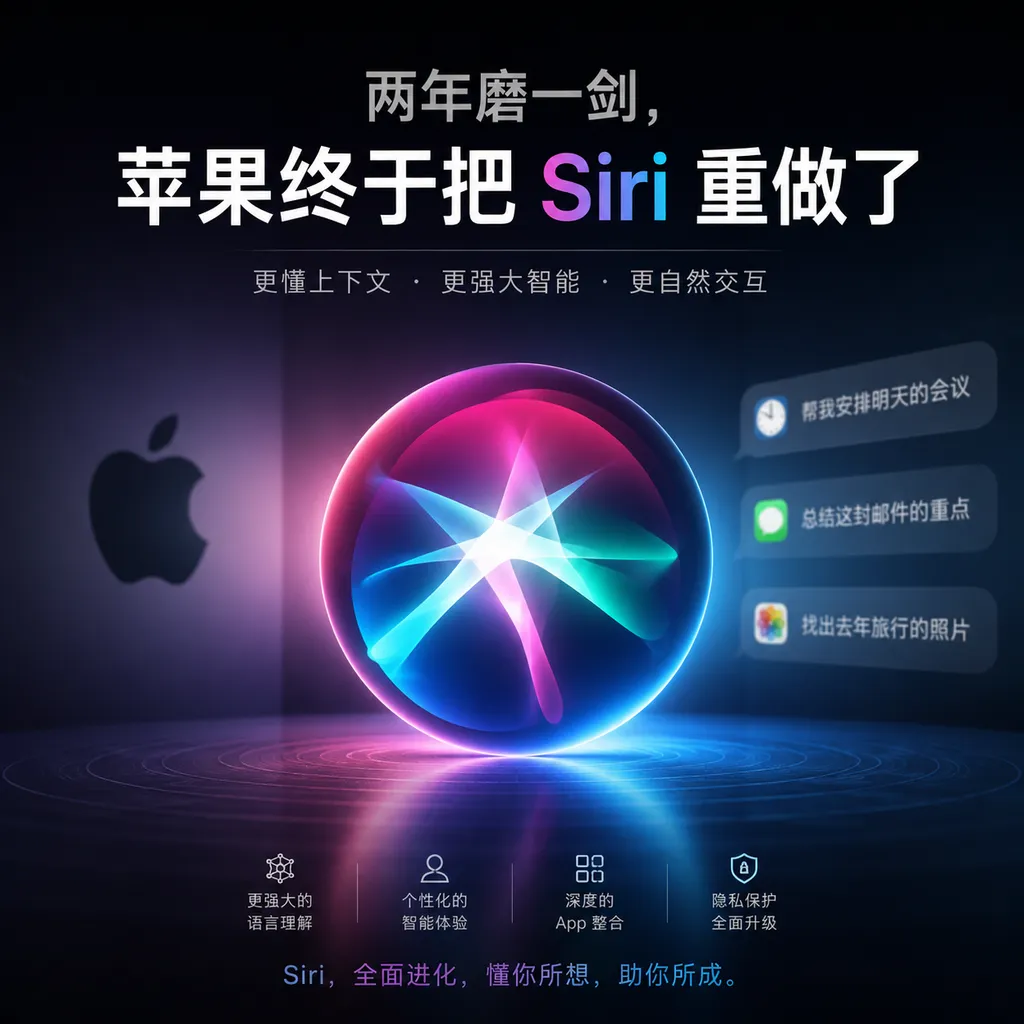
At WWDC26, Apple unveiled the new Siri AI and the second-generation Apple Intelligence architecture, integrating Google's Gemini at the core. It supports system-level screen awareness, file interaction, and introduces a standalone app for the first time.
Two Years in the Making, Apple Finally Redoes Siri
At the WWDC keynote on June 8, 2026, Tim Cook handed the stage to Craig Federighi. The latter spent nearly half an hour clearing up Apple’s awkward history with AI over the past two years—Siri AI was officially unveiled, Apple Intelligence entered its second-generation architecture, the underlying framework brought in Google Gemini, and screen awareness and file interaction rolled out across all platforms.
This is the largest reconstruction of Siri since its launch in 2011, and likely the last major product release during Cook’s tenure. The pressure is high: over the past two years, users have already moved their task habits to ChatGPT, Claude, and Gemini, leaving Apple only hardware and system privileges as its trump cards. The question now is whether Apple can regain the entry point; Federighi’s answer—create a true AI companion that “lives” in the system, not just a voice assistant that only checks the weather when called.
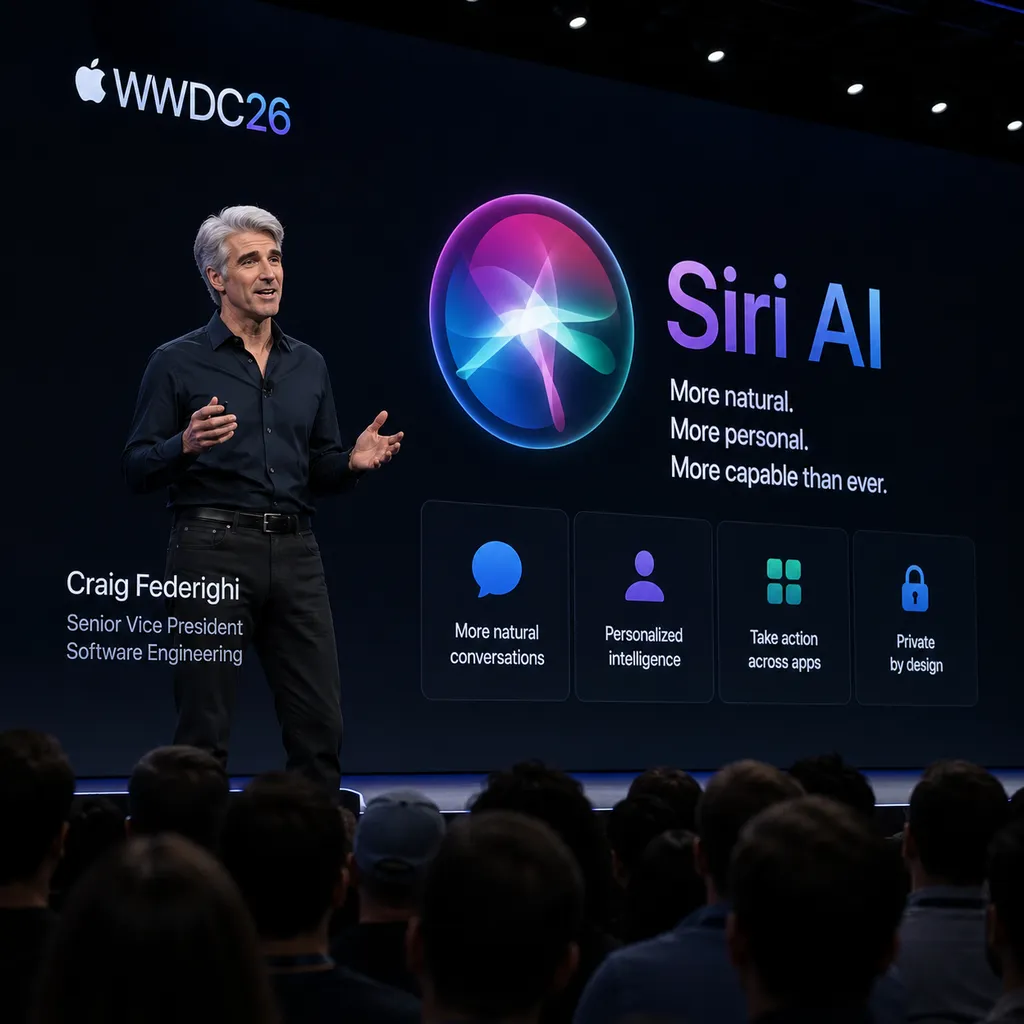
No Longer Just a Voice Assistant: Three Forms of Siri AI
Apple defines this new Siri AI as an “entirely new version of Siri,” emphasizing it’s an AI companion, not a voice assistant. In product terms, the new Siri has at least three forms.
The first is a resident on the Dynamic Island. Wake Siri or long-press the power button, and the Dynamic Island expands into a large bubble containing new animations and conversation interface. This differs from the old semi-transparent overlay covering the bottom—it’s designed as a floating layer you can enter or exit at any time without interrupting your current task flow. Swipe down from the top center of the screen to bring up a “Search or Ask” interface that supports both typing and voice input, effectively merging Spotlight and Siri into one entry point.
The second is a standalone app. This change is critical. Previously, Siri had no “home,” and conversations were ephemeral. The new Siri has a standalone app with UI logic almost identical to ChatGPT and Claude: conversation history list on the left, multi-turn chat in the middle, and an attachment picker at the bottom for uploading documents and images. Swiping further down from the Siri floating layer’s result view takes you into the full conversation view. This signals Apple’s acceptance of a reality: AI assistants need to be built according to the chatbot paradigm—past “single Q&A then done” designs have proven wrong in the market.
The third is a system-level agent. Siri AI can read any content on the screen and interact with third-party apps. In the demo, Mike asked Siri to check concert ticket information and remind him to enter a lottery; he also asked Siri to search for “photos traveling with the kids”—both tasks span multiple apps, requiring Siri to call the calendar, mail, photos, and web search simultaneously.
The voice side also sees major upgrades. New Siri’s voice expressions are more vivid, and users can customize speed, expressivity, and accent. CarPlay and AirPods gain the same capabilities, meaning Siri will feel much more like a real person in your car or headphones.
Apple Intelligence 2nd Gen: Apple Finally Relents, Brings in Gemini
More noteworthy than Siri itself is the underlying architecture.
Apple officially announced a partnership with Google, bringing Gemini in as the cloud-side large model. This cautious yet pragmatic move comes after two years of trying to hold up Apple Intelligence with self-developed models—resulting in none of the promised features arriving on time. Gemini’s full version has parameters in the trillion scale, which Apple’s Private Cloud Compute infrastructure can’t fully support, so some complex queries will run directly on Google Cloud.
Apple didn’t yield on privacy. To maintain its “no one can access your data” pledge while running models on Google Cloud, it brought in NVIDIA’s Confidential Compute technology to encrypt both data and models in processing. The trade-off is slightly slower cloud inference, but Apple still brands it as Private Cloud Compute.
There are also key updates on device-side. Second-generation device-side models take over a series of core abilities:
- Dictation
- Natural language understanding
- More vivid voice expressions
- Screen awareness
Screen awareness is the most practical update here. Siri can understand what’s happening on your screen—an address in a message, a flight number in an email, a product in a picture—and act upon it. This capability was promised at WWDC two years ago as a demo, and now it finally works end-to-end.
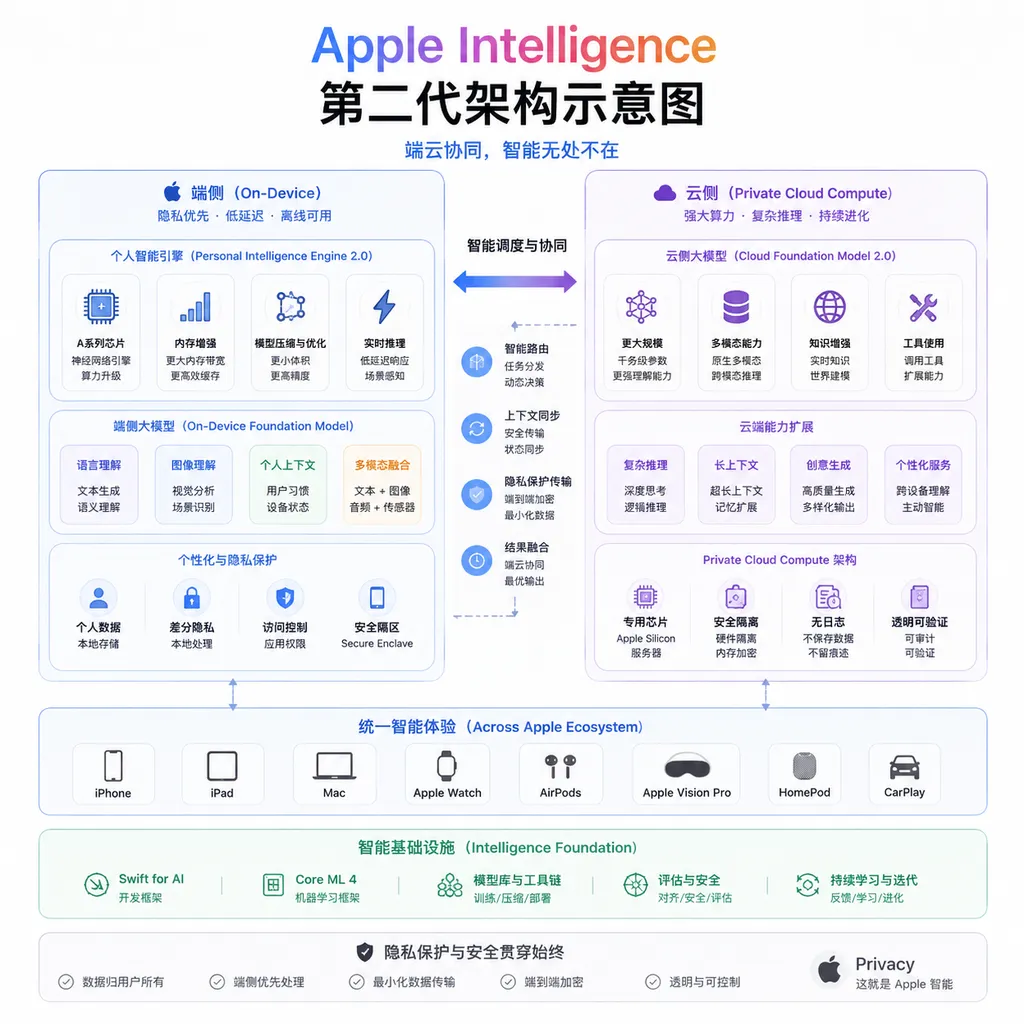
Device-cloud routing logic is the same as the last gen: Apple Intelligence first checks if the request can be completed on device, and if not, routes to Private Cloud Compute or Gemini. The difference is that the second-gen device-side model can handle much more, meaning most daily requests won’t need to leave the device.
macOS 27: Control + Click, Files Become Siri’s Context
macOS 27 integration carries more of a productivity vibe.
Apple has directly embedded Siri AI into Spotlight. The interaction logic is very Apple: Hold the Control key and click on an image, file, or text to ask Siri a question. The window can be freely resized and moved, meaning Siri on Mac is no longer a dialog box floating in the center of the screen but a resident panel you can place alongside your workspace.
More importantly, Siri can use Mac files to answer questions. You can select multiple files at once—a PDF contract, a reference screenshot, a meeting audio recording—bring up the key menu, and have Siri integrate them to answer. This is a big deal for developers and creators: previously, to feed multiple local files to ChatGPT, you had to upload them one by one; now the system-level Siri can directly access them, eliminating this transfer cost.
On privacy, file content is processed on-device by the local model by default, only going through the encrypted cloud route if complexity exceeds device capacity.
iOS 27 Camera: Siri Enters the Viewfinder
On iOS 27, Siri is integrated into the camera app.
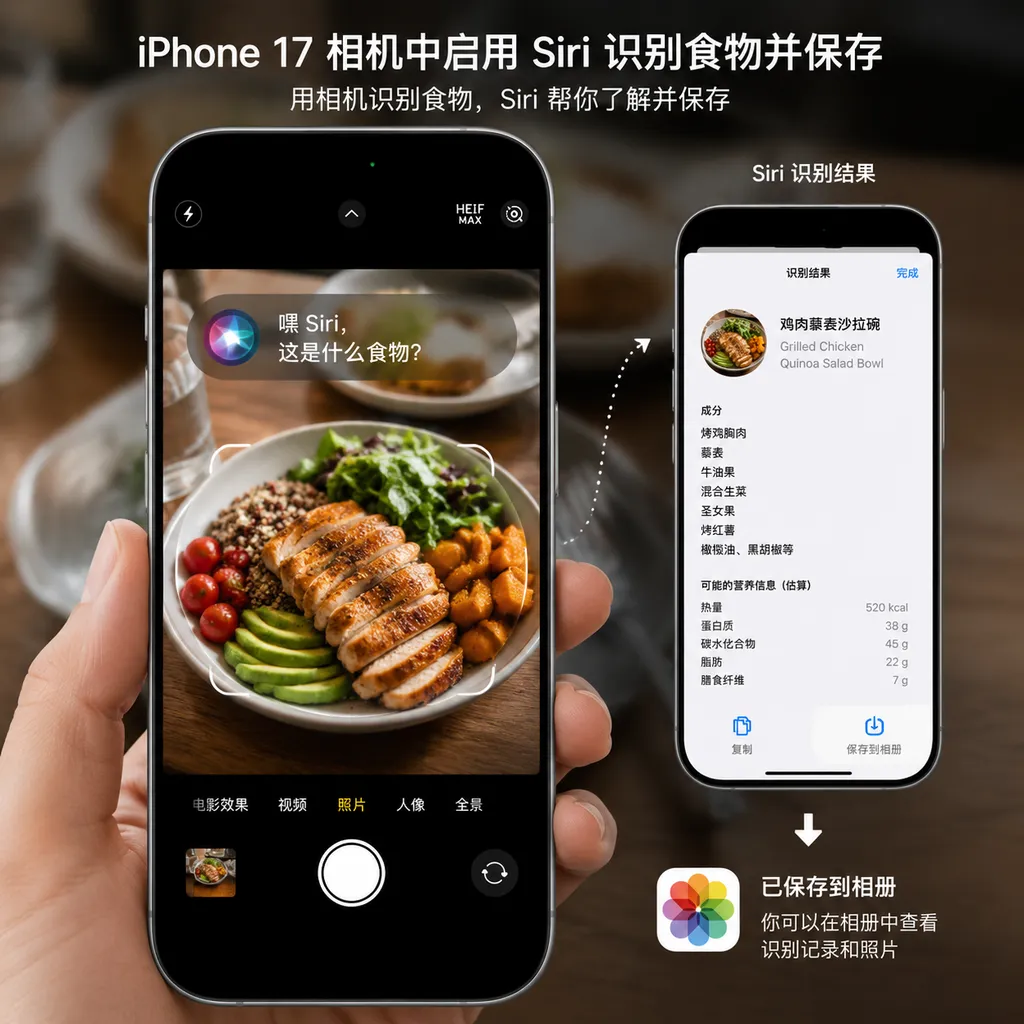
In the demo, Apple showcased a lifestyle example: recording daily food intake with the camera. Open the camera, enable Siri, snap a photo of the plate, and Siri automatically identifies what’s on it, saving it to the Siri app as a dietary record. This replaces the old “Visual Intelligence” experience, powered by the second-gen device-side model without uploading photos to the cloud.
This is a classic “AI finds a scene” case. The camera is already one of the most frequently used apps by iPhone users; embedding Siri means AI enters the most natural entry point—whatever you see, AI understands. Competitor Google Lens has been doing this for years, but here the advantage is integration with system-level Siri, meaning recognized results can directly trigger follow-up actions (recording, reminders, search).
The Photos app also gains two AI tools:
- Reframe: adjust photo perspective
- Extend: use generative AI to complete cropped scenes—for example, restoring the lower part of a building cut off in the shot
Both functions have long been available in Google Photos; Apple is catching up here.
Apple’s Calculus: Can AI Entry Points Turn Into Service Profits?
Aside from tech details, the commercial bet behind Siri AI’s reconstruction is very clear.
In Apple’s FY2025 revenue structure, products brought in $307 billion at 74% of revenue, while services brought in $109.2 billion at 26%. But the gross margin for services is a whopping 75.4%, far higher than the product side’s 36.8%. Services already contribute about 42% of Apple’s total gross profit.
From Siri AI’s product design, we can see several potential monetization paths:
- Apple Intelligence Pro Subscription: tiered access to advanced model abilities
- Default Model Routing Fees: similar logic to Google paying Safari for default search—future could involve charging OpenAI, Anthropic for “default AI assistant” slots
- Agent-based E-commerce Commission: Siri places an order, Apple takes a cut via App Store
- Apple Pay Routing Fees: payments triggered by AI agent
- Ads in Agent Results
Bank of America analysis points out the biggest uncertainty: if users have already moved core task habits to ChatGPT, Gemini, and Claude, then even with control of hardware and system privileges, AI value capture would shrink significantly. This Siri AI reconstruction is fundamentally Apple trying to reclaim the entry point.
Points Developers Should Watch
For developers, there are at least a few things to reassess from this WWDC:
- Importance of the App Intents framework spikes. Siri AI’s cross-app operations rely on App Intents. If your app doesn’t expose enough fine-grained Intents, Siri’s agent abilities might marginalize it.
- Screen awareness changes interaction assumptions. Previously, app design assumed user attention stayed on your interface—now Siri might be “watching” the user’s screen and offering operation suggestions, making UI parseability key.
- Standalone Siri app is a new traffic entry point. It will accumulate conversation history like ChatGPT, meaning users’ search paths may shift from Safari to the chat interface.
Apple’s timeline: developer betas of iOS 27, iPadOS 27, and macOS 27 are available now, public beta in July, official release alongside the fall launch of iPhone 18 Pro. The full capabilities of Siri AI will debut on iPhone 15 Pro and newer, as well as M1 and newer iPads and Macs.
Worth noting: the Gemini model has long been available on OpenAI Hub—one key lets you freely switch between GPT, Claude, Gemini, DeepSeek, with direct domestic access and OpenAI format compatibility. If you want to replicate a multi-model routing architecture like Siri AI in your own product, you can refer directly.
Final Thoughts
Two years ago at WWDC24, Apple Intelligence made its debut with a slew of promises that never materialized. This time, Siri AI finally turns those slides into usable products, but at the cost of accepting reality—self-developed models couldn’t carry it, Google Gemini plugs the gap. This is a rare case of Apple bowing its head, and a pragmatic choice.
For Apple, hardware and system privileges remain its strongest moat. The question is, when the entry point for this new era of AI assistants has already been in ChatGPT’s mindshare for two years, can Apple entice users back with a “resident in the system, screen-aware, file-operating” Siri? The answer will only become clear after the iPhone 18 Pro ships this fall.
References
- Apple iOS 27 Siri integrated into camera app, iPhone 17 users can record diet - IT Home: details on Siri integration into the camera
- Apple macOS 27 integrates Siri AI into “Spotlight” - IT Home: demo of Mac Control + click interaction
- Apple partners with Google for Apple Intelligence: Brings in Gemini - IT Home: second-gen architecture and device-cloud collaboration plan
- Apple launches Siri AI: standalone app, optimized for Dynamic Island - IT Home: product forms of Siri AI


