
Xcode 27 Beta Released: Apple Puts AI Agents into the IDE

On the first day of WWDC 2026, Apple released Xcode 27 Beta and the Core AI framework. The coding assistant has been upgraded to an agent workflow, and Foundation Models now support image input. Craig Federighi called Xcode the "best place" to build AI agent applications.
At the WWDC 2026 keynote early this morning, Apple pushed its developer toolchain to a whole new level in one go: Xcode 27 Beta is officially available for developers to download, accompanied by the debut of the Core AI framework and upgraded Foundation Models. Craig Federighi dropped an ambitious line on stage — Xcode is now "the best place" to build intelligent agent AI applications.
It sounds like typical Apple rhetoric, but if you break down this update, you’ll see it’s indeed more than just “adding some AI features again.” From last year’s Xcode 26.3 opening up access to Claude and Codex, to this year’s Xcode 27 pushing agent capabilities down into compilation, testing, localization, and simulator interaction across every stage, Apple’s direction in rewriting the IDE is becoming clearer: the coding assistant is no longer a chat window tucked in the sidebar, but an executable entity capable of running a complete workflow.
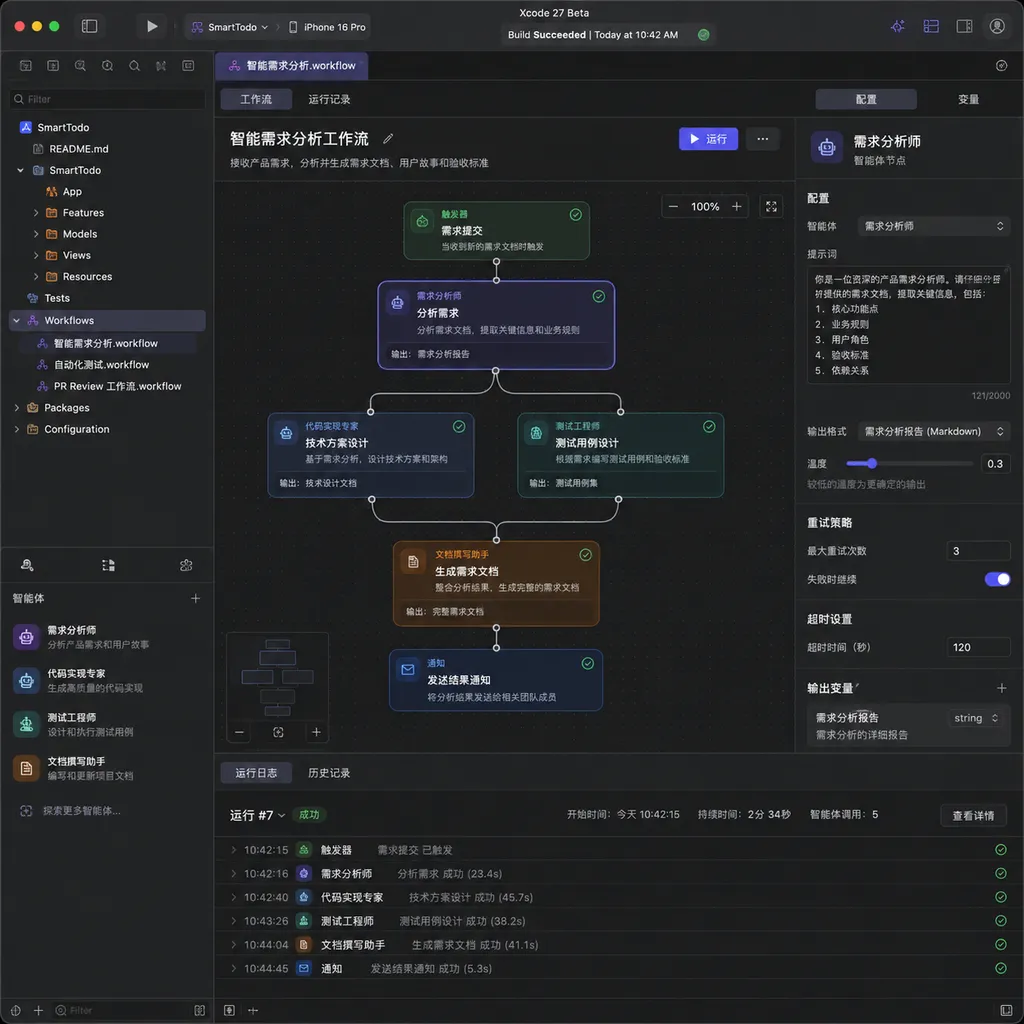
From “code completion” to “agents taking over the entire workflow”
During the Xcode 26 era, AI was essentially the Apple version of the GitHub Copilot philosophy: you write a bit, it completes a bit; you ask a question, it gives a quick answer. Even after 26.3 introduced Claude and Codex, the interaction model remained primarily “dialogue + insert code.”
Xcode 27 Beta throws out that paradigm. The new coding assistant exhibits three clear “agent” characteristics:
- Able to handle localization workflows. This is an interesting entry point. Multi-language adaptation in the Apple ecosystem has always been tedious —
.strings,.stringsdict,Localizable.xcstrings, plus a stack of keys to send off to translation vendors. Xcode 27 allows the agent to directly read localization resources in the project, generate, complete, and merge different language versions based on context, and identify manually edited translations to avoid overwriting them. This is not a simple “machine translation plugin,” but more akin to a localization engineer who understands your UI context. - Able to interact with the simulator. This is significant. Previously, after AI wrote code, developers still had to manually run it, click through the UI, read logs, and paste error info back. Xcode 27’s agent can drive the Simulator directly, click UI elements, read screen states, capture logs and crash stacks, then return to the code to fix issues itself. This is the “closed-loop execution” that tools like Claude Code and Cursor have been chasing — except Apple has built it into the IDE core, with a native-level understanding of its own debugger, Instruments, and XCTest.
- Able to integrate testing and debugging. The agent no longer just intervenes during coding but can trigger unit tests, run coverage reports, and pinpoint failing test cases. It effectively bridges the gap between “AI coding” and “AI debugging.”
If you’re an iOS/macOS developer who lives in Xcode, you’ll feel the weight of this upgrade. Historically, Xcode’s approach to automation, CI, and external tools has been semi-closed — requiring workarounds via xcodebuild. Apple actively extending the agent’s reach into the simulator and testing environment means it’s at least opened up quite a few internal interfaces within the IDE.
Foundation Models: now accepting image input
More noteworthy than Xcode itself is the upgrade to the Foundation Models framework.
Recall the background: Foundation Models is Apple’s device-side LLM framework released alongside iOS 26 last year. Models are published with the system, run on Apple Silicon, and never leave the device. Developers call the model via SystemLanguageModel.default, constrain output structures via @Generable, and expose app capabilities to the model via the Tool protocol. Fundamentally, it’s a “device-side, sandboxed, strongly typed” LLM runtime.
The biggest change this time: Foundation Models now support image input. Developers can feed images and text together into the device-side model, enabling multimodal tasks without internet connectivity. This step may have bigger implications than it appears:
- On-device multimodal processing enables privacy-sensitive image understanding apps — medical imaging assistance, receipt recognition, pet diaries, children’s education — without uploading photos to the cloud.
- It raises Apple Intelligence’s competitiveness against OpenAI, Anthropic, and Google’s cloud-based multimodal APIs. Cloud models are of course more powerful, but with the combination of “zero latency + zero cost + fully offline,” on-device multimodal will be the first choice for a significant subset of developers.
- In terms of framework design, handling image inputs requires rewriting strategies for constrained generation, token counting, and context window management. Apple will reveal more details in later WWDC sessions — notably, whether image inputs enter the
@Generablestructured reasoning path.
A quick architectural note: iOS/macOS apps now actually have two LLM systems — one is the “runtime LLM” (Foundation Models) invoked when the user runs the app, the other is the “toolchain LLM” used by developers while building apps (like Claude Code, Cursor, Codex CLI, and now Xcode 27’s agent). They both share the LLM label, but have entirely different security models, deployment methods, and callers. Xcode 27 upgrades significantly on the toolchain side, while Foundation Models gain multimodal capabilities on the runtime side. Apple’s pushing both lines in parallel with clear intent.
Core AI framework and MCP: Apple embraces open standards
Last year, Xcode 26.3 introduced the Model Context Protocol (MCP), allowing third-party models to connect to the IDE as agents. Xcode 27 takes this further: the newly released Core AI framework unifies developer APIs for multi-model access, context management, and tool invocation. In other words, Apple does not intend to lock the IDE to its own models — developers can use Claude to write Swift, GPT for code review, and Gemini for architectural comparisons, all through the unified Core AI framework interface.
This is a fairly un-Apple-like decision. Given Foundation Models are closed-source and Apple Intelligence is strategically extremely restrictive, choosing to open interfaces on the Xcode side shows Apple understands something: in AI competition for developer toolchains, Apple alone cannot beat the entire Claude Code and Cursor ecosystem. Instead of building behind closed doors, turning Xcode into an agent host for all models is more worthwhile.
Preview UI, debugging, and some small updates
Beyond major agent-related changes, Xcode 27 Beta also fixes some old issues:
- Preview now allows more flexible resizing and supports direct interaction within the preview interface — SwiftUI developers will love this, as preview sizing and interaction have long been pain points.
- Compilation performance, according to on-stage demos, is improved by about 20% for large Swift projects — though real-world projects will confirm if this claim holds.
- The new debugger and Instruments are integrated with agents, allowing performance data queries via natural language.
A few truths for developers
This Xcode 27 + Foundation Models + Core AI combo represents a relatively complete strategy: open in the IDE, closed in runtime, private on-device, third-party in the cloud. It’s not an easy strategy to execute, but the direction is correct.
For developers, a few tips:
- If you develop iOS/macOS apps and heavily rely on Xcode, it’s worth installing the Beta in a VM early, especially to experience the agent running tests and simulator interactions — there’s a generational difference from Xcode 26.
- With multimodal capabilities newly opened in Foundation Models, early adopter apps will get App Store featured spots — this is Apple’s usual way.
- If you need to compare multiple models — e.g., evaluating code repair quality across Claude, GPT, Gemini, DeepSeek — aggregation platforms like OpenAI Hub let you connect to mainstream models with a single key, avoiding multi-account/multi-key hassles. This is particularly handy for script-based evaluation outside the IDE.
- Remember that Foundation Models’
Toolprotocol and MCP tools are different things. The former is a strongly typed Swift function inside the app; the latter is a JSON-RPC method for cross-process calls by toolchain agents. Keeping them separate in architectural design is key to avoiding missteps.
Xcode 27 Beta is now available to Apple Developer Program members for download, with the official release expected alongside iOS 27/macOS 27 this fall. WWDC’s upcoming State of the Union and specialist sessions will reveal more API details — worth keeping an eye on.
References
- Xcode 27 Beta release: Apple calls it the “best place” to build AI agent apps - IT Home: First-hand WWDC 2026 coverage of Xcode 27 and the Core AI framework.


