
Apple responds to shell accusations: AFM is distilled from Gemini, but not Gemini
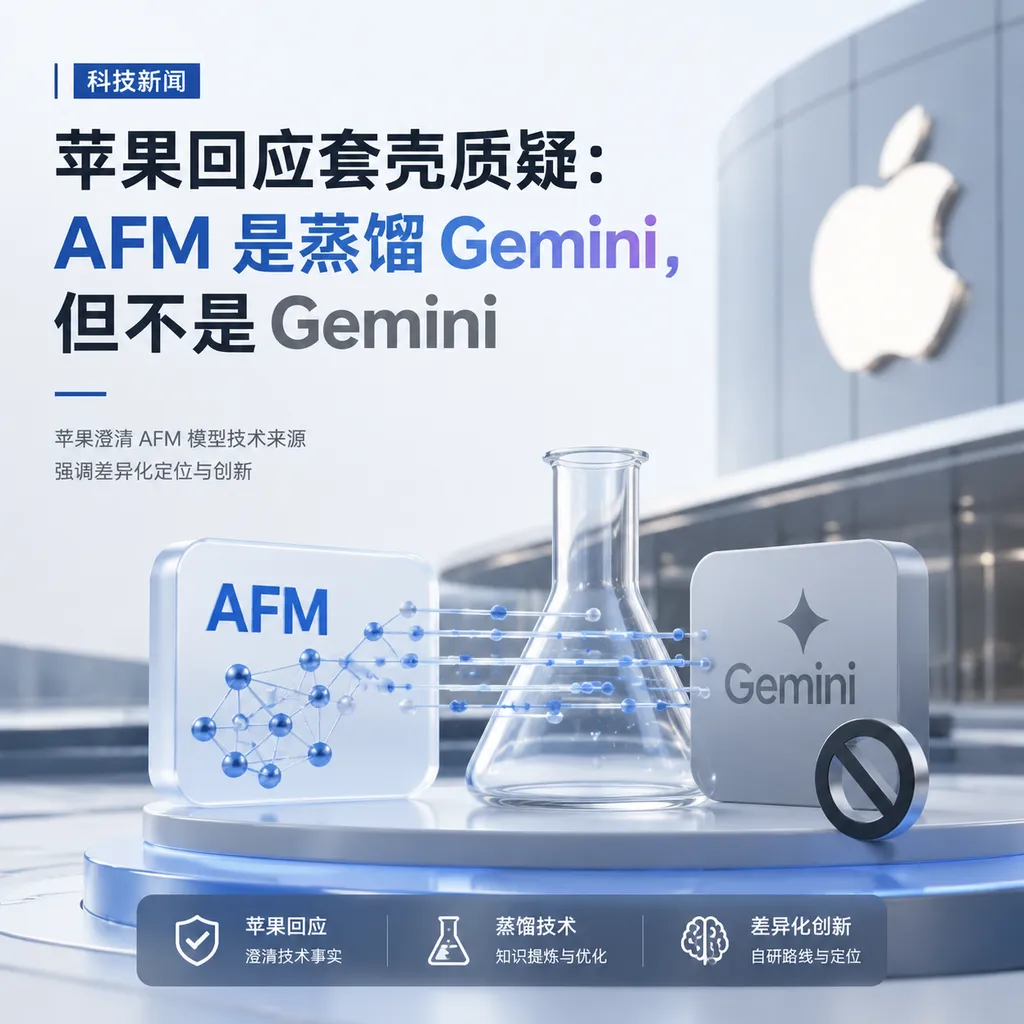
After the WWDC26 keynote, Apple executives made a rare collective appearance to clarify: although the new generation of Apple Foundation Models used Google Gemini for distillation training, the model code, data system, and inference stack are entirely self-developed, and the complete product line of five models was revealed for the first time.
Just a few hours after the WWDC keynote ended, several of Apple’s AI executives were cornered by reporters in the lounge area of Apple Park. The question was singular: The Apple Foundation Models (hereafter referred to as AFM) you released yesterday — are they actually just Gemini in disguise?
This impromptu group interview took place late at night on June 8 — WWDC26 day in Cupertino time. On June 9, Appleinsider compiled the original remarks from the executives, and Apple’s answer was unsurprising: No. Interestingly, though, they admitted to the most widely debated detail — AFM’s training did indeed use Google Gemini for distillation.
That’s what makes things delicate. If a model is distilled from Gemini, how can it claim it’s not just a rebranded shell?
Apple explains “rebranding” clearly for the first time
Let’s rewind to last year. Bloomberg and The Information both reported that after slow progress on its own AI development, Apple planned to spend $1.5 billion annually renting a custom Gemini from Google to support the repeatedly delayed “new Siri” of 2026. At the time, everyone assumed Apple’s AI offering would be underpinned by Mountain View.
This year’s WWDC demos weren’t bad at all. The new Siri can finally execute multi-step tasks across apps, operate based on on-screen context, and generate images faster than the Image Playground generation. But the “rebranding” rumors didn’t fade because of the good performance — in fact, the good performance reinforced them — everyone assumed Gemini was doing the heavy lifting.
Apple’s explanation this time is logically clear: Gemini is the teacher, AFM is the student. Distillation in training simply used Gemini’s output distribution to align the student model, but the final model delivered to users — whether parameters, inference code, or serving infrastructure — has nothing to do with Gemini. In Apple executives’ words: “When users invoke AFM, they won’t touch Google code, they won’t touch the Gemini agent, and they won’t directly access Google Search.”
Technically, this reasoning holds. The architecture of a distilled model is defined by the student, parameters are trained by the student, and weights are entirely separate from the teacher model. Similar practices have existed for years — for instance, after DeepSeek-R1, many small open-source models distilled using R1’s trajectories weren’t considered rebranded R1.
But “not rebranded” doesn’t mean “fully independent.” If Google were to restrict Gemini access or sharply raise prices, Apple’s next-generation model training costs would immediately spike — this dependency is structural, and not avoidable in the short term.
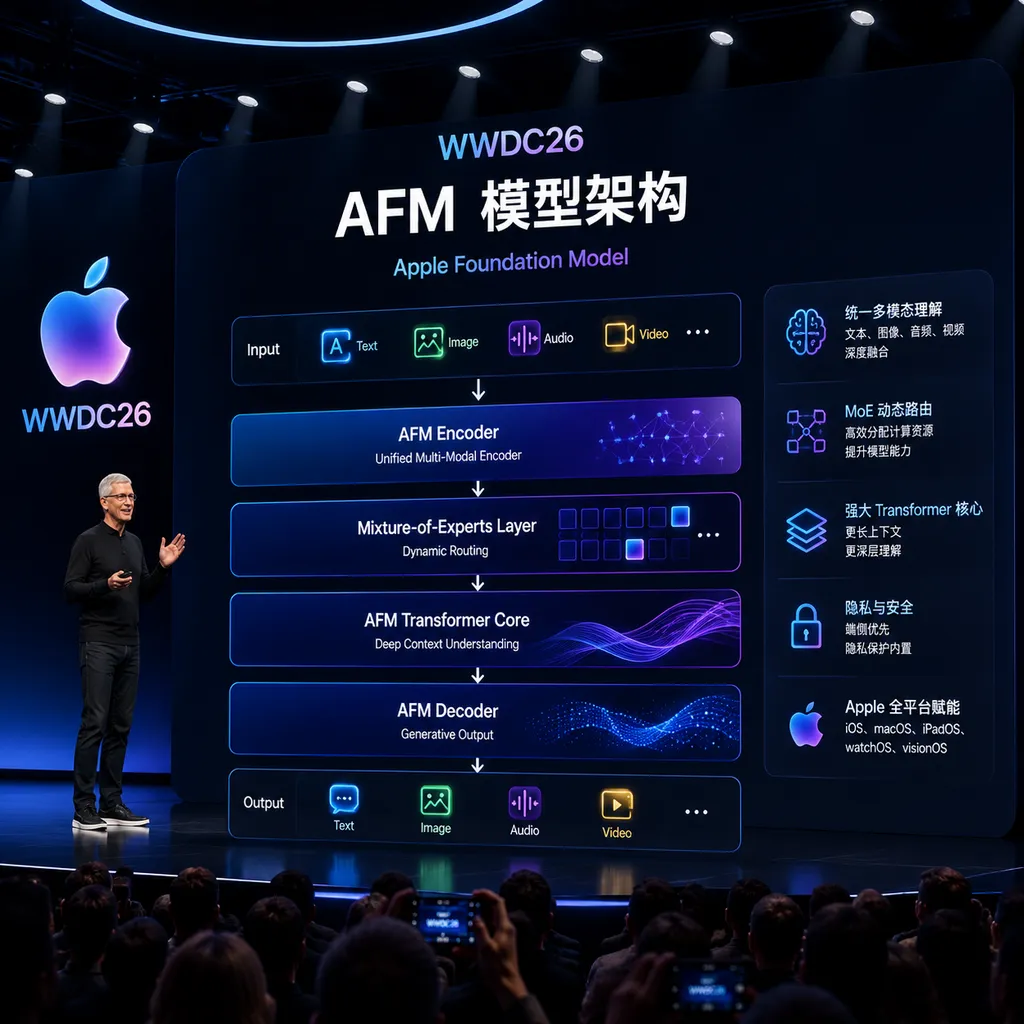
The AFM family of 5 models revealed in full for the first time
Before this WWDC, outside understanding of Apple’s model lineup remained at a “one on-device + one cloud” binary structure — the version revealed in Apple’s Machine Learning Research blog in 2024. This year Apple expanded the family to five:
- AFM Core: On-device base model handling common local language tasks such as system notification summaries, email rewriting, and semantic Spotlight search. At the 3B scale, 2-bit quantized to fit into A-series and M-series NPUs.
- AFM Core Advanced: Still on-device, but with native multimodal ability and a sparse architecture (likely some on-device MoE variant). Handles more complex local tasks like video frame understanding and cross-app visual-context reasoning.
- AFM Cloud: General-purpose cloud model for high-load requests not feasible locally. Continues the Parallel-Track MoE architecture idea from Apple’s 2025 paper.
- AFM Cloud Image: Dedicated to image generation and editing. Takes over most of Image Playground and Genmoji workloads going forward.
- AFM Cloud Pro: Flagship version for Agent tool calling and heavy-duty tasks, the most noteworthy release this time.
The key lies in AFM Cloud Pro’s infrastructure details. Apple admits this largest model no longer runs on its own Apple Silicon servers, but instead uses Google Cloud servers + NVIDIA GPUs. However, Apple emphasizes this deployment still passes the Private Cloud Compute (PCC) certification process.
This is the most information-rich revelation. PCC was Apple’s core AI privacy narrative — all cloud AI inference had to run on Apple’s custom Apple Silicon servers, hardware remotely attestable, software images auditable, no user data retained. Now Apple concedes that for Pro-level workloads, its own chips can’t handle it — they need Google’s datacenters and NVIDIA’s H100/B200 — yet claims PCC’s security model still holds.
How? Apple hasn’t shared details, but a reasonable guess is: PCC’s core is “attestable enclave” + “stateless compute + end-to-end encryption.” In theory, if the attestation chain can extend to NVIDIA Confidential Computing or GCP’s Confidential VM, plus Apple’s image signing, the same security claims can be preserved. But essentially, the trust root expands from “Apple hardware” to “Apple hardware + Google datacenter physical security + NVIDIA firmware,” thus widening the trust surface.
On-device model highlights: sparse architecture + Apple Silicon customization
Compared to cloud compromise, Apple invests far more effort in on-device development.
AFM Core Advanced is the star on-device release. Apple casually dropped the term “sparse architecture” — but its significance is notable — it means some form of MoE or conditional computation is now used on-device. Running MoE on a 16 GB RAM iPhone 17 Pro is an engineering challenge, given MoE’s usual drawbacks of high memory usage and expert routing overhead. Apple’s ability to fit it probably comes from something like MoE-only-in-FFN + shared attention, with ANE’s sparse scheduling instructions enabling hardware cooperation.
In its 2025 update, Apple’s ML team mentioned one detail: on-device models use KV-cache sharing + 2-bit QAT (quantization-aware training). 2-bit is already aggressive in on-device LLMs — traditionally, it starts at 4-bit. Apple dares to go 2-bit because it has ANE hardware support and custom kernels — a moat Google or Microsoft would struggle to replicate on Pixel or Surface.
AFM Core and Advanced roles are also interesting. Core handles high-frequency, low-latency tasks; Advanced is only activated when users trigger more complex requests. This likely means iOS 27 will have a dynamic scheduling layer routing tasks between the two on-device models, falling back to AFM Cloud when necessary. This three-tier routing resembles Gemini Nano/Flash/Pro, but Apple can push it further since it controls OS, hardware, and power management completely.
Practical impact for developers
For third-party developers, AFM’s main entry point remains the Foundation Models framework introduced at WWDC25. This framework will likely be upgraded this year, adding Cloud model access and more complete tool calling support.
From WWDC25’s already public interface, invoking local models looks like this:
import FoundationModels

@Generable
struct Itinerary {
    @Guide(description: "Destination city")
    let city: String
    let days: [DayPlan]
}

let session = LanguageModelSession()
let response = try await session.respond(
    to: "Plan me a 3-day trip to Joshua Tree National Park",
    generating: Itinerary.self
)
Apple’s bet is clear: structured generation + tool calling + local privacy. The @Generable macro directly treats Swift structs as the output schema, and the model fills in the blanks; Tool protocol lets models call external data sources. The design philosophy parallels OpenAI’s Structured Outputs and Anthropic’s Tool Use, but Apple leverages Swift’s type system and macros for a more native experience.
Whether AFM Cloud Pro will be open to third-party developers is unclear. Based on past strategy, it’s likely that third parties will only use on-device models, with the Cloud series reserved for system apps and Apple Intelligence itself. This aligns with Apple’s “satisfy its own needs first” approach.
What this means
Apple’s stance here is telling. One year ago, Tim Cook and Craig Federighi promised at WWDC24 that Apple Intelligence would run entirely on Apple Silicon. Now, a year later, Apple quietly runs its most powerful model on Google Cloud + NVIDIA. This admits the fact: in frontier model training and inference, Apple can’t catch top players in the short term.
But Apple’s response is also very Apple — absorb others’ capabilities into its own models, then wrap them in its own product experience and privacy narrative. Distilling Gemini, renting Google Cloud, using NVIDIA GPUs — these are tools; what users get remains AFM with Apple branding, Apple framework SDKs, Apple PCC privacy labels.
This “capabilities outsourced, experience in-house” strategy is somewhat like Microsoft’s relationship with OpenAI for Copilot, but not identical. Microsoft directly packages GPT‑4 into products; Apple distills knowledge from others’ models into its own smaller models and distributes them to 2 billion devices. The former feels like leasing; the latter more like “legal tech transfer.”
As for whether “rebranding” is an apt term, technically Apple wins — distilled models truly aren’t rebranded shells. But in product storytelling, Apple loses half — its most powerful model still runs on Google’s machines, with Gemini as the source of its strongest capabilities.
Notably, for developers in China, AFM’s capabilities will only be experienced through Apple devices themselves in the short term. For product testing and cross-comparing Gemini, Claude, GPT, and other closed models’ actual performance, aggregator platforms like OpenAI Hub remain the more practical option — one key for all mainstream models, avoiding the hassle of individual signups, overseas payments, and network workarounds.
The next few days of WWDC will feature over a dozen sessions diving into AFM’s training data, safety alignment, and framework details. Once those are out, we can revisit whether Apple’s clarifications today hold up.
References
- ITHome: Apple responds to “Gemini rebranding” speculation: iOS 27 Siri AI AFM self-developed — Appleinsider’s Chinese write-up of the group interview with Apple executives after the WWDC keynote, including full names and roles of the five AFM models.


