
Dewu is the first to integrate with WeChat AI Agent, making authentication and ordering as simple as one sentence.
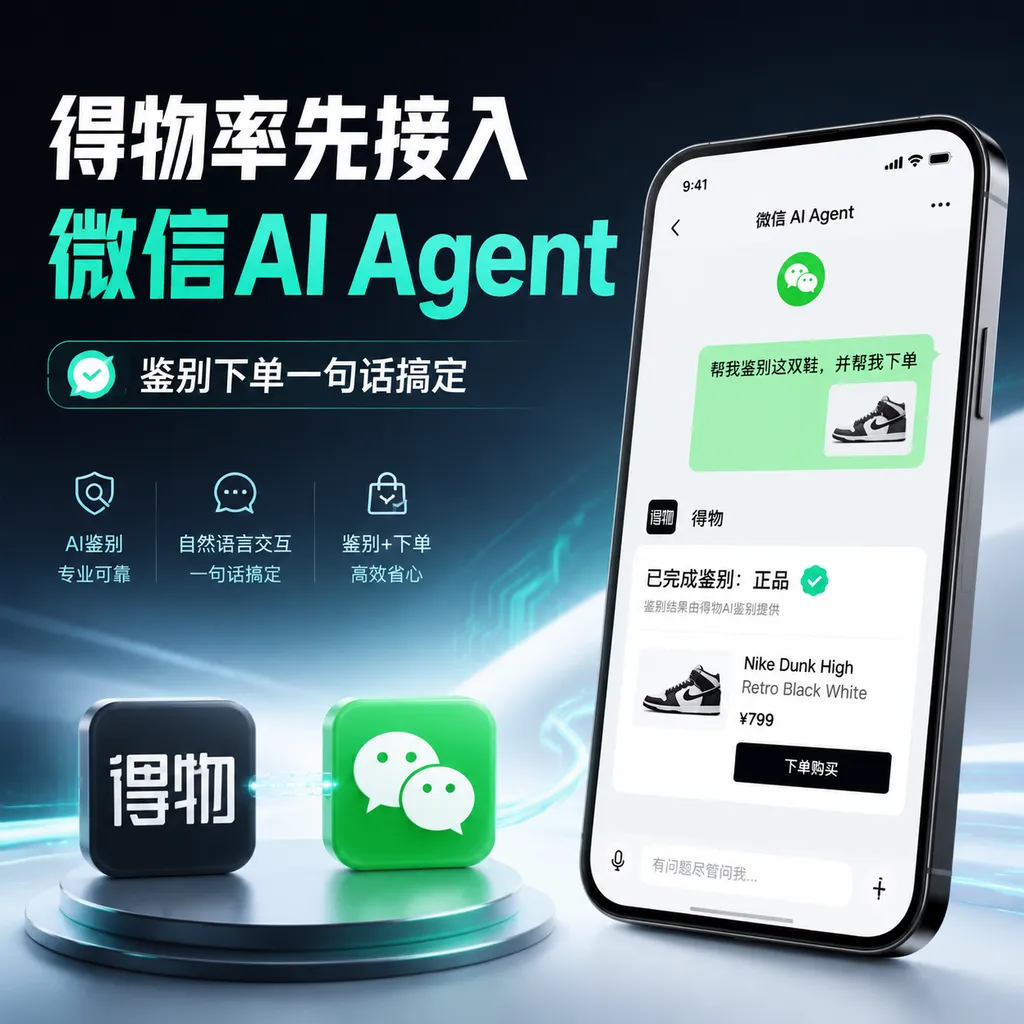
On June 9, it was reported that the Dewu App has become one of the first participants in the WeChat AI Agent ecosystem. Users can directly access Dewu’s scenario-based shopping guidance, product authentication, purchase ordering, and quality fulfillment capabilities through the Agent within WeChat. This marks the first e-commerce player to gain entry after the implementation of WeChat’s intelligent agent strategy.
WeChat AI Agent’s First E-commerce Ticket Goes to Dewu
On June 9, the Dewu App announced that it was the first to connect to the WeChat AI Agent ecosystem. This means that users no longer need to leave WeChat to open Dewu separately — they can now complete the full “Find Shoes — Authenticate — Order — After-sales” process directly within a conversation flow. Public information shows that this is one of the first e-commerce services granted access after the WeChat AI Agent ecosystem opened up, with Dewu being the fastest mover in its niche.
At first glance, this might look like an ordinary product collaboration, but in the context of WeChat’s moves over the past year, it carries a different weight. Starting in the second half of last year, WeChat began building its Agent foundation — first integrating Yuanbao, then shifting the official account ecosystem toward intelligent agents, and in Q2 of this year officially opening its Agent API to the public. Dewu’s entry at this stage means it is positioned right at the front of a brand-new traffic channel.
What Users Can Do in WeChat
According to Dewu’s published capability list, once integrated, users can invoke four types of services via the WeChat Agent:
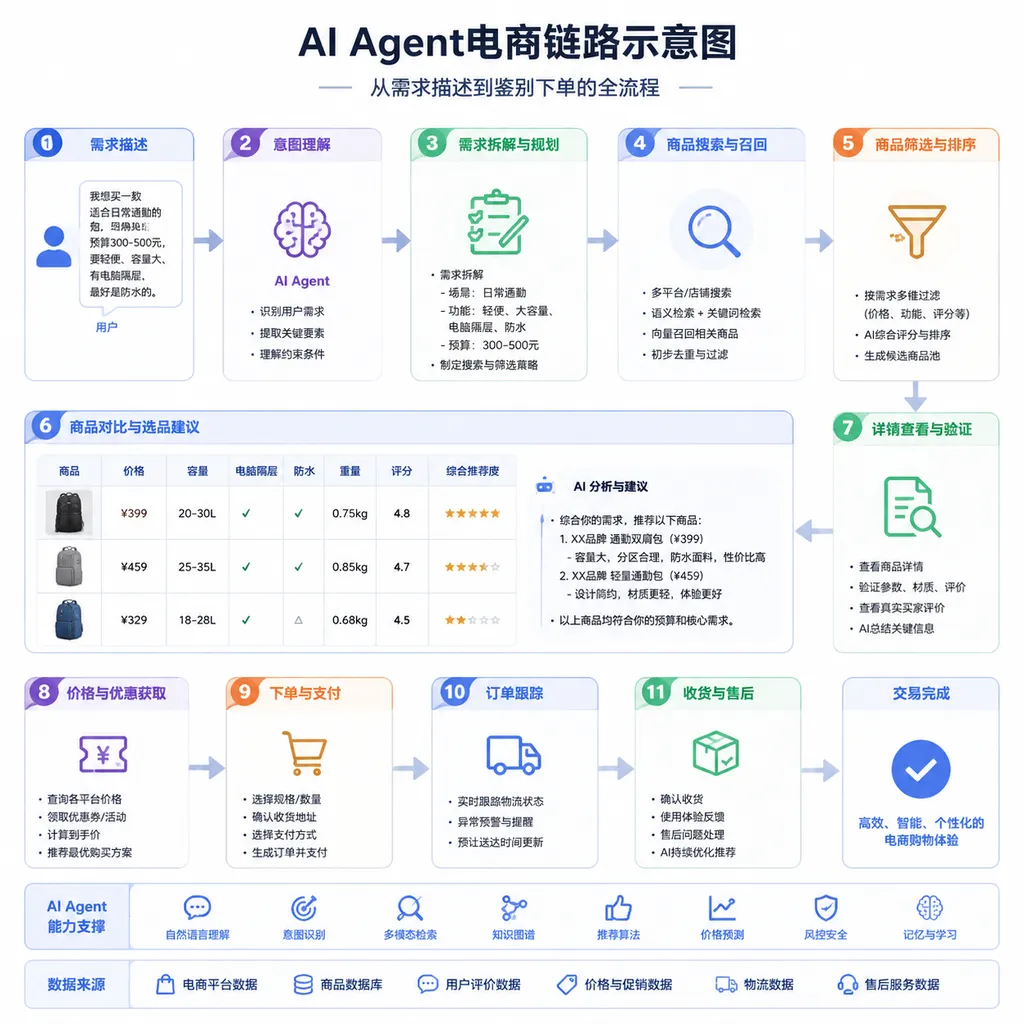
- Scenario-based shopping guides: Users can describe their needs in natural language, e.g., “I want a pair of white summer commuter sneakers under 3,000 yuan,” and the Agent will directly match products from Dewu’s SKU database.
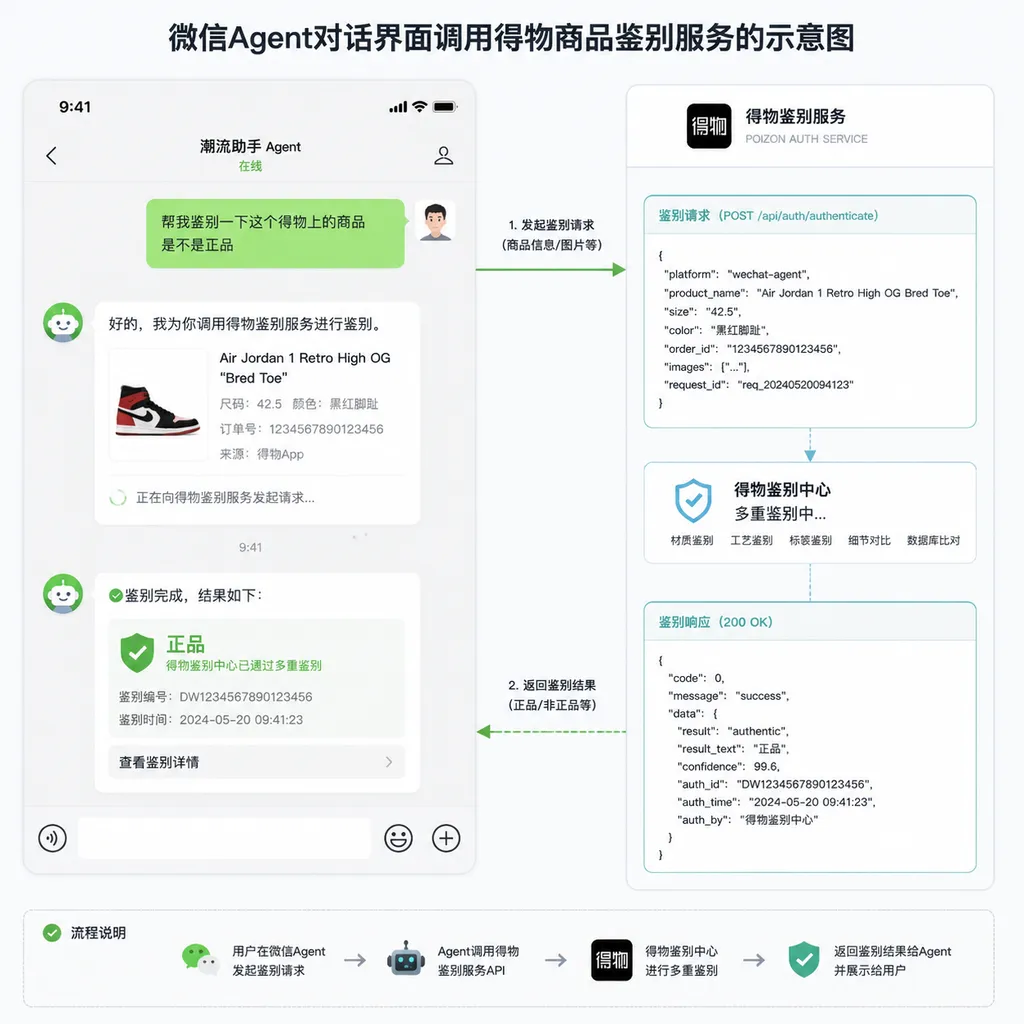
- Product authentication: Dewu’s flagship service. In second-hand trades, gift verification, and other scenarios, users can take a photo and upload it, and the Agent will invoke Dewu’s authentication to return a genuine/fake verdict and a detailed report.
- Purchase and ordering: Complete payment, address entry, and order creation within the chat flow, with no need to jump out.
- Quality fulfillment: Logistics tracking, after-sales requests, returns, and exchanges are all completed within the Agent.
Among these, “product authentication” is the most interesting link. In the past, Dewu’s authentication capability was its competitive moat, locked inside its own app. Now, by offering it as a tool to WeChat Agent, authentication has shifted from being “a Dewu feature” to “a service an AI Agent can call.” This is an intriguing identity transformation — from a C-side product to an MCP (or MCP-like) service node in the Agent ecosystem.
Why WeChat Chose Dewu as a First Mover
WeChat isn’t short of e-commerce partners — JD.com, Pinduoduo, and VIP.com are all in its portfolio. Several reasons stand out for Dewu getting the first batch slot:
First, Dewu’s services are highly “Agent-friendly”. AI Agents perform worst with vague services that require heavy manual intervention. Dewu’s core functions — authentication and trendy product recommendations — naturally have standardized input-output formats: image in, report out; need description in, SKU list out. This high degree of structure makes it easier to schedule than traditional shelf-based e-commerce.
Second, matched user demographics. Early heavy users of WeChat Agent are likely to be younger, more AI-receptive users, perfectly overlapping with Dewu’s core demographic. This means WeChat doesn’t have to spend much on user education for this group.
Third, avoiding direct conflict with WeChat’s own e-commerce infrastructure. Video Channel Shops and Mini Program e-commerce already cover most shelf-based scenarios. Dewu focuses on the “trendy + authentication” vertical, complementing, rather than replacing, WeChat’s internal e-commerce ecosystem.
What Agent Integration Means for Dewu
From Dewu’s perspective, this integration addresses three issues:
Diversifying traffic entry points. Dewu’s growth anxiety in recent years is clear: the post-90s/95s demographic dividend has peaked, and user acquisition costs are rising. WeChat’s pool of 1.2 billion MAUs, previously reachable only through passive channels such as shares or mini-programs, now becomes an active entry point — when a user asks an AI “Where can I buy authentic Air Jordans?”, Dewu can be summoned by the Agent proactively.
Unlocking the value of authentication services. Authentication is one of Dewu’s largest investments, but its value historically only impacted GMV conversion within Dewu’s own platform. Opening it to the Agent could turn it into a cross-scenario service — theoretically, a user who buys shoes on Xianyu could use WeChat Agent to have Dewu authenticate them. This is turning an internal capability into industry infrastructure.
Reusing fulfillment capabilities. Dewu’s self-operated quality fulfillment system (inspection, defect warranty, damage coverage, etc.) is also exposed to the Agent through this integration. For Dewu, this is a heavy-asset investment, and every additional call point helps to amortize costs.
Is This the True Starting Point for Agent E-commerce?
Over the past year, “Agent e-commerce” has become a buzzword. OpenAI launched Operator, Anthropic’s Computer Use demoed shopping, and Chinese companies are doing similar experiments. But few have actually made it work, for several reasons:
- Lack of protocol layer: For Agents to call e-commerce services, a standardized API protocol is needed. MCP solves part of this, but the complexity of e-commerce — SKU, inventory, pricing, promotions, addresses, payment — far exceeds that of typical tool use.
- Difficulty of closed-loop fulfillment: Many Agents can “find products,” but ordering often bounces back to the original app, and each jump means user drop-off.
- Trust issues: Letting AI spend your money is a much bigger psychological barrier than letting it write code.
The WeChat + Dewu collaboration solves at least the first two: WeChat provides a unified protocol layer, and fulfillment is completed within the WeChat ecosystem. The remaining trust issue is precisely where Dewu’s authentication can fill the gap — AI recommendation + platform authentication makes users more confident in hitting the “buy” button than AI recommendations alone.
A Few Notes for Developers
While this partnership is a product-level event, there are notable takeaways for those building Agent applications, e-commerce APIs, or MCP services:
- Vertical service Agent-ization is the trend. Stop thinking of your service as “a feature users access,” and start thinking of it as “a capability Agents can invoke.” This means rethinking API design, documentation, error handling, and rate limiting. Agents won’t tolerate vague API semantics the way humans might.
- Platform-level Agents are locking down access rights. WeChat, Alipay, and Douyin are all building their own Agent ecosystems. Vertical applications must decide early: integrate with a major platform’s Agent, build their own Agent, or pursue both paths. Dewu chose the first, betting on WeChat’s distribution capability.
- Multi-modal invocation will become standard. Product authentication is essentially multi-modal I/O (image + text). Dewu’s integration means WeChat Agent now has access to a multi-modal service. More Agent scenarios will demand such capabilities going forward.
At the model layer, the “understand — search — invoke — confirm” chain behind Agent e-commerce tests a model’s tool invocation stability, long-context memory, and multi-turn consistency. This explains why major LLMs are competing on tool-use benchmarks this year — there are real commercial scenarios waiting. Incidentally, OpenAI Hub also supports unified invocation of models such as GPT, Claude, Gemini, and DeepSeek, allowing developers to test tool-use performance across providers with a single key, saving the hassle of registering with multiple platforms.
What to Watch Next
Details of this integration have not been fully disclosed — for example, WeChat Agent’s revenue-sharing rules with Dewu, user data ownership, and copyright of authentication reports will all be worth watching. Once these rules are established, second and third batches of partners will quickly follow. Whether JD.com, Taobao, and VIP.com join in will be a key signal in the next month or two.
The real test for the WeChat Agent ecosystem is not how many partners join initially, but whether user engagement stabilizes and grows six months later. The biggest challenge for AI Agents in the past two years has not been “can we build it,” but “will users use it.” As a first-batch example, Dewu’s conversion data will largely determine WeChat Agent’s bargaining power in future partner onboarding.
On a bigger scale, this is the first real-world case of an Agent serving as a consumer traffic entry point — not a demo, not PR, not a PowerPoint. From that perspective, June 9 may turn out to be a more important date in hindsight than it appears today.
References
No domestic white-listed reference links available. Factual information in this article is sourced from public reports on June 9 by 36Kr, Sina Technology, TMTPost, Jiemian News, Sohu Tech, and others.


