
Tuhu integrates with WeChat AI Agent, becoming the first in the automotive aftermarket to take the plunge
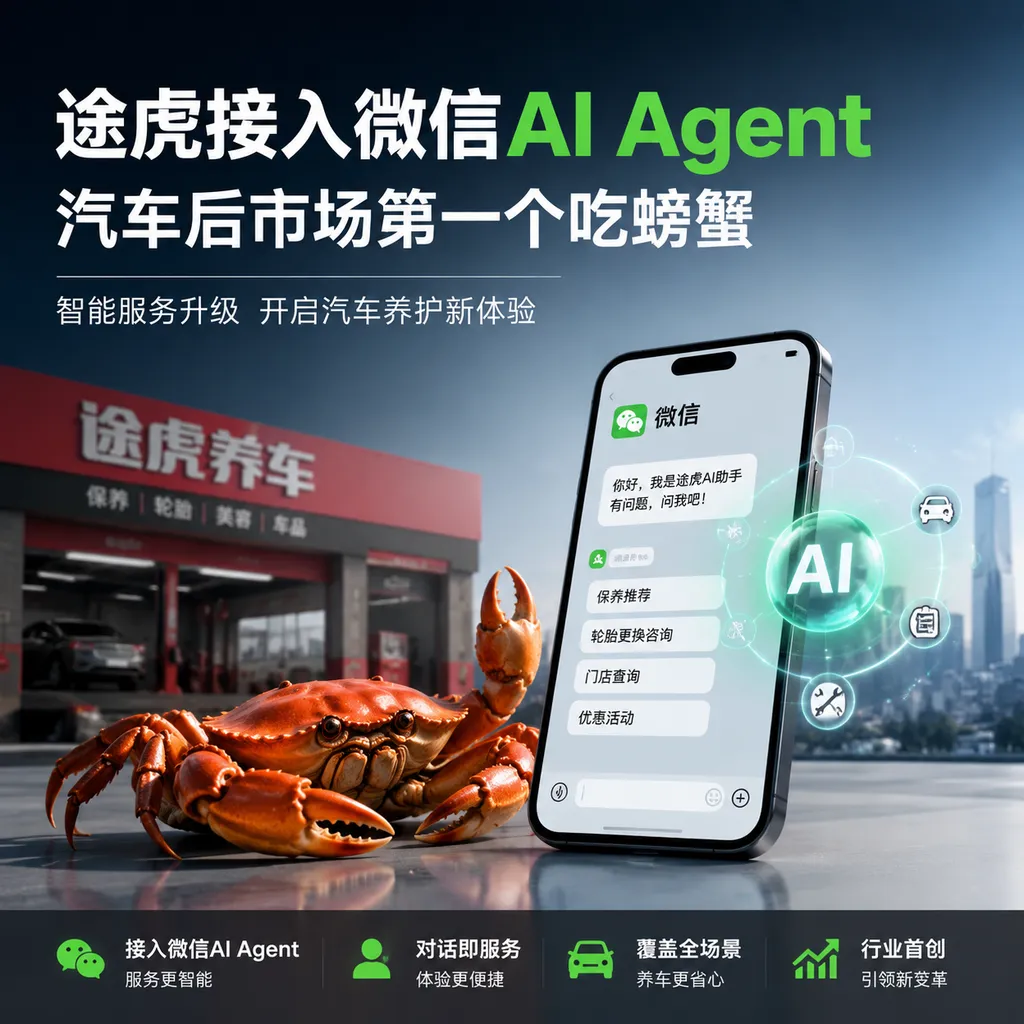
Tuhu Car Maintenance has become the first company in the automotive aftermarket sector to integrate with the WeChat AI Agent. The mini program has completed initial beta testing and will roll out intelligent services focused on scenarios such as fault diagnosis, store recommendations, and car maintenance ordering.
Tuhu Car Maintenance Integrates with WeChat AI Agent — The "Agent Moment" for the Automotive Aftermarket Has Arrived
On June 9, Tuhu Car Maintenance (09690.HK) and Tencent officially announced their cooperation in the AI Agent field. As one of the first batch of beta developers, Tuhu's mini program has already completed initial integration with WeChat AI. In the next phase, core scenarios such as vehicle fault diagnosis, store recommendations, and maintenance ordering will all be incorporated into the Agent workflow. One key point — this is currently the only company in the automotive aftermarket to integrate into the WeChat AI ecosystem.
At first glance, this may look like another routine "XYZ integrates with large model" cooperation press release, but when you place it in the context of 2026 — where WeChat AI Agent is reshaping the mini program ecosystem — the significance is different.
1. What Exactly Was Integrated?
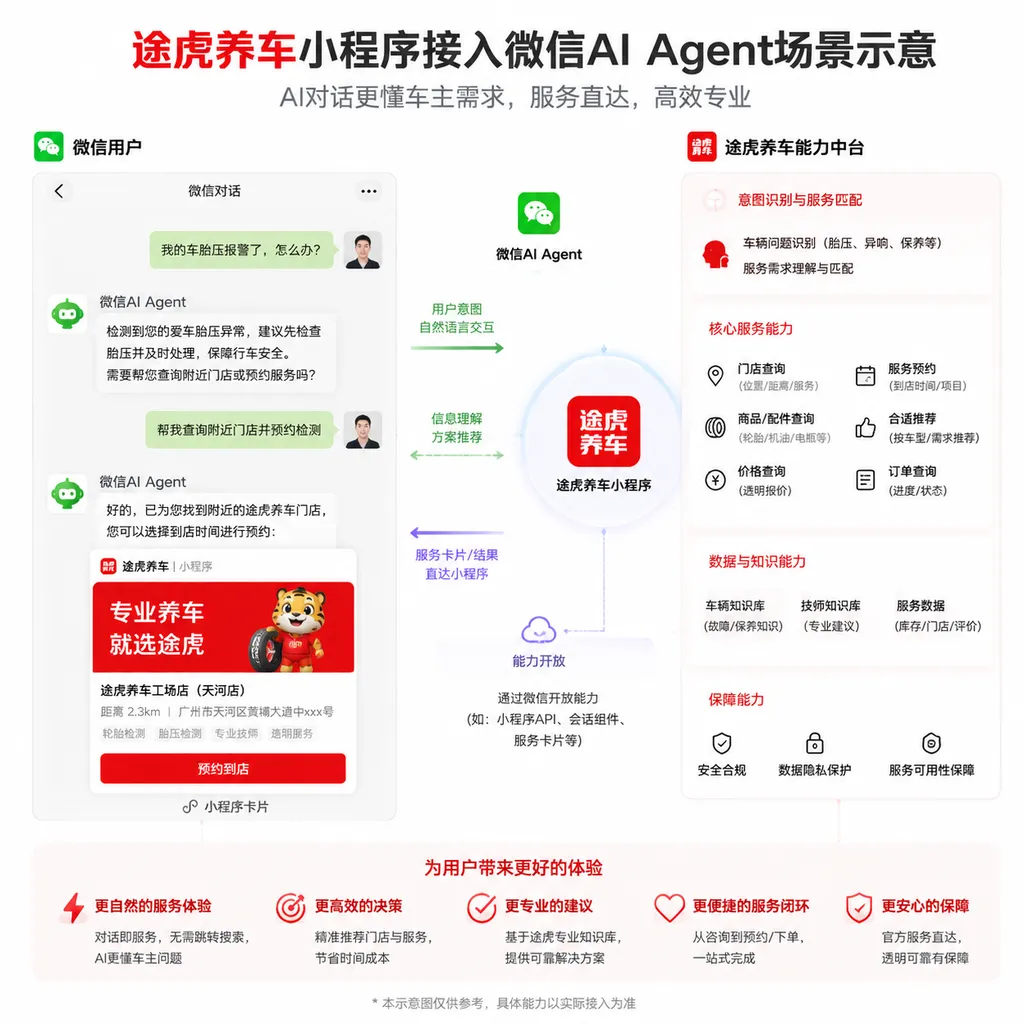
According to Tuhu and Tencent, this collaboration is not simply about "embedding a chat box in a mini program" — instead, WeChat AI Agent is treated as a new entry layer for interaction. The general user flow looks like this:
- A user, within WeChat (not necessarily inside the Tuhu mini program, but in WeChat’s native AI entry), uses natural language to express a car maintenance need, e.g., "My car makes a strange noise on cold start, where nearby can fix it" or "It’s time for wheel alignment, find a cheaper shop."
- The WeChat AI Agent interprets the intent, calls Tuhu’s Agent capabilities to conduct preliminary fault diagnosis, recommend nearby stores, match mechanics, and compare prices.
- Upon user confirmation, ordering, booking, and check-in are completed within the Agent’s closed loop, with final fulfillment relying on Tuhu’s offline service network.
Some key details worth noting:
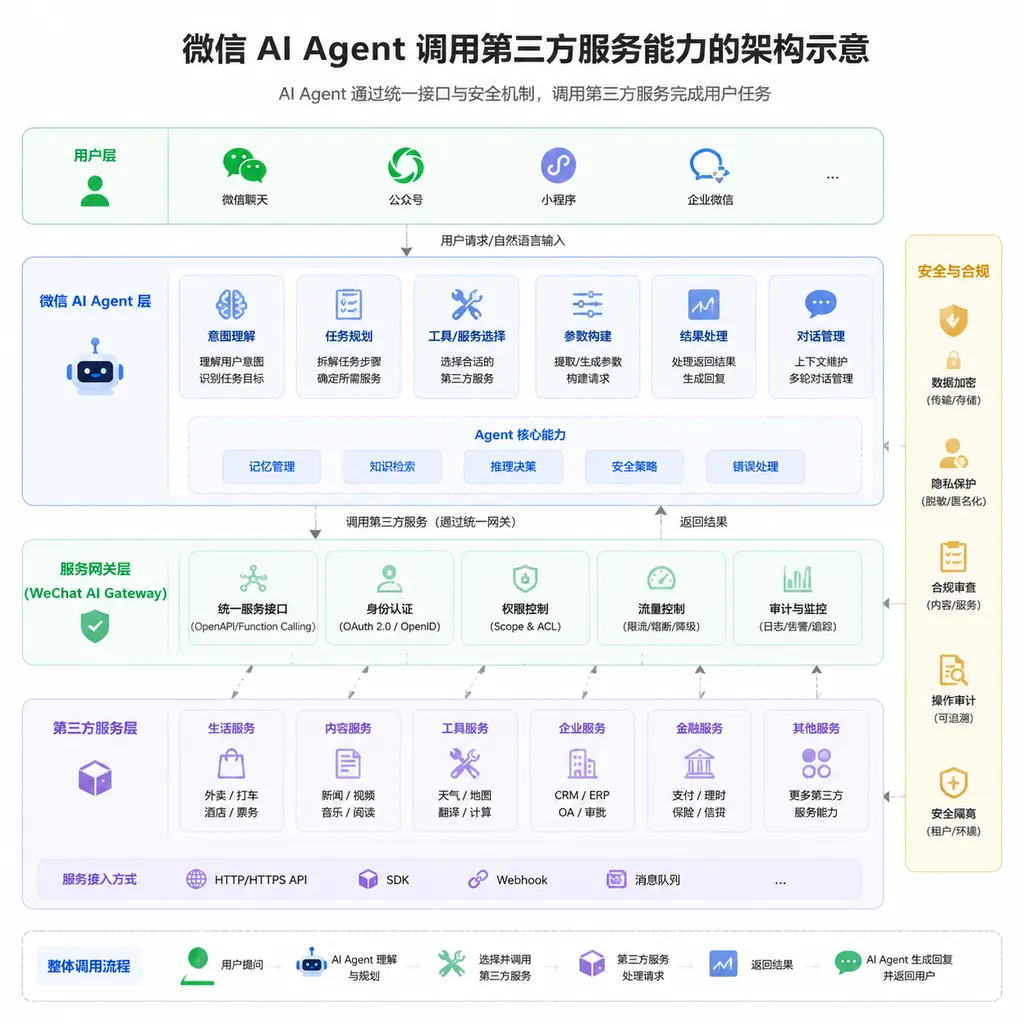
First, AI Agent is not a customer service bot. In past years, almost all major apps tried "smart customer service," essentially NLU + knowledge base + ticket system, answering "Your question is covered in FAQ item X." In Agent mode, the model actively decides — when to ask follow-up questions, when to call a store search API, when to return a structured card for selection — powered by an entire suite of capabilities like function calling, planning, and memory.
Second, Tuhu is among the first developers. WeChat AI Agent’s beta access is deliberately limited — Tencent aims to prevent low-quality Agents from polluting the mini program ecosystem. Being in the first batch means Tuhu met thresholds in data structuring, API exposure, and fulfillment stability. The automotive aftermarket has many players — JD Auto, Tmall Auto, various 4S groups — yet only Tuhu made the cut, which speaks volumes beyond the cooperation itself.
Third, this is another puzzle piece in the “WeChat as an operating system” narrative. Previously, Allan Zhang emphasized “use and leave,” but in the Agent era it’s inverted — now, "users don’t even need to enter a mini program, AI enters on their behalf." Tuhu has essentially transformed its service capabilities into a tool set for Agent calls, receiving demand traffic dispatched by WeChat AI.
2. Why Tuhu?
The automotive aftermarket is notoriously hard to standardize. Anyone who has owned a car for a couple of years knows how deep the water runs and how big the information gap can be.
For the past decade, Tuhu has been doing exactly one thing — standardizing and digitizing this business. According to the latest financial report, Tuhu has over 6,000 factory stores nationwide, all sharing the same ERP, pricing system, mechanic training, and service SOPs. On the SKU level, from oil filters to tires, each product has standardized codes and compatibility mapping.
This infrastructure is almost naturally suited for AI Agent integration:
- Structured vehicle database: The model can reverse-check all parts’ exact compatibility from a VIN number, avoiding embarrassing “one digit off, can’t be installed” situations.
- Standardized service packages: Maintenance, repair, modification — each has an SKU. The Agent can assemble an order directly without human double-checking.
- Store fulfillment capabilities: Once the Agent recommends a store, the user gets the promised service; otherwise, it's AI overpromising.
Conversely, with traditional 4S systems or small family-run garages, after the AI Agent recommends a store, prices may be opaque, service standards inconsistent, and mechanic skills uneven — the more precise the AI, the greater the user’s disappointment. This is why Tencent chose only one company in this space — Tuhu is the only one currently capable of absorbing the traffic.
3. How the User Experience Changes
From a car owner’s perspective, the changes look like this:
Previous process: Car problem → search symptoms on Baidu → compare reliable shops on Xiaohongshu / Douyin → open Tuhu App / mini program to search store → select service package → book → check in.
After Agent intervention: Ask AI directly in WeChat → AI asks some clarifying questions (How long has it been? Under what conditions?) → provides preliminary diagnosis + store recommendation + quote → one-click booking.
What’s eliminated is the user’s own information search, comparison, and decision-making. This used to be a key node in traffic distribution — a battleground where vertical apps, content platforms, and search engines fought over ad budgets. The Agent breaks through this layer.
For Tuhu, the benefit is potentially much lower customer acquisition cost; the trade-off is ceding more decision-making power to WeChat AI — rules on what makes a store “good” and what defines a “reasonable price” are set by AI, not Tuhu. This is the power transfer all companies integrating into large-platform Agent ecosystems must face.
4. AI Progress in the Automotive Aftermarket
Looking more broadly, automotive aftermarket intelligence falls into three layers:
- Intelligent diagnostics: Using OBD data + large models for fault prediction and cause analysis. This already exists — Tesla, NIO, and other new car makers have similar systems internally, but rarely open to third-party repair networks.
- Intelligent service matching: Based on vehicle condition, location, and budget, recommending suitable stores and services — this is what Tuhu’s integration with WeChat Agent primarily addresses.
- Intelligent fulfillment and quality control: Stores use visual models for repair process recording, automated QC, and parts anti-counterfeiting — Tuhu has already been running this internally.
Only when all three layers are connected can we call it true “AI car maintenance.” Today’s cooperation focuses mainly on the second layer, but with WeChat AI Agent as the entry point, its ripple effect will be larger — it will force other players to accelerate data structuring and service standardization; otherwise, they can’t even qualify for “Agent calling.”
5. Tencent’s Strategy
Now, from Tencent’s side. WeChat AI’s moves over the past year have been more aggressive than publicized. From Yuanbao integrating into mini programs, to AI summaries for official account articles, to now opening Agent capabilities to developers — Allan Zhang’s team has a clear goal: transform WeChat from an app factory into an Agent coordination center.
Think of it like this: In a few years, WeChat may no longer have as many mini program entries for users to proactively open — instead, AI will summon the appropriate service based on context. Mini programs will evolve from “interfaces” to “capabilities,” shifting from being used by people to being used by AI.
In this paradigm, the first partners to successfully integrate gain an asymmetric advantage. Tuhu has grabbed the pole position in the automotive aftermarket; by the time competitors wake up and try to integrate, user perception and data flywheels will already be spinning.
6. Questions for the Industry
- Who guarantees the service standards for Agent calls? If a car owner orders through WeChat AI and something goes wrong, who’s responsible — WeChat, Tuhu, or the store? This responsibility chain needs redesign.
- To what extent will data flow bidirectionally? Tuhu must provide store, SKU, and pricing data to WeChat AI; will WeChat AI, in turn, return user profiles and conversation context to Tuhu? This touches privacy and commercial boundaries.
- How will other categories follow? Food delivery, transportation, housekeeping, medical aesthetics — in these local service sectors with varying levels of standardization, who can replicate this model?
This news might have been just a PR-level cooperation two years ago, but in 2026, when Agent is widely recognized as the next-gen interaction entry point, it represents a concrete example of local life services migrating to Agent-first mode. Tuhu has hit the timing perfectly.
The automotive aftermarket may be deep waters, but at least this time, the first pipeline has been laid.
References
No domestic accessible reference links meeting the whitelist requirements are available. The original information comes from 36Kr news and multiple financial media reports on Tuhu Car Maintenance’s (09690.HK) announcement.


