
QQ Mail Beta AgentMail: The workstation where your mailbox becomes an intelligent agent

QQ Mail has quietly launched agent.qq.com, turning the mailbox into a native collaboration hub for agents. This isn’t just adding an AI assistant to the mailbox, but transforming the email protocol itself into a communication foundation between agents.
Overnight, QQ Mail Got a New Domain Name
In early June, someone posted on linux.do with a short title: QQ Mail is also internally testing AgentMail. Clicking in, there was only one line containing a link — agent.qq.com. No press conference, no announcement; Tencent has been keeping this very quiet.
Anyone familiar with the AgentMail concept knows this is a big deal. Overseas, a startup with the same name — agentmail.to — received seed funding earlier this year to do exactly “give an AI Agent a real mailbox” — not having AI help people read or write emails, but rather the opposite: making email protocol the fundamental channel for Agents to communicate with each other. Now Tencent has brought this concept into one of the oldest email products in China.
Honestly, QQ Mail hasn’t had an “eye-catching” update like this in a long time. The last time was around 2008, when Zhang Xiaolong led the team to make a major version. Over more than a decade, the product has been focused on scaling down, maintenance, and bug fixes, gradually fading in presence. This time, directly rolling out an independent secondary domain agent.qq.com is essentially launching a whole new product line for intelligent Agent services.

What Exactly Is AgentMail
To explain this properly, we first need to break down the concept of AgentMail.
The traditional email logic is “person to person” — one inbox belongs to one natural person, and email is an asynchronous, long-text, attachment-capable communication medium. Later AI was added, but AI’s role remained that of an assistant: helping you summarize emails, draft replies, and filter spam. AI was an add-on in the email system — never a first-class citizen.
AgentMail’s thinking flips this around. It believes that on the eve of large-scale deployment of Agents, every intelligent Agent should have its own inbox, its own email address, and its own SMTP/IMAP credentials. When an Agent needs to book a flight, check invoices, or negotiate with another Agent, it no longer has to navigate human-designed web interfaces or cobbled-together APIs — instead, it can work directly via email, a protocol that has run for forty years and covers the entire internet.
This is actually quite counterintuitive. Everyone is chasing MCP, A2A, and various new protocols, while AgentMail says: the email protocol is already good enough — it’s just that no one has designed inboxes for Agents before.
Its core arguments are:
- Email is inherently asynchronous: Agent-to-Agent tasks often take minutes to hours, perfectly matched by email’s asynchronous nature
- Email has threads: Conversations are naturally threaded, so Agents don’t have to maintain session states themselves
- Email can be parsed by any Agent: Pure text + attachments make it far simpler than proprietary APIs
- Email has identity: Each address is tied to a verifiable, revocable, and auditable identity
What Tencent’s AgentMail Looks Like
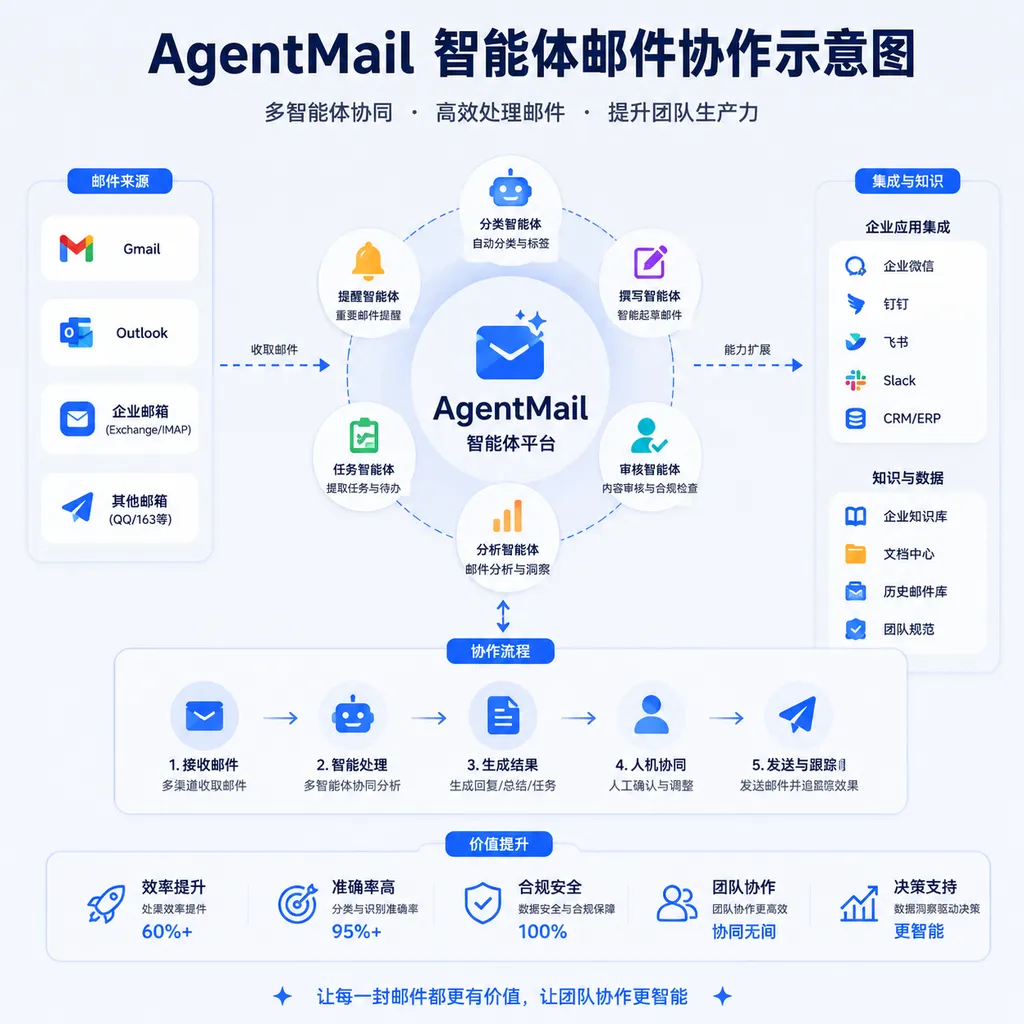
From the information leaked from the test page, Tencent’s version of AgentMail is not simply a copycat of the overseas API service, but leans toward a hybrid form of “enterprise internal Agent collaboration + personal Agent email proxy.”
Here are some design elements that can be discerned:
1. Each Agent Has an Independent Email Address
Users can create multiple Agent instances in agent.qq.com, with each instance assigned an independent sub-address (like agent_xxx@qq.com). These addresses can send and receive emails and can be directly targeted from external addresses.
This may seem simple, but it’s quite challenging for domestic email services — QQ Mail’s biggest headache has always been anti-spam. Granting Agents send/receive permissions means having to rebuild a credibility scoring system specifically for Agents, or the service could quickly become a spam haven.
2. Agents Can Send and Receive Emails From Each Other
This is the most interesting point. Two Agents can communicate via email, with the message content automatically parsed into structured data. If the sender includes a payload resembling a tool invocation, the recipient Agent can execute it directly.
In other words, QQ Mail has modified the SMTP protocol into an Agent-to-Agent transport layer. Coremail has also pushed a similar “AI-native email system”, but theirs is aimed at the enterprise (B2B) market. Tencent’s approach clearly targets consumers directly.
3. Human Users Act as an “Approval Layer”
A notable detail on the test page: when an Agent receives mail from an unfamiliar sender, or is about to carry out high-risk actions like payment or signing agreements, it automatically forwards the matter to the human user for approval. This mechanism is much like the “human-in-the-loop” in Cursor or Claude Code — Agents do the work, humans guard the key decision points.
Why QQ Mail, Why Now
This can be broken down into two layers of logic.
First is Tencent’s strategic calculus. Tencent’s AI pace has clearly accelerated this year — with multi-modal capabilities from Hunyuan, the Agent-ization of Yuanbao, and AI search in WeChat. But Tencent has always had a problem: it lacks a programmable collaboration base aimed at developers and heavy users. WeChat isn’t open, Enterprise WeChat is B2B, QQ is too entertainment-focused. QQ Mail is one of the few assets that still has a brand, has users, and can be reworked. Betting on AgentMail here means reusing an old brand to launch a new business — low cost, controllable risk.
Second is the industry timing window. By the first half of 2026, the biggest bottleneck for Agent deployment will no longer be model capability, but rather “how Agents engage with the outside world”. MCP solves Agent-to-tool interaction, A2A aims to solve Agent-to-Agent interaction — but both are new protocols, new ecosystems, new infrastructures. The advantage of email protocols is — it’s already there, with billions of addresses worldwide recognized by all systems. Whoever creates an Agent-friendly interface on the email layer first will seize a distribution node in the Agent internet.
Overseas companies like AgentMail, Resend, and Postmark are all trying this, but their market is ultimately developers. If Tencent truly extends this capability to its hundreds of millions of QQ Mail users, it becomes an entirely different scale.
Several Unresolved Issues
A bit of cold water: judging from the test page, Tencent has yet to answer some key questions:
How to Verify Agent Identity. If an email address claims it’s an Agent, how to prove it? SPF, DKIM, DMARC are designed for domains, not Agents. Without a trustworthy system akin to Agent ID, it will be trivial to forge a “customer service Agent” to trick approvals.
Preventing Abuse. Email is arguably the easiest channel to abuse. Granting Agents mail privileges opens a fresh doorway for automated marketing, phishing, and social engineering. Tencent’s anti-spam experience of over a decade will need to be rewritten for the Agent era.
Interoperability. Can QQ Mail’s Agent mailboxes communicate with normal users on Gmail, Outlook, NetEase Mail? Can they interoperate with Agents on overseas AgentMail? If it’s just Agents within QQ Mail playing among themselves, its significance is halved.
Developer Integration. The test page currently only shows end-user product features — no API, SDK, or Webhook documentation. If it’s just an AI assistant wrapper for ordinary users, this reverts to the old “email + AI assistant” path, which is not AgentMail.
What This Means for Developers
Looking ahead, if QQ Mail really solidifies AgentMail and opens APIs, it would be a notable bonus for domestic teams building Agent applications.
Imagine a few scenarios:
- You create a reimbursement Agent, deploy it on
agent.qq.com, and give it an email address. Employees can forward invoices from any mailbox; the Agent automatically recognizes them, records them, and generates reimbursement forms. - You build a customer-follow-up Agent, letting it represent you for certain email interactions. The other party doesn’t even know they’re communicating with an Agent, and matters needing decisions get forwarded to you.
- You develop a multi-Agent collaborative system — flight-booking Agent, weather-checking Agent, hotel-booking Agent — that exchange tasks via email, with full traceability, audit, and playback.
In the past, these scenarios required a self-built SMTP server and lots of middleware; if QQ Mail SaaSifies this capability directly, the barrier will drop significantly.
Of course, all this depends on Tencent being willing to open up, rather than locking AgentMail inside its own ecosystem. Judging from past experience, this still needs observation.
A Few Judgments
The AgentMail track is very likely to heat up in 2026. Overseas, agentmail.to is running, Coremail is laying out B-side (enterprise) plans domestically. Tencent’s entry basically signals this is a legitimate direction, not just a wishful startup dream.
This QQ Mail test carries more symbolic significance than actual function — it means big domestic players are seriously considering “how to adapt email protocol for the Agent era.” This is a fundamental infrastructure-level proposition; whoever sets the standard at this layer first will occupy a critical node in the next-generation Agent ecosystem.
Developers building Agent applications can now head to agent.qq.com to apply for testing and get familiar with the product early. Whether or not QQ Mail wins in the end, the paradigm of “giving an Agent a mailbox” will remain.
References
- QQ Mail Is Internally Testing AgentMail - linux.do — First discussion post on the test information, includes screenshot of agent.qq.com entry


