
GPT-5.6 Caught in Action: 1.5M Context, Launching Next Month

Only three weeks after the release of GPT-5.5, the GPT-5.6, codenamed **iris-alpha**, has already been caught by developers in the Codex backend, running smoothly with a 1.5M token context and a qualitative leap in frontend aesthetics. Polymarket gives an 85% probability of release before the end of June.
GPT-5.5 was released only three weeks ago, and the shadow of GPT-5.6 has already shown up in OpenAI’s own call logs.
Over the past few days, several sharp-nosed developers have discovered in the Codex backend logs an entry that shouldn’t have been there: gpt-5.6, internal codename iris-alpha (Iris flower). At first, everyone thought this was just leftover dirty data from canary testing—after all, just a week ago, if you forcibly specified gpt-5.6 in code, the system would curtly throw back a model is not supported. But now, through the ChatGPT Pro OAuth channel, some have actually managed to run this unreleased model in the Codex environment.
This is not just a baseless rumor. The tipster Leo came right out and said: the first batch of GPT-5.6 checkpoints has already entered internal testing, with an expected official release in July. On Polymarket, the contract for “released before June 30” has been pushed above 85%.
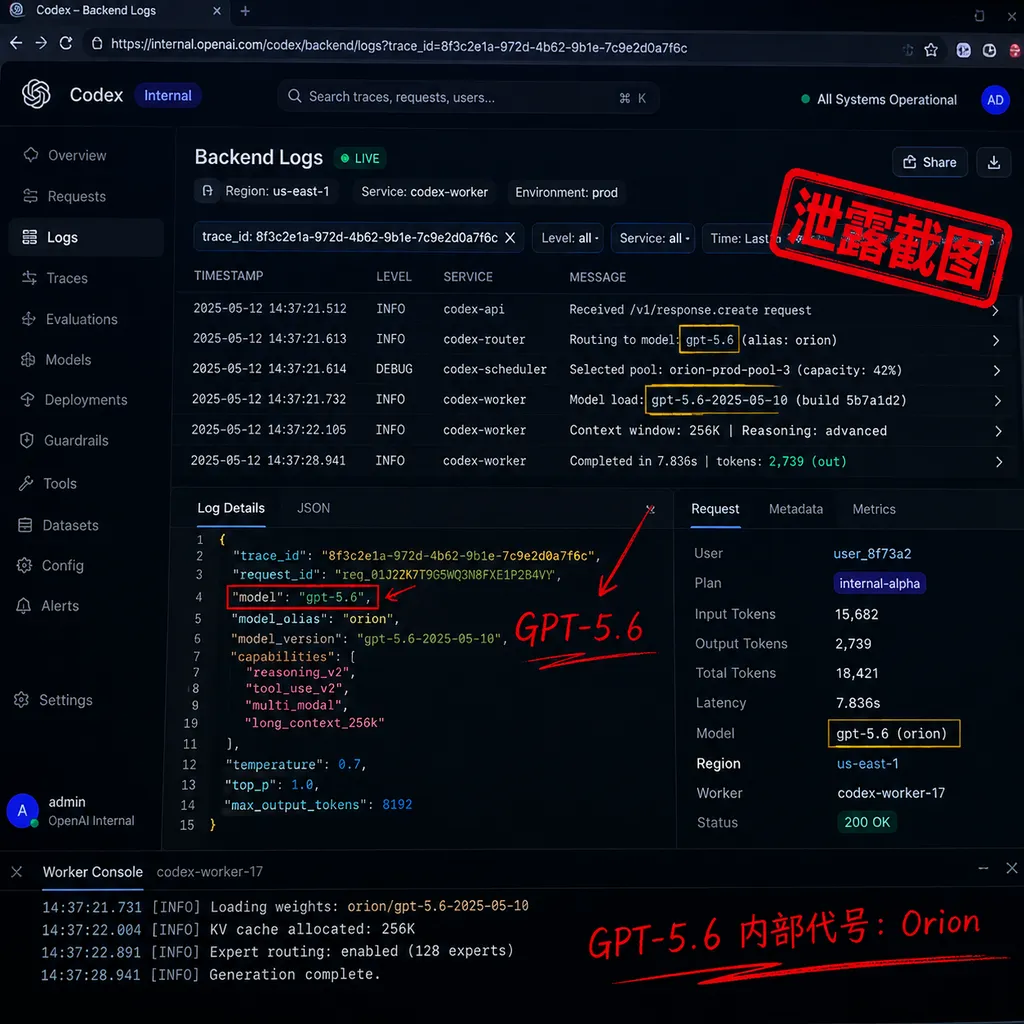
1.5M context, blowing past the previous generation by 43%
The most solid piece of leaked info is about the context window.
Probe testing shows GPT-5.6 has a context limit of 1.5M tokens. For comparison:
- GPT-5.5 API: 1.05M tokens
- GPT-5.5 via Codex OAuth channel: capped at 400K
- GPT-5.6: 1.5M tokens, a straight 43% jump
Developers pushed OpenCode to its limits: stuffing up to 900K tokens into the input, the model’s responses remained coherent; surpassing the original 1.05M ceiling and continuing to cram more in, requests were still handled. What does this mean? It means you can feed an entire medium-sized codebase—say, tens of thousands of microservice lines—into the prompt all at once, and have the model refactor, track dependencies, and pinpoint cross-file bugs with full context.
This was unimaginable before. GPT-5.5’s 1.05M was already enough to cover most single projects, but enterprise monorepos still relied on RAG slicing. The 1.5M window makes “feed the whole repo” a default option for medium projects rather than an engineering puzzle requiring architectural design.
More crucial is the detail the model itself disclosed: in test dialogues, the new model identified itself as running on openai/gpt-5.6, with the highest reasoning level settable to xhigh, and supporting an extremely quick fast mode. This configuration basically continues the adjustable “thinking budget” concept from the 5.5 era, but xhigh is a new tier. The existence of fast mode suggests OpenAI has done another round of significant engineering optimization for reasoning speed.
If/when it goes live, OpenAI Hub will also hook gpt-5.6 into its aggregation interface right away, same as before—OpenAI-compatible format, switch with one key:
from openai import OpenAI

client = OpenAI(
    api_key="your-openai-hub-key",
    base_url="https://api.openai-hub.net/v1"
)

resp = client.chat.completions.create(
    model="gpt-5.6",
    messages=[
        {"role": "system", "content": "You are a senior frontend engineer."},
        {"role": "user", "content": "Create a minimal-style homepage for a note app, in light purple tones, no AI vibe."}
    ],
    reasoning_effort="xhigh",  # New tier
    max_tokens=8192
)

print(resp.choices[0].message.content)
Note the reasoning_effort="xhigh" parameter—this is a tier added in 5.6 over 5.5. For regular Q&A, stick with medium or fast; don’t waste your reasoning budget.
“De-slopification”: AI finally starts to understand aesthetics
If 1.5M is GPT-5.6’s external skill, what really broke frontend developers’ defenses is its qualitative leap in UI generation.
For a long time, AI-generated code had an unspoken pain point: backend logic comes out nice, but the frontend crashes. Bloated CSS, garish high-saturation color schemes, generic card grids—the industry calls this Slop (mud code). Claude 4.5’s fame via Artifacts was largely due to its frontend aesthetics being unmatched among peers.
This leak’s most surprising element was a minimal note app called Lumen Notes. The developer provided no detailed UI guiding prompt, just let GPT-5.6 generate by default, and the result had these traits:
- Restrained colors: No high saturation, main tone in light purple, differentiating key components via color-coded tags
- Font weight hierarchy: Clear hierarchy of font sizes and weights, navigation so intuitive it needs no manual
- No AI vibe: None of that instantly recognizable “ChatGPT grid” formulaic layout

Leo himself admitted that 10 days ago he was publicly complaining about GPT-5.6’s terrible frontend output, and within a week it changed dramatically. This doesn’t look like regular iteration—more like OpenAI specifically trained targeted data for UI de-slopification.
This is more significant than a demo. It suggests that frontend might shift from “AI writes code + humans tweak styling” to “AI directly delivers commercial-grade UI.” Claude Artifacts’ moat—aesthetics—has been matched by OpenAI for the first time.
Three codenames, dual-version strategy
The leak also revealed three internal testing codenames:
iris-alpha(Iris)ember-alpha(Ember)beacon-alpha(Beacon)
As per convention, these three alphas likely correspond to checkpoints of different sizes or orientations—e.g., standard version, reasoning-enhanced version, Agent-specialized version. Based on OpenAI’s prior release rhythm, this is probably a “dual-version” strategy: GPT-5.6 Standard + GPT-5.6 Pro. The Pro version is expected to improve stability and multi-step reasoning for ultra-long tasks.
An industry veteran’s comment is worth noting: “Version numbers themselves aren’t important; what matters is that OpenAI is already using it internally as a daily debugging tool. When the engineers building AI trust it for actual R&D, that means its capabilities really have advanced.”
This is no exaggeration. Codex’s own team is running 5.6 to debug 5.7’s training pipeline—this kind of “dogfooding” is the hardest signal of model usability.
Iteration pace: from one upgrade every three years to one version every 40 days
Listing OpenAI’s recent release rhythm reveals something unsettling:
| Version | Release date | Interval since last version | |-------------------|------------------|------------------------------| | GPT-5.1 | 2025-11-12 | 97 days | | GPT-5.3-Codex | 2026-02-05 | 56 days | | GPT-5.5 | mid-May 2026 | ~45 days | | GPT-5.6 | Early July 2026 (est.) | ~40 days |
From GPT-3 to GPT-4 took nearly three years; from GPT-4 to GPT-5, over a year; and now, small version iteration cycles have compressed to around 40 days. This frequency is no longer about traditional model versions—it’s more like bundling RLHF + post-training + tooling optimization into rolling releases.
The logic is clear: in the Agent workflow era, benchmark scores aren’t the only metric; tool call stability, long-task persistence, UI delivery quality—these “last mile” aspects must be polished through high-frequency iteration. Annual releases aren’t fast enough.
June battleground: Anthropic and Google also have big moves
GPT-5.6 is not the only imminent bomb.
- Anthropic Claude Sonnet 4.8, codename
Conway, has already appeared in the Vertex AI backend list, focusing on persistent background agents—clearly targeting enterprise ultra-long tasks. There’s also rumored Claude Mythos 1 with leaked scores on Mythos Benchmark. - Google Gemini 3.5 Pro is also set for June, aiming to regain ground in multimodal.
- Musk’s Grok 5 is also rumored within this timeframe.
This means June will be 2026’s densest model release window. For developers, that’s good news—competition pressure forces all players to show their hand; improvements in real-world experience beyond benchmarks will be visible.
But application-level entrepreneurs must be cautious. At this iteration speed, any product plan based on “current model capability ceiling” could be swallowed by a new version in just 40 days. Claude Artifacts’ aesthetic moat being matched is just the beginning.
A bit of judgment
Personally, I think the most noteworthy aspect of GPT-5.6 isn’t the 1.5M context or the aesthetic leap, but that OpenAI has, for the first time, included a “Pro” tier in a minor version number.
This means OpenAI is turning version numbers into product lines rather than pure capability markers. The Standard version targets developer API and ChatGPT; the Pro version might be aimed at enterprise Agent scenarios. If this strategy holds, future GPT-5.7 and 5.8 will likely follow this tiered logic—making model selection more granular, and more expensive.
As for the exact release date, judging by Polymarket odds and Leo’s hints, end of June to early July is the highly probable window. Codex’s internal use is already stable; the rest is just a matter of PR timing.
Stay tuned—next month we’ll know for sure.
References
- GPT5.6 is coming? - linux.do: Earliest linux.do community discussion about gptimage calling mini-model reasoning, possibly indicating 5.6’s imminent arrival
- GPT-5.6 leaked - Zhihu column: Xinzhiyuan’s complete leak summary on GPT-5.6 internal codenames, 1.5M context, and Lumen Notes UI


