
DeepMind has brought its robot accelerator to Europe, and Gemini Robotics access is open to the public for the first time.
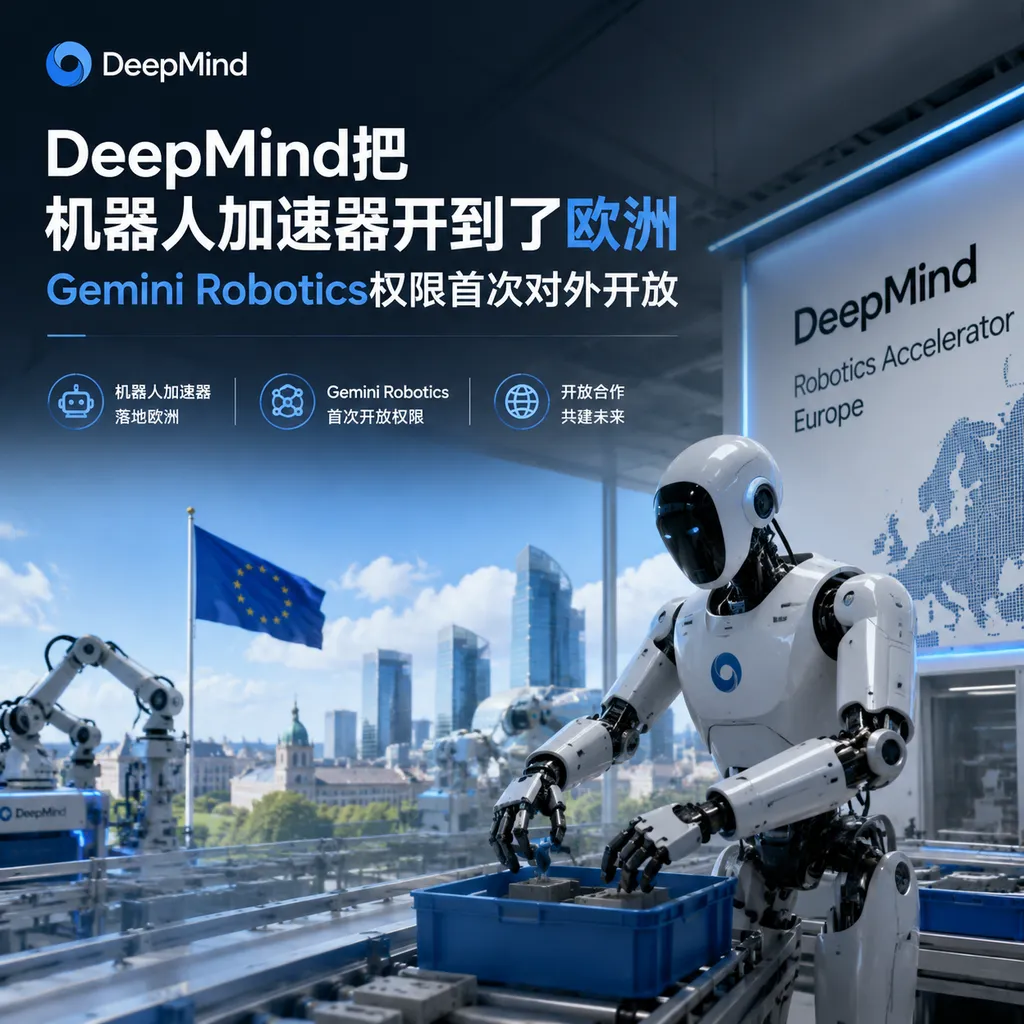
On June 9, Google DeepMind launched the first European Robotics Accelerator in London. Sixteen early-stage startups covering logistics, healthcare, marine, and neurosurgery were selected, and will receive Gemini Robotics model access and support from Google’s AI technology stack for the first time.
DeepMind Brings Its Robotics Accelerator to Europe, Gemini Robotics Access Granted Externally for the First Time
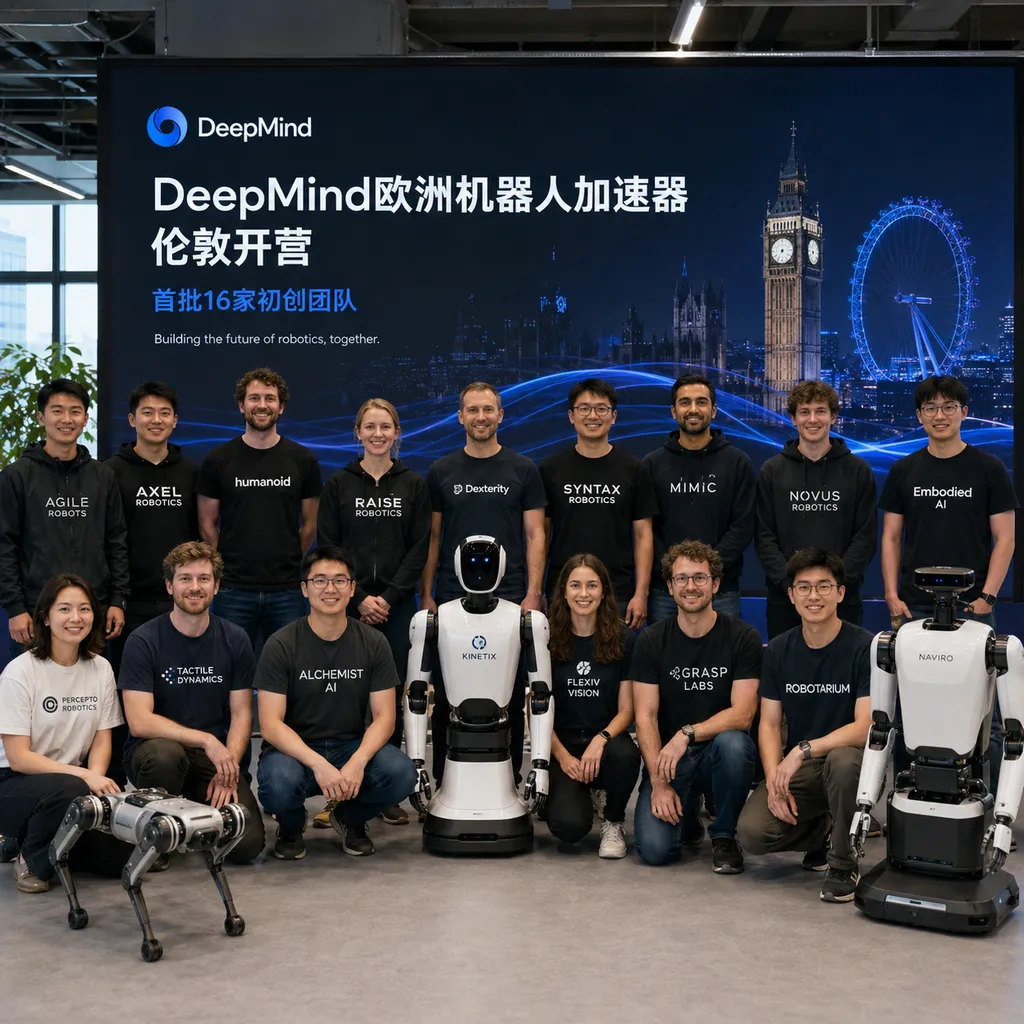
On June 9, Google DeepMind officially kicked off its first European robotics accelerator in London. Lasting three months, the first cohort of 16 startups arrived on Monday, spanning logistics, manufacturing, healthcare, construction, ocean exploration, and even neurosurgery—an unusually wide scope, far beyond a typical incubation program.
The real highlight here isn’t the word “accelerator.” DeepMind has had its share of incubation collaborations in Europe in recent years, with research nodes in Cambridge, Zurich, and Paris. What’s truly rare is the key it’s giving to selected companies: access to the Gemini Robotics model. This marks the first time since its release in March that the model has been systematically opened to external developers—though limited to these 16 companies.
A Key That’s Been Rarely Shared Before
Let’s review the timeline. This March, DeepMind launched two models: Gemini Robotics and Gemini Robotics-ER. The former is a VLA (Vision-Language-Action) model extending Gemini 2.0’s multimodal reasoning capabilities into the physical world; the latter strengthens Embodied Reasoning, enabling robots to understand spatial relationships and perform trajectory planning.
Shortly after, DeepMind released Gemini Robotics On-Device—a VLA model that can run directly on dual-arm robots without relying on the internet, ideal for latency-sensitive scenarios. Several details in this model drew considerable industry attention at the time:
- It’s DeepMind’s first VLA model that allows fine-tuning; developers need only 50 to 100 demonstrations to adapt it to new tasks and platforms.
- It was natively trained on the ALOHA dual-arm platform, but was officially demoed transferring to Apptronik’s Franka FR3 industrial dual-arm, and even humanoid robot Apollo.
- The accompanying Gemini Robotics SDK can interface with MuJoCo physics simulations, making the entire debugging workflow very friendly for hardware-focused teams.
However, access was initially through a “Trusted Tester Program”—closed and invitation-only, with very limited spots. In other words, for the past three months, most robotics companies have only seen demo videos without touching the actual model.
This accelerator marks the first time DeepMind has clearly stated: “Get selected and you get access.”
Who Are the 16 Companies?
Based on the official field distribution, the 16 startups can roughly be divided into three categories:
First category: typical industrial high-demand scenarios—logistics, manufacturing, construction. This is the most mature commercialization track for robotics, where VLA models can turn stations previously needing specialized teach-and-program methods into flexible production lines driven by natural language commands.
Second category: high-difficulty professional scenarios—healthcare, neurosurgery. Completely different gameplay here. Neurosurgical robots require sub-millimeter action precision; VLA models likely won’t directly handle end-effector control, but instead will take over upstream tasks such as surgical planning, instrument recognition, and visual understanding. Putting Gemini’s multimodal reasoning capabilities into operating rooms presents boundaries even harder to define than in factories.
Third category: edge scenarios—ocean exploration. Marine robotics is a long-overlooked area, with extremely poor bandwidth and high latency underwater; localized reasoning is practically a necessity. This aligns perfectly with Gemini Robotics On-Device’s independence from network connectivity.
Such breadth in topic choices reveals DeepMind’s thinking: this generation of VLA foundational models is not meant to be locked into a single vertical, but rapidly rolled out to find adaptation points. This is almost identical to the early-stage approach of LLMs—first give access, let frontline companies experiment, and then DeepMind collects data and feedback.
Equity-Free, But Not Without Cost
The official wording of the accelerator includes a noteworthy detail: equity-free, no shares taken. During the three months, participating companies receive:
- Exclusive mentorship from DeepMind technical experts and Google teams
- Access to the Gemini Robotics model
- Google AI tech stack (probably including Vertex AI, TPU compute quotas, and Google Cloud resources)
- A Demo Day at the end, connecting to DeepMind’s partner network and investors
Not taking equity sounds generous, but DeepMind isn’t after short-term returns. This kind of accelerator is essentially about cultivating the first batch of deployable customer cases within its own VLA ecosystem. Videos of robots running in logistics warehouses, certifications in hospital operating rooms, real deployment on ocean survey vessels—all these become key assets when Gemini Robotics is later marketed to automotive manufacturers or humanoid robot companies.
Comparatively, Nvidia’s Isaac platform pursues a “tools + simulation + hardware reference design” route, paired with the GR00T foundation model; OpenAI, after parting ways with Figure, rebuilt its robotics team but hasn’t released a formal model; Tesla follows an end-to-end self-development stack. DeepMind’s differentiation lies in: Gemini’s multimodal base + fine-tuning-friendly On-Device model + accelerator program, to quickly form a developer-centered ecosystem.
This logic mirrors how Android was opened to hardware manufacturers back in the day.
Why Europe, Why Now
The choice of Europe is no coincidence. Europe’s robotics industry foundation is solid—Germany’s industrial robotic arms, Switzerland’s precision manufacturing, Nordic medical robotics, UK’s dense academic research—but domestic AI foundational models have long been overshadowed by the US. For DeepMind (headquartered in London), launching the accelerator in Europe is both a boost to its home ecosystem and a bid to compete with European AI players like Mistral for talent.
The timing is also deliberate. The robotics industry in 2026 is far beyond the 2024 “watching videos in awe” stage. Humanoid robot companies are under pressure for mass deliveries; Apptronik, Figure, 1X, and Unitree are competing for industrial pilot orders. Fine-tune capability of foundation models, On-Device reasoning, cross-platform transferability have shifted from bonus features to selection criteria.
DeepMind opening access now is entering right in the window period. Wait another year, and key industrial deployment case studies will be claimed by competitors.
Technical Points Developers Should Watch
If you’re a robotics developer and not in this cohort, it’s okay—there are signals worth watching:
-
Expansion pace of Gemini Robotics SDK access. Currently requires applying to the Trusted Tester Program, but after accelerator projects prove successful, the toolchain will likely be further opened. MuJoCo integration, ALOHA compatibility, migration guides for third-party platforms (Franka, Apollo)—these are essentials for enabling smaller teams to join.
-
Sample efficiency of fine-tuning. If the 50–100 demonstration figure holds true, coverage for long-tail tasks will be substantial. Traditional reinforcement learning needs data volumes several orders of magnitude higher.
-
Cross-platform capability. The hardware platform used during Gemini Robotics On-Device training can be decoupled from the eventual deployment platform—a highly important but often overlooked engineering conclusion. This means model weights could become an “infrastructure layer asset” akin to CUDA.
-
Coupling of multimodal reasoning + physical actions. Embodied reasoning emphasized by Gemini Robotics-ER is on a different level from pure VLA. The former is closer to “the robot’s cerebrum,” the latter to “the cerebellum.” How these layers are separated or integrated in the future will shape the entire robotics stack.
A Judgment
At first glance, the scale of this accelerator isn’t large—16 companies, three months, one location in London. But it’s a clear signal: Gemini Robotics is moving from research project to product. DeepMind’s robotics research of recent years (RT-1, RT-2, RT-X, up to Gemini Robotics) has finally reached a stage of “external enablement.”
For domestic embodied intelligence teams, the reference value lies in this: the cooperation model between foundational model developers and robotics startups is shifting from simple API calls to “model access + tech stack + joint fine-tuning” deep binding. In this mode, whoever can secure fine-tuning access to a top VLA model first will gain a first-mover advantage in vertical scenarios.
Incidentally, on OpenAI Hub, Gemini series models (including the latest multimodal versions) have been kept in sync, allowing domestic developers to use a single key without dealing with VPN or account issues. But access to vertical-specific models like Gemini Robotics still runs through DeepMind’s own channels. It’s not just about money—it’s whether your product vision can win over DeepMind’s reviewers.
The start date for the next accelerator cohort hasn’t been announced yet. But by convention, with three-month cycles, preparations for the autumn batch should start now.
References
- Google DeepMind announces Gemini models that can run on robots - iThome: Detailed analysis of Gemini Robotics On-Device technical specifics, fine-tuning mechanism, and cross-platform transfer capability.


