
Claude Fable 5 is here: Mythos steps out of the lab
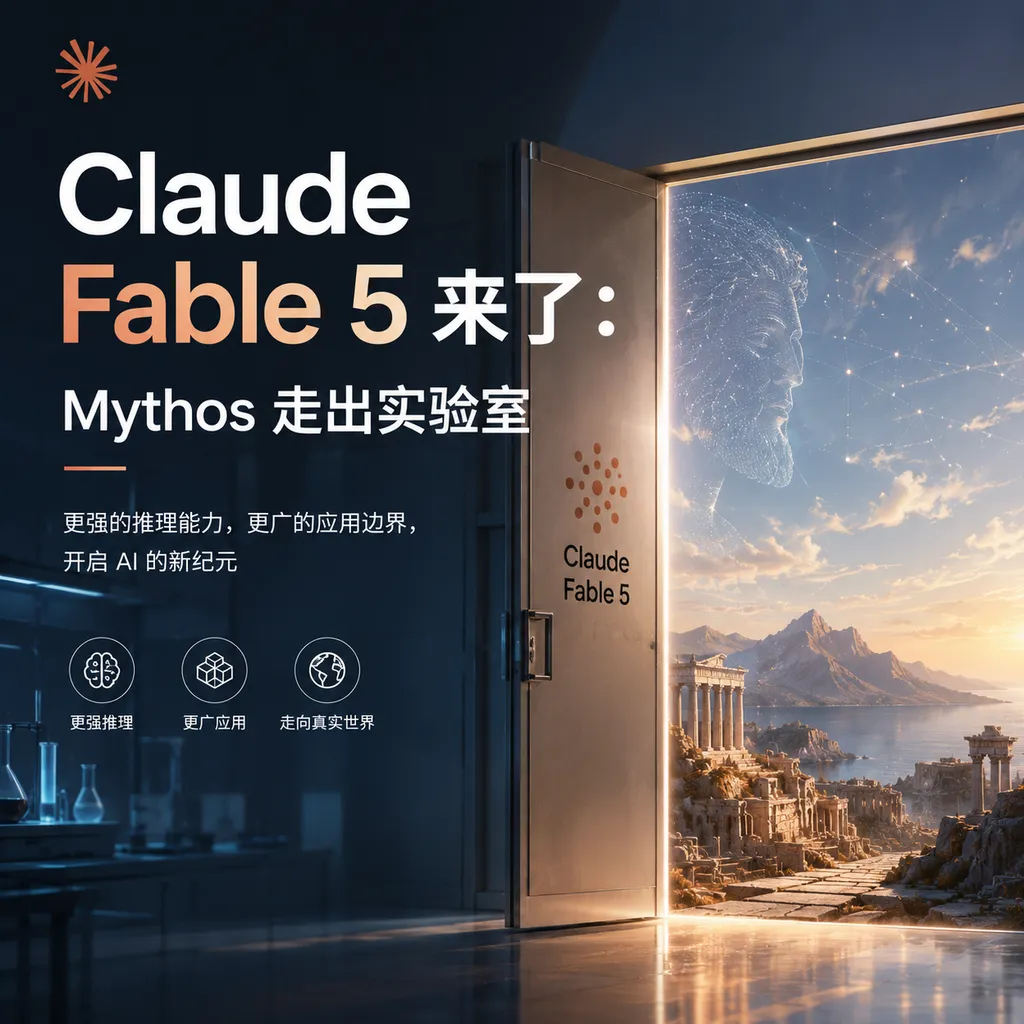
Anthropic released Claude Fable 5 today, the first Mythos-level model available to the public. It shares its underlying architecture with Mythos 5, which is restricted to controlled institutions, but adds safety guardrails for dual-use domains such as biology and cybersecurity.
Anthropic Released Mythos, But a Stripped Version
On June 9 (U.S. time), Anthropic released Claude Fable 5 — the first public model in the Claude 5 series, and the first time a Mythos‑level model has stepped out of controlled institutions and into the hands of ordinary developers.
The subtlety here is: just a few days earlier, Anthropic had publicly warned that the dangers of AI models were rapidly approaching a critical point. Then they released their most powerful public model to date. This “shouting danger while pushing product” stance has become Anthropic’s signature narrative style — it needs Mythos to support its position at the leading edge of capability, but must simultaneously use Fable, a fenced version, to maintain the persona of “responsible AI.”
What’s the Relationship Between Fable and Mythos?
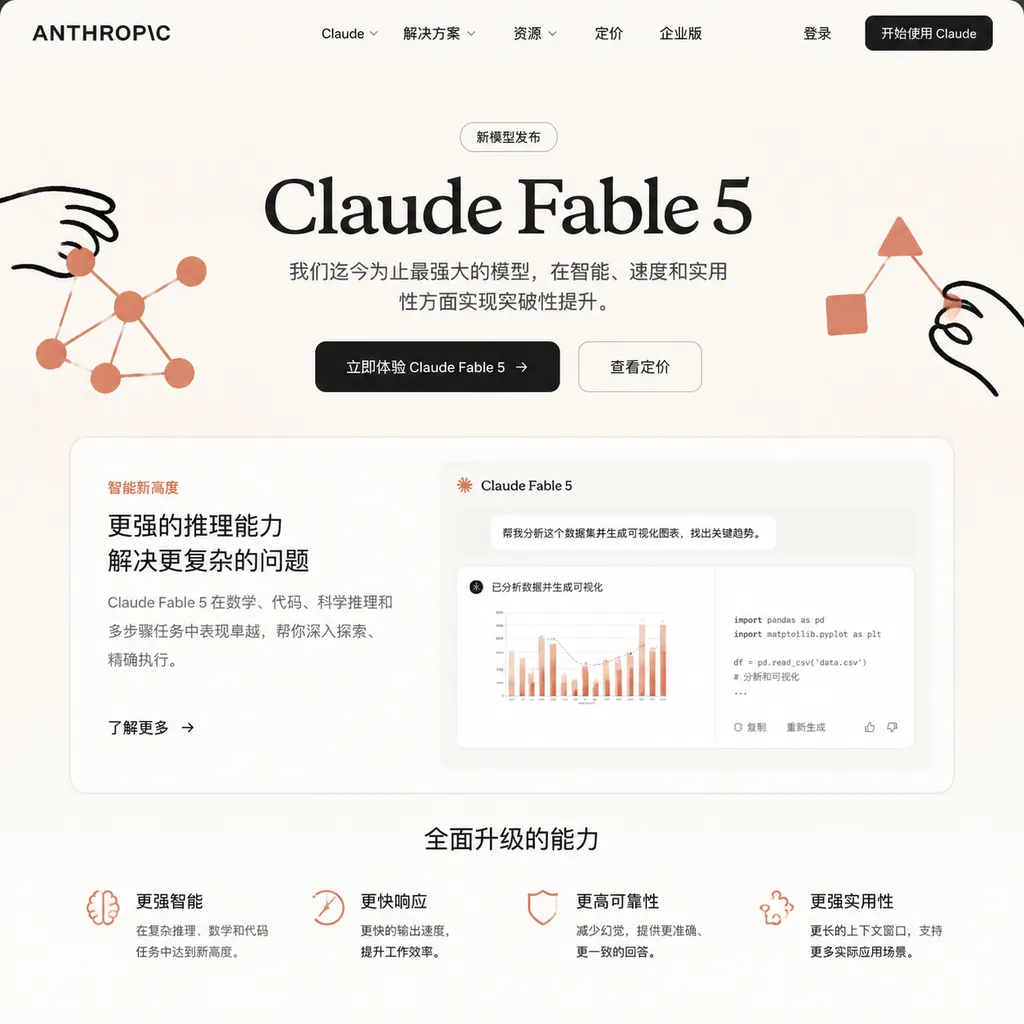
According to TechCrunch and multiple leaked sources, Claude Fable 5 and Claude Mythos 5 share the same underlying model. The only difference: Fable has explicit safety guardrails for “dual‑use capabilities” such as biology, chemistry, and cyberattacks — its outputs will be intercepted or refused. Mythos 5 has no such restrictions, but is only accessible to specific institutions approved by Anthropic — typically governments, national labs, and certain corporate partners.
In other words, Anthropic’s product strategy this time is to tier models by “access permissions” rather than “capability level.” This is completely different from OpenAI’s GPT‑4o / GPT‑5 approach of purely tiering by specs and pricing. Anthropic’s logic is closer to nuclear technology or military export controls: the capability is the same; whether you can use it, and to what extent, depends on who you are.
This is a very interesting turning point. Over the past two years, everyone has been competing on parameters, context length, and pricing — Anthropic this time is competing on “admission.” This is not a product decision, it’s a policy decision.
Where Are the Capability Gains?
Based on feedback from developers who’ve gotten the preview and Vertex release versions, Claude Fable 5 shows obvious improvements in several areas:
- Practical usability for long context — not just an expansion in token count (Anthropic already had 200K) — but stability when doing multi‑hop reasoning, cross‑document referencing, and long‑chain agent tasks in 100K+ contexts. Previously, Opus often showed attention decay at the end of long contexts; Fable 5 clearly tightens this.
- State retention across multi‑turn dialogues — in typical agent scenarios like Claude Code, the model needs to maintain awareness of project structure, file states, and user intent across a dozen or more turns. The probability of “forgetting” or “going off‑track” at the end of long sessions drops significantly in Fable 5.
- Coding ability — this is a key focus for Anthropic in the past two generations. Fable 5 reportedly outpaces Opus 4.x in complex refactoring, cross‑file modifications, and long‑chain debugging. Claude Code users can already switch via
/model claude-fable-5[1m]—[1m]means million‑token context slots.
But here’s the caveat: in sensitive areas such as biology, synthetic chemistry, cyber intrusion, and exploit development, Fable 5 is more conservative than Opus 4.x and refuses more often. Security researchers, bioinformatics scientists, and red team engineers may find the model “hard to use” — that’s the part Mythos reserves for controlled institutions.
Pricing: Reportedly Twice the Cost of Opus
Developer discussions on linux.do mention Fable 5 pricing as roughly twice that of Opus. Anthropic hasn’t officially disclosed the complete pricing page, but reverse‑engineered from Vertex AI metering data, the approximate range is:
- Input: ~$30 per million tokens
- Output: ~$150 per million tokens
If true, this would make it the most expensive model among current public APIs. This pricing suggests Fable 5 won’t be a “daily driver” model — it’s for critical decisions, complex agents, and deep coding tasks. Running it for 7 days to solve a tough problem is worth it; having it write a README is just burning money.
This aligns with Anthropic’s longstanding product philosophy of “let the model do the work itself”: expensive is fine, as long as it can truly replace an engineer’s hours.
How to Use It
If you’re already in Claude Code, switching is simple:
/model claude-fable-5[1m]
The 1m in brackets indicates million‑token context slots. Anthropic retained both 200K and 1M tiers, with different per‑token pricing.
If using the API, the official call method remains unchanged:
import anthropic

client = anthropic.Anthropic()

response = client.messages.create(
    model="claude-fable-5",
    max_tokens=4096,
    messages=[
        {"role": "user", "content": "Analyze this 50K-line codebase to find potential concurrency issues"}
    ]
)
print(response.content)
For developers in mainland China, direct connection to Anthropic’s official API remains unstable. OpenAI Hub has already integrated claude-fable-5, allowing direct calls in OpenAI-compatible format:
from openai import OpenAI

client = OpenAI(
    base_url="https://api.openai-hub.net/v1",
    api_key="your-key"
)

response = client.chat.completions.create(
    model="claude-fable-5",
    messages=[
        {"role": "user", "content": "Implement a small MVCC-capable KV store in Rust with full code and tests"}
    ],
    max_tokens=8192
)

print(response.choices[0].message.content)
The benefit is no need for overseas credit cards or proxies, and the same key can switch between GPT, Gemini, and DeepSeek for comparisons — with expensive models like Fable 5, cross‑model comparison is crucial during evaluation.
What Exactly Are the “Dual‑Use Guardrails”?
Anthropic didn’t detail this in their blog, but from the public system card, Fable 5’s guardrails cover several categories:
- CBRN-related — chemistry, biology, radiological, nuclear weapon “synthetic pathway‑level” information is refused. Textbook‑level knowledge is still accessible, but anything touching on “executable synthesis steps” is cut off.
- Cyber attack chains — generation of PoCs for high‑risk vulnerabilities, targeted phishing content, or large‑scale social engineering templates is refused. Conventional penetration testing methodology and CTF problems are still discussable.
- Model self‑leakage — Fable 5 refuses to output information that could be used to deduce its underlying weights, training data details, or guardrail prompts — Anthropic has heavily reinforced this layer.
These guardrails aren’t simple keyword filters — they’re reportedly powered by a classifier model based on Mythos 5 itself. Ironically, the safety net around Fable 5 is a stronger, unrestricted Mythos 5. This “using the child’s spear against the child’s shield” setup is a signature tactic of Anthropic’s safety engineering team in recent years.
Will It Be “Jailbroken”?
Almost certainly. Any publicly released model gets various jailbreak prompts thrown at it within 72 hours. Fable 5’s guardrails are said to have undergone Anthropic’s most rigorous adversarial testing — but “most rigorous” and “unbreakable” are separated by the entire security research community.
The more interesting question is: when Fable 5 is jailbroken, will its outputs approach Mythos 5’s capabilities? If so, Anthropic’s “tiered access” strategy has a loophole — you don’t need approval, just a sufficiently good prompt. That’s why Anthropic has concurrently increased rewards for jailbreak sample submissions.
What This Means for Developers
A few practical recommendations:
- If your product is code agents, complex workflow orchestration, long‑document analysis, Fable 5 is worth serious evaluation, especially if you’ve hit the ceiling with Opus 4.x.
- If your use case is customer service, content generation, simple Q&A, Fable 5’s cost‑performance is poor — continue using Sonnet or Haiku level models.
- If you work in security research, biomedicine, or chemistry, Fable 5 likely won’t suit you — consider reverting to Opus 4.x or applying for institutional access to Mythos 5.
- If you do multi‑model comparative evaluation, connect as soon as possible for baseline tests — especially noting differences with the GPT series and Gemini series on agentic benchmarks like SWE‑bench and Terminal‑Bench.
A Bigger Question
The release of Fable 5 brings to the forefront a topic previously discussed only within the AI safety circle: When models become powerful enough, who should be allowed to use them?
The past answer was “anyone who can pay.” Anthropic’s new answer is: “Capabilities are tiered, but tiering is based on identity, not price.” This is a very EU‑style, regulation‑friendly stance — and easily criticized as “elitist.”
OpenAI hasn’t adopted this logic, xAI won’t, and open‑source players like DeepSeek certainly won’t. But if the “capability gap” between Fable 5 and Mythos 5 is found to be significant, regulators may start asking: why aren’t other vendors doing this?
That’s the real highlight of Claude Fable 5’s launch — it’s not just another stronger model; it’s Anthropic’s practical move in “productizing AI governance.” And this approach may very well become an industry‑wide template within a year or two.
Model launches have never been this political.
References
- linux.do - claude-fable-5 now usable in Claude Code: first‑hand switch commands and usage feedback from the developer community
- linux.do - Discussion of Claude Fable now live on Vertex: includes pricing rumors and early trial discussion


