
Xiaohongshu Launches RED Skill: Embedding AI Capabilities into Posts
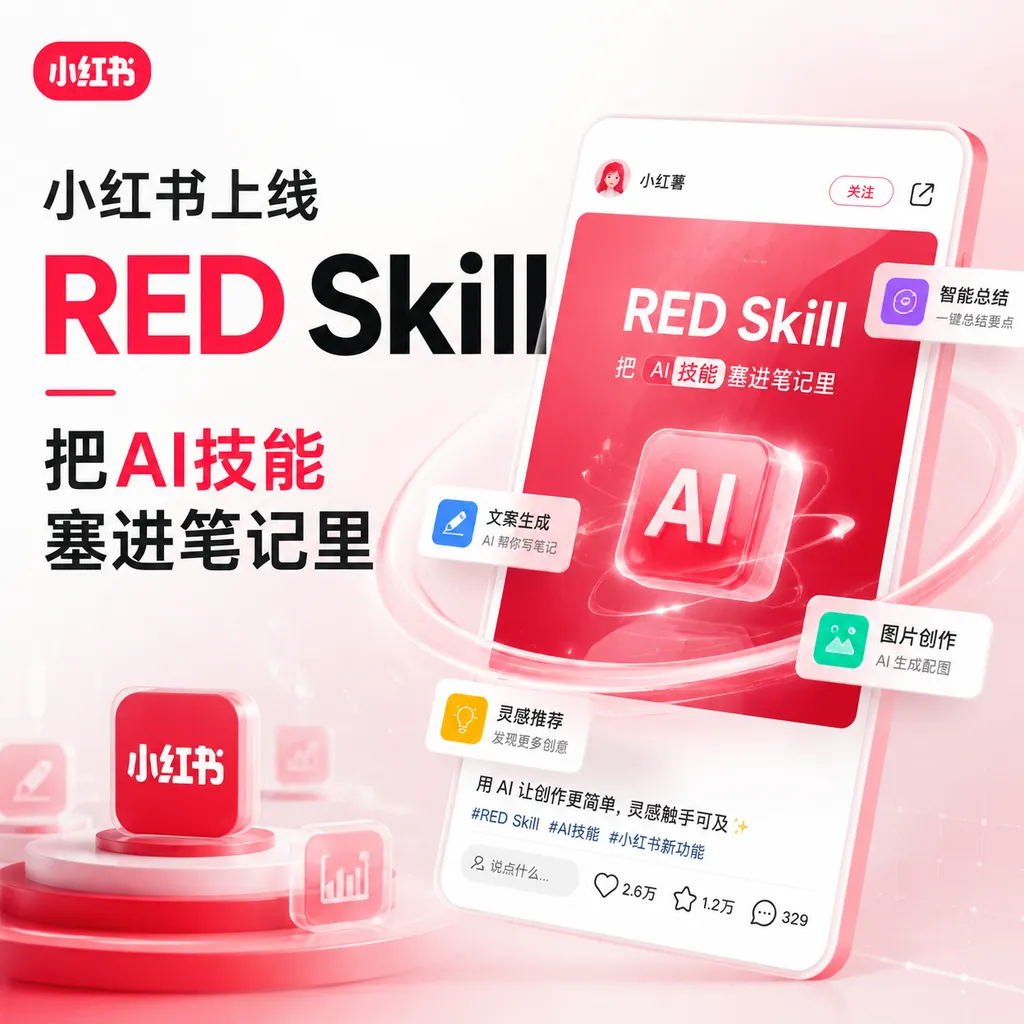
Xiaohongshu has officially launched RED Skill, allowing creators to embed AI Skill components into their posts. Users can copy the command with one click and install it into agents like Claude Code for use. This is the first attempt to deeply integrate Skill distribution with community content.
Xiaohongshu Integrates AI Skill into Notes: RED Skill Officially Launched
On June 10, Xiaohongshu officially brought the RED Skill feature—tested internally for over half a month—into public view. Simply put, creators can attach an AI Skill component to their notes. Readers can click it to copy an installation command and run it in their own Claude Code or other Agents—reducing the entire process to just two steps, without digging through repositories on GitHub, reading README files, or configuring environments.
This initiative traces back to May 24, when Xiaohongshu Tech Potato announced that notes would be open for uploading Skills. At that time, it was a small-scale beta, with invitations sent to a batch of AI bloggers to try it out. By June 8, the platform rolled out the “RED Skill Awards” support campaign and a curated leaderboard. Today, applications are open to all creators who meet the requirements. The pace has been neither fast nor slow—clearly, the product form was refined before scaling up.

What Problem Does This Actually Solve
Let’s talk about what a Skill is. It’s not a Prompt, though many people treat it like an “advanced prompt.” A truly functional Skill packages the process, rules, and tool invocation methods for completing a specific task into a standardized, reusable module—usually including a SKILL.md description file, and potentially accompanied by Python scripts, configuration files, API documentation, and other supporting materials. After Anthropic popularized this concept through Claude Code, Skill has become one of the hottest keywords in the AI Builder community over the past six months.
However, distributing Skills has always been troublesome. Developers upload their creations to GitHub, ClawHub, or various specialized tech communities, where the audience is almost entirely peers. Ordinary users have no idea these things exist. Even if they happen across one, they are baffled by the markdown and yaml documents and don’t know how to use them. This leads to an awkward paradox: Skills are meant to improve efficiency for non-technical users, yet they circulate only within tech circles.
RED Skill focuses on one thing—switching the distribution channel from “developer communities” to “content communities.” Creators use a note to clearly explain usage scenarios (Xiaohongshu’s specialty), attach a component below, and readers simply click “Use,” copy the command, and paste it into their Agent to execute. Done.
Among the first invited testers was AI blogger @归藏, who developed a PPT-generating Skill that had gained 10,000 stars on GitHub in 25 days—already top-tier. As soon as he got early access, he synced it to Xiaohongshu, and within a few days, over 3,000 people used it. GitHub stars represent developer interest, while Xiaohongshu usage numbers reflect penetration in real-life scenarios—two metrics with largely different audiences.
Product Form More Restrained Than Expected
What’s worth noting is Xiaohongshu’s approach. It hasn’t heavily invested like Alibaba, ByteDance, or Tencent.
- Alibaba’s “Shrimp Assistant” Skill marketplace is free to use, but the computing power consumed by Skill calls directly translates into Alibaba Cloud revenue.
- ByteDance uses a dual strategy: “Douzi” directly supports selling Skills, taking a cut from transactions.
- Tencent aims to package millions of WeChat mini-programs into standardized Skills and profit from transaction commissions.
Xiaohongshu’s approach is visibly different: it doesn’t run AI, only showcases and distributes. Once a Skill is downloaded, it runs on the user’s local Agent, consuming the user’s own computing power, with no financial connection to Xiaohongshu. This is more like a “storefront display” for technical products—using its content ecosystem to energize distribution, while profitability is not the focus for now.
This restraint may actually be a good thing. The commercial model for Skills hasn’t matured yet—those who rush to monetize may fail sooner. Xiaohongshu’s strategy is lighter: capture traffic and mindshare first, then have room for ads, creator incentives, and e-commerce.
How to Use: Requirements and Process
For creators, to enable RED Skill upload permissions, they must meet several hard requirements:
- Followers ≥ 1,000
- Account age ≥ 6 months
- Healthy account status, no violations
- Completed real-name verification
Once these are met, apply under “New Feature Experience” to gain upload and attach permissions. The upload process is straightforward: upload the SKILL.md source file (you can also have an Agent help upload it), fill in a basic intro, and after review, check the option to insert a Skill component when publishing a note.
For users, it’s even simpler—click the “Use” button in the component below the note, copy the command, paste it into your AI assistant (Claude Code etc.), and installation is done.
Clear Shortcomings
However, the product currently has its share of issues—no need to sugarcoat them.
First, format support is too basic. The beta version only supports Markdown and TXT; YAML configurations and Python scripts can’t be uploaded. This means relatively complex Skills can’t be fully listed. Independent developer 杉森楠 summed it up well: in real workflows, a good Skill is more than a prompt—it needs Python scripts, configuration files, permission documentation, API parameters, and especially scripts, which are often key to making the Skill actually run. Without these, Skills degrade into “more complex prompts.”
Example scenario: converting files from Platform A to Platform B. While it sounds simple, in practice you need to log in, obtain permissions, read links, download files, process formatting, and then upload them—a full chain. The first time you have an Agent do this, you often write temporary scripts to bridge each step. These scripts should be packaged into the Skill for reuse later. But since RED Skill doesn’t accept scripts, users must manually complete complex Skills in their Agent, immediately raising the barrier.
Second, broken usage chain. Users discover a Skill on Xiaohongshu, decide to use it, but must jump out of Xiaohongshu’s app to install and run it in an external Agent environment like Claude Code. Xiaohongshu is completely “invisible” in the remaining steps—it can’t detect whether the Skill was installed successfully, how it ran, or if it failed, who will notify the user. Insiders say they plan to enable in-app usage later, but for now, this break in experience is objective reality.
Third, questionable data metrics. The “number of users” shown on the Skill detail page counts those who click the “Use” button—not actual installs. Testing shows some high-traffic notes have fewer than 15 real users, while some niche content delivers over 900 actual installs. There’s a clear disconnect between traffic and usage conversion. In the short term, this counting method will reduce the leaderboard’s guidance value.
Why Xiaohongshu, and Why It’s Suitable
Looking back, the distribution of AI Skills indeed needs a content community to carry it, and Xiaohongshu might be the most suitable in China.
Official stats highlight some key figures: AI Skill-related content creators on the platform number over 300,000, relevant topics have over 600 million impressions, and active developers exceed 160,000. This is no longer “developers occasionally dropping by,” but a sub-ecosystem of its own. From the AI heavyweights frequently sharing and demoing on Xiaohongshu over the past six months, you can see that the company has found a unique niche in the AI wave—an “AI inspiration community.”
Bringing AI applications into specific scenarios is indeed better suited to content-based expression. Most users don’t care whether the underlying tech is Claude or GPT—they care whether “this can make my PPT” or “help me organize my materials.” Skills encapsulate capabilities at the “scenario” level, and the best medium for expressing scenarios is image-text notes and short videos. GitHub READMEs will never convey that a Skill is “addictive” to use, but Xiaohongshu notes can.
The Skill distribution track became crowded in March this year. Tencent, Alibaba, and ByteDance all jumped in, followed by Zhipu and Meituan, and now Xiaohongshu. The competition is essentially over the traffic gateway in the AI era—similar logic to the App Store battles of the mobile internet era: whoever controls distribution controls user retention.
An Observation
RED Skill currently feels like an MVP—capable of running the most basic usage chain, but far from a closed loop. Its shortcomings are visible: limited formats, broken chains, imprecise data. Yet the product form reveals thoughtful strategy—no involvement in compute power, no monetization yet, focusing on spinning up the content and creator flywheel.
The flashy early stage of Skills is cooling down, and discussions within developer circles are increasingly focused on whether they can improve real workflows. Launching RED Skill at this time isn’t a bad choice—tech circles have gone through one round of selection, and what remains is worth bringing to general users.
Whether this becomes Xiaohongshu’s new business direction depends on the next steps: integrating usage data, implementing creator incentives, and supporting complex Skills. Until then, it’s essentially a “display window,” but even that is a traffic business.
References
- ITHome: Xiaohongshu Announces Opening of “RED Skill” Feature to Creators — Official info on RED Skill launch and creator requirements


