
Zhiyuan invests 2 billion to build an embodied intelligence ecosystem, targeting developers
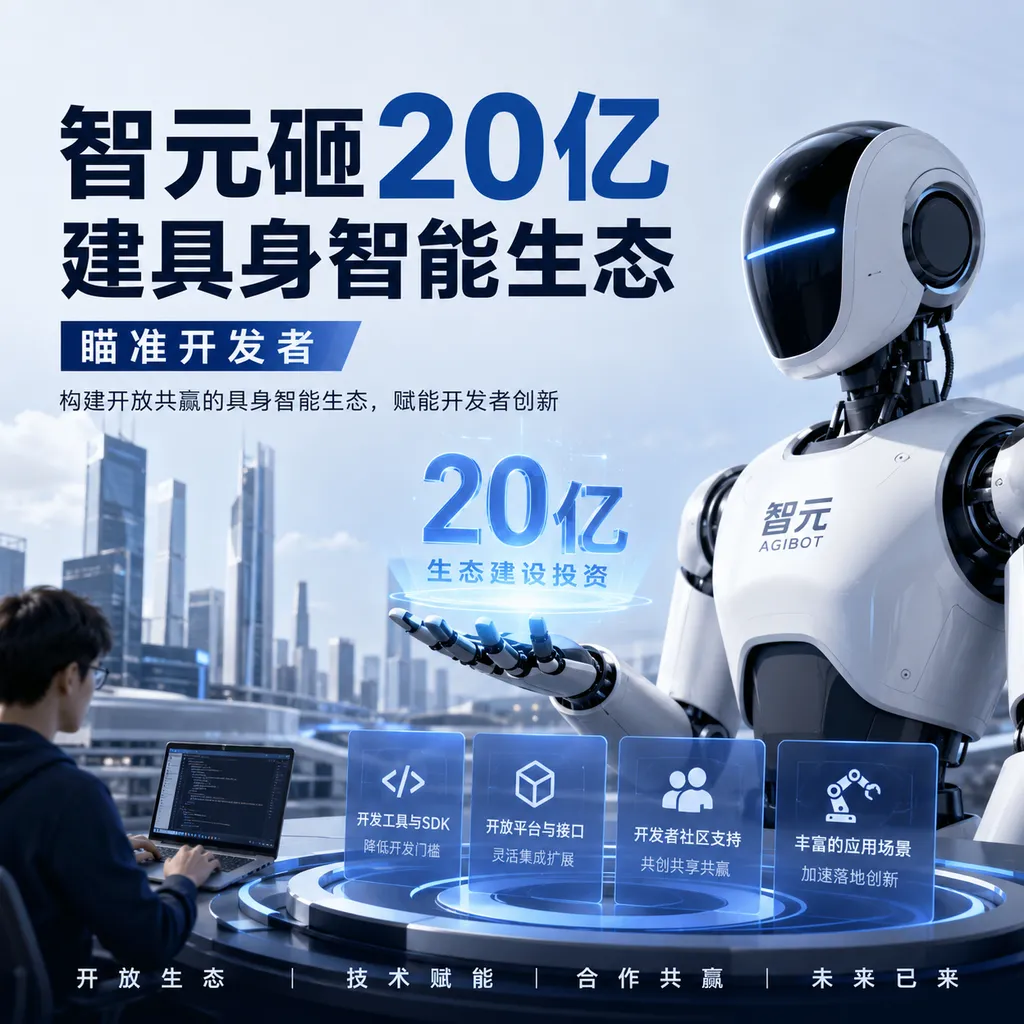
On June 10, Zhiyuan officially released the "Yuansheng Ecosystem Development Plan," with an initial investment of 100 million yuan in 2026 and a total investment of 2 billion yuan over the next five years. The plan focuses on building an embodied intelligence developer ecosystem around four key dimensions—scientific research, education, partnerships, and community—alongside the launch of the AIMA technology framework.
Zhiyuan Invests 2 Billion to Make Embodied AI a Business for Developers
On June 10, Zhiyuan (AGIBOT) officially launched the "Yuansheng Ecosystem Development Plan". In short: 100 million will be spent this year, with a total of 2 billion invested over the next five years, all aimed at supporting developers, universities, research institutions, and ecosystem partners in the embodied AI industry chain.
This is the official implementation of the "Yuansheng" plan following the initial signal released at the APC 2026 Partner Conference in April. Launched in parallel with this ecosystem plan is Zhiyuan AIMA, officially called "the industry's first open and complete embodied AI ecosystem technology framework", which includes the open-source operating system Lingqu Link-U OS and the universal robot task development platform Genie Studio.
Put simply: Zhiyuan is betting all the assets it accumulated in hardware over the past two years on the longer road of software platforms and developer ecosystems.
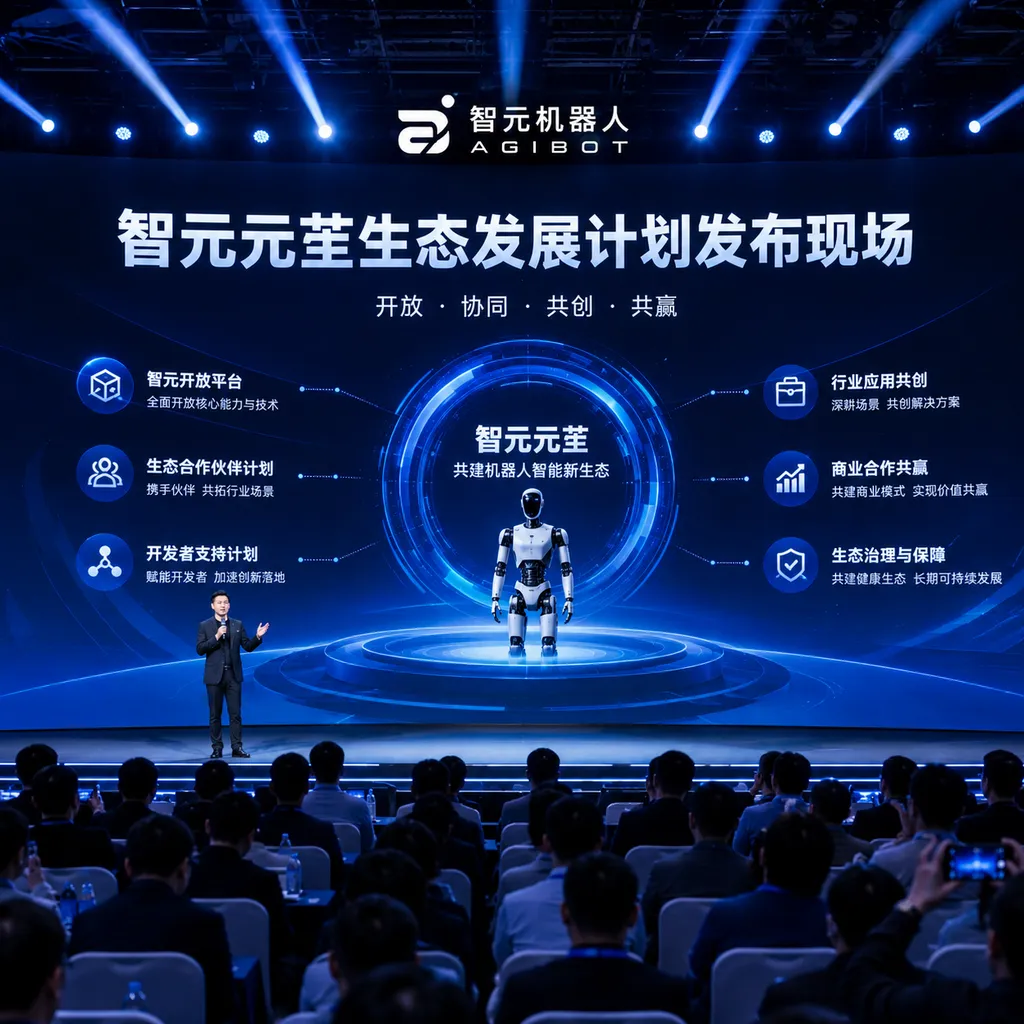
Where the Money Goes: Four Dimensions, Million-Level Targets
Let’s look at Zhiyuan’s "Yuansheng" plan. The 2 billion fund will be invested over five years in four directions:
- Scientific and academic innovation: Collaborating with universities and research institutions to support foundational research in embodied AI
- Education and talent cultivation: Co-building disciplines, majors, and teacher systems with institutions
- Ecosystem partner development: Supporting upstream and downstream application providers and industry solution providers
- Developer community operations: Building the developer community around the AIMA technology framework
The quantitative targets are quite ambitious—Zhiyuan’s open letter to developers clearly states: covering thousands of research institutions, connecting with tens of thousands of ecosystem partners, cultivating hundreds of thousands of developers, and reaching millions of end users.
The initial 100 million funding for 2026 will focus on empowering AIMA developers. The allocation logic mirrors the strategies used by early cloud vendors launching developer programs: compute vouchers, hardware subsidies, training resources, competition prizes, funding for industrial-academic-research projects, etc.
The official explanation of "Yuansheng" is "origin awakening, co-existence, co-growth". It may sound like standard corporate PR, but in the context of embodied AI at this point in time, it has a deeper logic.
Why Now: From "Body Competition" to "Deployment State"
Over the past two years, the hottest trend in the domestic humanoid robot industry has been competition over whose robot can run faster, jump higher, or screw bolts more steadily. Zhiyuan, Unitree, Figure, and Tesla Optimus are all battling on this layer of parameters. But once parameters are maxed out, the industry must face one question: Robots are built—who will develop the applications?
Zhiyuan now introduces a new term—embodied AI’s "deployment state"—meaning the industry should move from "building active robots" to "getting robots to work in real environments, reuse capabilities, and commercialize."
I agree with this assessment. Look at the large model industry: after GPT-3.5 was released, OpenAI’s ecosystem growth wasn’t driven by the model itself, but by the API + Plugin + GPT Store developer chain. Android and iOS won after hardware maturity thanks to developer ecosystems. In robotics, no matter how advanced the hardware, without thriving applications, the entire industry can’t take off.
The problem is that developing embodied AI applications has a far higher barrier than mobile apps—it requires expertise in perception, motion control, large models, reinforcement learning, and real machine testing environments. Most developers simply can’t enter. Zhiyuan’s 2 billion essentially aims to lower this barrier.
AIMA Technology Framework: Two Key Components
The "Yuansheng" plan relies on Zhiyuan’s simultaneous launch of the AIMA technology framework. The product philosophy clearly learns from the layered logic of cloud-native and AI infrastructure.
Lingqu Link-U OS: The Operating System of Embodied AI
The official positioning is "the software root," an embodied AI-native open-source operating system. The 1.0 version will be officially open-sourced within 2026.
Its significance is comparable to Android for the mobile phone industry. Currently, each robotics manufacturer writes its own vertical stack for its hardware, with no shared software layer—this is a nightmare for developers. If Link-U OS can truly become a cross-hardware open standard, Zhiyuan would essentially be claiming the position of the "Android of embodied AI."
Of course, whether this succeeds is another matter. The Linux ecosystem already has operating systems for robotics (ROS, ROS 2). For Link-U OS to stand out, it depends on its openness and compatibility with different hardware.
Genie Studio: A Universal Robot Task Development Platform
This is closer to developers’ daily work. Officially described as an integrated "collect, train, test, deploy" development platform, focused on producing endless robot task skills.
In other words: developers don’t have to build their own data collection pipelines, reinforcement learning frameworks, or simulation environments—the platform provides it all. It’s somewhat like SageMaker + Hugging Face for embodied AI—data, training, evaluation, deployment all in one.
This toolchain is especially valuable for small teams and university labs. Historically, training even a simple grasping skill could take months just to set up the environment. If Genie Studio truly enables the full flow of "demonstration data collection → strategy training → simulation verification → real machine deployment," the cycle could be reduced to days.
Education Line: Co-Creation with 100 Schools, Empowering 1,000 Teachers, Growing 10,000 Talents
A significant portion of the 2 billion will flow into education. At the APC 2026 Education Ecosystem Forum in April, Zhiyuan co-founder and CTO Peng Zhihui announced the "Hundred-Thousand-Ten-Thousand" plan—co-create with 100 schools, empower 1,000 teachers, and grow 10,000 talents.
Supporting actions include:
- December 2025: The University Graduates Employment Association, in collaboration with Zhiyuan, launched the "Embodied AI Robot Industry-Education Integration Base" project
- February 2026: The first batch of 30 institutions completed public listing and entered the construction phase
- Collaboration agreements with over 30 universities, including University of Electronic Science and Technology, Xiamen University, Guizhou Transportation Vocational University, and Shandong University of Science and Technology Vocational College
- Signed with Hitch Open to jointly push humanoid robots to extreme athletic training challenges with top global universities
This model mirrors Huawei’s HarmonyOS talent ecosystem push and NVIDIA’s CUDA education certification system—talent is the moat. Students trained today will be the main force building applications for Zhiyuan’s ecosystem in three years. It’s a long-term, high-barrier investment.
Zhiyuan also proposed a new talent training pyramid: from top-tier innovative talent (research-focused), to engineering talent, to technical skill talent, and finally to general digital literacy. This layered approach matches the real talent structure needed for embodied AI deployment—algorithm breakthroughs, engineering deployment, and production-line maintenance.
Horizontal Comparison: What Future Zhiyuan Is Betting On
Looking more broadly, in the past six months, domestic embodied AI has roughly split into three routes:
| Route | Representative Players | Core Strategy | | --- | --- | --- | | Hardware Route | Unitree, Zhongqing | Capture market with extreme hardware cost-performance | | Closed-Loop Application Route | Figure, Tesla | Self-developed hardware + self-developed models, vertical integration | | Platform Ecosystem Route | Zhiyuan (latest pivot) | Open OS + development platform + developer ecosystem |
None of these routes are absolutely right or wrong, but Zhiyuan’s choice is clearly betting on the "open ecosystem" winning. This is similar to Android’s strategy against iOS—diffusing the competitor’s vertical integration advantage with massive developer numbers and scenario coverage.
The risks? Two clear points:
- Openness requires restraint. Zhiyuan both sells hardware and develops applications—balancing the roles of "referee" and "player" is a classic open ecosystem dilemma. If Link-U OS is optimized only for Zhiyuan’s hardware, then "open" becomes an empty slogan.
- Is 2 billion enough? For comparison, OpenAI’s annual training cost is already in the tens of billions of USD, and Google/ NVIDIA spend similar amounts annually on developer ecosystems. Spread over five years, 2 billion RMB means only 400 million per year—supporting "thousands of research institutions, tens of thousands of ecosystem partners, hundreds of thousands of developers" requires extreme funding efficiency.
On the flip side, compared to continuing to compete with Unitree on hardware costs or Tesla on automation, Zhiyuan’s bet on developer ecosystems may offer better odds. Hardware’s ceiling is manufacturing profit margins; ecosystem’s ceiling is platform company valuation logic.
An Observation
It’s worth noting that Zhiyuan’s APC 2026 releases were very dense—four new hardware products, six AI models, seven productivity solutions, plus the AIMA technology framework and the "Yuansheng" plan. This isn’t just a product launch—it’s a clear strategic pivot.
For developers, this is a window of opportunity. Early entrants—whether building applications, industry solutions, or simply participating in the community—can get funding, hardware, and traffic. This kind of bonus period typically lasts 18-24 months.
For the industry, the more important signal is: domestic embodied AI competition has shifted from hardware parameters to software platforms and developer ecosystems. Over the next year, similar ecosystem plans will likely be launched by other major players.
As for whether "Yuansheng" can truly become the Android of the embodied AI era—that’s something to revisit in five years. But for now, Zhiyuan has given a clear answer—it has chosen a longer, slower road, but one with a higher ceiling.
References
- Zhiyuan fires the first shot of embodied AI’s "deployment state" - Zhihu Column: In-depth interpretation of the strategic intent of the Yuansheng plan, including Zhiyuan’s industry judgment at the deployment stage


