
Alibaba Cloud Price Reduction: ACS Agent Sandbox Default Computing Power Lowered
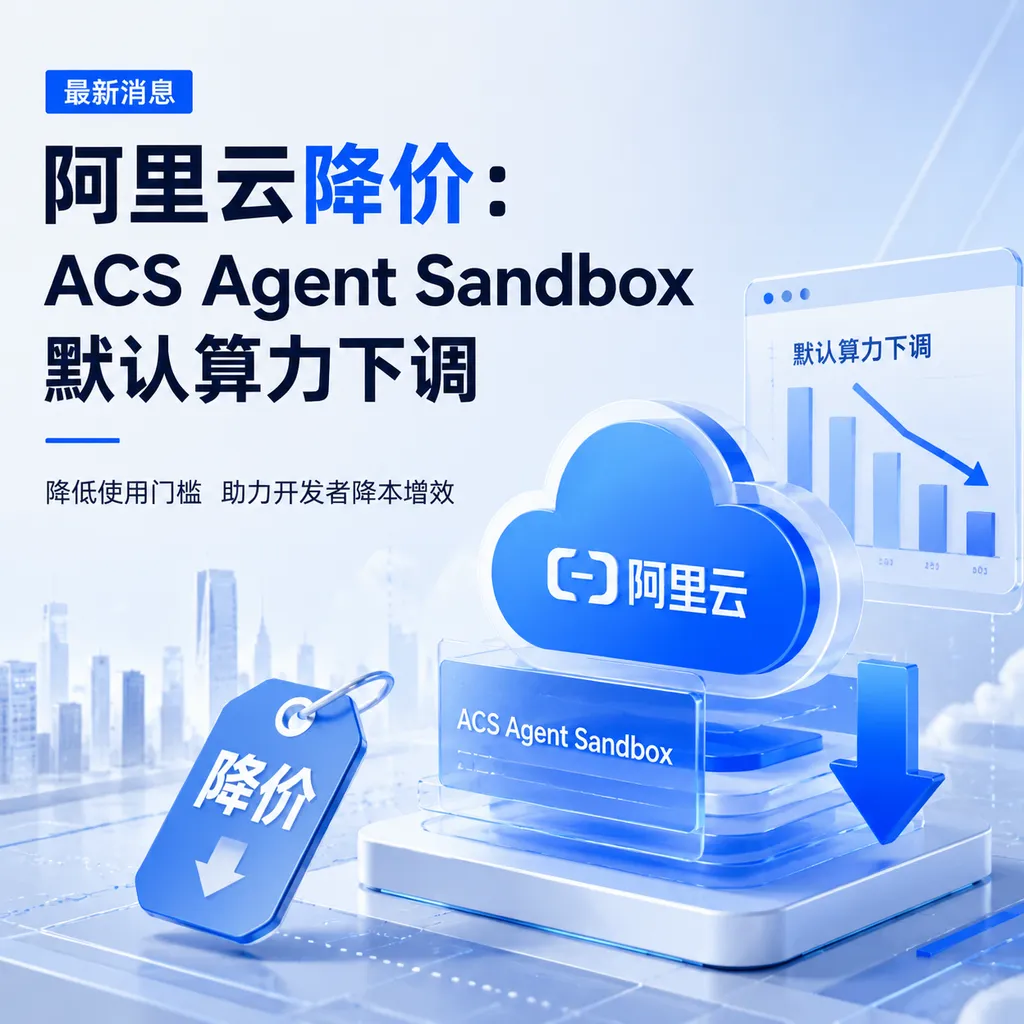
Alibaba Cloud announced that starting from June 15, it will lower the price of the default computing power quality for the Container Compute Service ACS Agent Sandbox, while keeping the prices of other computing power specifications unchanged, aiming to capture the infrastructure market for enterprise-level AI Agent production deployments.
Alibaba Cloud Lowers Default Compute Price for ACS Agent Sandbox, Targeting the Agent Infrastructure Market
On June 10, Alibaba Cloud issued a price cut announcement: starting from June 15 at 12:00, the Agent Sandbox (default compute quality) in the Container Compute Service (ACS) will officially be cheaper. The adjustment scope is restrained—only the default tier is affected, while ACS's general-purpose and performance-oriented default and best-effort tiers remain unchanged.
It looks like a routine price adjustment, but in the current overheated competition in the Agent infrastructure market, this move is quite interesting.
What Kind of Product Is This
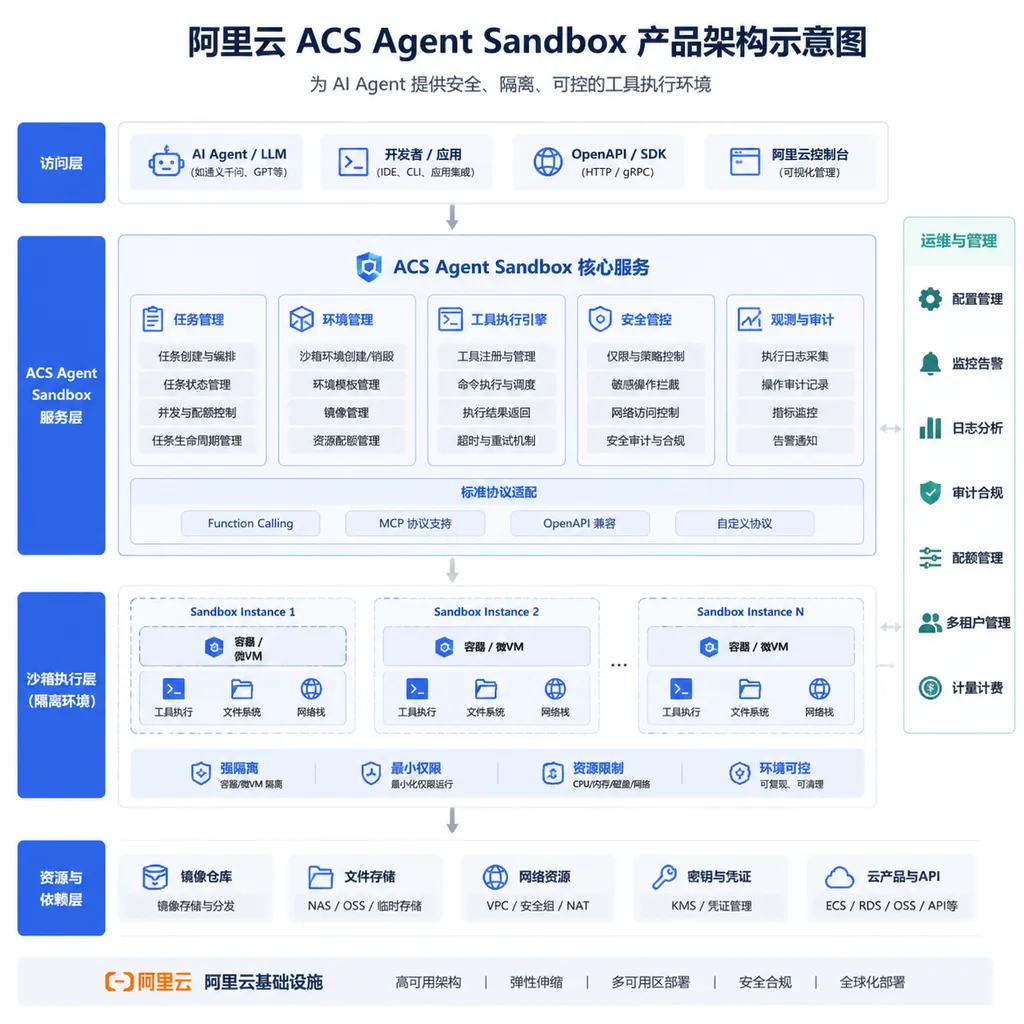
Let’s clarify the background first. ACS Agent Sandbox is a type of sandbox compute specifically designed for AI Agents under Alibaba Cloud’s Container Compute Service (ACS). Earlier this year, it completed testing of new compute capabilities, positioning itself as a "production-grade Agent runtime foundation".
Unlike ordinary container compute, its design goal is not to run web applications or microservices, but to handle two typical Agent workloads:
- AgentRL Scenarios: In reinforcement learning training—trajectory sampling, environment interactions, multi-path parallel exploration. This requires spinning up thousands of isolated environments in a very short time, destroying them after use, and being extremely sensitive to elastic creation speed.
- AgentServing Scenarios: Deep research Agents, tool invocation, multi-turn conversations—these require each user session to have an independent secure execution environment, capable of sleeping when the user leaves and waking in seconds when they return, saving money without compromising experience.
From a technical standpoint, the Agent Sandbox is robust:
- MicroVM-level Isolation: Each sandbox is an independent micro virtual machine with end-to-end isolation for compute, network, and storage. For scenarios like Code Interpreter or Browser Use, which run user-generated code in the sandbox, this is essential.
- Elastic Scaling—15K Sandboxes per Minute: Through image caching acceleration, warm pool preheating, and load-characteristic-based pre-scheduling, it achieves rapid sandbox creation in hundreds of milliseconds, reducing typical image pull time by 90%+.
- Memory-level Sleep/Wake: Sandboxes can sleep on demand while retaining memory state, waking quickly within 1–10 seconds. No CPU or memory fees during sleep, only temporary storage is billed.
- Checkpoint/Restore: Saves sandbox memory state snapshots for migration and cloning, designed for branch parallel exploration in Agent scenarios.
- Ecosystem Compatibility: Native Kubernetes support and E2B-compatible SDK—this is key for developers; teams already using E2B can migrate with near-zero modifications.
Where the Price Cut Hits
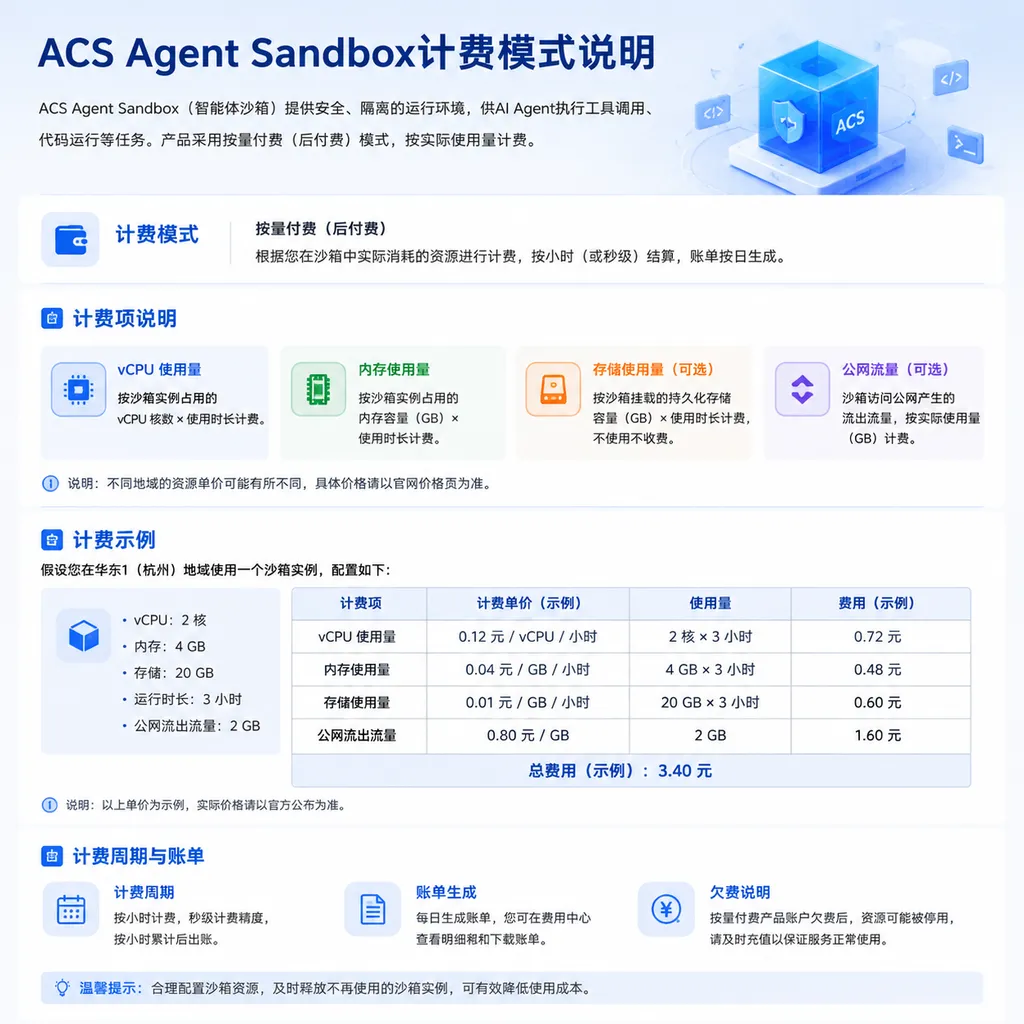
Now for the pricing details. ACS Agent Sandbox bills separately for vCPU count and memory size, priced per second and invoiced hourly. The published prices before the cut were roughly:
- vCPU: ¥0.00003006/second (about ¥0.108/hour)
- Memory: ¥0.00001499/second (about ¥0.054/hour)
Alibaba Cloud hasn’t disclosed the exact percentage decrease, only stating “price reduction,” effective from June 15, 12:00. It’s worth noting that ACS also has a best-effort compute quality tier, priced around 20% of the default tier, aimed at “cost-sensitive and fault-tolerant offline tasks”—this price cut does not affect that tier.
In other words, Alibaba Cloud is lowering the price of its main commercial tier. Default compute corresponds to stable supply with SLA guarantees for production workloads—enterprises actually pay real money for this. Cutting the main tier price sends a stronger signal than cutting best-effort.
Why Cut Prices Now
The timing isn’t random.
Over the past year, the Agent infrastructure track has moved from “proof of concept” to “production deployment.” Overseas companies like E2B, Daytona, and Modal have made Agent sandbox services into cloud-native standard products; domestically, Volcano Engine and Tencent Cloud have adapted container compute for Agent scenarios. Alibaba Cloud’s Agent Sandbox is still in beta, but is clearly aimed at matching E2B—its E2B-compatible SDK is an explicit signal.
The thing is, Agent sandbox compute has a unique customer structure:
- Top-tier Agent companies: Running AgentRL training consumes astronomical compute—large-scale parallel sampling can easily spin up tens of thousands of sandboxes, making them very price-sensitive.
- Mid-sized Agent SaaS providers: In AgentServing scenarios, each active user corresponds to a long-running sandbox, with margins directly determined by compute costs.
- Individual developers/small teams: Want to try production deployment but are deterred by per-second billing.
All three types are highly price-sensitive. Cutting the default tier benefits the first and second groups most—those already doing serious production deployment and consuming at scale. Not cutting best-effort implies Alibaba Cloud believes future revenue will be supported by stable compute, not low-cost volume runs.
The Subtle Relationship with the E2B Ecosystem
The E2B compatibility deserves separate mention.
E2B is currently the most widely used Agent sandbox SDK globally, with mature open-source ecosystem, community resources, and documentation. But E2B’s own hosted service runs overseas, posing compliance and latency issues for domestic teams.
Alibaba Cloud’s Agent Sandbox with E2B-compatible SDK offers a “semantically identical, better-performing, lower-priced” domestic alternative. Paired with this default tier price cut, domestic Agent teams wanting E2B but blocked by compliance or network issues will find it much more appealing.
For developers, the migration cost from E2B is near zero—the SDK call patterns and semantics for sandbox creation, connection, execution, and teardown are identical. Swapping the underlying layer barely touches application code.
An Overlooked Detail: State Persistence
When discussing Agent sandboxes, people usually focus on isolation and elasticity, but state persistence is an underrated capability for Agent scenarios.
Imagine a deep research Agent: the user starts a research task in the morning, halfway through closes the browser for a meeting. In the afternoon, they return and need the Agent to restore exactly where they left off—browser tabs, variables in the Python kernel, intermediate files—all present.
Traditional container solutions serialize state to external storage and reload it on restart, causing notable latency and interruptions. Agent Sandbox’s memory-level checkpoint does something else: preserves an entire MicroVM memory snapshot, restoring in 1–10 seconds as if the application had never been closed.
This has a direct impact on retention in AgentServing-type businesses. After the price cut, long-session economics improve—almost no cost during sleep, per-second billing when active, overall per-user costs remain controllable.
What This Means for Domestic Agent Teams
Beyond marketing slogans, this price cut has several concrete impacts for teams actually building Agents:
- Lower Barrier to Production Deployment: Mid-sized teams previously constrained by compute costs can migrate more online traffic into strongly isolated sandboxes, improving security and control.
- Improved Economics for AgentRL Training: Reinforcement learning training consumes compute at scale; cutting default tier prices directly lowers training bills.
- Increased Appeal for Domestic E2B Migration: Teams using E2B overseas now have a local option with better performance, pricing, and compliance.
- Beta-phase Window Benefits: Agent Sandbox is still in beta, meaning official responses to customer feedback are more proactive, with higher support priority and greater negotiation space for customization needs.
Of course, some caveats: Agent Sandbox is currently available only in six regions—South China 3 (Guangzhou), South China 2 (Heyuan), North China 1 (Qingdao), North China 3 (Zhangjiakou), North China 5 (Hohhot), Southwest China 1 (Chengdu), while key East China regions are not yet covered. Teams deployed in East China 2 (Shanghai) will need cross-region calls, adding latency and bandwidth costs.
By the Way
Another unavoidable topic in Agent development is model invocation. Agent sandbox solves the execution environment problem, but the Agent’s brain is still in the large model side. If you need multi-model routing or cross-vendor comparisons, platforms like OpenAI Hub (openai-hub.com) let you call GPT, Claude, Gemini, DeepSeek with one key, support direct domestic connections, and are compatible with the OpenAI format. Combining this with localized sandbox compute like Agent Sandbox makes the infrastructure layer cleaner for production deployment.
In Conclusion
The price cut itself may not be huge, but the signal is more important: Alibaba Cloud is offering concessions on its main commercial tier, indicating the Agent infrastructure line has moved from “market education” to “customer acquisition.”
In the coming months, Volcano Engine and Tencent Cloud will likely follow suit. For developers, this is good news—getting Agent production deployments running depends on cheap, stable, and ecosystem-compatible compute. Once these three conditions are met, we’ll likely see many Agent products, previously shelved due to cost, launch in volume next year.
See you at 12:00 on June 15.
References
- ACS Container Compute Upgrade & AI Agent Solutions - Zhihu Column: Detailed explanation from the Alibaba Cloud ACS team on Agent Sandbox product positioning, compute quality grading (default/best-effort), and AI Agent solutions.


