
Xiaomi MiMo trillion-parameter model soars to 1000 tokens/s, hundreds of times faster than you can read.

On June 9, Xiaomi, in collaboration with TileRT, released the MiMo-V2.5-Pro-UltraSpeed, achieving for the first time on a general-purpose GPU a trillion-parameter model inference speed exceeding 1000 tokens/s, with a peak of 1200. API access applications are open for a limited time, and pricing is three times that of the standard edition.
Trillion-Parameter Model Achieves the Speed of a “Reverse Typewriter”
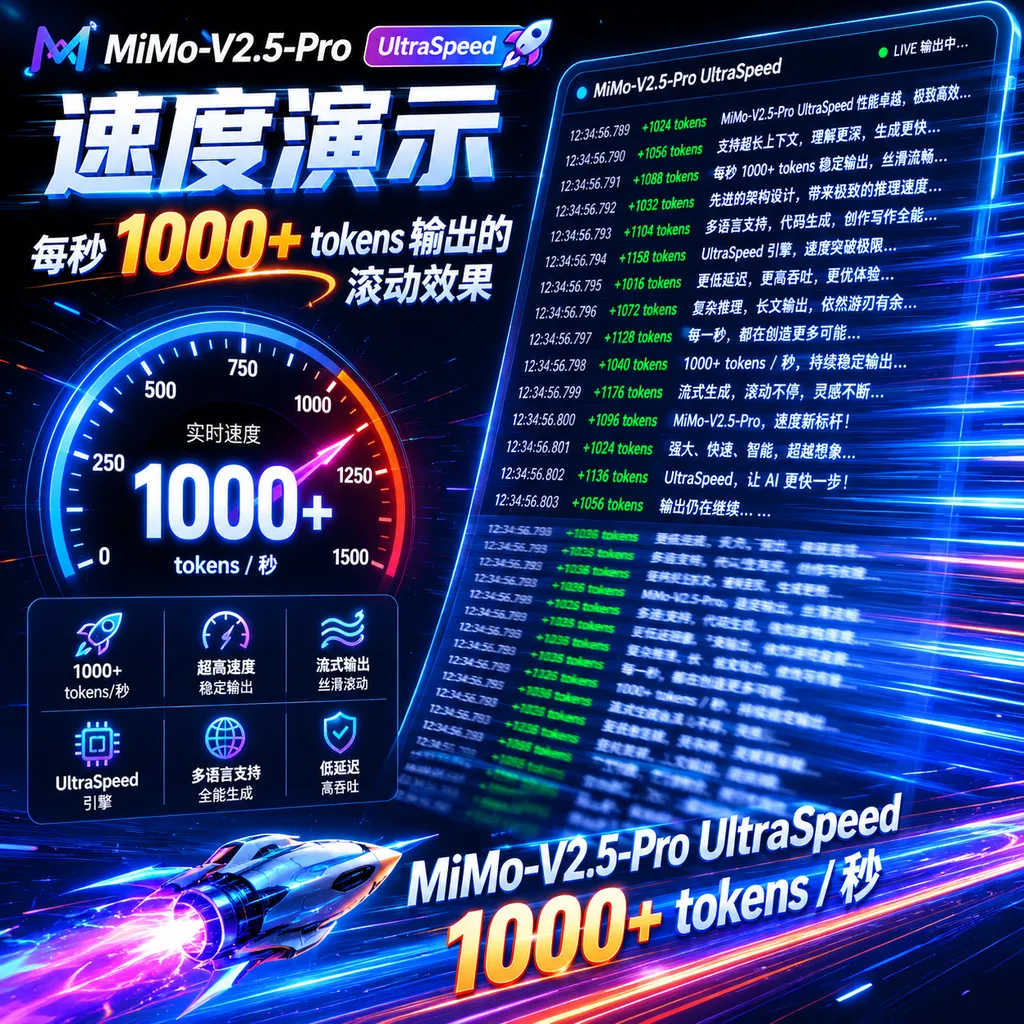
On June 9, Xiaomi’s MiMo team, together with the inference systems team TileRT, dropped a not-so-small bomb: Xiaomi MiMo-V2.5-Pro UltraSpeed officially launched. For the first time ever, a trillion-parameter large model running on a general-purpose GPU reached a single-user generation speed of over 1,000 tokens/s. The peak number was even more jaw-dropping—1,200 tokens/s.
On the same day, Lei Jun posted a message on Weibo, uncharacteristically blunt: “The industry’s first breakthrough to over 1,000 tokens/s output speed on a trillion-parameter model.”
What’s the significance of this number? A token roughly corresponds to 1.5 to 2 Chinese characters. At 1,000 tokens/s, that’s about 1,500 to 2,000 characters per second in Chinese. The average human reading speed is 4–5 characters per second, meaning the model generates content 300 to 500 times faster than you can read. Characters fly past the screen in entire paragraphs before you can even glance at them.
The Key Is Not Just “Fast” — It’s Achieving This on General-Purpose GPUs
Looking only at the “speed” number, others in the industry have already broken into four digits—but most relied on custom ASIC chips, such as certain inference-focused startups that achieved extreme bandwidth with specialized hardware.
Xiaomi took a completely different path. The official description: “A single standard 8-card general-purpose GPU node,” no custom chips, and that’s what’s truly worth highlighting in this release. It means the acceleration scheme could potentially be reproduced by any vendor with a standard H-card cluster, lowering the barrier significantly.
So how did they achieve it? The official disclosure points to three core technologies:
First is FP4 quantization, applied only to MoE expert layers. MiMo-V2.5-Pro uses a Mixture-of-Experts (MoE) architecture, where most parameters are concentrated in expert layers. Xiaomi’s method is lossless FP4 quantization for these large expert layers only, while keeping attention and routing layers at original precision. This reduces memory usage and bandwidth pressure while hardly affecting overall performance—a fine-tuned “cut where there’s redundancy” approach rather than a crude blanket quantization.
Second is DFlash block-parallel speculative decoding. Traditional autoregressive decoding generates tokens sequentially—each step waits for the previous one. DFlash predicts an entire block at once, then verifies in parallel. Official data shows that in code and mathematical reasoning scenarios, an average of 6–7 tokens can be confirmed per cycle—boosting generation efficiency several times over.
Third is TileRT-level inference system restructuring. This is the core collaboration with TileRT, centered around the keywords “persistent kernels + heterogeneous pipeline.” A common bottleneck in GPU large-model inference is constant operator switching and kernel launch overhead, preventing full hardware utilization. TileRT’s method keeps kernels resident and schedules different operators in a pipelined manner, keeping the GPU almost constantly busy.
Each of these technologies alone isn’t particularly novel—FP4, speculative decoding, kernel fusion are all being used in the industry. But codesigning them together and running at 1000+ tokens/s on a trillion-parameter MoE model—that’s hardcore engineering.
API Pricing: Triple the Price, Ten Times the Speed
The business strategy kept pace. The MiMo-V2.5-Pro-UltraSpeed API went live simultaneously, priced at three times the standard MiMo-V2.5-Pro.
The standard version pricing reference:
- Input: cache hit 0.025 RMB per million tokens, cache miss 3 RMB per million tokens
- Output: 6 RMB per million tokens
At triple the rate, UltraSpeed output is about 18 RMB per million tokens. Compare that to a 10× speed increase: content produced per unit of time is ten times greater, with only triple the unit price—a good deal for scenarios bottlenecked by output speed.
There’s a catch: This is a limited-time application-only program. From June 9, 2026, to 23:59 on June 23—a two-week window. Ordinary developers may have to queue for API access; officials explicitly said “priority will be given to companies and professional developers with actual business needs.” The reason is clear—high-speed inference resources are limited and can’t be opened freely.
For approved accounts, restrictions include:
- Maximum of 10 successful queue entries per day
- Single session limit of 30 minutes
- Automatic resource release after 5 minutes of idle time
Currently, Token Plan packages are not supported—pure pay-as-you-go API billing. Ordinary users can try the free conversation feature via a dedicated webpage at ultraspeed.xiaomimimo.com, and API application is at platform.xiaomimimo.com/ultraspeed.
What 1000 tokens/s Can Unlock
Once speed reaches a certain threshold, the nature of applications changes. This isn’t just shortening a progress bar from 30 seconds to 3 seconds—it’s making previously impossible scenarios feasible.
The official release mentioned several directions worth elaborating:
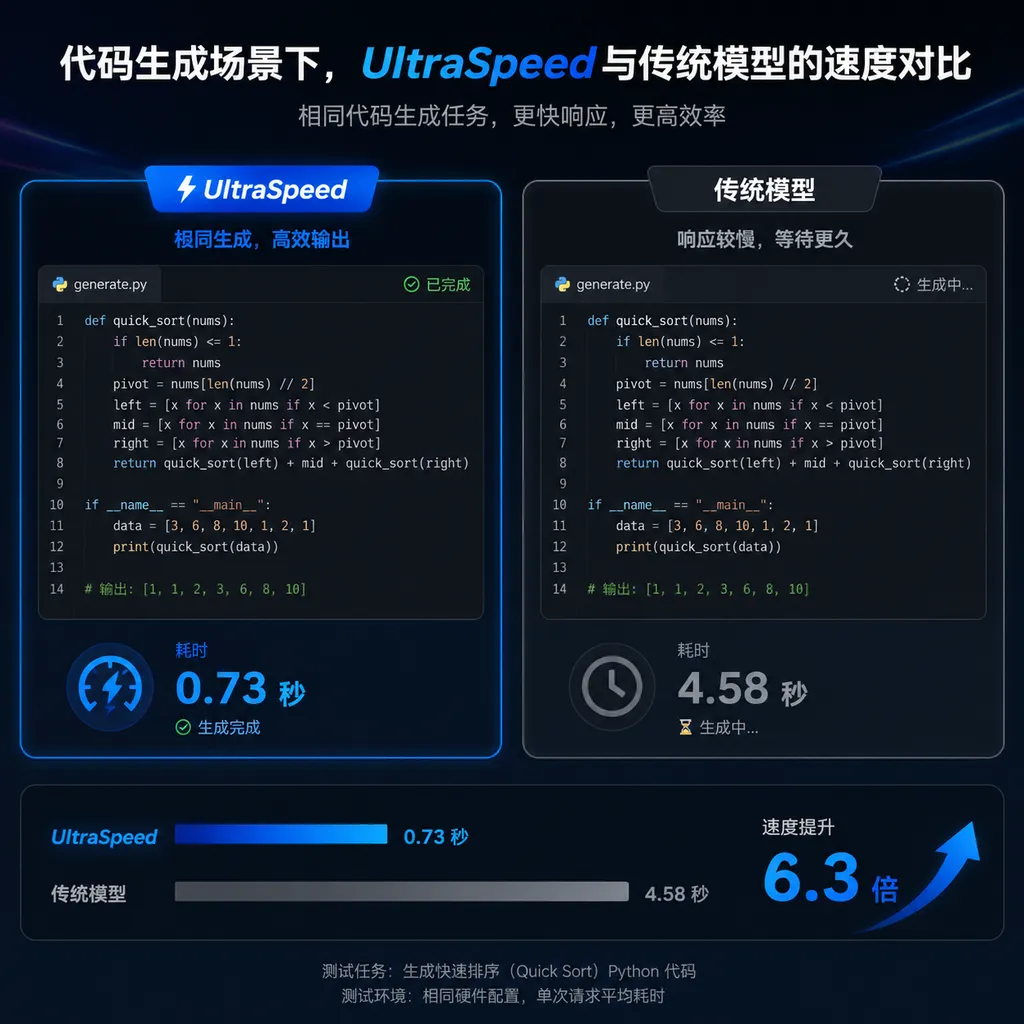
Code generation and Agents. Developers using tools like Cursor or Claude Code often suffer from long waits—especially when modifying large files or coordinating across multiple files. Models producing only tens of tokens per second can be frustrating. At 1000 tokens/s, results are virtually “instant.” Programming agents can loop more frequently—self-correct, rewrite multiple times, and parallel-test multiple solutions—each iteration costing far less in time and resources. The official demo’s “Recreate macOS interface in 1 minute” case derives from this kind of high-frequency Agent behavior.
Parallel reasoning chains. Reasoning models (like the o-series or DeepSeek-R1) tend to “think for a long time,” with CoT easily running into thousands or tens of thousands of tokens. With this speed, multiple reasoning chains can be run in parallel for self-consistency, then vote for the final answer. Quality rises significantly because the model now has a “trial-and-error budget.”
Millisecond-level decision scenarios. This is perhaps the most imaginative: high-frequency trading, real-time fraud detection, medical imaging-assisted decision-making. In the past, trillion-parameter models couldn’t enter these scenarios due to inference latency, leaving small models to handle them. But if 1000 tokens/s can be stably provided, the “heavy artillery” of trillion-parameter models can be deployed on the real-time battlefield.
A Victory for Engineering
As of 2026, the storyline in the large-model race has shifted from “the bigger the parameter count, the better” toward “how to make large models affordable and fast.” New model releases from OpenAI and Anthropic increasingly emphasize capability curves and Agent abilities, while domestic competitors are locked in tougher competition on the inference engineering front—DeepSeek’s MLA and V3 inference optimizations last year proved that algorithm-system codesign can yield far more gains than imagined.
Xiaomi’s MiMo-V2.5-Pro-UltraSpeed work closely parallels DeepSeek’s path—not a single-point breakthrough, but full-stack coordination from quantization strategy to decoding algorithm to inference framework. The difference is that Xiaomi chose a more aggressive presentation—directly branding it “1000 tokens/s trillion parameters,” making speed the product’s main selling point.
Frankly, Xiaomi’s MiMo series has not been highly prominent in the domestic large-model lineup. This UltraSpeed release is an effective “engineering flex”—a coherent tech narrative, hard performance numbers, and reasonably restrained pricing. Whether API access performance meets expectations, whether the application-only system can be sustained, and whether post-window regular services will emerge—all remain to be seen in the next two weeks.
For developers, if your business is truly limited by large-model output speed—like programming agents, real-time translation, or batch long-document generation—this two-week window is worth applying for. Even if not immediately integrated into production, running benchmarks can give you firsthand insight into what “trillion parameters + 1000 tokens/s” feels like.
The large-model engineering competition still has plenty of room in 2026.
References
- Discussion on Xiaomi MiMo-V2.5-Pro-UltraSpeed release - linux.do: Community first-hand discussion and speed conversion analysis
- Xiaomi launches MiMo-V2.5-Pro UltraSpeed, output speed breaks 1000 tokens/s for the first time - IT Home: Includes Lei Jun’s post and API application details


