
Qianwen launches the College Entrance Exam Volunteer Agent, turning a 5,000-yuan consultation into a free service.
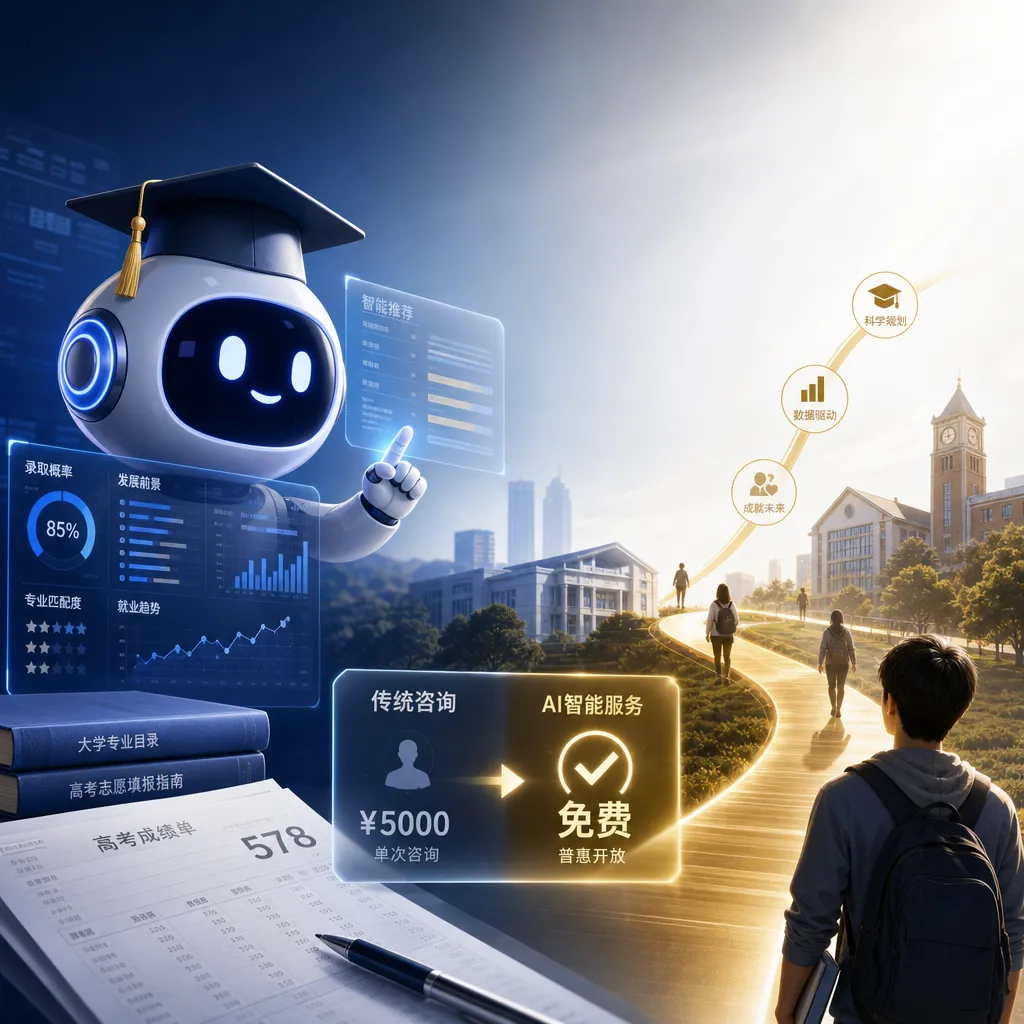
On June 10, Qianwen released the country’s first full-cycle college entrance exam application Agent, offering three capabilities: application report, application calendar, and application Q&A. Based on Quark’s eight years of college entrance exam data and the college application large model, it is available free of charge to candidates nationwide.
Qianwen Launches Gaokao Volunteer Agent, Turning a 5,000 Yuan Consultation into a Free Service
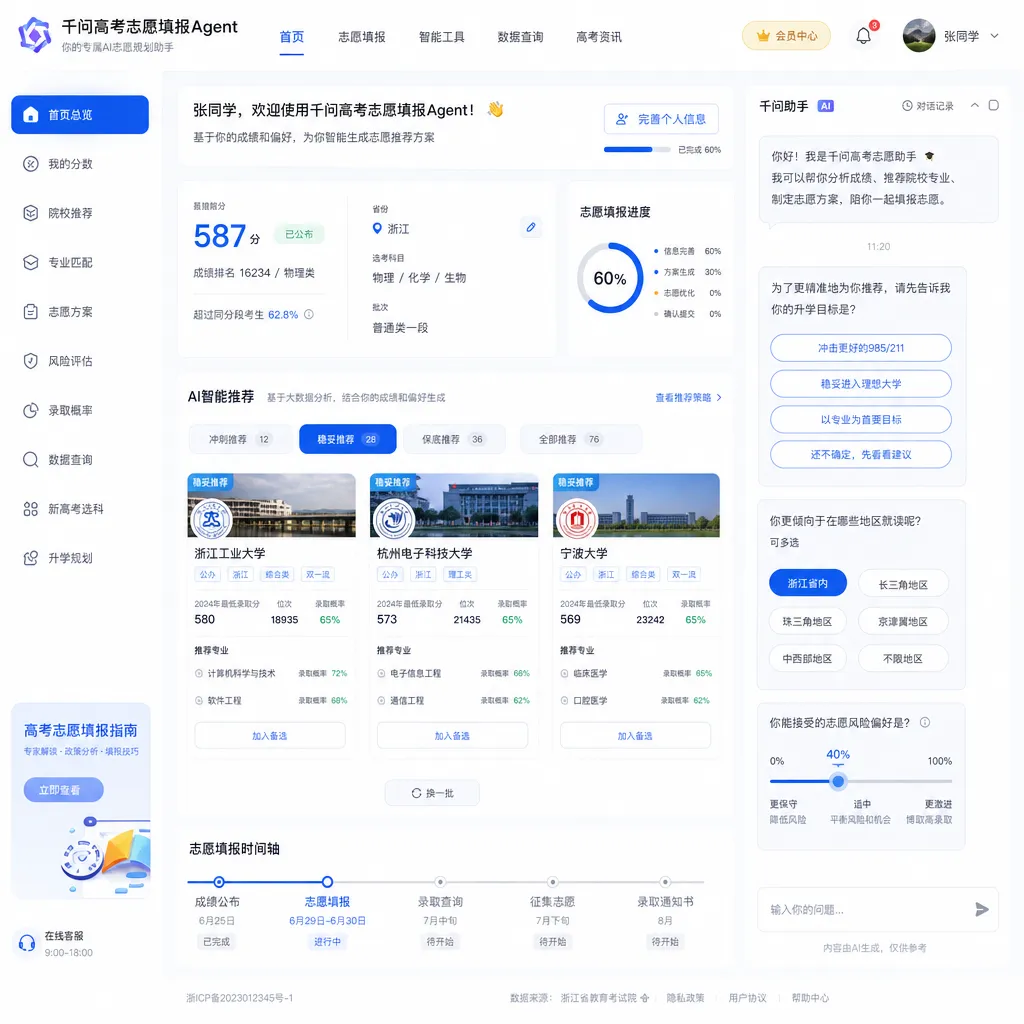
With less than a week left before the end of the national Gaokao, the issue of filling out college applications has already become a headache for millions of families. On June 10th, Qianwen officially launched a Gaokao Application Agent, claiming it as the "first full-cycle Gaokao application Agent in China," focusing on three main capabilities—Application Report, Application Calendar, and Application Q&A—all completely free.
The background of this matter is worth discussing briefly. In 2026, the national Gaokao registration number is around 12.9 million, but the proportion of families who can afford professional application planning consultants is less than 5%. On the market, a decent in-depth application consultation service typically costs over 5,000 yuan, and top experts like Zhang Xuefeng sell out their slots immediately each year. The remaining 95% of students and families basically rely on themselves to check score lines, browse forums, and ask relatives.
Qianwen’s goal this time is to replicate the service experience of that top 5% for the remaining 95%.
Three Core Capabilities: Breaking Application Filling into Executable Steps
The challenge in gaokao applications isn’t “not knowing how to choose,” but “not knowing where to start.” An ordinary student, from receiving scores to final submission, must go through more than a dozen steps including rank positioning, university selection, major research, balancing ambitious/stable/safe choices, and adjustment planning—each with its pitfalls.
Qianwen’s Agent breaks this process into three parts:
Application Calendar plays the role of "task scheduling." Based on the student's provincial application timeline, it generates a personalized schedule—when to do basic preparation, when to position your score, when to explore yourself, when to research universities and majors. Students just need to follow the calendar’s tasks step-by-step to complete a full application plan. A small detail here is that even if two students have identical scores, subject selections, and province, their calendars will be completely different if their interests, MBTI type, and city preferences differ.
Application Report is the core deliverable. Once students submit basic information like subjects and estimated scores, the Agent generates a 15 to 40-page PDF report covering dozens of application combinations that can be directly entered into the official system. Last year, Alibaba pioneered the “AI Application Report” format on Quark, with nearly 13 million downloads—already proving its necessity.
This year’s upgrades include two substantial improvements:
- Dynamic Adjustment: Students can provide feedback anytime while reading the report, like “I don’t want to go to this school” or “Recommend me a few more finance majors,” and the report updates in real-time.
- Proactive Suggestions: If the Agent detects that your recommended majors are too scattered, it will advise, “You’re wasting opportunities, focus your choices.”
These may sound simple, but engineering them into the Agent requires linking recommendation systems, user feedback, and reasoning chains—far more complex than simply plugging into a large model.
Application Q&A handles everyday consultation scenarios. The main difference from general AI assistants is that Qianwen intentionally makes its Gaokao answers “more restrained”—using professional tools like rank positioning instead of fabricating answers. In sensitive contexts like Gaokao, this is essential; last year, several generic large models suffered from “hallucinated score line errors.”
Qianwen’s Gaokao Application Model: Trained from Expert Thought Processes
Looking at the product form alone, one might think the technical difficulty isn’t high—just a knowledge base plus conversation. But the real complexity lies in decision-making.
Jiang Guanjun, head of AI algorithms for the Qianwen business unit, provided some figures: Gaokao applications involve ten core dimensions—university, major, region, employment, etc.—with a theoretical combination space exceeding hundreds of millions. The biggest problem for general large models in such long-chain, domain-heavy scenarios is not “inability to compute,” but lacking expert experience in balancing ambitious/stable/safe choices—this is a type of tacit knowledge no one writes down.
Qianwen’s solution was to extract the thought processes of seasoned application planners, convert them into multi-turn dialogue and reasoning chain training data, and use reinforcement learning plus supervised fine-tuning to build a “plan-execute-reflect” reasoning mechanism. Then, they stress-tested the model with a synthetic “AI Student” system covering 400,000 combinations—essentially regression testing with artificial students.
Thinking alone isn’t enough—the Agent must act. Here, Qianwen built a full scheduling system:
- A powerful memory engine to store each student’s profile while isolating others’ data (critical in Gaokao—mixing files is disastrous)
- 39 “Skills” and professional tools, including search engines, employment info queries, application matching, etc.
- Results returned by tools go through a reflection check to prevent single-path error propagation
In terms of data, Qianwen’s Gaokao knowledge base covers nearly 3,000 universities nationwide and over 2,000 majors. Interestingly, it also integrates unstructured information like transfer policies, student satisfaction, and cafeteria quality—unavailable in traditional databases but highly valued by students. Score lines are easy to find, but cafeteria quality usually requires asking seniors.
8 Years of Data is the Real Moat
This Agent can function largely because it’s backed by Quark’s eight years of Gaokao service data.
Quark has been making Gaokao tools since 2018, now in its eighth year. Each Gaokao season, Quark is one of the highest monthly active search apps. Over the years, they’ve accumulated not just a score line database but also user behavior data—what kind of student goes to which school, what issues they repeatedly mull over during application, and when they suddenly change their minds. Such data cannot be obtained merely by running a crawler.
Last year, Alibaba integrated Quark’s Gaokao capabilities into its “AI Application Report,” generating 13 million downloads. This year, these capabilities have been upgraded into an Agent and integrated into Qianwen’s general AI assistant—essentially transferring domain-specific experience into a broader AI entry point.
Here’s a product insight worth expanding on: While all general large models compete in reasoning and multi-modality, Qianwen chose to deeply focus on high-seasonality, high-specialization, high-paying scenarios like Gaokao applications. This path is smart. Gaokao applications are a perfect example of where Agents excel, but generic Chat models struggle—they require planning, tool execution, long-term memory, and proactive advice. Moreover, the experience differences in such scenarios are instantly noticeable to users—far more persuasive than “my model reasons 10% faster.”
Engineering Details: Optimization for County and Rural Areas
This release includes a small but important detail—Qianwen’s engineering team specifically optimized for older devices and poor network environments.
Although it looks like a performance tweak, the logic is that the real audience in dire need of application assistance are those in county and rural areas. Families in first- and second-tier cities generally have access to resources; the lower you go, the more opaque the application process is. However, the further down-market you go, the worse the devices and networks.
Qianwen also launched the Gaokao “Warm Mango Charity” program to provide guidance for remote areas. While its commercial significance may be small, it is precisely the kind of truly inclusive problem that AI can solve.
Some Observations
Horizontally comparing, many players have joined the Gaokao application track this year. Baidu Wenxiaoyan, ByteDoubao, and Tencent Yuanbao have all built their own application tools, but most remain in the “Q&A + knowledge base” stage. Qianwen’s offering is a complete Agent—capable of planning, tool execution, reflection, and dynamic plan adjustment—definitely ahead of peers by half a step.
However, with Agents, no matter how good the launch demo looks, the true test is real-world performance. Gaokao applications are unique in that there is only one chance per year—mistakes can’t be undone. Whether this year’s version can withstand millions of students pouring in simultaneously, and handle edge cases (special admissions, top programs, special quotas) without failure, will only be evident after score release in late June.
For developers, there’s another point worth noting: Qianwen has successfully run its complete Agent scheduling, memory engine, tool usage, and reflection architecture through a full vertical scenario. This methodology will likely be reused in other fields—medical consultation, legal advice, study-abroad planning—all of which fundamentally combine expert knowledge, decision reasoning, and tool usage.
From an industry perspective, this is China’s first truly consumer-facing, million-user-scale, full-process Agent product implementation. The concept of Agents has been discussed for over a year; this year we finally see an application running at this scale.
The market price curve for application planning will likely be redrawn this year.
References
No qualifying domestically accessible reference links available.


