
Midea Partners with Alibaba: Whole-House Smart System to Create 'Intention-Driven' AI Brain
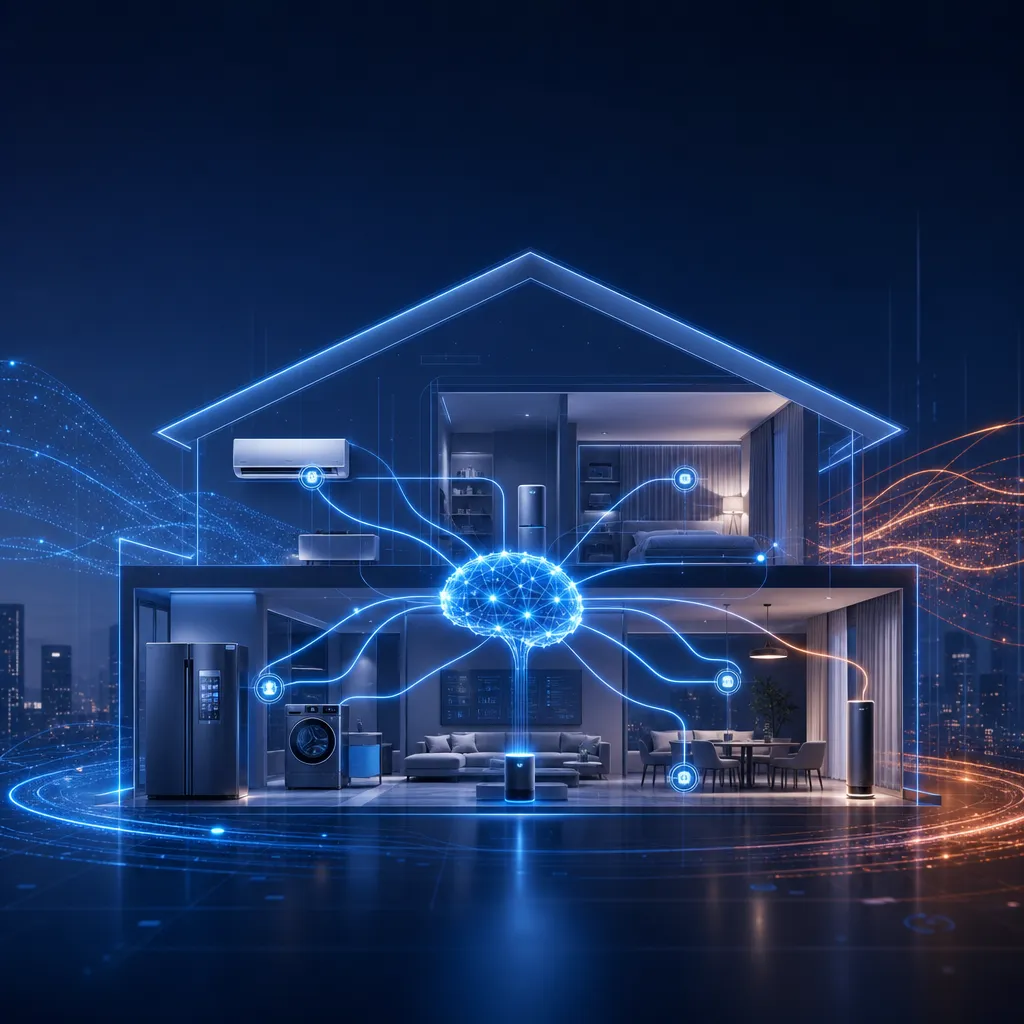
On June 10, Midea and Alibaba signed a strategic cooperation agreement to jointly develop a household scenario AI brain based on the Qianwen large model. The cooperation covers the full stack from cloud infrastructure and computing power supply to embodied intelligence, promoting the upgrade of whole-house intelligence from "people-driven devices" to "intention-driven spaces."
Midea Teams Up with Alibaba: Whole-House Intelligence Aiming for an ‘Intent-Driven’ AI Brain
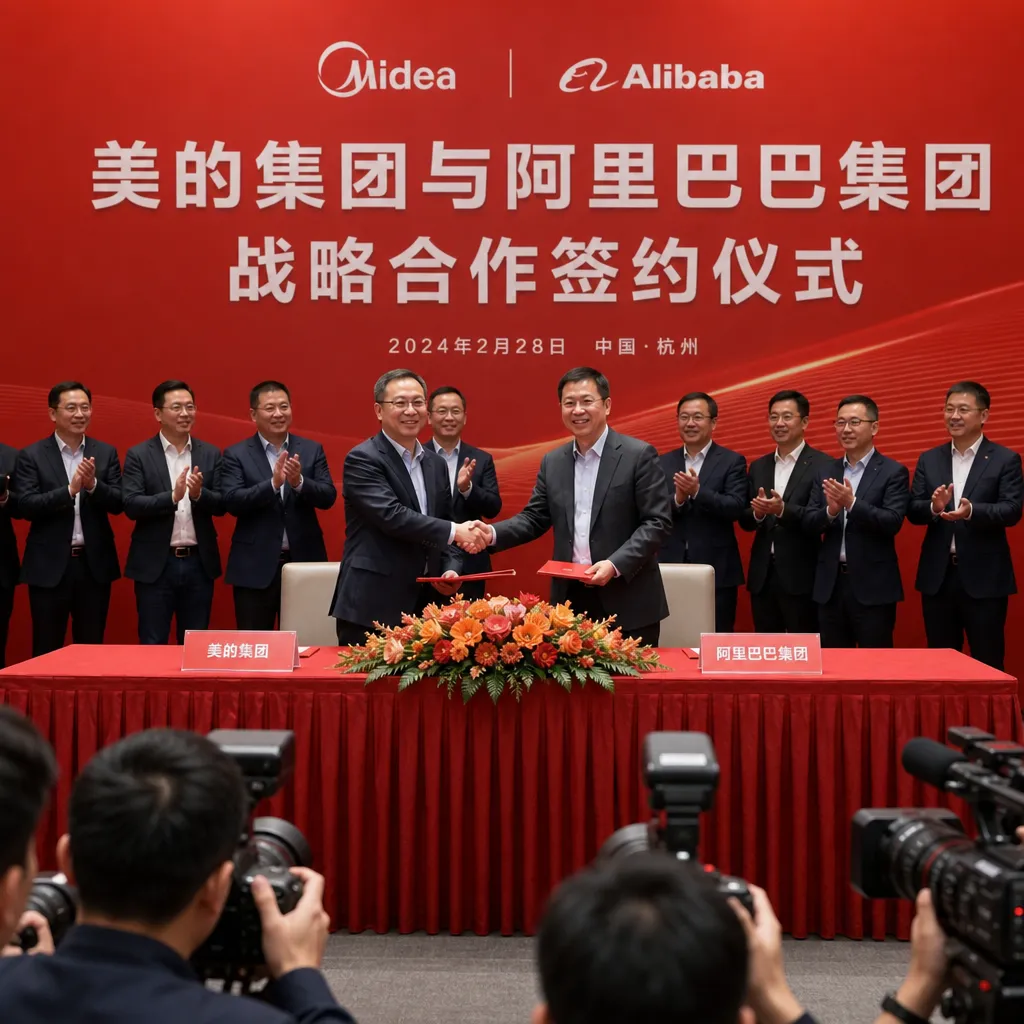
On June 10, Midea Group and Alibaba officially signed a strategic cooperation agreement in Hangzhou. This isn’t just a routine “partnership between industry giants” press release — both sides are targeting the combination of “Whole-house intelligence + AI large model + commercial ecosystem”, with the key goal being jointly developing an AI brain for household scenarios.
The signing ceremony had a high-profile lineup. Midea was represented by Chairman Fang Hongbo, Vice President and President of the Building Technology Division Guan Jinwei, and Vice President Gu Yanmin. Alibaba CEO Wu Yongming attended in person, accompanied by Alibaba Cloud Senior Vice President Liu Weiguang and Qwen Division President Wu Jia. The actual signatories were Midea Vice President and CDO Zhang Xiaoyi, and Chen Wei, General Manager of Alibaba Cloud's International Business Division. Just from the attendee list, it’s clear this collaboration spans three business lines — cloud, models, and international expansion — rather than being a single-department connection.
In One Sentence: What Are They Exchanging?
Midea wants AI capabilities + global cloud infrastructure.
Alibaba wants a trillion-level hardware entry point via home appliances + flagship overseas business client.
This needs to be viewed in the context of each company’s transformation pace. Midea has long declared its position as an “AI + global technology group,” with overseas business share steadily increasing; the B2B Building Technology and Robotics divisions need stronger computing power and model capabilities as their foundation. On Alibaba’s side, Wu Yongming made clear last year the dual strategic axes of “AI-driven” and “user first.” The Qwen series models hold the top share of China’s open-source ecosystem, and Alibaba Cloud urgently needs large clients to prove the commercial loop for new consumption modes such as “AI Tokens.”
Both sides lack what the other holds — the motivation for cooperation is solid.
Four Cooperation Levels — From Core Computing Power to Household Scenarios
Based on the official announcement, the cooperation is segmented into four parts, which makes more sense when stacked from the bottom up:
1. Cloud Infrastructure Layer: Domestic + Overseas Dual Base
What Midea’s globalization strategy currently lacks most is stable, reliable overseas cloud infrastructure. As early as 2025, Midea had already built a business digital base in Singapore’s overseas region using Alibaba Cloud public computing power. This cooperation pushes it to the next stage — both sides will jointly expand cloud resources in key regions of Europe and Asia-Pacific.
There’s an implicit conclusion here: Midea’s overseas expansion has moved past the stage of “anything will do” — it is now pursuing data compliance, low latency, and local service. Europe’s GDPR, Southeast Asia’s localized data storage — these require existing cloud regions from vendors; building their own data centers would be too slow.
2. Computing Power Layer: Tokens Cooperation + Training Compute Guarantee
The most noteworthy here is the phrasing “AI Tokens cooperation.” Computing power supply pricing is shifting from hourly GPU billing to settlement based on model token consumption — a new model Alibaba Cloud has promoted to large clients over the past year.
Midea’s training workload isn’t light either:
- Whole-house intelligent AI brain: multimodal perception models for home scenarios
- Embodied intelligence: household service robots, cleaning robots
- Industry-specific models: covering appliances, HVAC, building systems
Stacking these training needs results in a sizable computing bill. Alibaba Cloud’s promise is “continuous and stable computing power guarantee,” backed by its self-developed Pingtouge Zhenwu AI chip system — which Midea has already been using since last year.
3. Model Layer: Qwen-Driven Household AI Brain
This is the most imaginative part of the deal. The original statement:
“Relying on Qwen large model capabilities, Alibaba and Midea will jointly develop an AI brain for household scenarios, continuously enhancing full-modality perception, and driving whole-house intelligence from ‘human-driven devices’ to ‘intent-driven spaces’.”
This “human-driven devices” vs “intent-driven spaces” contrast perfectly sums up the awkwardness of smart home development over the past decade.
Traditional smart home logic? You pull out your phone, open an app, find the air conditioner icon, tap it, adjust the temperature. Or you say, “Hey X, set the living room AC to 26°C.” Fundamentally, a person is still operating a device, just replacing the remote with voice commands or an app.
“Intent-driven” is a different logic: you say “I’m feeling sleepy,” and the system infers — close curtains, dim lights, set AC to sleep mode, turn off the living room TV, mute the cleaning robot. This requires not just single-command recognition, but overall understanding of context, user preferences, and device coordination.
Large models can solve this — traditional rule engines cannot. The “smart scenes” appliances have offered in the past are essentially preset rule combinations. With large models, true contextual understanding and dynamic reasoning become possible.
Midea claims to have “built the first AI agent implemented in the appliance industry,” which is somewhat marketing-flavored, but underlying multi-modal perception capabilities (visual, voice, sensor data fusion) are indeed a strong point of the Qwen series.
4. Commercial Ecosystem Layer: Appliance + Integrated Services
This is Alibaba’s proudest card. Instant retail (Ele.me, Taobao Flash Sale), local life services (Gaode, Fliggy), smart mobility — all of these are Alibaba’s resource pools.
Example scenario: The fridge detects milk is nearly finished, and the AI brain directly calls Ele.me’s API to order milk delivered within 30 minutes; the range hood detects you didn’t cook tonight and proactively pushes nearby restaurant discounts. This “hardware perception → service invocation” loop was previously beyond Midea’s capability due to lack of service ecosystem — and beyond Alibaba’s capability due to lack of in-home hardware entry.
My Judgment: This Is Strongly Complementary — But Has Some Shoals
First, why this looks promising:
First, the timing fits. Starting in late 2025, competition in domestic large model applications shifted from “whose model is stronger” to “who can find real high-frequency scenarios.” The home setting is rare — high frequency, strong demand, low tolerance for errors — whoever succeeds first will define the household AI entry point for the next five years.
Second, the complementarity is indeed strong. Midea has hardware, channels, overseas routes; Alibaba has models, cloud, service ecosystem. Overlap is low, turf wars minimal.
Third, once “AI Tokens” billing runs smoothly, it will be an industry-wide example — turning large models from “looks expensive” to “pay as you use” is key for B-side scaling.
Now, what to watch out for:
First, openness in the appliance industry. A home won’t only have Midea appliances — Haier, Gree, Xiaomi, Huawei each take a share. Will the Midea + Alibaba AI brain only serve Midea devices or open protocols? If closed, user experience ceiling is fixed; if open, there will be protocol battles with competitors.
Second, privacy and data boundaries. “Intent-driven space” requires the AI brain to constantly sense user behavior, dialogue, preferences. Where is this data stored? Who can access it? Will it be used for model training? None of this has been clarified yet. Home scenarios are more sensitive than phone scenarios — regulation will eventually intervene.
Third, the Qwen large model is a core player in the open-source ecosystem; Qwen3 series holds top download counts on Hugging Face. Will Midea, at some point, choose to fine-tune its own model for edge deployment rather than continuously paying token fees to Alibaba Cloud? This is the eternal game between large clients and cloud providers.
Compared to the Past Twelve Years — What's Different This Time
Midea and Alibaba have been working together since 2014. That year, Alibaba took a stake in Midea’s e-commerce business, focusing on new retail and digital operations. Over twelve years, cooperation progressed from channel digitization → ERP cloud migration → overseas digital base — step by step from “selling goods” to “infrastructure.”
This time, the big difference is that the AI brain is not a tool — it is the product itself. Previously, Alibaba provided back-end capabilities to Midea, invisible to end users. Now, the household AI brain will be directly in users’ homes, shaping their core experience of the “Midea” brand. This upgrades their relationship from “supplier” to “product co-builder,” with much deeper ties.
An Industry-Level Observation
By the first half of 2026, “large model + major hardware manufacturer” combinations are becoming standard: Huawei with Pangu, Xiaomi with MiLM, OPPO with self-developed models, vivo with Blue Heart… every phone maker is working on cloud–edge synergy. But in appliances, there hasn’t been a truly strong player entering before — mainly because appliance replacement cycles are long (3–5 years for a fridge, unlike phones replaced yearly), making AI capability integration feel less urgent.
The Midea + Alibaba move essentially sets an example for the entire white goods industry: if your product doesn’t have an AI brain, in the next five years it may be defined as a “feature phone.” How Haier, Gree, and TCL respond next is worth watching.
As a side note for developers: the latest version of Alibaba’s Qwen series and other mainstream closed-source models can now be called directly via OpenAI Hub with a single key — avoiding multi-platform accounts and compatibility adaptations — which is especially useful for smart hardware prototype teams.
In Closing
Signing is just the start. The true test of depth will be whether, in the next year, they can release a product that ordinary users try and say, “Whoa, this is really different.” Smart homes have been hyped for over a decade — from X10 to Zigbee to Matter — each time promising disruption but still ending up at app-controlled lightbulbs.
Whether the large model wave can truly shift this scenario — Midea and Alibaba’s cooperation will be a key sample to watch.
References
No domestic, whitelist-approved reference sources available.


