
HiDream-O1-Image-1.5 ranks third globally, Chinese model surpasses Google and NVIDIA for the first time
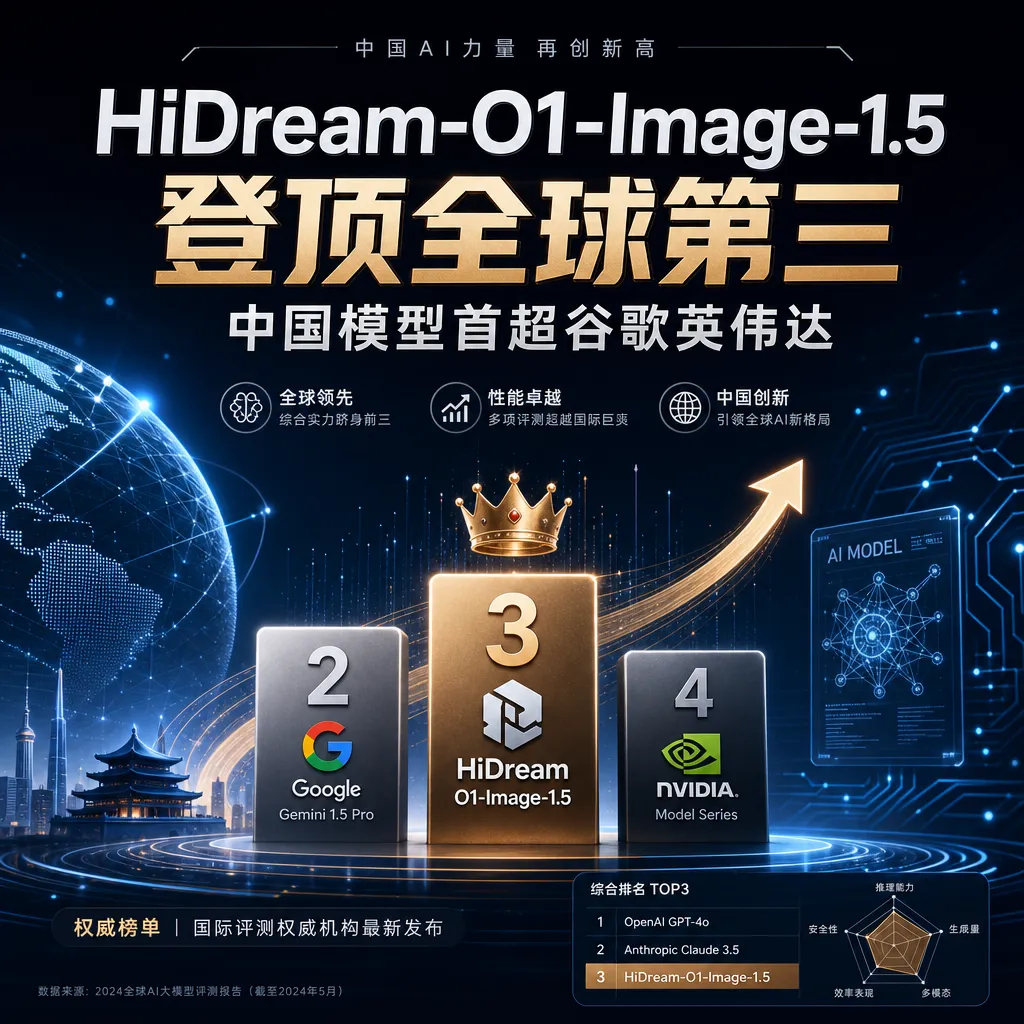
HiDream-O1-Image-1.5, released by Zhixiang Future, ranked third globally and first in China on the Artificial Analysis text-to-image leaderboard, surpassing Google Nano Banana 2 and NVIDIA Cosmos3, second only to OpenAI's image model. This marks a technological breakthrough for Chinese enterprises in the field of visual generation.
HiDream-O1-Image-1.5 Ranks Third Globally, First in China — Chinese Model Surpasses Google and NVIDIA
Zhixiang Future’s text-to-image model HiDream-O1-Image-1.5 has just secured third place globally and first place in China on Artificial Analysis’s text-to-image leaderboard, surpassing Google’s Nano Banana 2 (Gemini 3.1 Flash Image Preview) and NVIDIA’s Cosmos3-Super-Text2Image. This marks a landmark breakthrough for Chinese enterprises in large-scale visual generation models.
Directly Benchmarking OpenAI, Quality Close to GPT Image 1.5
Artificial Analysis’s leaderboard has long been viewed as the gold standard for text-to-image models. HiDream-O1-Image-1.5 ranks just behind OpenAI’s image model, with generation quality on par with GPT Image 1.5 (high), Google Nano Banana 2, and NVIDIA Cosmos3-Super-Text2Image. The key point is that it is the only closed-source commercial model from China in this top tier.
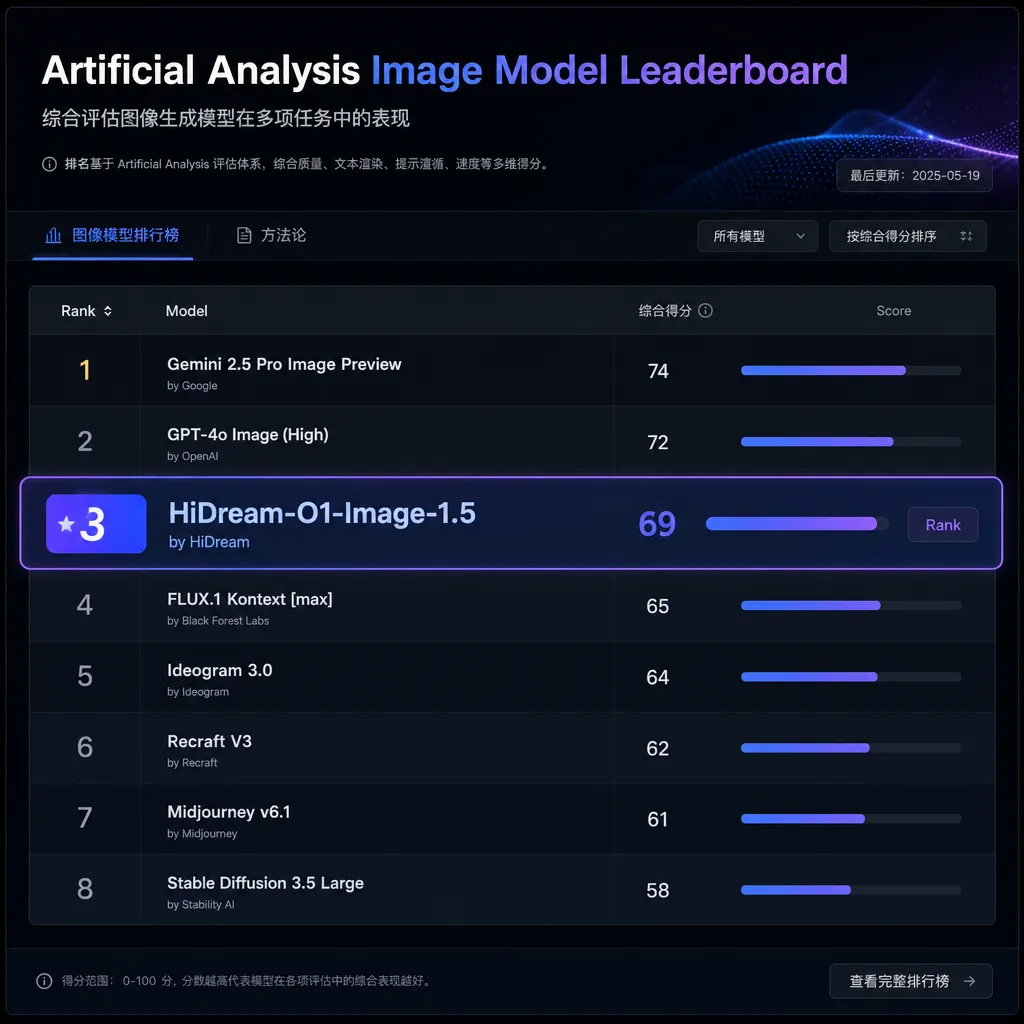
This ranking is not self-reported, but based on Artificial Analysis’s Image Arena human blind tests. Users compare image quality without knowing which model produced it, and HiDream-O1-Image-1.5 consistently beats products from major international companies, indicating that it has reached top-tier levels in aesthetics, detail, and prompt comprehension.
Technical Approach: Differentiated Strategy with Unified Transformer Architecture
HiDream-O1-Image-1.5’s architecture design is particularly noteworthy. Most mainstream text-to-image models use a "text encoder + VAE + diffusion model" separated architecture, such as Stable Diffusion and the FLUX series. HiDream instead chose a Unified Transformer (UiT) architecture, unifying raw pixels, text, and task conditions into the same token space, and using a single Transformer to process all modalities.
This concept is similar to multimodal large language models — treating images and text as the same "language." The advantage is that the model can directly understand the correspondence between text and image in text-to-image tasks, reducing cross-modal information loss. The downside is higher training difficulty and greater computational cost, which is why most companies still follow the separated architecture route.
Zhixiang Future had already open-sourced HiDream-O1-Image (8B parameter version) in May, anonymously listed as "Peanut" on Artificial Analysis’s leaderboard, scoring 1187 ELO and ranking as the world’s #1 open-source model, ahead of Qwen Image (27B) and FLUX.2. The recently released 1.5 version is a closed-source commercial variant — parameter count undisclosed — but performance suggests significant optimization.
2K Resolution Output, Priced at $80 per 1,000 Images
HiDream-O1-Image-1.5 supports up to 2K resolution image generation, a mainstream configuration among commercial models. Pricing is $80 per 1,000 images — higher than OpenAI’s DALL-E 3 (~$20 per 1,000 standard quality images) — but given its leaderboard position and output quality, the price is reasonable.
Currently, the model can be accessed via Zhixiang Future’s HiHarness platform and the third-party Vivago platform. HiHarness is Zhixiang Future’s inference platform, similar to OpenAI’s API service; Vivago integrates models from multiple providers.
It’s worth noting that HiDream-O1-Image-1.5 is closed-source, unlike the open-sourced 8B version from May, which developers could self-host. Those needing on-prem deployment or wishing to study model details may need to wait for possible future open-source updates.
Changing Position of Chinese Models in the Text-to-Image Track
Around this time last year, the leaderboard’s top 10 was essentially dominated by overseas companies — OpenAI, Midjourney, Google, Stability AI. Domestic players like ByteDance’s Doubao, Alibaba’s Tongyi Wanxiang, and Baidu’s Wenxin Yige were chasing but had limited international presence.
The emergence of the HiDream-O1-Image series has changed this dynamic. The open-sourced 8B version took first place among open-source models; the closed-source 1.5 version entered the global top three. This is the first time a Chinese company has directly competed against OpenAI, Google, and NVIDIA at the highest level in the text-to-image field.
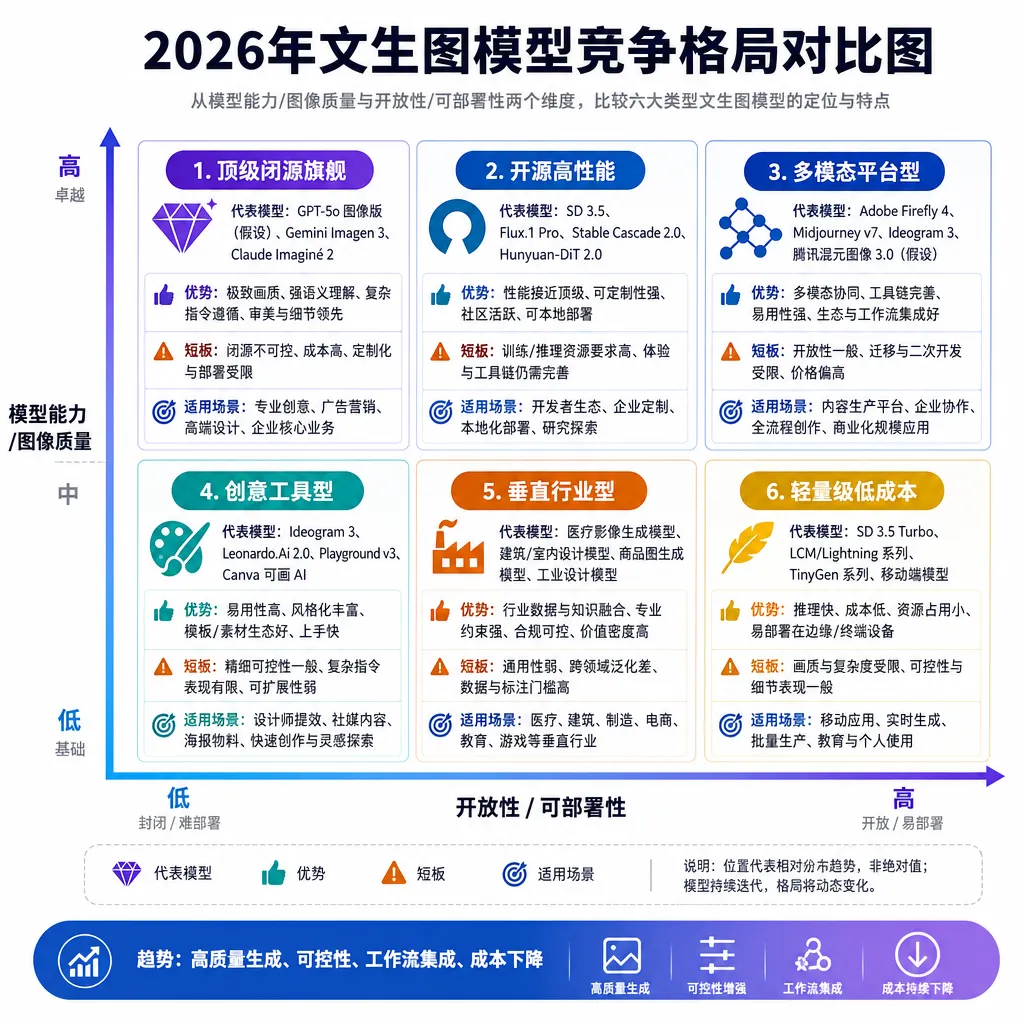
However, rankings are just one dimension. Commercialization involves API stability, inference speed, cost control, and ecosystem integration. While DALL-E 3 may not always win blind tests against HiDream, its API has been integrated into countless applications with a far more mature developer ecosystem. Zhixiang Future must continue pushing engineering and business deployment to truly establish itself.
Open-Source vs Closed-Source: HiDream’s Dual Strategy
Zhixiang Future maintains both open-source and closed-source product lines — a strategy worth noting.
The open-source 8B version builds reputation, engages developer interest, and ranks high, similar to open-source marketing tactics. Meta demonstrated with Llama that this path works: open-source models can quickly gain users and communities, build technical influence, and then monetize via cloud services, enterprise editions, and licensing.
The closed-source 1.5 version is a commercial product directly competing with OpenAI and Midjourney, serving B2B and B2C customers willing to pay for high-quality content. These customers care about generation quality and API stability, not whether the model is open-source.
The risk is resource dispersion. The open-source version needs ongoing iteration to remain competitive, while the closed-source version requires heavy engineering investment for optimization and maintenance. As a startup, whether Zhixiang Future can support both lines depends on future funding and team expansion.
Technical Details: UiT Architecture’s Advantages and Challenges
The Unified Transformer architecture sounds promising but is challenging to implement.
The first challenge is organizing training data. In traditional architectures, the text encoder can use pre-trained CLIP, the VAE can use Stable Diffusion’s, so the main focus is training the diffusion model. UiT requires training a Transformer from scratch to process both text and pixels — demanding larger-scale paired data with higher quality.
Second is inference efficiency. Transformer’s computational complexity for processing images is O(n²), where n is the number of tokens. A 2K image split into patches can easily generate thousands of tokens — impacting inference speed and costs. Zhixiang Future likely implemented optimizations like Flash Attention, KV cache compression, and quantization acceleration, but these specifics remain undisclosed.
Finally, controllability. The separated architecture’s advantage is modularity — swap LoRA for style control, add ControlNet for composition adjustments. UiT blends everything into a single model; though theoretically capable of learning complex cross-modal relationships, fine-grained control in real-world use remains unexplained by Zhixiang Future.
Competitive Comparison: HiDream vs Qwen Image vs FLUX.2
In China, HiDream-O1-Image competes mainly with Alibaba’s Qwen Image and Black Forest Labs’ (formerly part of Stability AI) FLUX.2.
Qwen Image (27B) is an open-source model with far more parameters than HiDream(8B), yet scores lower on Artificial Analysis’s ELO leaderboard. This suggests that parameter count isn’t the only determinant of quality — data and training strategies matter. Qwen Image’s advantage is Alibaba’s ecosystem integration, enabling seamless connections to Tongyi Qianwen, DingTalk, and Taobao — difficult for startups to replicate.
FLUX.2 is currently one of the most popular open-source text-to-image models, available in pro and dev versions. FLUX uses an improved diffusion architecture, not UiT. In practice, FLUX.2 dev excels in prompt comprehension and style diversity, with abundant community fine-tunes and plugins. While HiDream’s open-source version scores higher, its ecosystem is still in early stages.
In closed-source models, HiDream-O1-Image-1.5 directly competes with OpenAI’s DALL-E 3 / GPT Image and Midjourney. Price-wise, HiDream is the most expensive, but its quality is indeed in the top tier. The key difference is API usability and stability — OpenAI’s API docs, SDK, and error handling have been refined for years; Midjourney’s Discord bot has strong user habits. HiDream must focus on developer experience to capture this market segment.
Commercialization Path: Beyond API Services
Zhixiang Future is unlikely to rely solely on API sales. The text-to-image market’s business models are more complex than text models:
- API Services — targeting developers and enterprises. Direct monetization, but highly competitive with price wars.
- Application-level Products — like Midjourney’s Discord bot or Stable Diffusion WebUI, providing ready-to-use tools. Successful apps could yield far higher revenue than pure API.
- Industry Solutions — tailored for sectors such as e-commerce, advertising, gaming, film, with high-res, bulk generation, and style controllability. High ticket but requires deep industry knowledge.
- Model Licensing & On-prem Deployment — for enterprises needing high data security (government, finance, defense). The open-source 8B may be insufficient; licensing closed-source for on-prem could be a lucrative stream.
Zhixiang Future appears active in multiple areas: HiHarness for API services, open-source for community engagement, and partnerships with third-party platforms like Vivago to expand reach. Which path succeeds will depend on data in the coming half year.
Beyond the Leaderboard: Real Challenges for Text-to-Image Models
Artificial Analysis measures single image generation quality, but real-world applications face other issues:
Consistency Issue — generating sequences (comic panels, multi-angle product shots) while ensuring consistent characters, objects, and styles. This remains a challenge even for Midjourney and DALL-E 3. It’s unclear if HiDream has targeted solutions.
Controllability Issue — precisely controlling composition, lighting, details via text prompts alone is difficult. The Stable Diffusion community uses plugins like ControlNet and IP-Adapter; commercial models like Adobe Firefly offer structured input interfaces. How HiDream addresses this demand deserves attention.
Copyright & Safety Issues — copyright disputes over training data continue; Getty Images’ lawsuit against Stability AI is ongoing. Risks of generating inappropriate content (violence, pornography, deepfakes) are regulatory focuses. As a Chinese company, Zhixiang Future likely faces greater content moderation and compliance pressure.
Inference Cost Issue — generating 2K images is expensive. HiDream’s $80/1,000 pricing raises questions over profit margins and the ability to sustainably reduce costs — key to long-term viability.
A New Signal for Chinese AI
HiDream-O1-Image-1.5’s ranking reflects collective breakthroughs of Chinese AI companies in visual generation. Over the past year, ByteDance’s Doubao, Alibaba’s Qwen Image, Baidu’s Wenxin Yige, and MiniMax’s video generation model have all advanced rapidly.
Common trends include:
- Differentiated Technical Routes — no longer simply following OpenAI/Google architectures; exploring alternatives aligned with their own data/resources. HiDream’s UiT is an example.
- Dual-track Open-Source + Closed-Source — using open-source to gain visibility and build ecosystems, while monetizing closed-source. Meta’s Llama showed this works; Chinese companies learned quickly.
- Strengthened Global Outlook — targeting international markets and benchmarking top global products. Zhixiang Future’s leaderboard push on Artificial Analysis is meant to prove itself globally.
But rankings are a starting point. Giants like OpenAI, Google, and Meta have more than model performance — they have engineering capacity, ecosystem integration, and brand influence. Chinese companies have a long road ahead to match these strengths.
Still, HiDream-O1-Image-1.5 proves one thing: in the text-to-image race, Chinese companies are now capable of competing head-to-head with global giants — without lagging behind. This is a positive beginning.
References
- HiDream-O1-Image Native All-Modality Large Model Tops AA Open-Source Leaderboard — Zhihu — Detailed analysis of HiDream-O1-Image’s open-source version technical features and leaderboard performance


