
DiffusionGemma is here: Diffusion models break into text generation, speed increased 4x

Google DeepMind released the experimental open-source model DiffusionGemma today, bringing the parallel generation approach from image diffusion to text, outputting whole chunks of tokens at once instead of generating them word by word. Compared to autoregressive models of the same size, inference is about 4 times faster, and NVIDIA has simultaneously completed optimization and adaptation for the entire RTX lineup.
Google Brings Diffusion Models into Text Generation
Early this morning (June 10), Google DeepMind posted DiffusionGemma—an experimental open-source text model based on the diffusion approach—on its official blog. The only key number provided by the official release: at the same model size, text generation is 4× faster than traditional autoregressive models.
This isn’t Google’s first bet on diffusion language models. Looking back at the closed-source Gemini Diffusion demo first unveiled at Google I/O 2025, it achieved a ridiculous speed of 1479 tokens/s—but that remained locked inside AI Studio and never released. Exactly one year later, DeepMind has finally decided to open-source and “Gemma-ize” this technical route, handing it over to the community to experiment with—this comes after the Gemma family surpassed 400 million downloads and 100,000 derivative models over the past year, making this a convenient architectural trial.
Why Diffusion Can Run Faster than Autoregressive
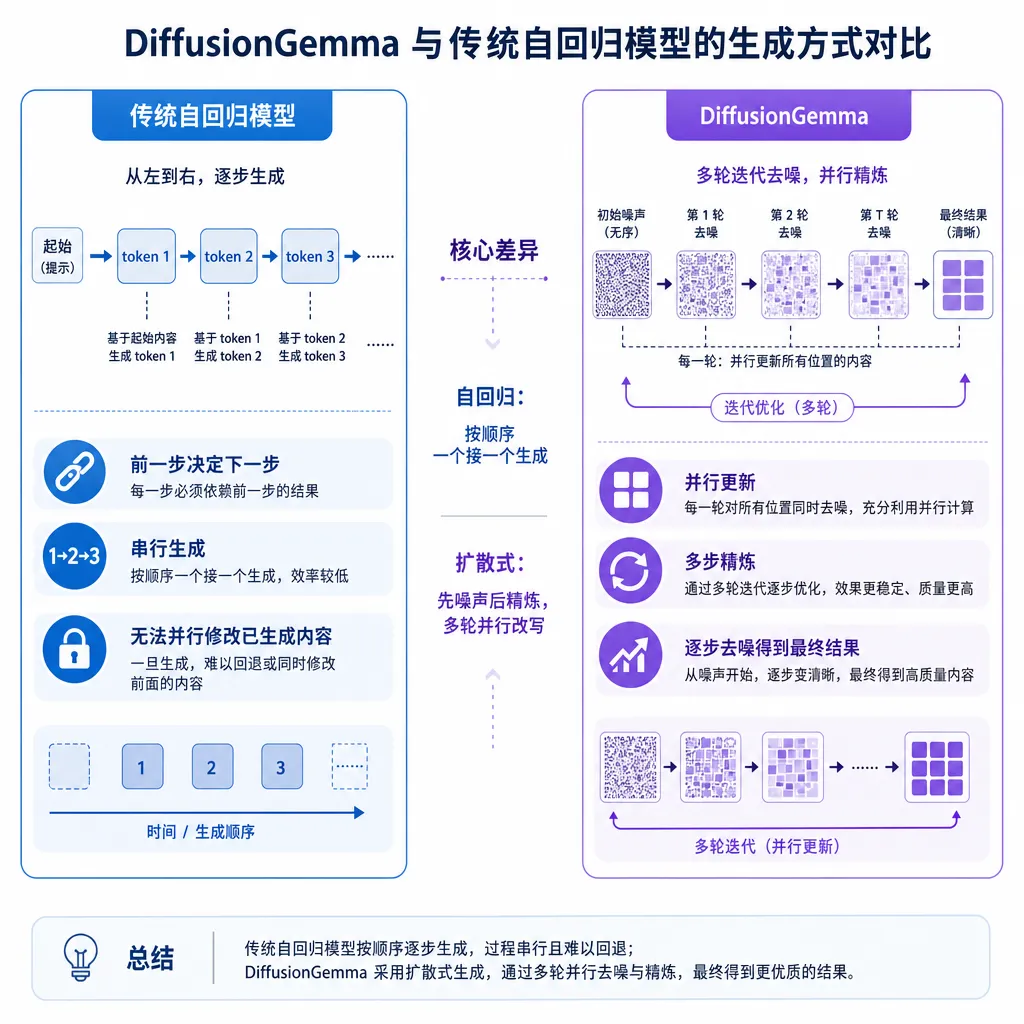
To understand the significance of DiffusionGemma, we must first revisit the autoregressive paradigm, the standard for LLMs. GPT, Claude, Llama, Qwen—every mainstream large model you can name essentially does the same thing: given the previous N tokens, predict the N+1 token. It generates text one token at a time, recalculating attention for each.
The limitations of this paradigm are obvious:
- Latency is inherently limited: generating 1,000 tokens requires 1,000 forward passes—parallelization is impossible
- Good for batch inference, poor for single-user experience: GPU utilization is pitiful when used by just one person
- Errors propagate along the sequence: if a wrong word appears early, the rest must follow suit
Diffusion models take a different route: they start with heavily noisified "garbled" text and iteratively denoise it over several steps to restore coherent text. The key is: each denoising step processes the entire sequence in parallel. In other words, DiffusionGemma doesn’t write one word at a time—it first drafts a fuzzy version, then polishes it repeatedly—each pass polishes all positions at once.
This approach has been fully explored in image generation with models like Stable Diffusion, but applying it to discrete text tokens has been difficult mainly due to two challenges: defining the diffusion process in discrete space, and meeting text’s much stricter local coherence requirements—images can tolerate blurry patches, but text collapses with a single wrong preposition. DeepMind’s version integrates several engineering optimizations from academia over the past two years (mask-based diffusion, self-conditioning, variable step sampling) into the Gemma architecture, resulting in a workable engineering convergence.
Where the 4× Speed Comes From
Google’s official blog compares it with a Gemma autoregressive model at the same parameter count. Breaking it down:
1. Parallel decoding throughput advantage
A single inference can generate an entire block of tokens at once—according to NVIDIA’s adaptation blog, DiffusionGemma “outputs whole blocks of text” instead of streaming token-by-token. This is a game-changer for single-user scenarios (developer local runs, IDE inline completion, agent tasks), as these cases are bottlenecked by latency, not throughput.
2. Steps far fewer than token count
Traditional autoregressive generation of 1,000 tokens requires 1,000 steps. DiffusionGemma greatly compresses its denoising steps; in typical configurations, it can output entire sequences in just a few dozen steps. Each step involves heavier computation, but the drastically reduced step count makes it faster end-to-end.
3. RTX-side hardware optimizations
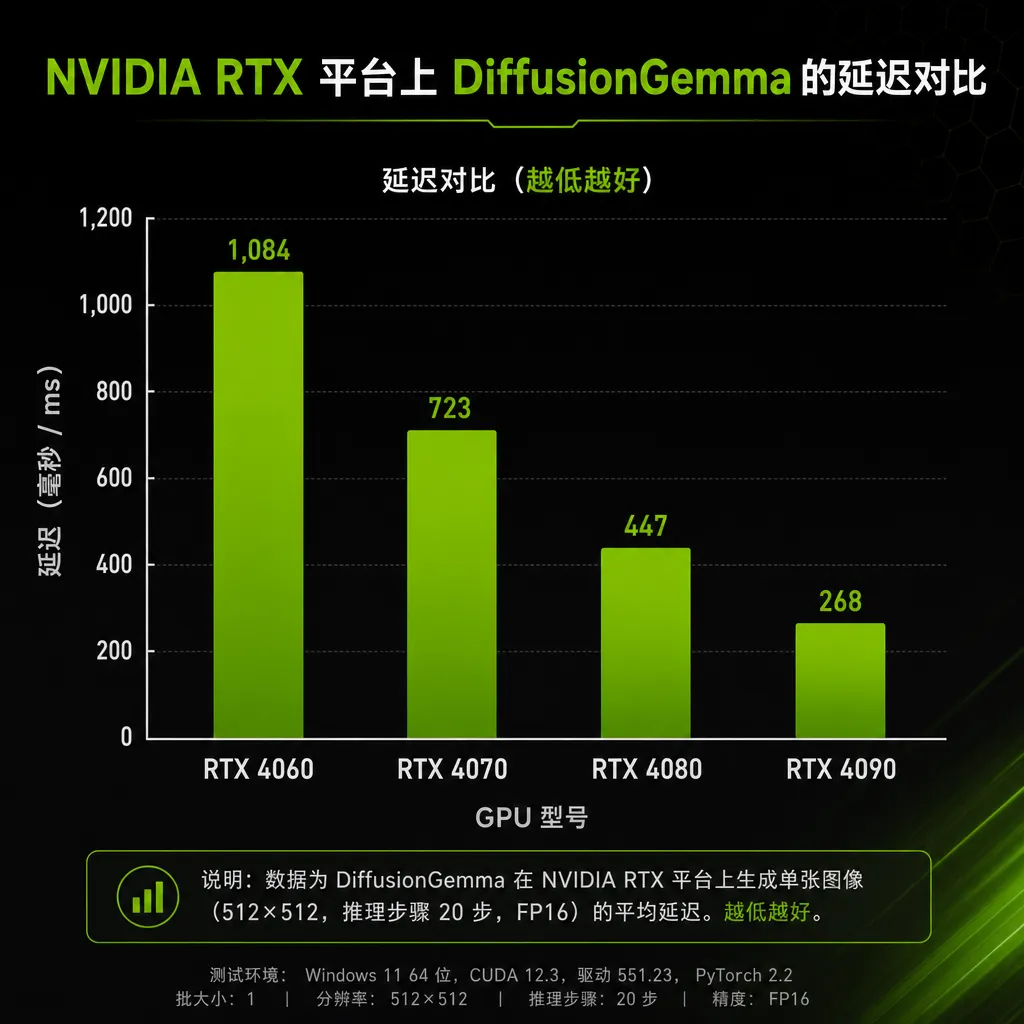
NVIDIA almost simultaneously announced kernel-level optimizations for DiffusionGemma across GeForce RTX, RTX PRO workstations, and DGX Spark product lines. RTX Tensor Cores achieve much higher utilization in parallel token inference than in token-by-token autoregression. This means developers running DiffusionGemma on their own 4090 or 5090 GPUs will feel a much smoother experience compared to same-sized Gemma models.
Can It Actually Be Used: Quality Concerns
After the speed story, the question is quality. Diffusion language models have circulated in academia for years without entering production—mainly because their output isn’t "smooth" enough.
Take last year’s Gemini Diffusion score of 89.6% on HumanEval—basically tied with Gemini 2.0 Flash-Lite’s 90.2%. This score is interesting: diffusion models perform similarly or even match autoregressive models on strongly structured tasks (code, math, JSON—anything with clear syntax constraints), but still show shortcomings in free-form long text generation (creative writing, lengthy dialogues)—mainly with long-range consistency and coherence.
DiffusionGemma, as the first non-autoregressive member of the Gemma family, is clearly positioned as “experimental.” Judging from the blog’s wording, Google doesn’t intend for it to replace mainline Gemma; it’s more like giving the community a new toy:
- Good for: code completion, structured output, constrained generation, low-latency interactive applications
- Not great for: long-form creative writing, complex multi-turn reasoning, strictly factual Q&A
This positioning is pragmatic. Diffusion models’ “block output” feature means they may better grasp the overall semantic intent of the prompt (since they think about all positions simultaneously from the start), but the trade-off is losing the autoregressive “write-as-you-go” flexibility.
What It Means for Developers
The impact can be viewed on two levels:
Short-term: another open-source model you can run locally, but with niche scenarios. DiffusionGemma is already on Hugging Face, weights open-source, and friendly for local inference. If you’re building applications needing low latency, where streaming response isn’t crucial, and output has structural constraints—e.g., code block completion in IDEs, form filling, batch data cleaning—this model is worth benchmarking. On consumer GPUs like RTX 4090, the perceived advantage will be even greater than the numbers suggest.
Long-term: autoregression isn’t the only answer. Over the past three years, everyone assumed Transformer + autoregression = LLM, but this year from Mamba-type SSMs to now diffusion language models, we can see big players quietly exploring outside paradigms. DiffusionGemma moves diffusion language models from papers to open-source production readiness—the significance lies not in what it can do today, but in raising the floor for this technology track.
As a side note, OpenAI Hub’s mainline models (GPT, Claude, Gemini, DeepSeek) are still commonly aggregated via API, but for local-first open-source models like Gemma, it’s better to download weights and run them directly—after all, the low-latency benefits of diffusion models are best enjoyed on-device.
Things That Still Need Clarity
- Context length: The official release hasn’t disclosed DiffusionGemma’s max context. Diffusion models’ compute scaling patterns for long contexts differ from autoregression—needs community testing.
- Fine-tuning ecosystem: Gemma’s killer feature is community fine-tuning; whether DiffusionGemma can replicate this (LoRA, QLoRA, various domain adaptations) depends on whether DeepMind releases the relevant training scripts.
- Quantization compatibility: Multi-step inference in diffusion models is more sensitive to quantization error; whether INT4/INT8 quantization causes degradation is key for deployment to consumer hardware.
The community discussion threads on Hugging Face will likely produce answers in the next week or two. Today’s release of DiffusionGemma feels more like an “engineering preview”; the real test is what the community can achieve with it in the next three months.
References
- Technical breakdown of Gemini Diffusion’s record-breaking speed - Zhihu: Chinese technical analysis from last year’s Gemini Diffusion debut at I/O
- Gemma 4 series model updates - Community discussion: Official model cards and derivative model ecosystem for Gemma series on Hugging Face


