
Meshy launches the world’s first 3D AI Agent — should modelers be worried?
Meshy has moved the entry point for 3D creation from the toolbar to a dialog box, enabling the generation of commercially usable 3D assets in a single sentence. The world’s first 3D AI Agent is officially online — the ChatGPT moment for the 3D industry may have truly arrived.
Generate Commercial-Ready 3D Models in One Sentence — Meshy Compresses the Modeling Process into a Dialogue Box
Late at night on June 10, Meshy officially released its 3D AI Agent — the official wording is “world’s first.”
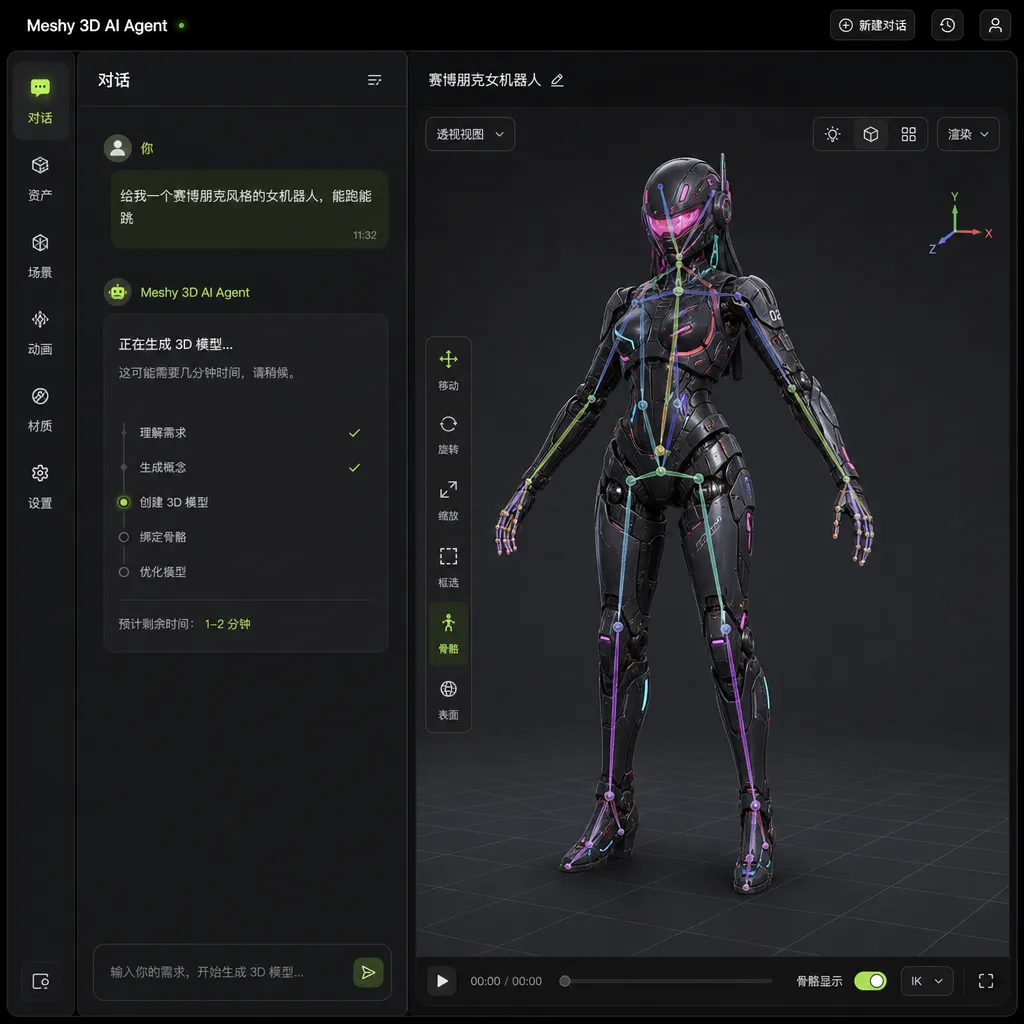
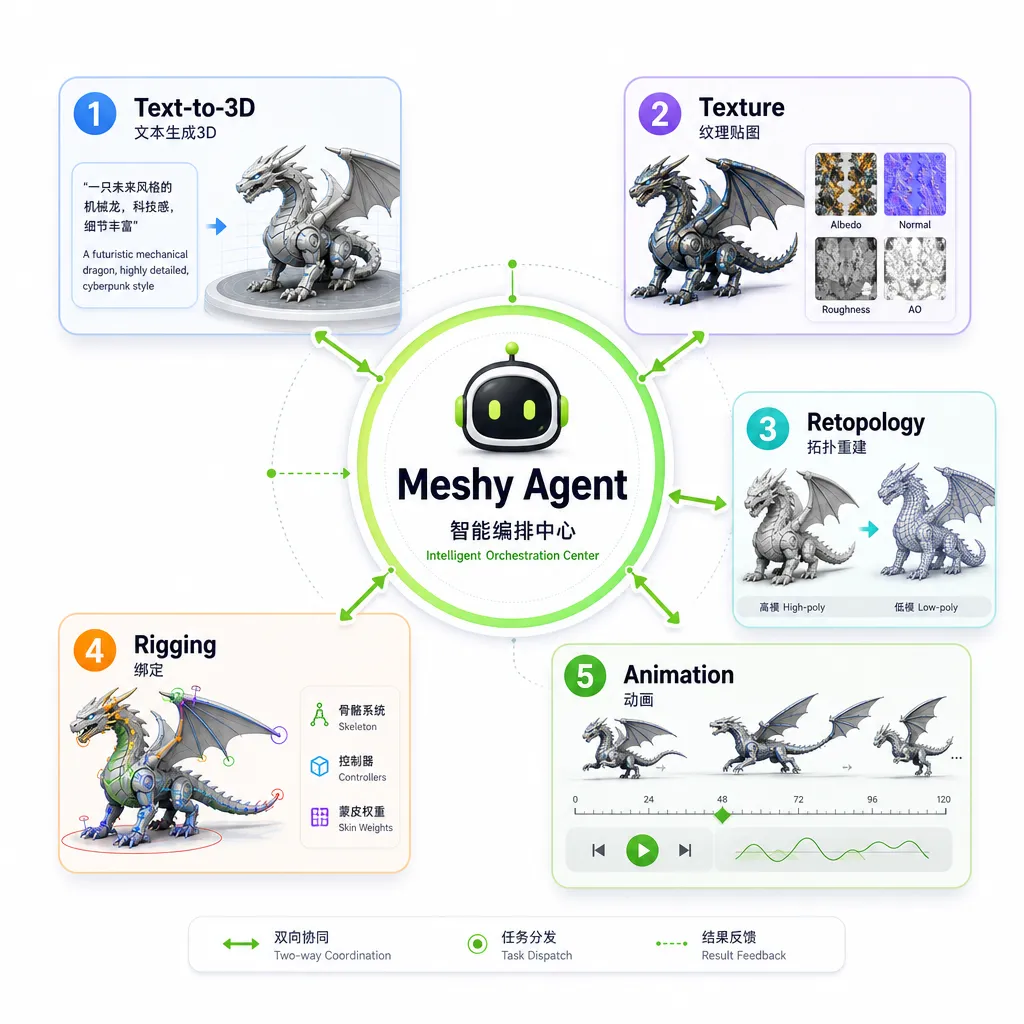
This isn’t just another model update; it’s about compressing the workflow that was previously scattered across multiple independent tools — Text-to-3D, Image-to-3D, Retopology, Rigging, Texture — into an intelligent agent that can understand natural language, plan steps on its own, and call the appropriate toolchain.
For those who have worked on 3D assets, this is as significant as when ChatGPT swallowed the entire NLP toolchain at the end of 2022.
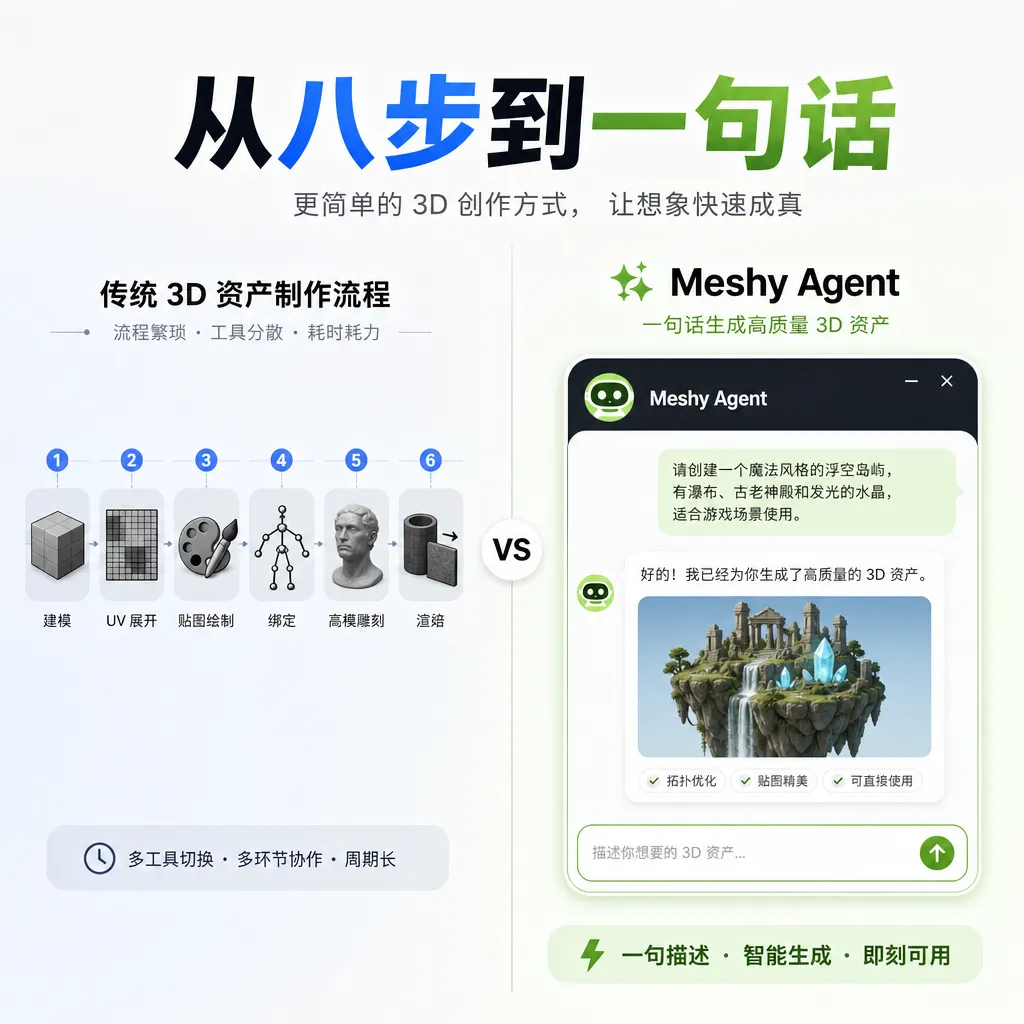
Previously, if you wanted to create a character ready for Unity/Unreal, you’d generate concept art in MidJourney, mesh in Meshy or Tripo, clean topology in Blender, return to Substance for texturing, and rig in Mixamo — seven or eight pieces of software and dozens of back-and-forth steps.
Now, Meshy says: tell the Agent what you want, and it will handle everything else.
What Did It Actually Do: From “Tool” to “Workflow Orchestrator”
To understand the significance of this move by Meshy, you first have to look at the friction in 3D generation over the past two years.
Between 2023 and 2025, the Text-to-3D field produced a number of solid models — Meshy’s own Meshy-5, Tripo 3.0, Rodin Gen-2, Tencent’s Hunyuan3D 2.5 — with geometric accuracy and texture quality closing in on handcrafted modeling.
But everyone hit the same bottleneck: what was generated was not a “usable asset” but a “decent-looking mesh.”
Messy topology, chaotic UVs, textures without layers, no rigging, not directly usable in game engines — these issues made AI-generated 3D models something to use early in the pipeline, but never at the delivery stage.
For a professional artist, an AI-generated model still requires 4–6 hours of manual post-processing.
What Meshy has done this time is wrap post-processing inside the Agent as well. According to official demos, it can automatically:
- Intent parsing: You say “Create a medieval knight that can run directly in Unity,” and it breaks this down into geometry, materials, topology count, rigging, animation compatibility, etc.
- Multi-round self-calls: Calls Text-to-3D first to generate base shape, notices topology is bad and calls Remesher, spots insufficient texture resolution and reruns Texture Refiner.
- Multimodal input: You can provide a reference image, a voice description, or even a rough sketch.
- Editability: After generation, you can continue the conversation — “Change the helmet to fully enclosed,” “Make the clothing leather,” “Export FBX with Mixamo rig.”
Put simply, it links Meshy’s own models and a bunch of open-source 3D tools together with an LLM brain.
The approach isn’t new — Cursor, Devin, Manus have proven this in code and general tasks — but it’s the first time 3D has been handled this way.
Why Meshy, Why Now
There are plenty of companies doing 3D generation. Meshy’s ability to be the first to launch an Agent comes down to two factors.
First, a complete “family” of models. Since 2023, Meshy has been stacking solutions for generation, texturing, remeshing, PBR texture separation across the entire chain. By the end of 2025, its tool stack can basically cover the whole journey from “concept art” to “riggable model.”
This is the prerequisite for an Agent to run — you need enough “tools” for the Agent to call. Tripo, Rodin and the like are more geometry- or texture-focused, with incomplete toolchains.
Second, ample user data. Meshy has disclosed that it has over a million monthly active users and has generated over 100 million 3D assets cumulatively. This means during Agent training, there were massive “user prompt → expected output” samples to learn from.
This is similar to GPT’s early advantage — having a large model isn’t enough; you need to know what users actually want.
The timing is delicate. Vision Pro 2 and Meta Quest 4 are launching this year, and demand for UGC 3D content is visibly rising; in the game engine world, Unity 6.2 and Unreal 5.6 now have AI asset pipelines in the official docs.
The tipping point for 3D assets from “niche production” to “mass consumption” could be in 2026.
Tried It Out — How Does It Score?
Right after the launch event, we tested several scenarios with Meshy’s Agent.
Scenario One: Game NPC — Prompt: “A tavern owner for an indie game, fat, bald, wearing an apron, needs to be able to run animations in Unity directly.”
Agent took about 4 minutes, producing an 8K poly low model with UVs, PBR textures (Albedo / Normal / Roughness separated), and FBX rigged to Humanoid bones. Imported into Unity and applied Mixamo animations — it runs. This would be at least half a day’s work traditionally.
Scenario Two: Industrial Design — Prompt: “An ergonomic office chair with metal frame and mesh backrest.”
This was average. Geometry was fine, but textures for metal and mesh were not cleanly separated. Exported to Keyshot for rendering still required manual layer separation. Usable, but needed fixing.
Scenario Three: Complex Multi-Round Editing — This is where the Agent shines — you can watch and tweak as it works: “Poly count too high, drop below 5K,” “Change texture style to cyberpunk,” “Add detachable armrest.”
It understands context each round, unlike previous tools that require fully rerunning the process.
Overall impression: suitable for consumer-level and lightweight commercial use, still short for heavy industrial pipelines.
Given Meshy’s iteration speed, that gap could be closed in a matter of months.
The 3D Industry Will Change — But Not Immediately
The unavoidable question: will modelers lose their jobs?
Not in the short term. AAA game and film asset standards are still far beyond AI — for a “Black Myth: Wukong”-level character, hair, cloth, facial rig complexity are out of reach for any current generation model.
But the mid-tier market will be reshaped. Mobile games, indie games, AR/VR apps, e-commerce 3D product displays, virtual streamer avatars, educational materials — these sectors have supported many outsourced artists, and now a product manager can handle them independently with Meshy Agent.
This follows the same playbook as Canva overtaking small design firms.
A deeper change is that the supply curve for 3D content will steepen sharply.
When production cost drops from “thousands of yuan per model” to “pennies per model,” places to insert 3D content will suddenly multiply — product pages, social profiles, game UGC, AR filters. Demand will be driven by supply, as we saw with ChatGPT for text and Midjourney for images.
Commercialization Path: Agents Are Worth More Than Models
One more note on Meshy’s pricing strategy.
Traditional 3D generation products charge per generation — a few cents to a few yuan each time. Meshy Agent has switched to a subscription based on task complexity — Pro at $30/month unlimited, Studio at $80/month for team collaboration and API access. This pricing is clearly inspired by ChatGPT Plus / Cursor.
The logic is: when the tool becomes an Agent, users are paying not for “one generation” but for “a period of productivity.”
This change in SaaS valuation is structural — OpenAI, Anthropic, Cursor have benefited from it, and Meshy is now joining in.
If you’re a developer wanting to try Meshy but don’t want to deal with domestic proxy/payment issues, Meshy’s API mainly connects directly to its official service.
However, multi-model aggregation platforms like OpenAI Hub already unify GPT, Claude, Gemini, DeepSeek via one key — when and if 3D Agents join such aggregators will be worth watching.
Several Follow-Ups to Watch
- Will open source catch up? — Tencent Hunyuan3D, Alibaba ModelScope are pursuing 3D generation; Agent-ization is inevitable. Meshy has first mover advantage but no deep moat.
- Will engine makers enter directly? — Unity and Unreal have acquired AI companies; if they integrate Agents into editors, third-party tools could be sidelined.
- Copyright and asset compliance — For commercial use of AI-generated 3D models, source of training data is a minefield. Meshy emphasizes “compliant training data” in its FAQ, but details are undisclosed.
- Multi-Agent collaboration — Next step could be multiple Agents cooperating — one for geometry, one for texturing, one for rigging. Currently, Meshy is single Agent with multiple tools; structurally, there’s room to upgrade.
Final Thoughts
For the past two years, 3D generation has been in a “seems about to explode but hasn’t” state. Models are improving, but user experience has always had a barrier — you had to know modeling, pipelines, and engines to implement AI output.
Meshy’s Agent essentially embeds that “professional knowledge threshold” into the model itself.
This is not a technological breakthrough, but a reconstruction of product form. Just like ChatGPT didn’t invent Transformers but defined the consumer form of LLMs, Meshy Agent may define the form of 3D generation for the next three years.
Whether modelers lose jobs is uncertain, but the next startup making 3D tools — if not Agent-first — may not even get a ticket to enter.
References
- Zhihu - Discussion on the 3D AI Generation Track — Comparisons and industry discussion of 3D generation tools like Meshy, Tripo, Hunyuan3D
- GitHub - Awesome 3D Generation — Open-source 3D generation projects and toolchains, which can serve as a reference for Meshy Agent’s tool structure
- Hugging Face - 3D Generation Models — Collection of open-source 3D generation models, including Hunyuan3D, TripoSR and comparable models


