
Alibaba Cloud Meoo CLI Open Source: One-Click Cloud Deployment for Local AI Programming
Alibaba Cloud today open-sourced the Meoo CLI command-line tool, enabling local AI programming assistants such as Claude Code, Codex, and Cursor to directly invoke cloud capabilities. This integrates the entire chain from databases and login to deployment, allowing local toy projects to instantly become online products.
Alibaba Cloud Spins Off Meoo into a CLI — Local AI Programming Assistants Can “Go to the Cloud” for the First Time
On June 11, Alibaba Cloud Meoo (“MiaoWu”) released an open-source command-line tool — Meoo CLI. Developers reading this news will probably smile knowingly: someone has finally seriously tackled the age-old question of “What happens after AI finishes writing code?”
Over the past year, local AI programming assistants have become wildly competitive. Claude Code, Codex, Cursor, Cline — any of them can produce a decent demo in five minutes. But the problem is clear — all of them stop at “runs locally.” Beyond that, whether it’s connecting to a database, adding user login, configuring object storage, or actually publishing the project to the public so others can access it, developers have to step in themselves: open the cloud console, set up RDS, configure VPC, bind domains, tweak CORS. AI gets you to 80 points locally, but the remaining 20 points require three hours of manual work.
What Meoo CLI does is, essentially, take over that last 20%.
This Is Not Just Another “AI Programming Tool” — It’s an Add-on for Existing AI Programming Tools
Let’s clarify the positioning to avoid misunderstandings.
When Alibaba’s ATH Business Group launched Meoo on April 15, the focus was “zero threshold, generate a full-stack application with one natural language sentence.” It integrated four major models — Qwen3.6-Plus, Kimi K2.5, GLM-5, MiniMax-M2.5 — with a built-in swarm agent mode, targeting non-technical roles like finance, designers, and product managers. More than 10,000 Alibaba employees use it internally, but honestly, it’s a web-based “AI website builder” for beginners.
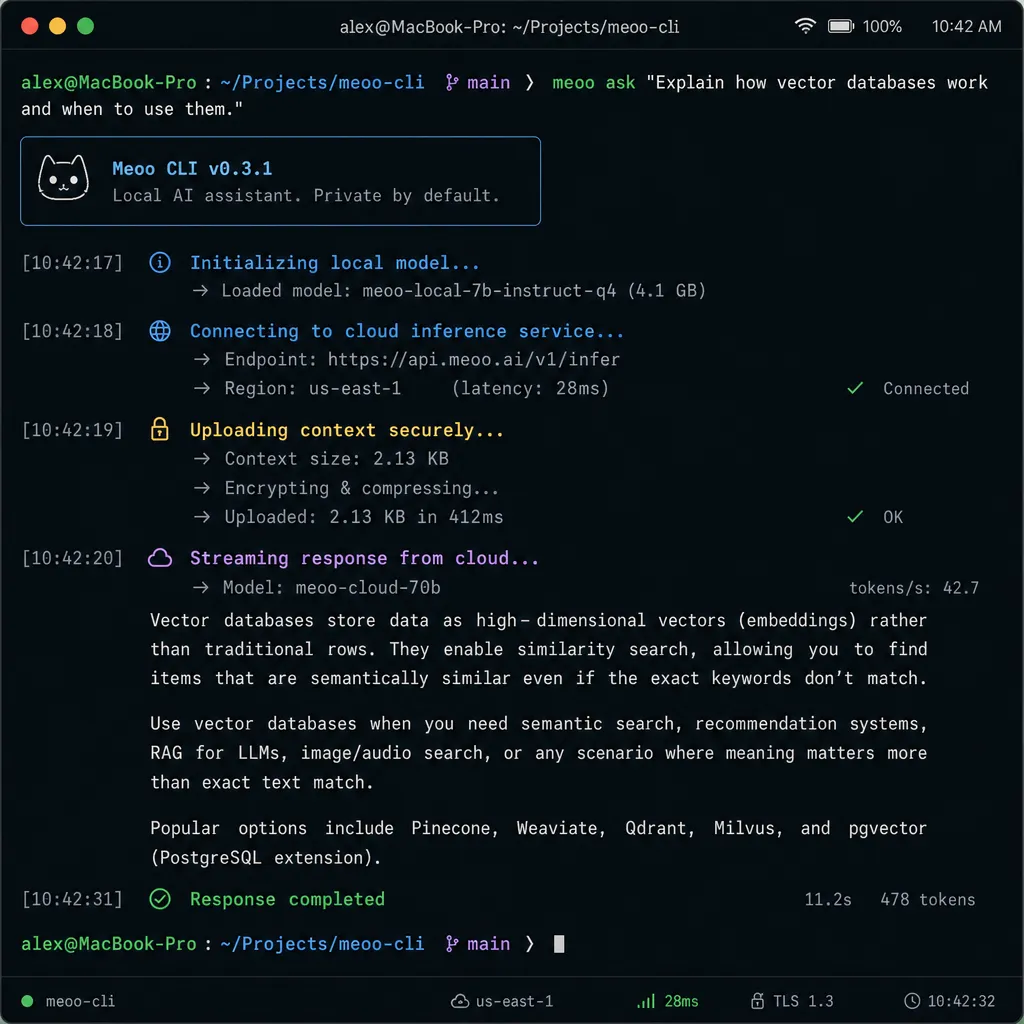
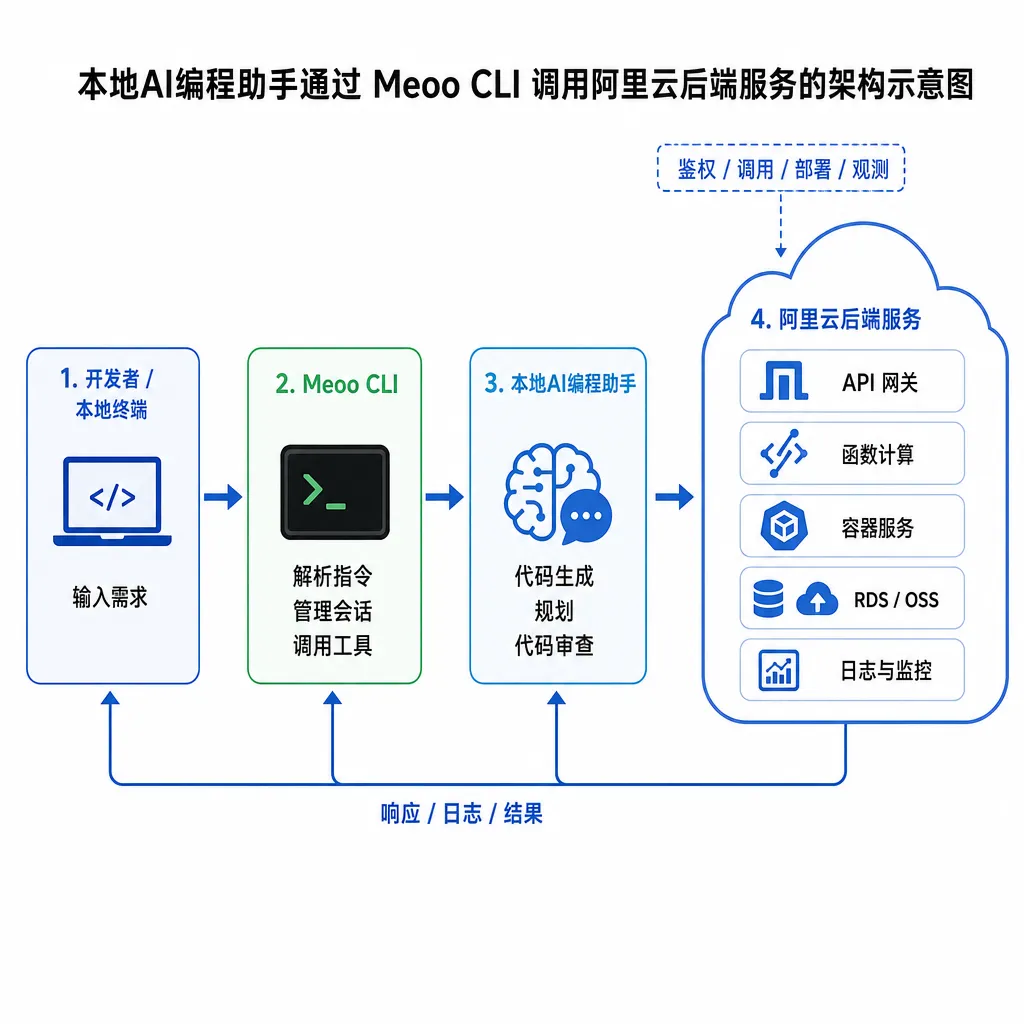
Meoo CLI is a completely different product line. It doesn’t compete with Claude Code or Cursor; instead, it positions itself as a “connector for cloud capabilities.” Developers still use their preferred local AI assistants to write code, and Meoo CLI works behind the scenes to provide four essentials:
- Database access: No manual RDS setup or security group configuration — one CLI command mounts a ready-to-use instance.
- User login: Directly call ready-made account systems, OAuth, and session management.
- File storage: Object storage bucket setup, permissions, CDN binding all packaged together.
- Project deployment: Once code is written locally,
meoo deployassigns a domain and makes it publicly accessible.
In short, compared to existing solutions: Vercel CLI only handles frontend deployment, Supabase CLI only handles BaaS, while Meoo CLI aims to be the “full-stack backend dedicated to AI programming assistants.” It assumes the caller is an AI agent, not a human.
Why Don’t AI Programming Tool Vendors Do This Themselves?
This is the most interesting aspect of the release.
Claude Code and Codex are products from model vendors, and they must maintain “model neutrality” — they’ll never tie themselves to one cloud vendor’s SDK. Cursor is an independent startup with no cloud resources — adding them would be a loss-making venture. As a result, these AI programming assistants can “write backend code,” but cannot guarantee that “the backend code will actually run.”
Alibaba Cloud’s strategy is clear: at the model layer, it has Qwen but doesn’t force you to use it; at the agent layer, it has Meoo but you don’t have to use it — as long as you deploy to Alibaba Cloud in the end, it’s fine. Meoo CLI is open-source and compatible with mainstream AI programming assistants. The stance looks humble, but the business model is straightforward: channel AI-generated code into Alibaba Cloud’s IaaS and PaaS.
Vercel took this route with v0, Cloudflare with Workers AI, and AWS with Amplify. Alibaba Cloud’s difference here: no forcing developers to change their toolchain — keep using Claude Code, and it serves as your cloud adaptation layer.
What a Typical Workflow Looks Like
Say you used Claude Code to build a to-do list app that needs persistence, login, and to be published so friends can try it. Before, you’d have to:
- Register a cloud account, create a database, change the connection string.
- Find an authentication solution — Auth0, Clerk, or write your own JWT.
- Find static hosting — Vercel or Netlify.
- Wrestle with CORS and environment variables.
- Buy a domain or use a free subdomain.
With Meoo CLI, ideally, the AI assistant calls the CLI-exposed tools during code generation:
# Install
npm install -g @meoo/cli
meoo login

# In the project directory
meoo init                  # Initialize project metadata
meoo db create todos       # Create a database table
meoo auth enable           # Enable user login
meoo storage create assets # Create a storage bucket
meoo deploy                # One-click publish
The AI assistant calls these commands via MCP or similar mechanisms, effectively “feeding” Claude Code or Codex the cloud console so the model can click all the buttons for you. Developers just need to say in natural language, “Help me deploy this project online and add login functionality,” and the rest is handled by the AI and CLI.
If this experience works smoothly, it could significantly raise the ceiling for “weekend projects” by individual developers — before, many could produce code, fewer could deploy it, and even fewer could maintain it after deployment.
Some Details Worth Mentioning and My Judgment
First, open-sourcing. The Meoo website is a commercial product, but the CLI is open-source. This approach isn’t rare among cloud vendors — Supabase, PlanetScale do the same — but for Alibaba Cloud, it’s a rare “lowering of posture.” Open source means developers can audit what it sends to the cloud, whether it’s vendor-locked, and whether it can be self-hosted to integrate with other clouds. If future community contributions turn the CLI into an abstraction layer (one set of CLI commands connecting to multiple clouds), then Alibaba Cloud is truly building an ecosystem; if it’s just putting code out as marketing, it’s the same old playbook.
Second, model layer choice. The Meoo main product integrates Qwen, Kimi, GLM, and MiniMax — strongly flavored with the domestic model alliance. But the CLI layer is model-agnostic — whether you use Claude Sonnet 4.6, GPT, or DeepSeek locally doesn’t matter. This “open at the top, closed at the bottom” design is quite clever — let the market handle the code-writing experience developers care about most, and keep the profitable cloud resources in-house.
Third, competitor comparison. Compared to Cloudflare’s Wrangler and Vercel’s CLI, Meoo CLI covers more — it takes care of database, auth, storage, and deployment all at once — but at the cost of less customization, as everything is within the Alibaba Cloud stack. Compared to Supabase CLI, Meoo lacks maturity in Realtime and Edge Functions, but gains the “AI assistant native” angle. In the short term, Meoo CLI’s appeal to domestic developers lies mainly in two points: stable domestic network and direct integration with existing Alibaba Cloud resources. Overseas developers likely won’t be interested.
Fourth, whether it’s truly easy to use depends on SDK granularity. The upper limit of CLI experience depends on API design. If meoo db create still requires filling out many config items and tweaking parameters behind the scenes, AI assistants will still struggle. Ideally, the CLI provides “AI-friendly” tool descriptions (similar to MCP schemas) so models instantly know what to pass. This will need validation once the community tries it.
Zooming Out
In the first half of 2026, competition among AI programming tools has shifted from “whose model is smarter” to “whose end-to-end experience is smoother.” Anthropic is pushing Claude Code to dominate IDE mindshare, OpenAI is integrating Codex, and domestic players like Trae and Tongyi Lingma are also vying for entry points. But all these tools repeat the same task: making local code writing smoother.
As for “what happens after local coding,” it’s long been an overlooked vacuum. Meoo CLI is the first to explicitly fill that gap — not competing with AI assistants, but specializing as a cloud adaptation layer. I think this product decision is correct.
Whether Alibaba Cloud can retain developers depends on two factors: first, if the CLI is genuinely easy to use and truly “zero configuration”; second, if the pricing model is transparent — avoiding “free during demo phase, then bill shock at scale.” The former determines whether developers want to try; the latter determines whether they want to stay.
It’s worth noting that OpenAI Hub already supports calling Qwen, Kimi, GLM, and other models underlying Meoo via the OpenAI-compatible format. Developers wanting to combine domestic models with Meoo CLI in their local AI assistants can use a single key for multiple models, avoiding platform-switching hassles.
Meoo CLI is now open-source, distributed via npm, with documentation updated alongside the project repository. If you happen to have a Claude Code or Cursor project stuck halfway at the “deployment” step, this tool is worth spending half an hour to try.
References
No domestically accessible official repository link yet — keep an eye out for future updates to the GitHub open-source repository address.


