
DeepSeek has started recruiting for Code Harness, aiming to compete with Claude Code.
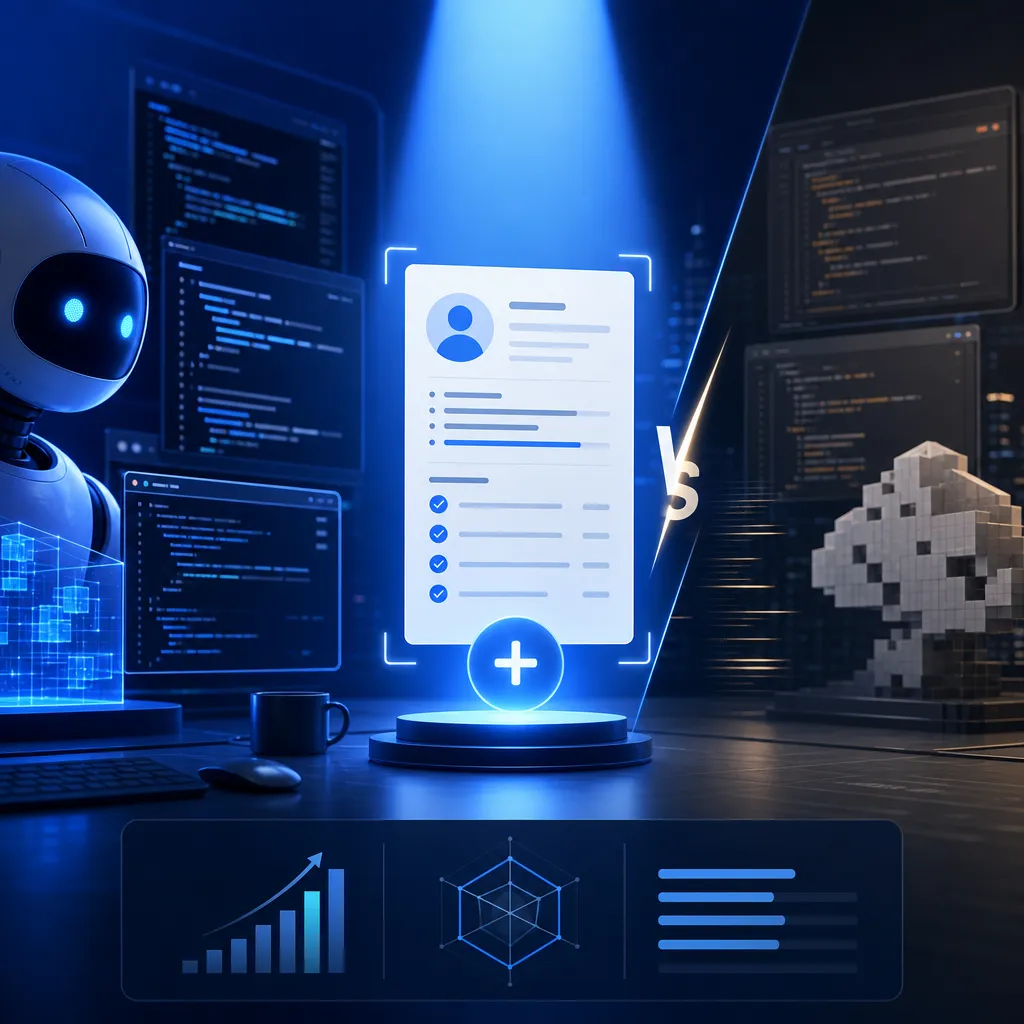
DeepSeek has posted two positions in Haidian, Beijing — Harness Product Manager and R&D Engineer — officially forming a desktop Agent team to compete with Anthropic’s Claude Code. The engineering shell outside the model is the real decisive factor in this battle.
DeepSeek is Going to Make Claude Code Too
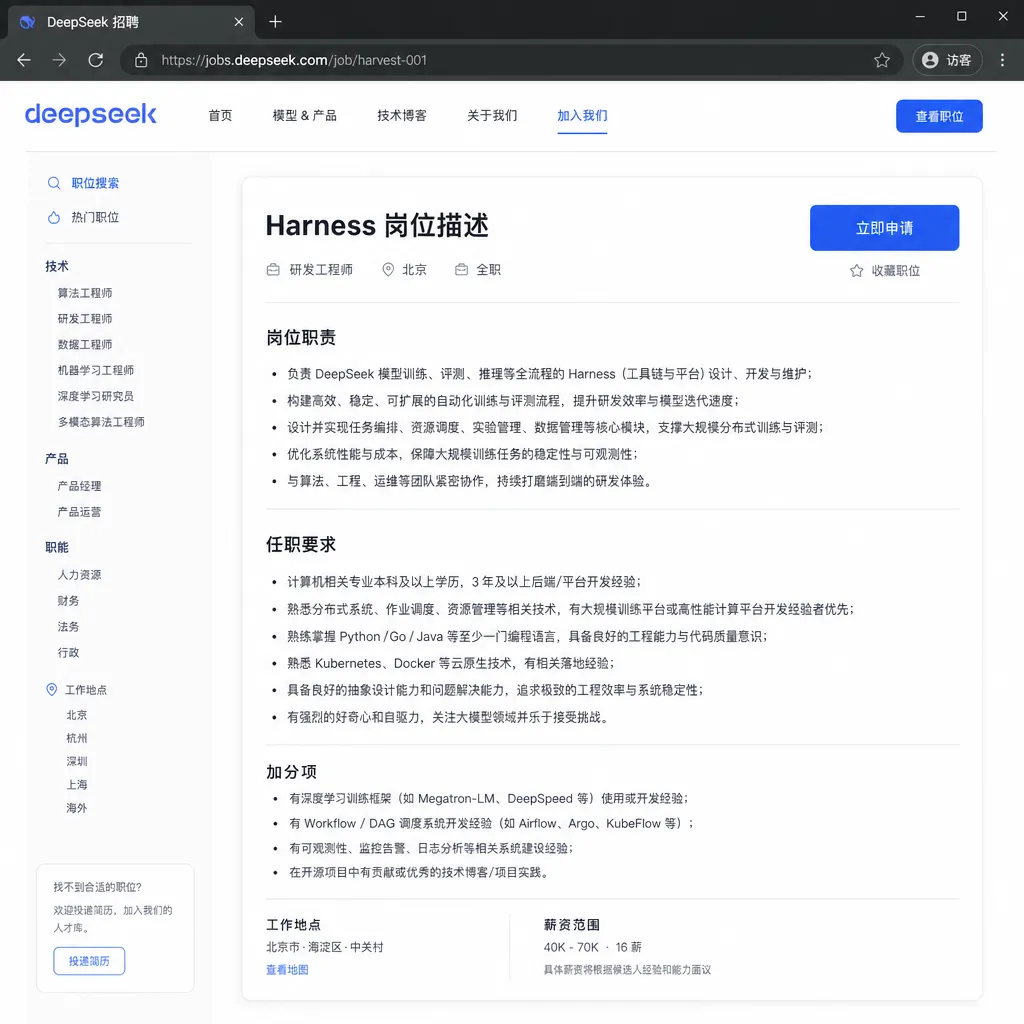
In the past two days, DeepSeek has posted two positions on recruitment channels: Agent Harness Product Manager and Agent Harness R&D Engineer, with the work location limited to Haidian, Beijing. The job description is very straightforward—join the Harness team, participate in the entire process of DeepSeek’s desktop Agent product, and “define DeepSeek’s understanding of Harness.”
If you only look at the recruitment description, it’s a bit vague, but a single sentence from DeepSeek’s senior researcher Chen Deli on social media made it crystal clear: “Come to DeepSeek to build Code Harness from scratch—in short, it’s benchmarked against Claude Code.”
This is the first time DeepSeek has so clearly aimed a product directly at Anthropic’s most profitable product type. Over the past year, DeepSeek has been viewed externally as a company that “only makes models, not products”—V3, R1, and V4 were released one after another, but the official app was long just a chat box, with everything else handed off to the community and cloud vendors. This hiring move means the strategic shift is already being implemented at the execution level.
What is Harness: The Model is Just the Base
Let’s first explain the word “Harness” so readers don’t mistake it for just another marketing term.
In engineering, the original meaning of Harness is “test wiring” or “runtime framework.” Applied to Agents, it refers to the external system layer that enables a bare model to actually do work. DeepSeek directly gave a formula in the job description:
Model + Harness = Agent
The model handles understanding, reasoning, and generation; the Harness manages context, calls tools, plans tasks, reads/writes files, executes terminal commands, recovers from errors, and collects feedback. Put simply, it’s about installing a “mind” that can write code into a “body” that can enter a real engineering environment.
This concept became hot suddenly at the end of 2025 because Anthropic proved with Claude Code that no matter how high a model’s benchmark score is, developers won’t automatically use it. What actually changes workflows is an engineering Agent like Claude Code—one that can open terminals, read projects, modify files, run tests, and submit PRs—not that pretty snippet of code sitting in a chat box. Codex, Cursor, OpenCode, and Manus are all doing the same thing; the only difference is the product shell.
Signals Hidden in the Job Description
The requirements for PM are very specific—almost custom-tailored for industry heavy users:
- Have deeply used products like Claude Code, Cowork, Codex, Cursor, OpenCode, GitHub Copilot, Manus, Hermes, and integrated them into daily work;
- Understand technical mechanisms like LLM API, KV Cache, Agent Loop, Tool Use, Reasoning, Planning, Skills, MCP, Memory, Subagent, Multi-Agent;
- Have first-hand practice in Prompt Engineering, Context Engineering, Harness Engineering;
- Possess UI/UX design literacy, able to complete prototypes and visuals with AI assistance.
These criteria filter out 90% of traditional PMs. DeepSeek wants not a product manager who “understands users,” but someone who themselves uses Claude Code heavily for coding and has opinions on the details of each Agent product.
The R&D engineer profile is similar—“high-intensity users of Agent products,” “with taste and judgment for model behavior,” “strong perception of developer experience.” In other words, DeepSeek assumes the people in this team are engineers whose main job is doing real work with AI.
Desktop, Not an IDE Plugin
Note that the job description repeatedly uses the term: desktop Agent product.
This is a very clear choice in product form. Traditional AI coding products have two main paths:
- IDE Plugin: Copilot, Cursor, Continue—focus on in-editor completion;
- Chat Box: DeepSeek’s own app, ChatGPT’s code Q&A.
Claude Code takes a third path—a resident Agent on the terminal/desktop that can globally orchestrate the file system and shell. The advantage here is that it’s not tied to an IDE, can take over the entire work directory, work across languages, projects, and toolchains, and is more like a true “junior developer.”
By choosing “desktop” rather than “IDE plugin,” DeepSeek is clearly targeting Claude Code’s form factor. This means users will likely see an independent desktop client in the near future—possibly with a TUI, possibly with a lightweight GUI—but core-integrated with the OS, shell, Git, and file system.
The Community Has Already Paved the Way
Interestingly, before DeepSeek officially stepped in, the developer community had already made a “DeepSeek version of Claude Code.”
The open-source project DeepSeek-TUI had gained some limited popularity among domestic developers—an in-terminal coding Agent that can read/write files, execute shell commands, search the web, manage Git, and coordinate sub-Agents via TUI. Its popularity was due to straightforward reasons:
- Low cost (DeepSeek’s API pricing is attractive);
- Stable domestic access;
- Long enough context;
- Low deployment barrier, no compliance headaches for enterprises.
But the ceiling of community projects is obvious: they can adapt around API calls, but can’t do reverse feedback for model training; they can optimize prompts and toolchains, but can’t get the closed loop of “real task failure → model iteration.”
Now that DeepSeek is officially taking this path in-house, the intention is clear—turn a need already validated by the community into a core product.
Why This Time DeepSeek Must Do It Itself
In the past, large model companies followed the product logic of “train the model first, then make applications,” with research and product in series. But in the Agent era, this sequence is being broken, because:
A code Agent failing in a real project might not mean “insufficient coding ability.” It could be due to:
- Incorrect long context compression strategy;
- Unstable task decomposition;
- Biased tool call decisions;
- Insufficient understanding of engineering constraints (lint, CI, test);
- Defective ongoing tracking of user intentions.
These problems only surface in the Harness layer and can only be fundamentally fixed by feeding the data back into training. In other words, Harness is not just an output for model capabilities—it’s also a training ground for them. Third parties can’t do this—it requires interface design authority, closed-loop training data, and real internal task scenarios.
That’s why Chen Deli’s job post subtitle wrote “Product and Research” rather than just “Product.” The Harness team is set up from the start as an integrated production-research unit.
Time Window
Timing is worth mentioning.
On April 24, DeepSeek released a preview of V4, emphasizing improvements in Agent tasks, knowledge processing, and reasoning, and explicitly mentioning “special optimization for mainstream Agent tools like Claude Code.” Later, DeepSeek also launched image recognition mode in beta, addressing V4-Pro’s shortcomings in recognizing architecture diagrams, design drafts, and error screenshots when connected to Claude Code.
According to The Information, V4.1 is expected to be released in June. That is to say, the iteration pace on the model side hasn’t slowed. The formation of the Harness team seems more like starting the productization front line after the model has reached a new stage.
Looking outward, global daily token consumption has exceeded 360 trillion, with IDC predicting a 300 million-fold increase in the next 5 years. AI programming and Agents are the main consumers. Alibaba CEO Wu Yongming said in the latest financial report that in the past half-year, most of Alibaba Cloud’s API growth came from AI coding. This is a market no one can pretend not to see.
Some Observations
A few personal opinions:
First, DeepSeek’s chances in making Harness are actually good. It has several advantages other domestic players don’t: self-developed models, low prices, community foundation already validating demand, and model and product teams in the same office. Claude Code’s biggest pain points in China are compliance and cost—exactly DeepSeek’s comfort zone.
Second, the challenge is not the model, but engineering aesthetics. Claude Code’s usability doesn’t come from Claude being much smarter; Anthropic has finely polished Tool Use, error recovery, context management, and human-AI collaboration pacing. DeepSeek has leaned more toward research temperament in the past; product-side refinement still needs proof. That’s why the JD repeatedly emphasizes “taste in model behavior” and “strong perception of developer experience”—they know this is a weak spot.
Third, retention is another hidden battlefield. In early May, DeepSeek was reported to have its valuation increase fivefold in 21 days to 350 billion, with up to 50 billion fundraising goals. At the same time, star researchers like Guo Daye, Wang Bingxuan, and Wei Haoran have left for better-paying places. Harness, as a dense production-research integrated team, will only face greater pressure for talent competition.
Fourth, this is a collective shift in pace for Chinese AI ‘making products’. In the past year, everyone chased model scores; starting in 2026, it’s obvious more companies are moving research results into engineering products. Manus, Cowork, ByteDance’s Trae, Alibaba’s Qwen Code, and now DeepSeek Harness—the track is already crowded.
For developers, this is good news: within a few months, truly domestic alternatives in desktop Code Agent products may appear. When DeepSeek Harness is officially released, OpenAI Hub will also integrate it immediately, allowing domestic developers to switch and compare between Agent backends like DeepSeek, Claude, GPT, and Gemini with a single key—such horizontal comparisons may illustrate more than official benchmarks.
As for how many people Chen Deli’s “build Code Harness from scratch at DeepSeek” can attract—that depends on the release cadence after June.
References
- linux.do: Discussion on DeepSeek Agent Harness job postings — Original recruitment information summary and community discussion
- Zhihu: DeepSeek forming Harness team—no “super powered” need apply? — Analysis of job profile and team positioning


