
DaXiao Kaiwu Kairos world model sweeps four major evaluations, 4B parameters outperform Cosmos 14B

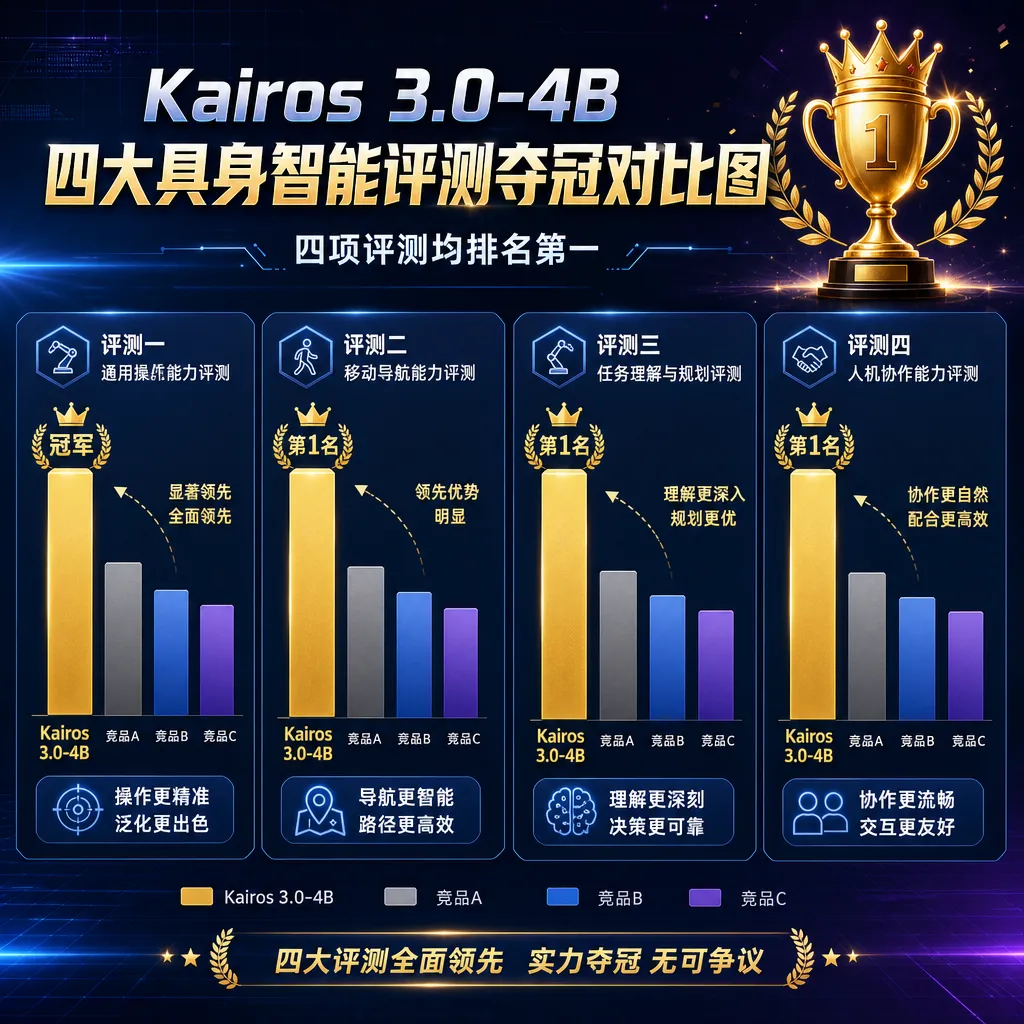
DaXiao Robotics has open-sourced the embodied native world model Kairos 3.0-4B, taking first place in four evaluations including RoboTwin 2.0 and LIBERO-Plus. Its reasoning speed is 72 times faster than NVIDIA Cosmos 2.5, and it can generate long videos of up to 7 minutes, truly bringing the concept of a “world model” to a practical, functional level.
A 4B World Model That Outperforms NVIDIA’s Cosmos 14B
In the past couple of days, the embodied AI community hasn’t been talking about which company released another humanoid robot, but about Daxiao Robotics’ enlightened world model, Kairos — RoboTwin 2.0, LIBERO-Plus, WorldModelBench Robot, DreamGen: the four most competitive world model / embodied AI benchmarks today. This single company took first place on all of them. They’ve open-sourced the model weights directly on GitHub under the name Kairos 3.0-4B.
To be honest, the world model track has been a bit overhyped over the past year. After NVIDIA released Cosmos, many teams worldwide followed suit, but most approaches still just “hook an action head to the back of a vision/language large model,” in essence an extension of the VLA approach. The significance of Kairos this time is that it was redesigned from the architectural level for “causality in the physical world” — and its performance blows away competitors like Cosmos 2.5, Alibaba’s Wan 2.2, and Ant’s Lingbot. With only 4B parameters, it beats 14B and even 28B models, and not by a small margin.
First, the numbers: 72× inference speedup is not just a slide-deck number
On A800 GPU benchmarks, Kairos 3.0-4B completed a 10-second video generation task in 9.5 seconds — meaning it achieved 1:1 real-time inference in the cloud, with generation time essentially equal to video length. For comparison:
- Cosmos 2.5: 687.2 s (about 72× slower)
- Alibaba Wan 2.2: 85 s (about 9× slower)
- Ant Lingbot: 1436 s (about 151× slower)
VRAM usage is also striking. 4B parameters consume only 23.5GB, similar to Wan 2.2’s 5B, but far below Cosmos 14B’s 70.2GB and Lingbot 28B’s 46.1GB. This is backed by Daxiao’s self-developed “Hybrid Temporal Linear Attention Operator” — the paper is not yet out, but judging from results, they likely rewrote the attention computation along the temporal dimension, cutting down the world model’s two most compute-heavy dimensions: “long sequence + video.”
If you’ve ever deployed a video generation model, you know how critical this gap is. Cosmos 2.5 14B needs 11 minutes for a 10-second video; at that speed, it’s unsuitable not only for controlling robots but even for offline data augmentation. Kairos 3.0-4B’s 9.5 seconds essentially turns “world-model-driven robotics” from a research problem into an engineering problem.
Benchmark details: 80.03 on PAI-Bench-robot, 70% higher physical consistency
Topping all four benchmarks — let’s look at why this is impressive:
PAI-Bench-robot (a physical AI benchmark co-developed by Georgia Tech and CMU)
Covers 2,808 real-world cases and is one of the most-cited embodied AI benchmarks in the physical AI field. Kairos 3.0-4B scored 80.03, surpassing:
- Cosmos 2.5-2B: 78.3
- Alibaba Wan 2.2-5B: 78.6
- Cosmos 2.5-14B: 79.4
- Ant Lingbot: 79.96
The margin may look small, but note — it uses 3.5× fewer parameters than Cosmos 14B.
WorldModelBench Robot
A hard metric for long-horizon physical scene understanding. Kairos scored 9.08; Cosmos 2.5-14B scored 8.94. This benchmark is for “long horizons” — the longer the prediction, the more physical errors accumulate. Traditional models start to collapse after 5 seconds; Kairos remains stable up to 7 minutes.
Physical Consistency (PA) / Instruction Following (IF)
- PA (Physical Accuracy): Kairos 0.529 vs. Alibaba Wan 2.2’s 0.314 — nearly 70% higher.
- IF (Instruction Following): Kairos 0.609 — 27% higher than Cosmos 2.5-14B.
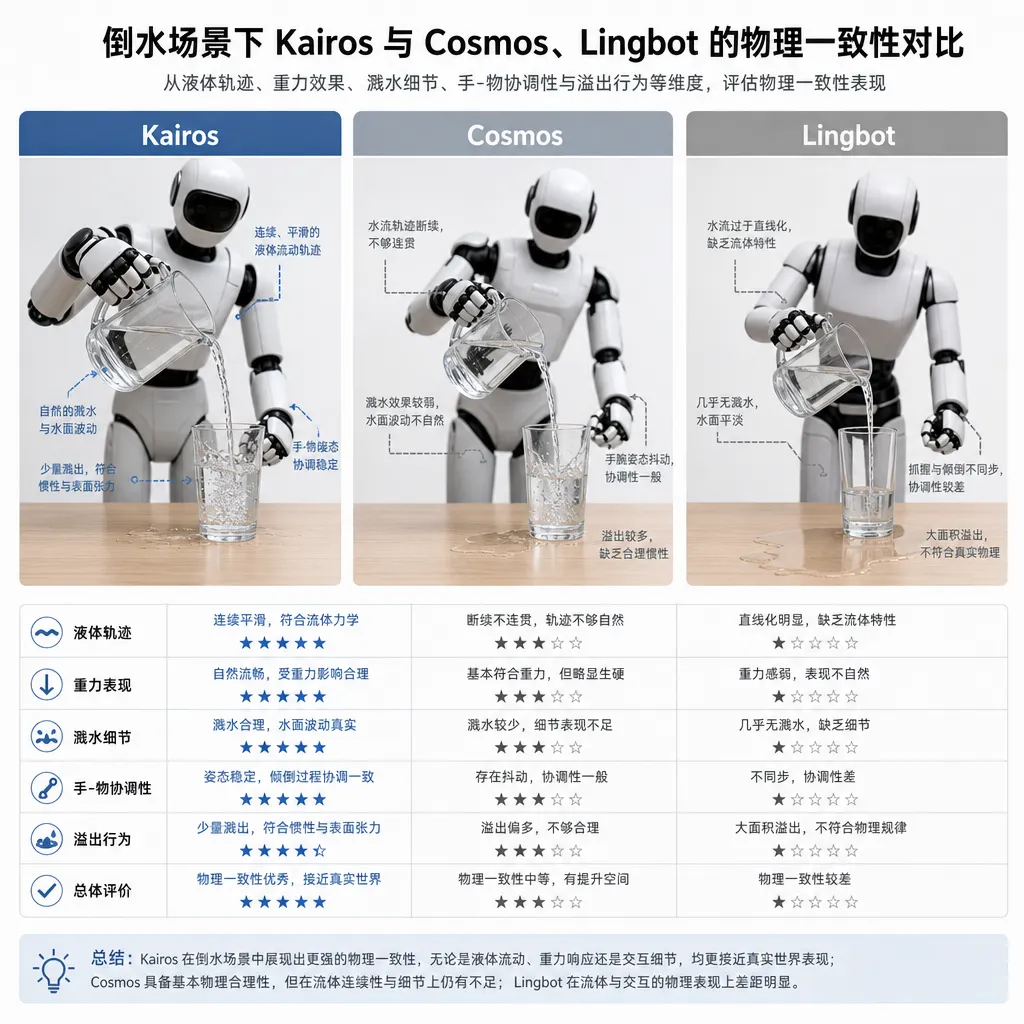
What does a 70% PA lead mean? In an official demo of pouring water from a cup into a sink, Kairos produced a steady flow rate, total volume strictly matching the cup’s capacity, perfectly following the law of mass conservation. Cosmos 2.5 and Lingbot produced flows that were too fast, with total liquid volumes exceeding the cup’s actual capacity — physically nonsensical.
Even more striking is the stone-stacking scene. Kairos strictly adhered to gravity and support mechanics, with each stone stacked where it belongs; Cosmos 2.5’s stones began to float, and Lingbot simply made the bottom stone vanish.
This gap shows one thing: merely adapting a “generic video generator” trained with diffusion models + video data has a ceiling in physical causality. No matter how many videos you’ve seen in training, you can’t learn mass conservation or rigid-body mechanics from data alone — these need to be built into the architecture as priors.
What they got right architecturally
Kairos claims to be the first in the industry to achieve “multimodal understanding–generation–prediction” integration as a native embodied world model. “Native” is key.
Mainstream industry approaches fall into two camps:
- VLA camp: Attach an action head to a VLM (vision-language model). Represented by Figure’s Helix and Physical Intelligence’s π0. Pros: reuse VLM’s semantic understanding. Cons: physical consistency depends heavily on data scale.
- Video generation camp: Treat the world model as a “controllable video generator.” Represented by Cosmos, Wan. Pros: high visual realism. Cons: no causality understanding, predictions worsen badly over longer horizons.
Kairos takes a third route — it jointly trains “understanding–generation–prediction” within the same network, grounding cognition in physical and causal laws themselves rather than in the statistical distribution of video data. This approach is actually similar to what LeCun has long advocated with JEPA, but Kairos has achieved it to the extent that it can control a robot body.
Edge deployment is even more interesting. Kairos 3.0-4B is the industry’s first embodied world model deployed on NVIDIA’s Jetson Thor T5000 edge platform. With THOR’s 517 TFlop edge compute, Kairos achieves 1:1.5 real-time generation (generation time: video length), meaning a robot can “imagine” what will happen in the next second while adjusting actions in real time.
The model directly outputs full-body control instructions — from upper limbs to fingers to lower limbs — without the intermediate “world model prediction → planner → controller” translation chain. This is using the world model as a brain, not a simulator.
7-minute long video generation: long horizons no longer collapse
Most video generation models start suffering from disappearing objects, drifting attributes, or collapsing physics after 5 seconds. Kairos 3.0 can stably generate 7 minutes of embodied dynamic-interaction video, thanks to its “hierarchical task parsing + self-reflection loop” mechanism.
In short: the agent decomposes a complex user instruction (e.g., “make breakfast”) into a sequence of subtasks, each corresponding to a spatio-temporal physical prediction, and iteratively optimizes via self-reflection during generation.
In the official home-scene demo, the robot completed an entire autonomous workflow:
- Tidied up cups and tissue box on the table, planned placement
- Went to the laundry area, picked up clothes, opened washer, put them in, started it
- Walked through the living room into the kitchen, opened fridge for milk, cupboard for cereal, drawer for bowl and spoon
- Poured cereal and milk into the bowl, completing breakfast prep
In this workflow, the causal relationship between “opening the fridge” and “pouring milk” was inferred by the model itself — this is the “brain” capability of a world model, something VLA models can’t achieve by just imitating data.
What this means for the industry
A few takeaways:
First, the open-source strategy is bold. 4B parameters + 23.5GB VRAM = runnable on a consumer-grade A6000 or even a 24G 4090. This deployment threshold means academia and small teams can directly build on Kairos for secondary research, significantly accelerating the domestic embodied AI research ecosystem. GitHub: github.com/kairos-agi/kairos-sensenova.
Second, Cosmos’s advantage is gone. Previously, Chinese world-model teams generally took NVIDIA Cosmos as the baseline. Now, a baseline is being outperformed by an open-source model with 72× speed and superior physical metrics — next-round comparisons will shift.
Third, real-time on edge is the real inflection point. If you’ve done embodied AI data collection, you know how painful simulation and teleoperation can be. A world model running 1:1.5 real time on edge means a robot can run “imagination” to preview actions before executing physically — a key to driving reinforcement learning’s “trial and error” costs near zero.
Of course, Kairos isn’t above scrutiny. For example, in which tasks can it maintain physical consistency over 7 minutes? Where are its “cross-embodiment” generalization boundaries? These will need third-party replication. But from the currently public benchmarks and demos, this company has pushed “world-model-driven embodiment” significantly forward.
As a side note, for AI app developers, multi-model usage is now the norm. OpenAI Hub (openai-hub.com) lets you call GPT, Claude, Gemini, DeepSeek, etc., with one key, domestic access, and OpenAI-compatible format — quite convenient for agent orchestration. On the embodied AI open-source side, local deployment is still the main route, but hybrid architectures using a cloud LLM for high-level planning + local Kairos for physical prediction are already being tried.
In closing
In the 2026 embodied AI race, the most interesting thing isn’t another humanoid robot launch, but that the world model — once seemingly a research toy — is now letting robots actually work. By open-sourcing, Kairos has lowered the engineering entry bar to a new level — 4B params runnable, A800 real-time inference, edge full-body control — and the rest is now up to the community.
References
- Kairos Official GitHub Repository - Open-source code and weights for the enlightened world model Kairos 3.0-4B


